
TL;DR:
- Targeted prospect lists significantly increase lead conversion rates and reduce sales cycle time.
- Building and segmenting lists based on ideal client profiles improves outreach personalization and effectiveness.
- Focusing on quality, relevance, and data accuracy in list creation enhances lead engagement and campaign ROI.
Most marketing leaders at professional services firms know the frustration: you send out hundreds of outreach messages, invest hours into campaigns, and still watch your conversion rates flatline. The instinct is to send more, reach wider, and contact everyone who might possibly need your services. But that logic is backwards. Targeted prospect lists drive higher lead conversion, and firms that build them strategically are pulling ahead of competitors who still rely on spray-and-pray tactics. This guide explains what prospect lists are, why they work, and exactly how to build and use them.
Table of Contents
- The fundamental value of prospect lists
- How prospect lists impact lead generation results
- Practical strategies for building effective prospect lists
- Applying prospect lists to optimize outreach campaigns
- A fresh perspective: Prospect lists vs. the myth of mass outreach
- Next steps: Enhance your prospect list strategy with The Lead Lab
- Frequently asked questions
Key Takeaways
| Point | Details |
|---|---|
| Quality outperforms quantity | Focusing on targeted prospect lists elevates lead conversion rates over generic outreach. |
| Segmentation unlocks value | Segmenting lists produces higher engagement and response rates from the right prospects. |
| Practical strategies matter | Building and applying prospect lists with best practices delivers measurable results. |
| Personalized outreach wins | Utilizing prospect lists enables more tailored messaging that resonates and drives success. |
| Partner with experts | Collaboration with lead generation professionals can optimize your prospecting and campaigns. |
The fundamental value of prospect lists
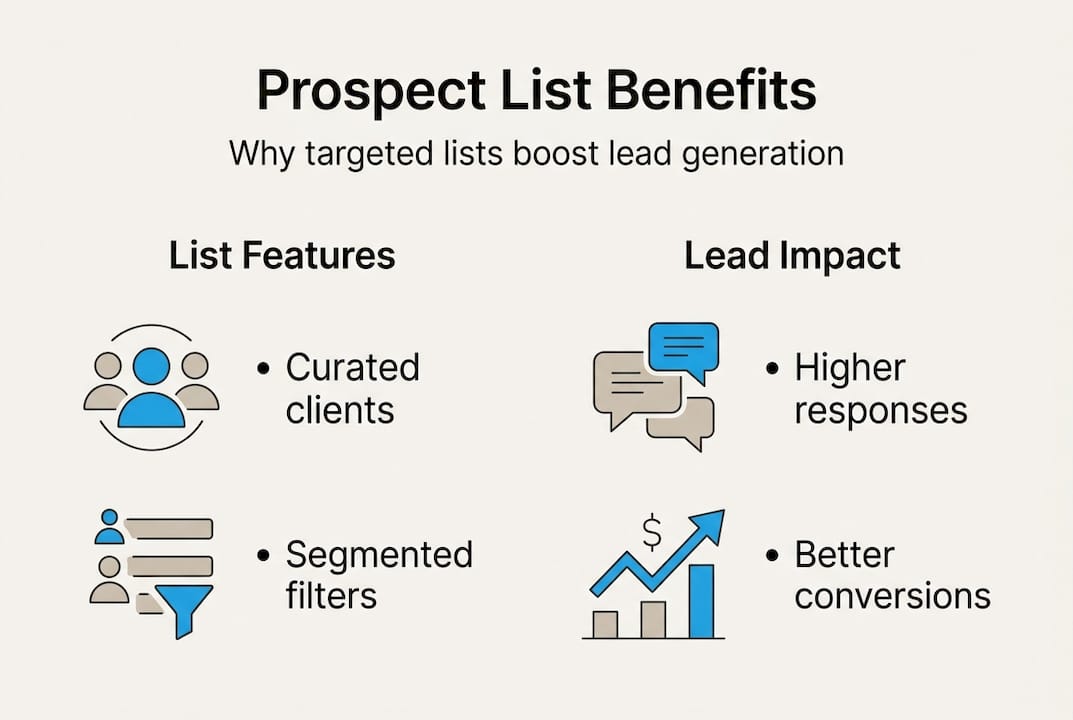
A prospect list is a curated, organized set of potential clients who fit your ideal customer profile and have been specifically selected for outreach. It is not a scraped database of random contacts. It is not everyone in your industry. It is a deliberate, filtered collection of people who are most likely to need what you offer, have the authority to make buying decisions, and can be reached through your chosen channels.
This distinction matters more than most firms realize. When you compare scalable lead generation built on targeted lists versus generic broadcast outreach, the difference in outcomes is not marginal. It is dramatic. Firms running targeted campaigns consistently report shorter sales cycles, higher response rates, and better quality conversations because every contact on their list was chosen for a reason.
For professional services firms, specifically law firms, consultancies, accounting practices, and financial advisors, this is especially critical. Your clients are not impulse buyers. They are decision-makers who weigh trust, expertise, and fit carefully before engaging. Reaching the right person with the right message is worth ten times more than reaching a hundred wrong people with a generic pitch.
“The firms winning at lead generation today are not the ones sending the most messages. They are the ones sending the right messages to the right people.” This principle sits at the core of every effective outreach strategy.
Here is what a well-built prospect list delivers:
- Focus: Every outreach effort targets someone who actually qualifies as a potential client, eliminating wasted resources on unfit contacts.
- Personalization: Knowing exactly who you are talking to allows you to craft messages that speak directly to their role, industry, and challenges.
- Efficiency: Your sales team spends time on warm, relevant leads instead of cold, unresponsive ones.
- Higher conversion: Relevant contacts convert at significantly higher rates because the offer aligns with their actual needs.
- Cleaner data: A maintained prospect list keeps your CRM accurate and your outreach compliant with data regulations.
Pro Tip: Segment your prospect list from day one. Even a simple breakdown by industry, company size, or job title will allow you to tailor messages more precisely, and that single change often doubles response rates on its own.
Many firms also underestimate how the structure of business websites for lead generation affects list quality. If your website collects leads through forms, downloads, or consultation requests, those inbound contacts should feed directly into your prospect list as warm, pre-qualified additions.
How prospect lists impact lead generation results
With the value of prospect lists understood, let’s examine the measurable impact they make on results. The difference between generic and targeted outreach is not just anecdotal. It shows up consistently in response rates, pipeline velocity, and closed revenue.

Segmentation increases response rates significantly when applied to LinkedIn and email campaigns. Firms that segment their outreach by job title, company size, and industry consistently see two to three times higher engagement compared to unsegmented campaigns. That is not a small improvement. Over a quarter, that difference translates into dozens of additional qualified conversations and a measurably larger pipeline.
Consider this comparison:
| Metric | Generic outreach | Targeted prospect list |
|---|---|---|
| Average response rate | 2 to 5% | 12 to 25% |
| Qualified leads from 100 contacts | 1 to 3 | 10 to 20 |
| Time to first meeting | 4 to 6 weeks | 1 to 2 weeks |
| Message personalization | Low | High |
| CRM data quality | Poor | Strong |
| Cost per qualified lead | High | Significantly lower |
These numbers reflect a pattern that digital marketing for consultants research confirms repeatedly: precision outperforms volume every time, especially in relationship-driven industries.
Here is how the impact flows from list building to closed leads:
- Define your ideal client profile: Establish specific criteria including industry, company size, geography, job title, and pain points. This filters your universe of potential contacts down to the ones most likely to convert.
- Build and enrich your list: Source contacts who match your criteria from LinkedIn, industry associations, conference attendees, and your own CRM. Add verified contact information and relevant context notes.
- Segment for messaging: Divide your list into groups based on shared characteristics so you can write messages that feel personal rather than generic.
- Launch targeted outreach: Send personalized messages to each segment, referencing their specific industry challenges and how your services address them.
- Track engagement by segment: Monitor open rates, response rates, and meeting bookings by segment to identify which groups convert best and why.
- Refine and repeat: Use what you learn from each campaign cycle to improve your list criteria and messaging for the next round.
This sequential process is what separates firms getting strong LinkedIn lead gen results from those stuck in the cycle of high effort and low return. Without a structured list, step three simply cannot happen. You cannot personalize what you have not segmented.
Equally important is what happens after the first response. Strong lead nurturing strategies keep prospects engaged through a structured follow-up process, and your prospect list is the foundation that makes that nurturing systematic rather than reactive.
Practical strategies for building effective prospect lists
Knowing the impact, the next step is practical implementation — building lists that actually elevate your results. The difference between a list that generates meetings and one that collects dust is almost always in how it was built.
Start with your ideal customer profile, often called an ICP. This is a detailed description of the type of client who gets the most value from your services and is most likely to buy. Your ICP should cover industry, company revenue range, employee count, geographic location, decision-maker title, and the specific problems they are trying to solve. Without this foundation, segmentation helps marketers target ideal customers precisely, but only if those segmentation criteria are grounded in real client data.
Here is a breakdown of the best sources and filters for building your list:
| Source | Best for | Key filters to apply |
|---|---|---|
| LinkedIn Sales Navigator | Active decision-makers | Job title, company size, industry, seniority |
| Industry associations | Niche verticals | Membership type, committee roles |
| Conference attendee lists | Intent-based prospects | Event topic, speaker/attendee type |
| CRM historical data | Re-engagement campaigns | Past interactions, deal stage |
| Website analytics | Warm inbound leads | Pages visited, form completions |
| Trade publications | Content-engaged prospects | Publication type, article comments |
Once you have your sources identified, apply strict filters rather than pulling broad data. It is better to have 200 highly relevant contacts than 2,000 loosely related ones. Every unqualified contact on your list dilutes your average response rate and wastes your team’s time.
Pro Tip: Use LinkedIn’s Boolean search operators to build highly specific prospect lists directly within the platform. Combining job title, company size, and industry filters inside LinkedIn Sales Navigator gives you a pre-screened pool of contacts that can be exported and enriched with additional data before outreach begins.
Best practices for list building:
- Verify contact information before outreach. Outdated emails and changed job titles are the fastest way to tank deliverability and waste effort.
- Add context notes for each contact where possible. Knowing that someone recently posted about a challenge you solve is powerful personalization fuel.
- Set a refresh schedule. Prospect lists decay over time as people change jobs and companies evolve. Review and clean your list at minimum every 90 days.
- Avoid buying bulk lists. Purchased contact databases are notoriously inaccurate and often violate data compliance requirements.
- Use strategic B2B messaging as a guide when setting your targeting criteria, ensuring your list aligns with the message you plan to deliver.
Common pitfalls to avoid include casting too wide a net in the name of volume, failing to document your ICP criteria so different team members build inconsistent lists, and neglecting to track which list segments actually produce results. Also take care when qualifying IT vendors or tech partners to support your list enrichment process. Not every data enrichment tool delivers the accuracy or compliance standards professional services firms need.
Applying prospect lists to optimize outreach campaigns
Once you have built your prospect list, here is how to leverage it for campaign success. Having a great list is only half the equation. The other half is using it effectively in your outreach campaigns.
The core principle is alignment. Your messaging must match the segment. A CFO at a 200-person consultancy has different priorities than an HR director at a 50-person law firm, even if both are on your list. Sending the same message to both is a missed opportunity. Optimized outreach improves lead quality precisely because it treats different segments as the distinct audiences they are.
Here is a proven campaign sequence using your prospect list:
- Map messaging to segments: Before writing a single outreach message, document the primary pain point and priority for each list segment. This becomes the hook for every message in that sequence.
- Write segment-specific connection requests: On LinkedIn, your connection request is your first impression. Reference something specific to their role or industry in the first sentence.
- Send a value-first follow-up: After connecting, share something genuinely useful. A relevant insight, a short case study, or a question that shows you understand their world. Do not pitch yet.
- Introduce your offer in message three: By the third touchpoint, you have established relevance. Now you can introduce how your services address the exact challenge you have been referencing.
- Follow up with persistence and patience: Most prospects respond between the third and fifth touchpoint. A structured follow-up cadence built into your CRM keeps this systematic.
- Track response rates by segment: Your list segments should each have their own performance metrics so you know which groups convert and which need different messaging.
Personalization tactics that lift response rates include:
- Referencing a recent post, award, or company milestone in your opening line
- Mentioning a shared connection or mutual professional interest
- Using the prospect’s industry-specific language and terminology
- Acknowledging a specific challenge common in their role before offering any solution
- Keeping messages short: under 150 words for LinkedIn outreach is a reliable benchmark
For deeper engagement, reviewing LinkedIn outreach tips regularly helps keep your approach fresh and aligned with what is working on the platform right now. Similarly, understanding the mechanics of generating LinkedIn leads helps you structure campaigns that build momentum over time rather than burning out after a single send.
Pro Tip: A/B test your messaging across segments by creating two versions of each message and sending each version to half of a given segment. After two weeks, compare response rates. The winning version becomes your control, and you keep testing from there. This iterative process compounds over months into a significantly more effective outreach system.
A fresh perspective: Prospect lists vs. the myth of mass outreach
Here is what years of running lead generation campaigns for professional services firms actually reveal. Mass outreach does not just underperform. It actively damages your brand. When prospects receive generic, irrelevant messages at scale, they do not simply ignore you. They form a negative impression that makes future outreach from your firm harder to land, even when the message is relevant.
“More outreach is not a strategy. It is a symptom of not knowing who you are trying to reach.”
Sustainable growth in professional services is built on trust and relevance. Both require focus. A prospect list forces that focus by making you define who matters before you spend a dollar or an hour on outreach. Firms that embrace this discipline do not just get better results in a single campaign. They build a muscle for precision that improves every subsequent campaign.
The lead nurturing wisdom that holds up across every high-performing campaign points to the same conclusion. Quality of targeting beats quantity of outreach, every single time, without exception.
Pro Tip: Review your outreach metrics monthly, not quarterly. Early signals like connection acceptance rates and first-reply rates tell you quickly whether your list quality and messaging are aligned. Catching a mismatch at week two saves weeks of wasted effort.
Next steps: Enhance your prospect list strategy with The Lead Lab
Building a high-quality prospect list takes a clear process, the right tools, and consistent refinement. If your firm is ready to move beyond guesswork and build a lead generation engine that actually performs, The Lead Lab can help.
The Lead Lab specializes in done-for-you LinkedIn outreach campaigns built on precisely targeted prospect lists, personalized messaging, and systematic follow-up. Browse the success stories from firms that have already transformed their pipelines, or join one of the upcoming lead gen webinars to see proven strategies in action. If you are ready for a consultation, the team is available to design a campaign tailored to your firm’s ideal client profile and growth goals.
Frequently asked questions
What is a prospect list?
A prospect list is a curated set of potential clients who match your ideal customer profile and are targeted for lead generation outreach. It is built with specific criteria rather than collected at random.
How does a prospect list improve lead quality?
By focusing outreach on relevant prospects, conversion rates improve and marketers spend less time on low-value leads. Targeted lists drive higher quality leads because every contact has been vetted against your ideal client criteria before outreach begins.
What are the best sources for building a professional prospect list?
LinkedIn, industry databases, and website analytics are the top sources for creating prospect lists tailored for professional services. LinkedIn segmentation improves lead targeting when combined with precise filters like job title, company size, and industry.
Can automation tools help with prospect list creation?
Yes, automation tools can save time and help segment your lists more efficiently based on chosen criteria. Segmenting with automation improves efficiency and reduces the manual effort of managing large contact sets.
What types of outreach benefit most from a prospect list?
Campaigns that require personalization, like LinkedIn and email outreach, benefit the most from targeted prospect lists. Optimized outreach improves lead quality because personalization is only possible when you know exactly who you are targeting.