TL;DR:
- A well-configured CRM is essential for effective lead capture, qualification, and nurturing.
- Automation and AI scoring significantly increase lead conversion rates by enabling rapid, targeted responses.
- Strategic CRM architecture with zero-leak workflows and cross-practice visibility maximizes lead retention and growth.
Most marketing leaders at professional services firms treat their CRM like a glorified spreadsheet. Contact records get updated after meetings, deals get logged when they close, and the platform quietly collects dust between those two moments. That’s a costly misunderstanding. A well-configured CRM is the engine behind every qualified meeting, every timely follow-up, and every client relationship that grows into repeat revenue. This guide covers how CRM platforms actually drive lead generation and engagement, from automated capture and AI scoring to zero-leak workflows and cross-practice coordination, so you can stop leaving pipeline on the table.
Table of Contents
- How CRM streamlines lead capture and qualification
- Automated workflows and AI scoring for higher conversion
- Segmentation and enrichment for targeted outreach
- Architecting CRM for zero-leak and cross-practice outcomes
- Breaking the myth: What most CRM strategies miss for lead generation
- Enhance lead generation with proven CRM solutions
- Frequently asked questions
Key Takeaways
| Point | Details |
|---|---|
| CRM centralizes lead capture | A CRM system collects, scores, qualifies, and routes leads efficiently to boost outcomes. |
| Automation and AI drive conversions | Automated workflows and AI scoring quickly move prospects through the pipeline, increasing conversion rates. |
| Segmentation amplifies outreach | Targeted segmentation and enrichment in CRM enable more relevant, engaging outreach that delivers higher ROI. |
| Zero-leak workflows ensure no lost leads | CRM systems with instant alerts and cross-team coordination eliminate lead leaks and maximize opportunities. |
| Tailored CRM strategies outperform generic setups | Custom CRM approaches for professional services yield stronger lead generation and sustained client engagement. |
How CRM streamlines lead capture and qualification
Every lead generation effort starts with a question: where do prospects come from, and how do you make sure none of them slip through? For professional services firms, leads arrive from multiple directions at once. Web forms, email campaigns, LinkedIn outreach, referrals, and live events all feed into the same pipeline. Without a central system, you’re stitching together spreadsheets and hoping someone remembers to follow up.
A CRM changes that entirely. As the CRM central hub for lead capture, qualification, scoring, routing, nurturing, and attribution, it turns scattered touchpoints into a single, trackable flow. Every inbound inquiry gets logged, timestamped, and assigned. Nothing disappears into an inbox.
Once leads are captured, qualification is where most firms lose momentum. Manual review is slow and inconsistent. CRM platforms solve this with automated scoring models that evaluate leads across three dimensions:
- Demographic scoring: Job title, company size, industry, and geography matched against your ideal client profile (ICP)
- Behavioral scoring: Email opens, page visits, content downloads, and event attendance tracked in real time
- Predictive scoring: AI models trained on historical win/loss data to surface which leads are most likely to convert
These scores feed directly into qualification frameworks. The most widely used include BANT (Budget, Authority, Need, Timeline), CHAMP (Challenges, Authority, Money, Prioritization), and GPCTBA/C&I (Goals, Plans, Challenges, Timeline, Budget, Authority, Consequences, and Implications). Each framework suits a different sales motion, but all of them work better when the CRM is doing the heavy lifting on data collection.
Routing rules are the final piece. When a high-score lead submits a form at 9 PM, the CRM should automatically assign it to the right partner or practice group and trigger an alert, not wait for someone to log in Monday morning. Speed matters more than most firms realize. Scalable lead generation strategies consistently point to response time as one of the highest-leverage variables in conversion.
| Qualification framework | Best for | Key focus |
|---|---|---|
| BANT | Transactional sales | Budget and timeline |
| CHAMP | Consultative services | Challenges first |
| GPCTBA/C&I | Complex engagements | Goals and consequences |
Pro Tip: Before layering AI scoring onto your CRM, audit your data hygiene. Duplicate records, missing fields, and inconsistent naming conventions will corrupt your model’s output. Clean data is the foundation for everything that follows, including lead nurturing strategies that actually move prospects forward.
Automated workflows and AI scoring for higher conversion
Capturing and scoring leads is only valuable if the system acts on that information fast. This is where workflow automation and AI-driven scoring separate high-performing firms from the rest.
CRM automation handles three core functions in the lead lifecycle:
- Assignment automation: Routes leads to the right person based on territory, practice area, or lead score without manual intervention
- Follow-up automation: Triggers personalized email sequences, task reminders, or LinkedIn touchpoints within minutes of a lead event
- Nurture automation: Enrolls leads in long-term sequences based on engagement behavior, keeping your firm top of mind without adding to anyone’s workload
AI scoring takes this further. Platforms like Salesforce Einstein and HubSpot’s predictive scoring engine analyze hundreds of behavioral and firmographic signals to rank leads by conversion probability. More importantly, they update scores dynamically as behavior changes. A lead who ignored your last three emails but just downloaded a case study gets re-scored upward automatically.
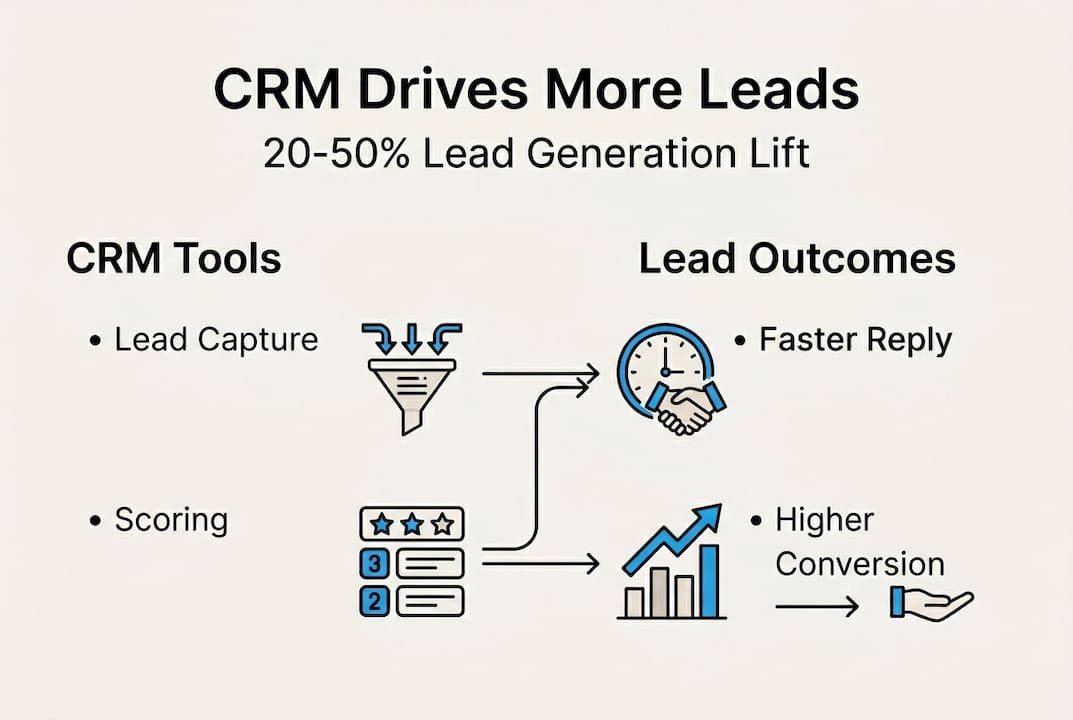
The benchmark that matters most here is response time. Automated lead scoring combined with routing rules that enforce a sub-2-hour response SLA drives 20 to 50% conversion lifts in professional services contexts. That’s not a marginal improvement. It’s the difference between winning and losing a competitive engagement.

Strategic messaging tips also play a role here. Automation is only as effective as the content it delivers. Pairing smart workflows with relevant, personalized messaging is what turns a timely response into a booked meeting.
| Workflow type | Traditional CRM | AI-driven CRM |
|---|---|---|
| Lead assignment | Manual, batch-based | Instant, rules-based |
| Follow-up timing | Calendar reminders | Behavior-triggered |
| Score updates | Weekly or manual | Real-time, dynamic |
| Conversion prediction | Gut feel | Model-based probability |
For firms looking to sharpen results further, optimizing outreach campaigns with CRM-backed data creates a feedback loop where every campaign improves the next one.
Segmentation and enrichment for targeted outreach
Not every prospect deserves the same message. That sounds obvious, but most professional services firms still send the same email to everyone on their list and wonder why engagement is flat. CRM segmentation fixes this by letting you group contacts based on attributes that actually predict relevance.
Effective segmentation for professional services goes beyond industry and company size. You can slice your database by:
- Client type: Existing clients vs. prospects vs. lapsed relationships
- Engagement history: Contacts who attended webinars, opened emails, or clicked specific content
- Regional focus: Practice areas or partners aligned to specific geographies
- Pipeline stage: Where each contact sits in the buying journey
Enrichment adds a layer of intelligence on top of segmentation. Relationship intelligence tools pull in data from email threads, meeting history, and LinkedIn activity to surface who knows whom, how warm a relationship is, and which contacts have gone quiet. For professional services, where trust drives decisions, this context is invaluable.
As ICP matching benchmarks show, quality targeting consistently outperforms volume-based approaches. The principle holds across firm types and deal sizes.
“Quality ICP matching yields 2 to 3 times better ROI than volume approaches.”
Multi-channel outreach amplifies these gains. A single LinkedIn message is easy to ignore. A coordinated sequence that includes a LinkedIn connection request, a personalized email, and a follow-up call from the right partner creates multiple touchpoints without feeling like spam. LinkedIn lead generation tips consistently show that sequenced, multi-channel outreach outperforms single-channel efforts by a wide margin.
The CRM also enables ICP matching at scale, tracking relationship history and project pipelines so your outreach is informed by what you already know, not just what a prospect filled out on a form.
Architecting CRM for zero-leak and cross-practice outcomes
Most CRM conversations focus on features. The more important conversation is about architecture. How you build your CRM determines whether it becomes a system that scales or a system that creates new problems as your firm grows.
Zero-leak workflows are the goal. Every lead that enters your system should have a clear path forward, with no gaps, no ambiguity, and no manual steps that depend on someone remembering to act. Zero-leak workflows with instant response SLAs under 2 hours are the benchmark for professional services firms that take lead generation seriously.
Building for zero-leak means:
- Automated handoffs: When a lead moves from marketing to sales, the CRM triggers the transition automatically, with all context attached
- Instant alerts: High-priority leads trigger real-time notifications to the right people, not daily digest emails
- Visibility across practices: Partners in different practice groups can see relevant relationship history without duplicating outreach efforts
- Data readiness for AI: Fields are standardized, records are deduplicated, and integrations are maintained so AI tools can operate on clean inputs
Cross-practice coordination is where many multi-service firms struggle. A partner in your tax practice may not know that a colleague in your consulting practice already has a relationship with a target account. CRM architecture that enables shared visibility prevents embarrassing overlaps and creates natural cross-sell opportunities.
The future of CRM may not live entirely inside traditional CRM platforms. AI layers, intent data tools, and conversation intelligence platforms are increasingly sitting alongside or on top of CRM systems. Designing your architecture to accommodate these additions is smarter than optimizing for today’s feature set alone.
Customized outreach campaigns and outreach agency benefits both point to the same conclusion: systems thinking beats manual prospecting every time.
Pro Tip: When configuring your CRM, build for the AI tools you plan to adopt in the next 18 months, not just the workflows you need today. Clean data architecture now means faster AI integration later.
Breaking the myth: What most CRM strategies miss for lead generation
Here’s what we see repeatedly with professional services firms: they invest in a CRM, configure it for basic contact management, and then wonder why lead generation results don’t improve. The platform isn’t the problem. The strategy is.
Most CRM rollouts fail at lead generation because they’re built around internal convenience, not prospect behavior. Fields are created to satisfy reporting requirements. Workflows are designed around how the firm operates, not how buyers make decisions. Segmentation is an afterthought.
The firms that get real results from CRM share a few traits. They prioritize ICP-driven segmentation from day one. They enforce response SLAs as a non-negotiable standard, not a nice-to-have. They invest in relationship enrichment so outreach is informed by context. And they treat CRM configuration as an ongoing discipline, not a one-time implementation project.
“Systems architecture trumps manual prospecting every time.”
Don’t chase features. Chase outcomes. The right question isn’t “does our CRM have AI scoring?” It’s “does our CRM help us respond faster, target better, and convert more?” For firms generating LinkedIn leads at scale, CRM with strong automation and AI scoring is the infrastructure that makes everything else work.
Enhance lead generation with proven CRM solutions
If the strategies above feel like a significant lift to implement on your own, you’re not alone. Most professional services firms don’t have the internal bandwidth to configure CRM workflows, build scoring models, and run targeted outreach campaigns simultaneously.
At TheLeadLab.com, we specialize in CRM-enabled LinkedIn outreach built specifically for professional services firms. Our CRM solutions for lead generation combine targeted prospecting, personalized messaging, and automated follow-up to fill your pipeline with qualified meetings. You can explore our client success portfolio to see what results look like in practice, or join our CRM webinars to go deeper on implementation strategy. The goal is simple: turn your CRM from a record-keeping tool into your most productive business development asset.
Frequently asked questions
How does CRM automation improve lead conversion rates?
CRM automation speeds responses and assigns leads accurately, driving 20 to 50% higher conversion rates by ensuring no high-priority prospect waits more than 2 hours for a follow-up.
What CRM features matter most for professional services lead generation?
The highest-impact features are automation, AI scoring, ICP-based segmentation, relationship tracking, and project pipeline management, all tailored to professional services workflows rather than generic sales processes.
Is inbound or outbound outreach better for lead quality?
Inbound leads tend to be higher quality, with 90% of revenue coming from inbound sources in many professional services contexts, but combining both approaches consistently outperforms either strategy alone.
What benchmarks should we target for CRM-enabled lead response?
Target a response time under 2 hours. Zero-leak workflows with this SLA are the proven benchmark for maximizing conversion rates in professional services lead generation.
How can CRM prevent lead leakage?
Automated handoffs, instant notifications, and cross-practice visibility eliminate the manual gaps where leads typically fall through, ensuring every prospect gets a timely, informed response.
6 Responses