
TL;DR:
- Personalization significantly increases response and conversion rates in LinkedIn outreach.
- Segmented, tailored messaging builds trust and delivers higher quality leads.
- Effective campaigns combine precise targeting, research, and empathetic understanding of prospects.
Most professional services firms assume that sending the same LinkedIn message to hundreds of prospects is a numbers game worth playing. It is not. The data tells a different story: personalization is no longer optional, it is the deciding factor between a campaign that fills your pipeline and one that damages your brand. If you are a marketing director or business leader tired of watching outreach efforts stall, this article breaks down exactly why customized LinkedIn campaigns outperform generic ones, and how you can build a framework that consistently delivers qualified leads.
Table of Contents
- The limitations of generic LinkedIn campaigns
- Why customization drives better lead quality
- Building a customized LinkedIn campaign framework
- Real-world impact: Professional services case studies
- Our take: The overlooked power of empathy in outreach
- Take your outreach to the next level with The Lead Lab
- Frequently asked questions
Key Takeaways
| Point | Details |
|---|---|
| Generic outreach underperforms | One-size-fits-all LinkedIn campaigns result in low response rates and minimal lead quality. |
| Customization boosts lead success | Tailored outreach campaigns deliver higher engagement, conversion, and better client relationships. |
| Frameworks drive replicable results | A structured approach to campaign building streamlines lead generation for professional services firms. |
| Real impact relies on empathy | Integrating empathy and relevance into campaign strategy is key for sustainable business growth. |
The limitations of generic LinkedIn campaigns
Generic LinkedIn outreach is exactly what it sounds like. You write one message, swap in a first name, and blast it to a broad list of prospects. It feels efficient. In practice, it is one of the fastest ways to erode trust with the very people you want to impress.
The core problem is relevance. When a prospect receives a message that could have been sent to anyone, they know it. Decision-makers at professional services firms receive dozens of these messages every week. The result is not just low engagement. It is active irritation, which can permanently close the door on a relationship before it ever starts.
Here is what makes generic outreach structurally weak:
- No audience segmentation: One message cannot speak to the specific pain points of a CFO, a managing partner, and a marketing director simultaneously.
- Poor targeting precision: Broad prospect lists include people who will never convert, wasting budget and effort.
- Weak brand perception: Impersonal outreach signals that you did not do your homework, which is a red flag in professional services.
- Low response rates: Generic outreach messages have significantly lower response rates among B2B audiences.
- Missed context: Generic messages ignore industry trends, company news, and role-specific challenges that make a message feel timely.
“The biggest mistake firms make is treating LinkedIn like an email blast platform. It is a relationship network. When your outreach ignores that, prospects notice immediately.”
The reputational cost is real. A poorly received campaign does not just fail. It can make future outreach from your firm harder, because prospects remember the noise. Investing time in outreach campaign optimization before you scale is far more valuable than sending volume for its own sake.
Generic campaigns also struggle with follow-up. When your initial message lacks a specific hook, there is no natural thread to pull in a second or third touchpoint. Customized campaigns, by contrast, create a logical conversation arc that makes follow-up feel helpful rather than pushy.
Why customization drives better lead quality
Customization is not about adding a prospect’s company name to a template. It is about building messages that reflect a genuine understanding of who that person is, what they care about, and why your solution is relevant to them right now.
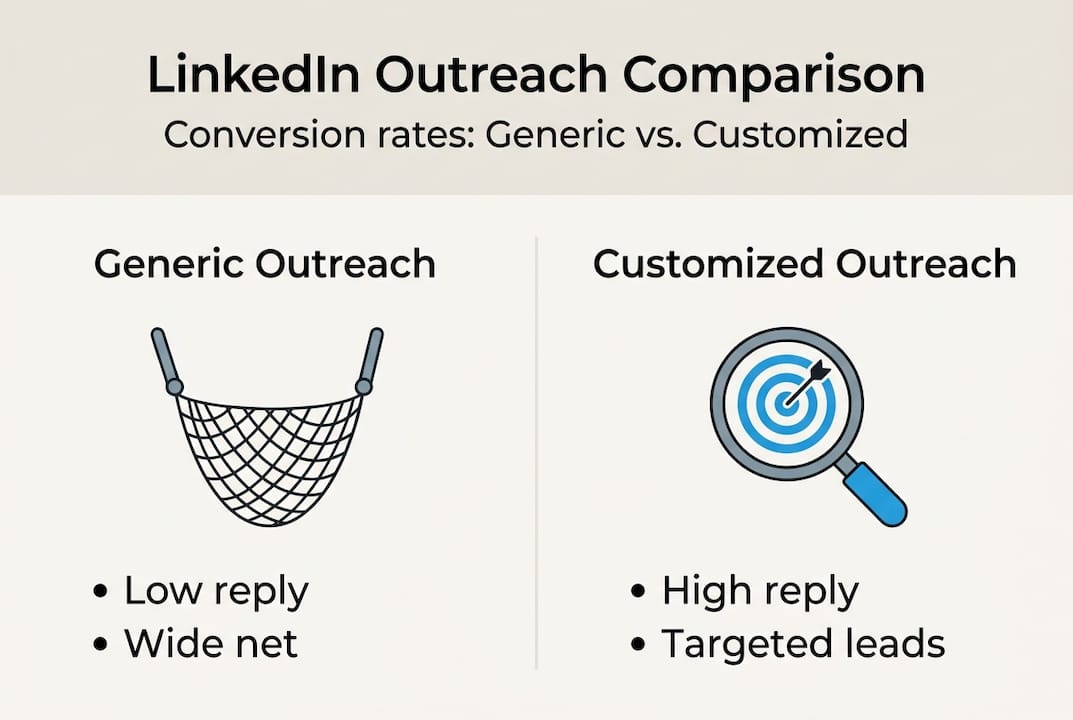
When you get this right, the results are measurable. Tailored messaging drives up to 30% higher conversion rates compared to generic alternatives. That gap compounds over a campaign lifecycle, meaning the difference between a customized and generic approach is not marginal. It is transformational.
Here is a direct comparison of what the data typically looks like:
| Metric | Generic outreach | Customized outreach |
|---|---|---|
| Connection acceptance rate | 15-20% | 35-50% |
| Message response rate | 5-10% | 20-35% |
| Qualified meeting rate | 1-3% | 8-15% |
| Conversion to opportunity | Low | Significantly higher |
The reason customized campaigns perform better comes down to perceived relevance. When a prospect reads a message that references their specific industry challenge or a recent company milestone, their brain registers it as signal rather than noise. They are more likely to respond, more likely to engage meaningfully, and more likely to become a qualified lead.
Customization also improves targeting precision. Instead of casting a wide net, you define tight audience segments based on role, industry, company size, and intent signals. Each segment gets messaging built for their context. This is what the personalized messaging guide approach is built on: specificity at every stage.
Pro Tip: Break your prospect list into three to five tightly defined segments before writing a single message. Each segment should share a common pain point or goal. This alone can double your response rate without increasing outreach volume.
Higher quality leads also mean less time wasted in your sales process. When prospects arrive already understanding why your firm is relevant to them, qualification conversations are shorter and conversion cycles tighten.
Building a customized LinkedIn campaign framework
A customized campaign does not happen by accident. It is the output of a deliberate process that starts well before you write your first message. Targeted prospecting combined with structured lead nurturing practices are what separate firms that scale their outreach from those that plateau.
Here is a step-by-step framework you can apply:
- Research your ideal client profile. Define the exact roles, industries, company sizes, and challenges your best clients share. Be specific. Vague profiles produce vague results.
- Segment your prospect list. Group prospects by shared characteristics. A managing partner at a 50-person law firm has different priorities than a VP of business development at a 500-person consulting firm.
- Write segment-specific messaging. Each segment gets its own connection request, opening message, and follow-up sequence. Reference their world, not yours.
- Launch with controlled volume. Start with a smaller batch to test message performance before scaling. This protects your LinkedIn account health and gives you clean data.
- Execute a structured follow-up sequence. Most responses come from the second or third touchpoint. Plan your follow-ups in advance and make each one add value.
- Analyze and refine. Review response rates, meeting bookings, and drop-off points after each campaign cycle.
Essential components of a high-performing customized campaign:
- A precisely defined ideal client profile
- Audience segments with distinct messaging angles
- A connection request that feels personal, not promotional
- An opening message focused on the prospect’s challenge, not your services
- A value-add follow-up that offers insight or a resource
- A clear call to action tied to a low-friction next step
Pro Tip: Use LinkedIn analytics alongside your CRM data to identify which segments are responding and which are not. Shift your message volume toward what is working within the first two weeks of a campaign.
Building in lead nurturing strategies from the start means you are not abandoning prospects who do not respond immediately. Many qualified leads convert weeks after initial contact.
Real-world impact: Professional services case studies
Frameworks are useful. Results are convincing. Here is what customized LinkedIn outreach has actually delivered for professional services firms.
Case study 1: Management consulting firm. A mid-sized consulting firm replaced its generic outreach with segmented campaigns targeting CFOs in the healthcare sector. Within 90 days, qualified meeting bookings increased by 40%. The key change was messaging that referenced specific regulatory pressures their prospects were navigating.

Case study 2: Boutique legal practice. A law firm focused on M&A work began personalizing outreach to private equity partners using deal-specific language. Response rates tripled compared to their previous template-based approach.
Case study 3: Financial advisory firm. By segmenting outreach by company growth stage and tailoring messages to the specific concerns of each stage, the firm saw a 35% increase in discovery call bookings in the first two months.
The pattern across all three is consistent. Specificity wins. Here is a direct comparison:
| Approach | Avg. response rate | Meetings booked per 100 prospects | Lead quality |
|---|---|---|---|
| Generic outreach | 6% | 2-3 | Mixed |
| Customized outreach | 28% | 10-15 | High |
Proven tactics used in these campaigns:
- Referencing a prospect’s recent LinkedIn post or company announcement
- Framing the opening message around a challenge specific to their role
- Using industry-specific language that signals insider knowledge
- Timing outreach around industry events or regulatory changes
Customized outreach helped professional services firms triple their inbound lead volume compared to generic messaging. That is not a marginal improvement. It is a strategic advantage that compounds over time.
For firms looking to expand their approach, exploring LinkedIn lead generation tips that align with your specific service model is a smart next step.
Our take: The overlooked power of empathy in outreach
Here is something the industry does not talk about enough. Most conversations about LinkedIn outreach optimization focus on technical variables: message length, send timing, connection request wording, automation tools. These things matter. But they are not what actually moves people.
What moves people is feeling understood. When a prospect reads your message and thinks “this person gets what I am dealing with,” something shifts. That moment of recognition is worth more than any A/B test result.
The firms that consistently outperform their competitors on LinkedIn are not just running better campaigns technically. They are demonstrating genuine empathy. They have done the work to understand their prospect’s world deeply enough to reflect it back accurately.
Automation is a powerful scaling tool, but it should amplify empathy, not replace it. If your personalization best practices are just variable fields in a template, you are missing the point. Real personalization requires understanding the human on the other side of the message. When you get that right, you are not just generating leads. You are starting relationships that last.
Take your outreach to the next level with The Lead Lab
If the frameworks and case studies in this article resonate, the next step is putting them into action with a team that has already done this for firms like yours.
At The Lead Lab, we build done-for-you LinkedIn outreach campaigns that are fully customized to your ideal client profile, your service offering, and your growth goals. From prospect targeting and message copywriting to response management and campaign analytics, every element is tailored. You can review our case study portfolio to see the specific results we have delivered for professional services firms. When you are ready to move from strategy to execution, book a consultation and we will map out a campaign built specifically for your firm.
Frequently asked questions
What is a customized LinkedIn outreach campaign?
A customized LinkedIn outreach campaign uses tailored messaging and precise targeting to connect with ideal prospects, improving engagement and lead quality. Personalized messaging improves outreach effectiveness by making each interaction feel relevant to the specific recipient.
Why do professional services firms need custom campaigns instead of generic outreach?
Custom campaigns deliver significantly higher response and conversion rates, making lead generation far more efficient for specialized service offerings. Tailored messaging drives up to 30% higher conversion rates compared to generic alternatives.
How can I start building an effective customized campaign?
Start with audience research, segment your prospects by role and challenge, personalize your messaging for each group, and use analytics to refine continuously. Targeted prospecting combined with structured lead nurturing is the foundation of every effective campaign.
What measurable improvements come from customizing LinkedIn outreach?
Customized campaigns typically boost inbound lead volume and increase conversion rates by 20 to 30% or more. Customized outreach has helped professional services firms triple their inbound lead volume compared to generic messaging approaches.
7 responses