TL;DR:
- Segmented outreach campaigns significantly outperform non-segmented ones in response and conversion rates.
- Combining content engagement with personalized outreach drastically improves lead conversion effectiveness.
- Proper targeting, tailored messaging, and relevance are more impactful than message volume when scaling LinkedIn outreach.
Most professional services firms spend hours each week on LinkedIn outreach and walk away with almost nothing to show for it. Generic connection requests, copy-paste messages, and zero tracking create a cycle of effort without results. Yet segmented campaigns outperform non-segmented ones by a significant margin, and firms using the right frameworks are booking qualified meetings consistently. This article breaks down the exact strategies, tools, and messaging structures you need to scale LinkedIn outreach efficiently, without sacrificing the personalization that professional services buyers expect.
Table of Contents
- Assessing your outreach foundation
- Tools and automation for scaling LinkedIn outreach
- Crafting high-impact, scalable messaging
- Combining inbound and outbound for 8x lead conversion
- Why scaling outreach is more about relevance than volume
- Get help scaling your LinkedIn outreach
- Frequently asked questions
Key Takeaways
| Point | Details |
|---|---|
| Segment for success | Personalized and segmented campaigns drive the highest conversion rates when scaling outreach. |
| Leverage hybrid strategies | Combining inbound content with targeted outbound leads to up to 8x higher conversions than cold approaches alone. |
| Use the right tools | Automation and compliance are critical to scaling effectively without risking your LinkedIn account. |
| Focus on relevance | High-quality targeting and compelling messaging always outperform high-volume, generic outreach. |
Assessing your outreach foundation
Before you invest in new tools or rewrite your messaging, you need an honest look at what your current outreach is actually producing. Most firms skip this step and wonder why new tactics don’t move the needle.
Start by tracking three core metrics: connection acceptance rate, reply rate, and lead conversion rate. These numbers tell you where in the funnel you’re losing people. If your acceptance rate is low, your targeting or profile is the problem. If acceptance is fine but replies are low, the messaging is failing. If replies happen but conversion stalls, your follow-up or offer needs work.
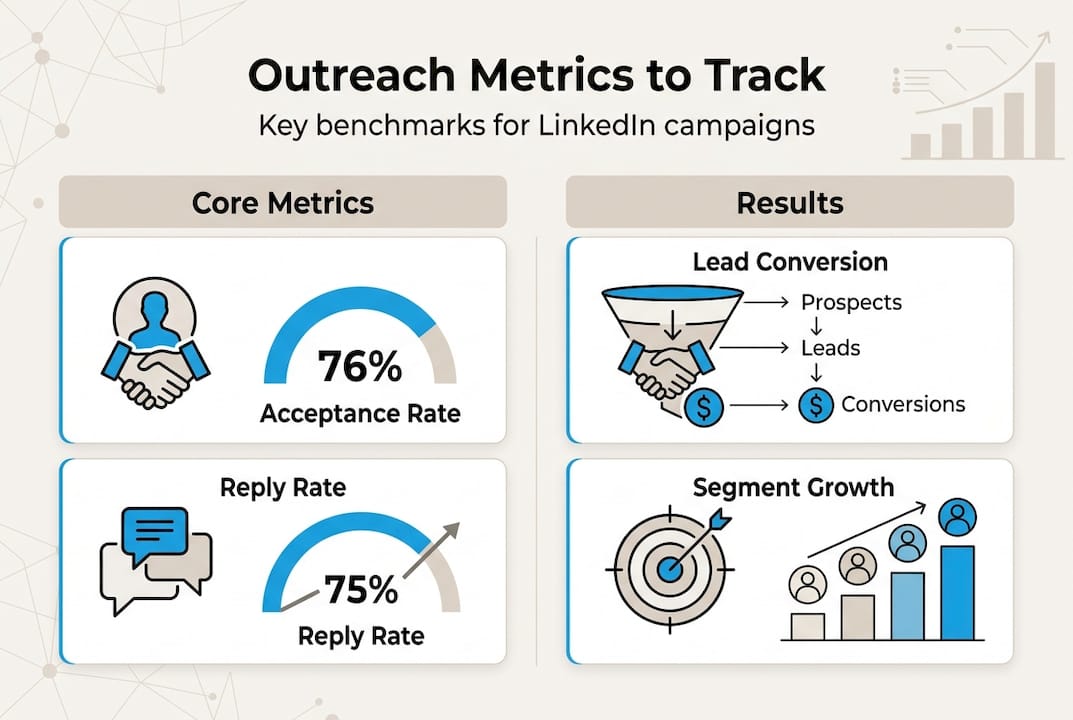
Here’s a quick benchmark reference for professional services firms in 2026:
| Metric | Benchmark range |
|---|---|
| Connection acceptance rate | 18 to 24% |
| Reply rate | 6 to 11% |
| Lead conversion rate | ~2.5% |
Most firms fall short of these numbers for three predictable reasons:
- Generic messaging that doesn’t speak to a specific role, industry, or pain point
- Poor segmentation, meaning the same message goes to wildly different prospect types
- No tracking, so there’s no way to know which message variants or audiences actually perform
The fix starts with segmentation. When you break your prospect list into defined groups (by industry, seniority, or company size, for example) and tailor your approach to each, response rates climb. This is one of the most well-supported principles in optimizing outreach campaigns for professional services.
Pro Tip: Before launching any new campaign, audit your last 30 connection requests. Calculate your acceptance rate manually if you haven’t been tracking it. That single number will tell you whether your targeting or your profile is the first thing to fix.
A well-structured audit gives you a clear priority list. Fix the earliest stage of breakdown first, whether that’s profile strength, audience targeting, or initial message copy. Once you have baseline numbers, you can test variations and know with confidence what’s improving. Explore some fresh outreach campaign ideas to bring new angles to your segmented lists.
Tools and automation for scaling LinkedIn outreach
Once you know your starting point and bottlenecks, it’s time to select the right tools to automate scaling. The wrong tool can get your account flagged or banned. The right one quietly multiplies your output while keeping interactions feeling human.
When evaluating any LinkedIn automation platform, look for four things:
- Personalization tokens that let you insert names, companies, or custom fields automatically
- Sequence logic so follow-ups trigger based on behavior, not just timing
- Daily limit controls to stay within LinkedIn’s usage thresholds
- Compliance safeguards that reduce the risk of account restriction
Here’s a simple comparison of automation approaches:
| Approach | Best for | Risk level |
|---|---|---|
| LinkedIn Sales Navigator + manual | Small, high-value lists | Low |
| Cloud-based automation tools | Mid-size segmented campaigns | Medium |
| Agency-managed outreach | Firms without in-house capacity | Low |
The numbers support investing in this infrastructure. Connection rates average 18 to 24% and reply rates hit 6 to 11% for well-run campaigns, while professional services lead conversion sits around 2.5%. Those rates sound modest until you multiply them across a list of 500 targeted prospects per month.
Here’s a simple process for automating a segmented campaign:
- Build separate prospect lists by segment in Sales Navigator using Boolean filters
- Upload each list to your chosen automation platform
- Write a unique connection message and two follow-up variations per segment
- Set daily send limits (no more than 20 to 30 connection requests per day)
- Monitor reply rates weekly and pause underperforming sequences
Pro Tip: Run one segment at a time when you’re starting out. This keeps your testing clean and makes it easy to attribute results to specific messages rather than mixing variables.
Automation works best when it handles timing and sequencing while you handle strategy and message quality. Think about customized outreach campaigns as the model here: automation scales delivery, but the human insight behind each segment is what actually drives results.

Crafting high-impact, scalable messaging
With the right tools selected, effective messaging becomes the difference-maker in results. Firms that nail their messaging see compounding returns. Those that treat it as an afterthought burn through their prospect lists with nothing to show.
Scalable messaging starts with a framework, not a single template. Build your message structure around three components:
- The relevance hook: One sentence that connects to something specific about the prospect’s role, industry, or recent activity
- The value statement: A clear, concise articulation of what you do and why it matters to them specifically
- The low-friction ask: A question or invitation that’s easy to say yes to, not a sales pitch
Here’s an example for an accounting firm reaching CFOs at mid-size manufacturers:
“Hi [Name], I work with CFOs at manufacturing firms navigating the margin pressures that have hit the sector hard this year. We’ve helped clients in your space find an average of 12% in recoverable costs within 90 days. Worth a quick conversation?”
This message is short, specific, and easy to respond to. It doesn’t feel automated, even though it can be sent at scale with the right personalization tokens.
One often-overlooked factor is how LinkedIn’s algorithm treats your content engagement. The platform now favors dwell time over surface-level likes, meaning posts that hold attention rank higher and increase your visibility to the exact prospects you’re trying to reach. Warm prospects who’ve seen your content convert at dramatically higher rates.
In fact, the hybrid approach of pairing content with direct outreach is 8x more effective than pure cold outreach alone. Your messages land differently when the prospect has already encountered your thinking.
For detailed guidance on structure and tone, the resources on high-impact outreach messaging are worth reading before you write your first sequence. And if you want to refine your follow-up cadence specifically, check out these LinkedIn messaging tips for B2B contexts.
Combining inbound and outbound for 8x lead conversion
To push conversions even higher, combine outreach with value-added content. This is the single highest-leverage shift most professional services firms can make to their LinkedIn strategy right now.
The difference between pure outbound and inbound-led outbound comes down to context. Pure cold outreach lands with no prior relationship, no trust, and no frame of reference. Inbound-led outbound reaches people who’ve already encountered your ideas and found them worth their time.
The data makes this impossible to ignore. Inbound-led outbound converts at 14.6% compared to just 1.7% for pure cold outreach. That’s nearly nine times the conversion rate from the same outreach effort, simply by warming the audience first.
Here’s a practical process for running a hybrid campaign:
- Publish a high-value post targeting your segment’s specific pain point. Think framework posts, short case studies, or contrarian takes on industry trends.
- Monitor engagement on that post and note who liked, commented, or shared it.
- Send personalized connection requests to engagers within 24 to 48 hours while the context is fresh.
- Reference the content in your opening message to create immediate relevance.
- Follow up with a secondary piece of content (a short PDF, a benchmark report, a relevant article) before making any direct ask.
Pro Tip: Set up a saved search in Sales Navigator that mirrors your content’s target audience. After each content post, run through that list and prioritize anyone who interacted with the post. That overlap is your warmest segment.
Segmentation is what makes this scalable. When you apply these segmentation strategies consistently, you can run multiple inbound-outbound cycles simultaneously for different audience segments without the effort multiplying proportionally. For more tactical depth on the outbound side, these LinkedIn outreach tips cover sequencing and timing in detail.
Why scaling outreach is more about relevance than volume
Here’s an uncomfortable truth most LinkedIn automation vendors won’t say out loud: scaling outreach by sending more messages to more people usually makes results worse, not better.
We’ve seen this pattern consistently. Firms that double their send volume without improving segmentation see their reply rates drop, their acceptance rates erode, and their accounts flagged more often. Volume without relevance is just noise at scale.
What actually moves metrics is message-to-market fit. When a CFO at a logistics firm receives a message that speaks directly to the cash flow volatility their sector faced last quarter, they respond. When they receive the same message a tech founder gets, they don’t. The difference isn’t the automation tool. It’s the thinking behind the targeting.
Data reinforces this. The firms that understand why LinkedIn outreach works consistently report that their best results come from tighter lists, more specific messages, and smarter timing, not higher volume. Relevance is the scaling lever that compounds. Volume without it just burns goodwill and prospect lists faster.
Get help scaling your LinkedIn outreach
If you’re ready to implement these strategies faster, expert support can accelerate your results significantly.
At The Lead Lab, we’ve helped professional services firms apply exactly these frameworks: precise segmentation, hybrid inbound-outbound campaigns, and automated follow-up sequences that feel personal at every touchpoint. You don’t have to figure it all out from scratch.
Start by reviewing real campaign results from firms in your space to see what’s possible. Join one of our expert webinars to see the strategies in action before committing to anything. Or reach out directly through our LinkedIn outreach services page if you’re ready to talk about what a done-for-you campaign would look like for your firm.
Frequently asked questions
What is the average reply rate for LinkedIn outreach in 2026?
Industry benchmarks show reply rates average 6 to 11% for LinkedIn outreach campaigns in 2026, with professional services firms performing closer to the lower end without proper segmentation.
Why is segmentation important for scaling outreach?
Segmented campaigns outperform non-segmented ones because tailored messages resonate with each specific audience group, driving higher acceptance and reply rates without increasing send volume.
How much more effective is inbound-led outbound compared to pure cold outreach?
Inbound-led outbound converts at 14.6% versus just 1.7% for pure outbound, meaning a warm content-first approach produces nearly nine times the conversion rate from the same prospect list.
Can automation harm my LinkedIn account?
Over-automation or using non-compliant tools can trigger LinkedIn’s safety systems and put your account at risk, so always use platforms with built-in daily limits and stay within the platform’s acceptable usage thresholds.