
TL;DR:
- Smarter segmentation significantly increases LinkedIn reply rates and ROI.
- Small, targeted segments under 400 prospects outperform broad, generic lists.
- Multi-layered segmentation based on detailed criteria enables personalized, effective outreach.
Sending more connection requests does not mean getting more leads. Many professional services firms pour resources into high-volume LinkedIn outreach, only to watch response rates stagnate. The fix is not more messages. It is smarter targeting. Segmented messages achieve a 72% higher reply rate than generic outreach, which means the firms that invest in precision consistently outperform those chasing volume. This article breaks down exactly what segmentation is, why the data behind it is so compelling, and how you can build and scale segmented LinkedIn campaigns that generate qualified meetings for your professional services firm.
Table of Contents
- What is segmentation in LinkedIn outreach?
- Why segmentation matters: The impact on response and ROI
- Core segmentation strategies for professional services
- From segments to campaigns: Personalizing and scaling outreach
- Why most LinkedIn outreach fails: The hidden segmentation trap
- Take your LinkedIn segmentation to the next level
- Frequently asked questions
Key Takeaways
| Point | Details |
|---|---|
| Segmentation defined | Dividing LinkedIn prospects into precise groups enables targeted, effective outreach. |
| Data-driven results | Segmented campaigns achieve up to 72 percent higher response rates compared to generic messaging. |
| Best practices | Use micro-segments and dynamically adjust based on live campaign metrics for ongoing success. |
| Pitfall to avoid | Overly large or generic segments dilute engagement and lower campaign ROI. |
What is segmentation in LinkedIn outreach?
Segmentation in LinkedIn outreach means dividing your target audience into smaller, more defined groups before you ever send a message. Instead of blasting the same connection request to every CFO in your database, you identify clusters of prospects who share meaningful characteristics and craft outreach that speaks directly to their situation.
At its core, segmentation divides prospects into targeted groups based on multi-dimensional criteria. The most commonly used filters include:
- Job title and seniority level (e.g., Managing Director vs. Operations Manager)
- Industry vertical (e.g., legal services, financial advisory, management consulting)
- Company size (e.g., 10 to 50 employees vs. 200 to 500 employees)
- Engagement history (e.g., prospects who have viewed your profile or interacted with your content)
- Behavioral signals (e.g., recently posted about a challenge your firm solves)
“Segmentation divides prospects into targeted groups based on multi-dimensional criteria, enabling outreach that feels personally relevant rather than broadly promotional.”
The difference between segmented and generic approaches is not subtle. A generic message says, “We help businesses grow.” A segmented message says, “We work with boutique law firms in the 20 to 100 employee range that are trying to attract higher-value clients without adding headcount.” One of those messages gets deleted. The other gets a reply.
For professional services firms, this specificity is especially powerful. Your buyers are sophisticated. They can spot a template instantly. When you invest in personalized messaging for LinkedIn lead generation, you signal that you understand their world, which is the first step toward earning a conversation.
Segmentation also makes your campaigns easier to optimize. When a message underperforms, you know exactly which group received it and can adjust the criteria or the copy without disrupting your entire outreach program.
Why segmentation matters: The impact on response and ROI
The numbers behind segmentation are hard to ignore. Segmented LinkedIn messages achieve reply rates of 9.36% versus 5.44% for generic outreach. That is a 72% improvement. For a firm sending 500 messages per month, that gap translates to roughly 20 additional replies every single month from the same effort.
Here is a quick summary of what the benchmarks show:
- Segments under 400 leads consistently outperform larger, broader groups
- Warm outreach to engaged prospects can double reply rates compared to cold lists
- Legal services and financial advisory sectors see outsized gains from persona-specific messaging
- Campaigns with customized LinkedIn outreach generate significantly more qualified meetings per 100 messages sent
| Outreach type | Avg. reply rate | Recommended segment size |
|---|---|---|
| Generic, unsegmented | 5.44% | N/A |
| Segmented by industry | 7.2% | Under 400 leads |
| Segmented by persona + pain | 9.36% | Under 400 leads |
| Warm outreach (engaged) | Up to 12%+ | Under 200 leads |
The segment size point deserves emphasis. Broad segments dilute impact. When you lump together 1,500 prospects who share only one characteristic, your message has to be vague enough to apply to all of them. That vagueness kills relevance, and relevance is what drives replies.
Smaller, tighter segments allow for message variants that address specific pain points. A 50-person segment of HR Directors at mid-size accounting firms gives you room to write something that feels almost one-to-one. That specificity is what optimizing outreach for lead quality actually looks like in practice.
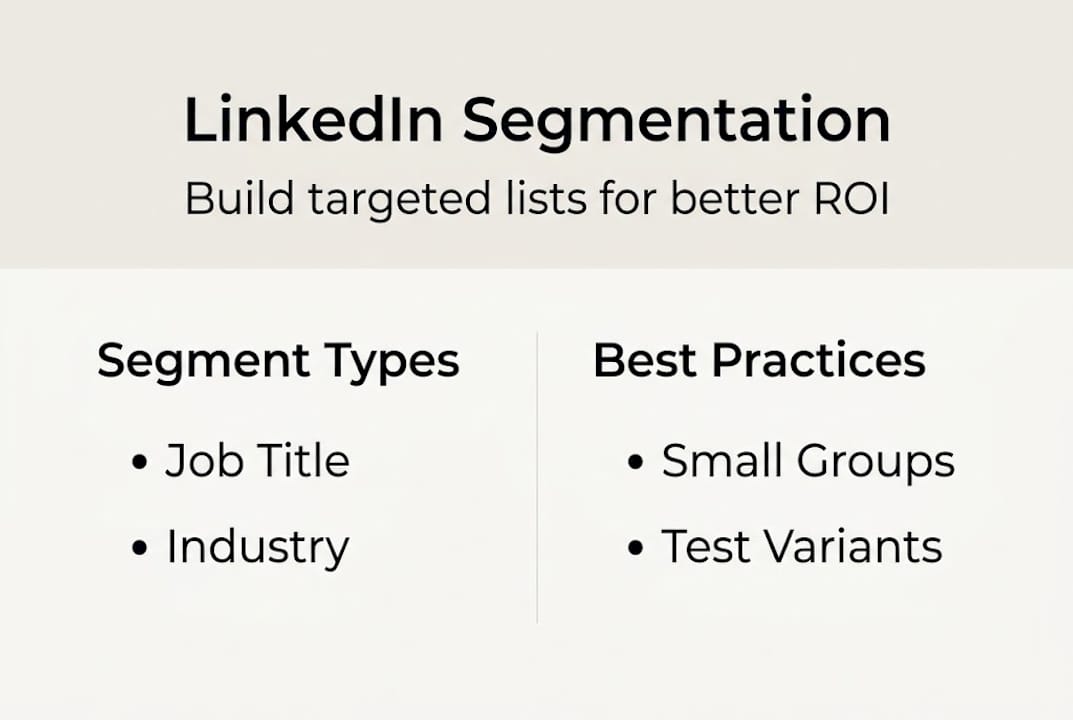
The InMail response benchmarks confirm this pattern across industries. Volume without segmentation is a diminishing return. Precision with smaller groups is a compounding advantage.
Core segmentation strategies for professional services
Knowing the data is one thing. Building segments that actually perform is another. Here is how to do it well.
The most effective approach is multi-layered segmentation. Instead of filtering by a single criterion, you stack multiple filters to create a highly specific group. Multi-layered segmentation using industry, persona, and pain point consistently outperforms single-filter approaches.

Single-layer vs. multi-layer segmentation:
| Approach | Example | Specificity | Expected reply rate |
|---|---|---|---|
| Single-layer | CFOs in finance | Low | ~5 to 6% |
| Two-layer | CFOs at 50 to 200 employee firms | Medium | ~7 to 8% |
| Multi-layer | CFOs at 50 to 200 employee RIAs facing compliance pressure | High | ~9 to 12% |
Here is a step-by-step process for building your first high-performing segment:
- Define your ideal client profile by revenue range, headcount, industry, and decision-maker title
- Identify a shared pain point that your firm uniquely solves for that profile
- Use Sales Navigator segmentation to filter by title, company size, geography, and seniority simultaneously
- Build a micro-segment of under 400 prospects who match all criteria
- Write message variants that reference the specific pain point and context
- Track performance at the segment level, not the campaign level
For targeted prospecting for LinkedIn, Sales Navigator is the most powerful tool available. Its Boolean search and account filters let you isolate micro-segments that would be impossible to build manually.
Pro Tip: Start with a segment of 50 to 100 prospects before scaling. Validate your message resonates by hitting a 20%+ acceptance rate before expanding the group. This protects your sender reputation and gives you clean data to iterate on.
AI tools can also help you maintain dynamic segments. As prospects change roles, grow their companies, or post about relevant topics, your segments can update automatically, keeping your LinkedIn messaging tips relevant without constant manual effort.
From segments to campaigns: Personalizing and scaling outreach
You have built your segments. Now you need to turn them into campaigns that generate real meetings. Here is how to do that systematically.
- Create message variants per segment that reference the specific industry, role, or pain point you identified
- Build a multi-touch sequence of 3 to 5 touchpoints spaced 3 to 5 days apart
- Personalize the opening line with something specific to the prospect or their company
- Track positive reply rate and meeting conversion as your primary KPIs
- Run split tests on message length, tone, and call-to-action across segments
- Review performance weekly and pause segments that fall below your benchmarks
The KPIs that matter most are positive reply rate, meeting conversion rate, and acceptance rate. A healthy acceptance rate benchmark sits at 20% or above. If a segment falls below that threshold, dynamic adjustment based on performance is essential before you consider scaling it further.
Key best practices to keep in mind:
- Never scale a segment that has not hit your benchmarks. Scaling a weak segment amplifies poor results.
- Use warm outreach signals to prioritize prospects who have engaged with your content recently
- Vary your outreach campaign ideas across segments to avoid message fatigue
- Adjust segment criteria when reply rates drop, not just message copy
Pro Tip: Split test segment size as well as message copy. A segment of 80 prospects often outperforms a segment of 300 for the same persona, simply because the smaller group allows for tighter personalization and cleaner feedback loops.
For crafting high-impact LinkedIn B2B messages, the goal is always to make the prospect feel like you wrote specifically for them. That feeling is what segmentation enables at scale. When you combine precise segments with well-sequenced messaging, you create a system that consistently surfaces qualified conversations. These B2B lead generation tips apply across industries but pay off most in professional services where trust is the currency.
Why most LinkedIn outreach fails: The hidden segmentation trap
Here is the uncomfortable truth most firms do not want to hear. You probably think you are already segmenting. You filter by industry. You target a specific title. You feel good about your list. But if that list has 800 or 1,200 people on it, you are not really segmenting. You are just filtering.
Real segmentation means your group is small enough that every message feels personal and specific enough that every prospect recognizes their own situation in your opening line. Overly broad segments with more than 400 leads consistently produce dropping response rates and should never be scaled without hitting 20%+ acceptance benchmarks first.
The firms that win on LinkedIn are not the ones with the biggest lists. They are the ones who obsess over micro-metrics: acceptance rate by segment, positive reply rate by message variant, meeting conversion by persona. Those numbers tell you exactly where to invest and where to stop.
Transforming LinkedIn marketing strategies starts with accepting that smaller, smarter segments beat larger, lazier ones every time. The trap is thinking that more prospects in a segment means more opportunities. It usually means more noise and fewer real conversations.
Take your LinkedIn segmentation to the next level
If this guide has made one thing clear, it is that precision beats volume every time on LinkedIn. Building and maintaining high-performing segments takes expertise, the right tools, and consistent iteration.
At The Lead Lab, we build done-for-you segmented outreach campaigns specifically for professional services firms. From prospect targeting and message copywriting to response management and campaign analytics, we handle the entire system. Browse our client portfolio to see real results from firms like yours, or join one of our LinkedIn outreach webinars to see our segmentation process in action. If you are ready to stop guessing and start generating qualified meetings, we would love to show you what a precision-built campaign looks like.
Frequently asked questions
What is the ideal LinkedIn segment size for outreach?
Segments smaller than 400 leads consistently outperform larger groups, generating better reply rates and more qualified conversations. Smaller segments allow for tighter personalization, which is the core driver of performance.
How much does segmentation improve LinkedIn message response rates?
Segmented messages deliver a 72% higher reply rate, moving from 5.44% for generic outreach to 9.36% for personalized segmented campaigns. That gap compounds significantly at scale.
What criteria are most effective for segmenting LinkedIn audiences?
The most effective criteria combine job title, industry, company size, engagement history, and behavioral signals. Segmentation using these criteria creates groups specific enough to support genuinely personalized messaging.
Should segments be adjusted during live LinkedIn campaigns?
Absolutely. Dynamic adjustment of segment criteria is critical for sustained performance. Scale only segments that consistently meet or exceed your 20%+ acceptance rate benchmark.
6 responses