
Most business development managers at professional services firms believe that more outreach equals more leads. Send 500 connection requests, get 500 chances, right? Wrong. Spray-and-pray yields only 1-3% response rates, while targeted prospecting boosts win rates by 20-40%. This guide breaks down exactly what targeted prospecting means, why it outperforms mass outreach on LinkedIn, and how you can build a repeatable system that fills your pipeline with qualified leads instead of noise.
Table of Contents
- What is targeted prospecting?
- 5-step targeted prospecting framework for LinkedIn
- Why targeted prospecting beats mass outreach: Data and impact
- Tools and strategies: Turning targeted prospecting into consistent results
- Common pitfalls and advanced tips for BD managers
- Accelerate your LinkedIn prospecting with The Lead Lab
- Frequently asked questions
Key Takeaways
| Point | Details |
|---|---|
| Precision beats volume | Personalized, well-researched outreach on LinkedIn wins over high-volume cold messaging every time. |
| Data-driven frameworks | Structured, stepwise processes using ICP, firmographics, and intent signals boost prospecting efficiency. |
| LinkedIn’s unique power | Over 80 percent of B2B social leads originate from LinkedIn, making it essential for BD managers. |
| Tools and tactics matter | Success relies on Sales Navigator, behavioral data, pre-warming, and compliance with platform best practices. |
| Ongoing refinement | Regularly update your methods and strategy to match LinkedIn’s changing rules and technology advances. |
What is targeted prospecting?
Targeted prospecting is a structured approach to identifying and engaging only the leads most likely to convert, based on specific, pre-defined criteria. Instead of blasting a generic message to thousands of profiles, you focus your energy on a curated list of high-fit prospects who match your ideal customer profile (ICP). Think of it as the difference between fishing with a net and fishing with a spear.
Sales prospecting basics tell us that not all leads are created equal. Targeted prospecting acknowledges this by filtering prospects through multiple lenses before a single message is sent. According to LinkedIn’s own guidance, targeted prospecting focuses on ideal customer profiles, firmographics, technographics, and buying signals, not just volume.
Here’s how targeted prospecting compares to mass outreach:
| Factor | Mass outreach | Targeted prospecting |
|---|---|---|
| Lead quality | Low | High |
| Personalization | Generic | Tailored |
| Response rate | 1-3% | 15-40% |
| Time efficiency | Low | High |
| Relationship depth | Shallow | Meaningful |
The core building blocks of targeted prospecting include:
- Ideal customer profile (ICP): A detailed description of your perfect client based on industry, company size, revenue, and pain points.
- Firmographics: Structural data about a company, such as sector, headcount, and geography.
- Technographics: The software and tools a prospect uses, which signals their maturity and needs.
- Behavioral signals: Actions like engaging with your content, visiting your profile, or attending a webinar.
“The shift from volume to precision is not just a tactic. It is a fundamental change in how professional services firms build relationships and win business.”
LinkedIn is the dominant platform for generating leads on LinkedIn in the B2B space, making it the natural home for targeted prospecting. Its search filters, intent signals, and professional context give you tools no other platform can match.

5-step targeted prospecting framework for LinkedIn
Understanding the principles is crucial, but actionable steps make all the difference. Here is a five-step framework you can put to work today.
A well-structured sales prospecting strategy always starts with clarity on who you are targeting and why. The LinkedIn prospecting guide for 2026 confirms that successful methodologies include defining your ICP, leveraging tools like LinkedIn Sales Navigator, layering intent data, and executing personalized multi-touch outreach.
- Define your ICP. Go beyond job title. Map out the industries, company sizes, growth stages, tech stacks, and pain points that make a prospect a genuine fit. The tighter your ICP, the sharper your targeting.
- Source and filter prospects with Sales Navigator. Use LinkedIn’s Sales Navigator guide to apply advanced filters: seniority, function, company headcount, geography, and recent activity. Build a focused list of 50-150 prospects per campaign, not thousands.
- Layer in intent and behavioral signals. Look for prospects who have viewed your profile, engaged with your posts, or interacted with competitors’ content. These warm signals dramatically increase your chances of a positive response.
- Pre-warm prospects through content engagement. Before sending a connection request, like or comment on their posts. This puts your name in front of them organically and makes your outreach feel less cold. Strong LinkedIn content strategies support this pre-warming phase.
- Personalize and structure multi-touch outreach. Your connection request, first message, and follow-up should each reference something specific about the prospect. Reference their recent post, a shared connection, or a challenge common in their industry.
Pro Tip: Keep your active outreach list under 100 prospects at a time. Smaller lists force you to personalize, and personalization is what drives replies.
Why targeted prospecting beats mass outreach: Data and impact
Knowing the process matters, but numbers tell the real story. Let’s compare the outcomes of both approaches.
The data is unambiguous. Spray-and-pray yields 1-3% response, while targeted prospecting lifts win rates by 20-40%. And LinkedIn is not just one channel among many. It drives 80% of B2B social leads, making it the single most important platform for professional services firms.
| Metric | Mass outreach | Targeted prospecting |
|---|---|---|
| Response rate | 1-3% | 15-40% |
| Connection acceptance | 15-25% | 40-60% |
| Meeting conversion | Under 1% | 5-10% |
| Pipeline quality | Low | High |
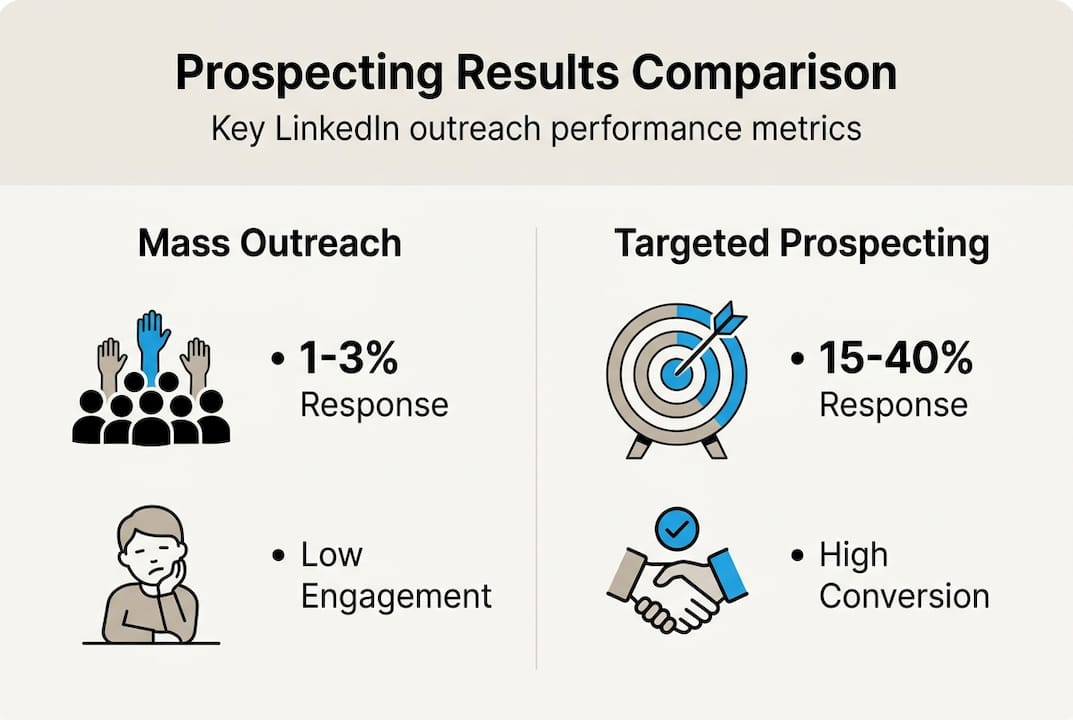
For optimizing campaign quality, the benchmarks you should aim for in 2026 are a connection acceptance rate above 40%, a reply rate above 15%, and a meeting booking rate between 5-10% of replies. If your numbers fall below these, your ICP or messaging needs refinement.
Here is the counterintuitive insight most BD managers miss: sending fewer messages often generates more pipeline. When you invest 10 minutes researching a prospect and crafting a relevant message, you are not wasting time. You are multiplying your conversion rate. Review your LinkedIn outreach tips to see how small personalization changes move the needle significantly.
Pro Tip: Track your acceptance and reply rates weekly. A sudden drop often signals that your targeting criteria have drifted or your messaging has become too generic.
Tools and strategies: Turning targeted prospecting into consistent results
Armed with proof of effectiveness, the next challenge is execution. Here is how to put targeted prospecting to work using the right tools and strategies.
The LinkedIn prospecting strategies that consistently produce results in 2026 combine smart tooling with disciplined human judgment. Over-relying on automation is one of the fastest ways to get your account flagged or banned.
The essential tools for targeted prospecting include:
- LinkedIn Sales Navigator: The gold standard for filtering and sourcing prospects. Use Spotlight filters to find prospects who have changed jobs recently or posted on LinkedIn in the last 30 days.
- CRM integration: Sync your LinkedIn activity with your CRM to track touchpoints, set follow-up reminders, and measure pipeline contribution.
- Intent data platforms: Tools like Bombora or G2 Buyer Intent reveal which companies are actively researching solutions like yours, letting you prioritize outreach.
- AI-powered research tools: Use AI to summarize a prospect’s recent posts, company news, or earnings calls so you can personalize at scale without spending hours on manual research.
The guidance from the LinkedIn prospecting guide 2026 is clear: BD managers should use pre-warming, Sales Navigator filters, CRM intent data, and AI for research and personalization, but avoid over-automation. LinkedIn’s algorithms detect unnatural activity patterns, and a banned account means lost pipeline.
For personalized messaging on LinkedIn, the winning formula is specificity. Reference the prospect’s industry challenge, a recent company milestone, or a shared connection. Generic openers like “I’d love to connect” are invisible. Specific openers like “I noticed your firm recently expanded into financial services” get replies. Pair this with strategic lead gen messaging frameworks to build a sequence that nurtures without pestering.
Pro Tip: LinkedIn limits connection requests to roughly 100-200 per week in 2026. Use this constraint as a feature, not a bug. It forces you to be selective and keeps your outreach quality high.
Common pitfalls and advanced tips for BD managers
While tools and strategies empower action, real-world prospecting demands avoiding common traps and leveraging advanced methods for sustained success.
Even experienced BD managers fall into predictable patterns that kill their results. The LinkedIn prospecting guide 2026 highlights that over-automation risks account bans, misunderstood ICPs waste effort, and neglecting nurture leaves money on the table. Here are the most common pitfalls and how to avoid them:
- Over-automating outreach: Automation tools that send bulk messages or connection requests at scale violate LinkedIn’s terms of service. Use automation only for scheduling and tracking, not for sending messages.
- Defining your ICP too broadly: A vague ICP means you are targeting everyone and converting no one. Revisit your ICP quarterly and tighten it based on which clients actually closed and delivered value.
- Ignoring the nurture phase: Most professional services deals take 3-6 months to close. If you give up after two messages, you are leaving your best opportunities behind. Build a nurture sequence that keeps you visible without being pushy.
- Prioritizing volume over engagement: Sending 200 mediocre messages is less effective than sending 30 thoughtful ones. Engagement rate is a better success metric than outreach volume for professional services.
For enterprise accounts, multi-threading is essential. This means engaging multiple stakeholders at the same target company, not just the primary contact. Connect with the decision-maker, their direct report, and a relevant peer. This builds internal momentum and reduces the risk of a single point of failure.
Thought leadership is another advanced lever. Regularly publishing qualified lead content on LinkedIn positions you as a trusted voice before you ever send a message. Prospects who already follow your insights are far more receptive to outreach.
“In professional services, trust is the product. Targeted prospecting is how you earn that trust before the first conversation.”
The target account selling approaches that work best for professional services firms treat LinkedIn as a relationship platform first and a sales channel second. Patience and consistency compound over time.
Accelerate your LinkedIn prospecting with The Lead Lab
Having learned the frameworks and tips, business development managers can now accelerate results by leveraging specialist expertise. Executing targeted prospecting at a high level takes time, skill, and constant refinement. Most BD managers are already stretched thin managing client relationships and business development simultaneously.
The Lead Lab’s targeted prospecting service is built specifically for professional services firms that want precision outreach without the trial-and-error. We handle ICP definition, prospect sourcing, message copywriting, response management, and campaign analytics so your team focuses on conversations, not setup. Our case studies show exactly how firms like yours have moved from inconsistent pipeline to predictable, qualified meetings. If you are ready to stop guessing and start converting, we are ready to build your campaign.
Frequently asked questions
What is targeted prospecting in LinkedIn sales?
Targeted prospecting on LinkedIn focuses on identifying and engaging high-fit leads using structured criteria, including firmographics and buying signals, instead of sending mass messages to unqualified contacts.
How is targeted prospecting different from mass outreach?
It prioritizes quality leads using filters, intent data, and personalization. Spray-and-pray yields 1-3% response rates, while targeted methods boost win rates by 20-40%.
What are the best tools for targeted prospecting on LinkedIn?
Sales Navigator, CRM integrations, and AI-powered research tools are the core stack. The key is using Sales Navigator filters and AI for research while avoiding over-automation that risks account restrictions.
What are acceptance and reply rate benchmarks for LinkedIn outreach?
Low-volume, personalized outreach sees over 40% acceptance and 15% reply rates. Warm outreach, where you have pre-engaged with a prospect’s content, can push acceptance rates to 50-70% compared to 20-35% for cold outreach.
6 responses