
Generating qualified leads on LinkedIn remains one of the biggest challenges for professional services firms. Many B2B sales and marketing teams invest heavily in outreach campaigns only to see poor response rates, wasted ad spend, and leads that never convert. The platform offers unmatched access to decision makers, but success requires a strategic approach that balances profile optimization, precise targeting, personalized engagement, and data-driven measurement. This guide walks you through proven strategies to transform your LinkedIn presence into a consistent lead generation engine that delivers measurable results for client acquisition.
Table of Contents
- Key takeaways
- Understanding the LinkedIn lead generation landscape
- Preparing your LinkedIn profile and targeting for lead generation
- Executing warm, value-first outreach campaigns
- Measuring and optimizing your LinkedIn lead generation results
- Explore expert lead generation support
- Frequently asked questions
Key Takeaways
| Point | Details |
|---|---|
| Profile optimization | Transform your profile into a client focused landing page by rewriting your headline to emphasize benefits and crafting a summary that highlights outcomes and pain points. |
| Warm outreach impact | Warm personalized outreach delivers significantly higher response rates than cold automated messaging. |
| Precise targeting | Use precise targeting and tailored messaging to improve conversions instead of generic blasts to broad audiences. |
| Benchmarks guidance | Follow benchmarks such as fifteen to twenty five percent response rate, two to three times higher conversions, seventy five to three hundred fifty dollar CPL, and eighty percent of B2B social leads coming from LinkedIn. |
Understanding the LinkedIn lead generation landscape
LinkedIn dominates B2B lead generation for professional services, but understanding the platform’s economics and conversion dynamics is essential before launching campaigns. 80% of B2B social leads come from LinkedIn, with 95.7% of B2B marketers actively using the platform for prospecting. This concentration creates both opportunity and competition.
Cost per lead varies significantly based on your approach and industry. LinkedIn CPL ranges from $75-175 for standard campaigns and $150-350 for premium professional services targeting. While these numbers appear high compared to other social platforms, LinkedIn leads convert 2-3 times better, making the investment worthwhile when executed properly. The key is understanding that higher upfront costs translate to better qualified prospects who actually need your services.
Warm, personalized outreach dramatically outperforms cold automation. Manual outreach response rates reach 15-25% when done correctly, compared to single digit responses from generic bulk messaging. This difference stems from prospects’ ability to immediately recognize authentic engagement versus templated spam. Professional services buyers particularly value consultative approaches that demonstrate understanding of their specific challenges.
The platform’s B2B focus means you’re reaching decision makers during their professional mindset, unlike consumer-focused platforms where business content competes with personal updates. This context advantage explains why conversion rates consistently exceed other channels. However, success requires treating LinkedIn as a relationship-building platform first and a direct sales channel second.
Key benchmarks to guide your strategy:
- Response rates of 15-25% for warm, personalized outreach
- Conversion rates 2-3x higher than other social platforms
- CPL ranging from $75-350 depending on targeting precision
- 80% of B2B social leads originating from LinkedIn
| Metric | Standard Range | Premium Services |
|---|---|---|
| Cost per lead | $75-175 | $150-350 |
| Response rate (warm) | 15-25% | 15-25% |
| Conversion multiplier | 2-3x vs other platforms | 2-3x vs other platforms |
“The quality of LinkedIn leads justifies the higher cost per acquisition. We see professional services firms consistently achieve better ROI from LinkedIn compared to broader social advertising because the audience is already in a business mindset.”
For more context on effective LinkedIn lead generation strategies, understanding these benchmarks helps set realistic expectations and budget appropriately for sustainable campaigns.
Preparing your LinkedIn profile and targeting for lead generation
Your LinkedIn profile functions as your primary landing page for inbound interest and outbound prospecting. Most professionals treat profiles as static resumes, missing the opportunity to position themselves as solution providers. Transform your profile by rewriting your headline to emphasize client benefits rather than job titles. Instead of “Marketing Director at ABC Consulting,” use “Helping SaaS companies generate 50+ qualified leads monthly through targeted LinkedIn campaigns.”

Your summary should address specific pain points your ideal clients face and preview the outcomes you deliver. Skip the career history narrative and focus on the transformation prospects experience when working with you. Include social proof through recommendations and featured case studies that demonstrate results similar to what prospects seek.
Consistent content posting establishes authority and keeps you visible in prospects’ feeds. Post niche content 3-5 times per week focused on your ideal client’s challenges, not generic industry news. Share frameworks, case studies, and contrarian insights that spark engagement. This content serves dual purposes: attracting inbound interest and providing conversation starters when you reach out directly.
Sales Navigator transforms LinkedIn from a networking platform into a precision prospecting tool. The advanced filters let you identify prospects by company size, industry, seniority, geography, and even technology usage. This granularity ensures you’re targeting decision makers who actually fit your ideal customer profile rather than wasting outreach on poor-fit contacts.
Engage prospects’ content before sending connection requests. Engaging prospects’ content before outreach warms the relationship and increases acceptance rates. Comment thoughtfully on their posts, share their content with added insights, and demonstrate genuine interest in their perspective. This pre-outreach engagement makes your eventual connection request feel natural rather than transactional.
Profile optimization checklist:
- Benefit-focused headline addressing client outcomes
- Summary highlighting transformation and social proof
- Featured section showcasing relevant case studies
- Regular content posting 3-5 times weekly
- Professional headshot and branded banner image
Avoid targeting audiences smaller than 50,000 prospects, which limits reach and increases costs. Equally problematic is targeting too broadly without clear ICP definition, which wastes budget on unqualified leads. The sweet spot balances specificity with sufficient volume to sustain ongoing campaigns.
Pro Tip: Update your headline and summary quarterly to reflect evolving client pain points and current case study results. This keeps your profile relevant and improves search visibility for prospects actively seeking solutions.
Explore professional LinkedIn profile examples to see how top performers structure their profiles for maximum lead generation impact.
Executing warm, value-first outreach campaigns
Successful LinkedIn outreach follows a structured sequence that builds trust before asking for meetings. The biggest mistake professionals make is jumping straight to calendar links in initial messages. Instead, design multi-touch campaigns that progressively demonstrate value and relevance.
Start by identifying 20-30 high-value prospects weekly who match your ideal customer profile. Research each prospect’s recent activity, company news, and shared connections. This reconnaissance provides personalization hooks that make your outreach feel tailored rather than templated.
Effective outreach sequence:
- Engage 2-3 of their recent posts with substantive comments over 3-5 days
- Send a personalized connection request mentioning specific shared interests or mutual connections
- After acceptance, send a welcome message offering a relevant resource without pitching services
- Follow up 5-7 days later with a question about their current challenges in your area of expertise
- Share a brief case study or framework relevant to their expressed pain point
- Suggest a brief exploratory conversation only after establishing mutual interest
Personalization extends beyond using first names. Reference specific challenges their company faces, recent content they shared, or industry trends affecting their business. This research investment pays dividends in response rates. Warm manual outreach achieves 15-25% response rates compared to single digits for generic bulk messaging.
Avoid immediate pitching and cold automation, which damage your reputation and trigger LinkedIn’s spam filters. The platform’s algorithm detects repetitive messaging patterns and can restrict your account. More importantly, prospects immediately recognize and ignore templated outreach.
Track response rates by message variation to identify what resonates with your audience. Test different opening hooks, value propositions, and call-to-action styles. Small changes in messaging approach can double response rates when aligned with prospect priorities.
“The difference between 5% and 20% response rates comes down to demonstrating you understand their specific situation before asking for their time. Generic outreach gets ignored. Relevant, researched engagement gets replies.”
Pro Tip: Reference a mutual connection or shared group membership in your initial message to increase warm response likelihood. This social proof immediately elevates trust and acceptance rates.
Multi-step sequences outperform one-off pitches because they allow prospects to engage at their own pace. Some respond immediately, others need multiple touchpoints before feeling comfortable. Build sequences that provide value at each step regardless of whether prospects reply, positioning yourself as a helpful resource rather than a pushy salesperson.
Learn more about LinkedIn outreach best practices to refine your messaging approach and increase qualified conversations.
Measuring and optimizing your LinkedIn lead generation results
Tracking the right metrics separates guesswork from strategic optimization. Cost per lead, response rate, and conversion rate form the foundation of your measurement framework. Monitor these metrics weekly to identify trends and adjust tactics before wasting significant budget on underperforming approaches.
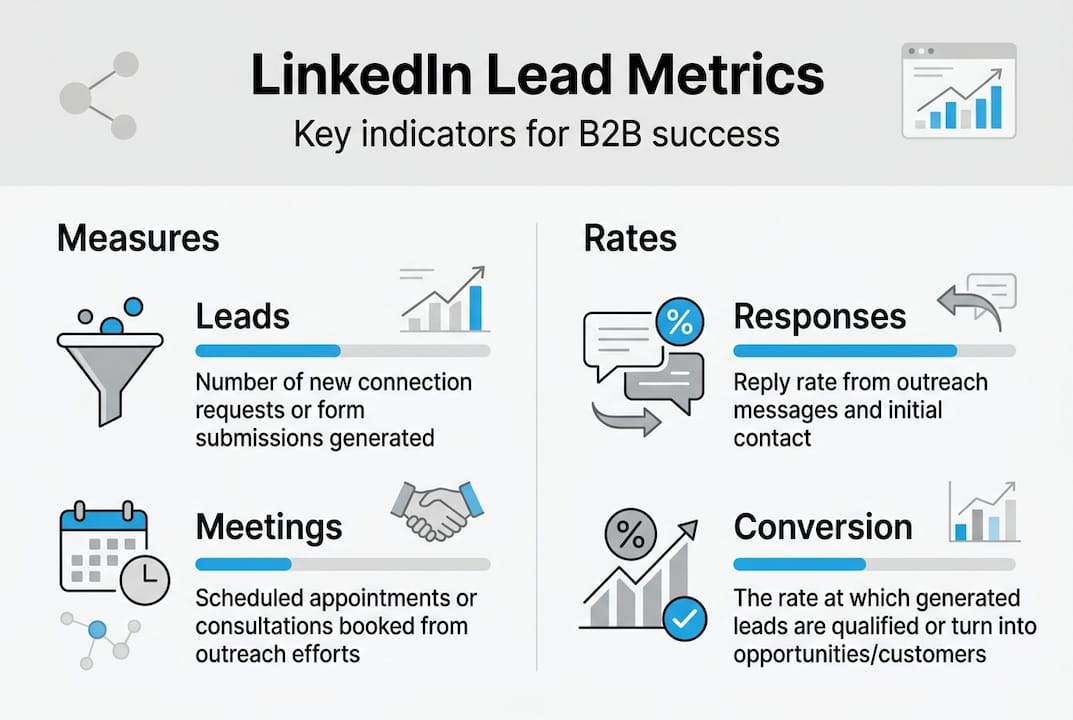
Cost per lead varies dramatically between organic and paid strategies. Organic CPL averages $164 lower than paid ads, with organic around $164 versus paid campaigns near $310. However, this comparison oversimplifies the strategic value of each approach. Organic builds long-term authority and trust but requires consistent effort over months. Paid accelerates pipeline growth and targets bottom-funnel prospects ready to buy.
Response rate indicates message relevance and targeting precision. If you’re seeing less than 10% response rates, your messaging likely feels generic or you’re targeting prospects outside your ideal customer profile. Test different value propositions and narrow your audience criteria. Response rates above 20% suggest strong product-market fit and effective personalization.
Conversion rate from lead to qualified opportunity reveals whether you’re attracting the right prospects. High lead volume with low conversion indicates targeting misalignment. You’re reaching people interested in your content but not ready or able to buy. Refine your ICP definition and adjust Sales Navigator filters to focus on decision makers with budget authority.
| Metric | Organic Approach | Paid Approach | Hybrid Strategy |
|---|---|---|---|
| Average CPL | ~$164 | ~$310 | ~$220 |
| Time to results | 2-4 months | Immediate | 1-2 months |
| Trust building | High | Medium | High |
| Scalability | Limited by time | High | Balanced |
A hybrid approach combining organic content with targeted paid campaigns delivers optimal results for most professional services firms. Use organic efforts to build authority, nurture existing connections, and attract inbound interest. Deploy paid campaigns to accelerate outreach to specific account lists or promote high-value content offers to cold audiences.
Key optimization opportunities:
- A/B test message variations to identify highest-performing hooks
- Analyze response patterns by industry, seniority, and company size
- Refine audience targeting based on conversion data, not just response rates
- Adjust content topics based on engagement metrics and lead quality
- Review campaign performance monthly and reallocate budget to top performers
Regularly audit your audience targeting to ensure you’re not drifting from your ideal customer profile. As campaigns run, LinkedIn’s algorithm may expand your audience beyond initial parameters if you don’t monitor closely. This audience drift increases CPL and reduces conversion rates over time.
Measure not just lead volume but lead quality through downstream metrics like meeting show rate, proposal acceptance, and closed revenue. A campaign generating 50 leads monthly at $200 CPL outperforms one producing 100 leads at $150 CPL if the first converts at twice the rate.
Discover strategies for measuring LinkedIn lead gen ROI to build comprehensive dashboards that connect LinkedIn activity to revenue outcomes.
Explore expert lead generation support
Implementing a comprehensive LinkedIn lead generation strategy requires significant time, expertise, and ongoing optimization. Many professional services firms recognize the platform’s potential but struggle to execute consistently while managing client work and business operations. That’s where specialized support transforms results.
The Lead Lab specializes in done-for-you LinkedIn lead generation tailored specifically for professional services firms. We handle everything from profile optimization and content strategy to personalized outreach campaigns and response management. Our approach combines the relationship-building benefits of manual outreach with the efficiency of strategic automation and proven messaging frameworks.
We’ve helped firms similar to yours generate consistent qualified meetings through targeted LinkedIn campaigns that respect your brand and engage prospects authentically. Our team manages prospect research, message personalization, follow-up sequences, and performance analytics so you can focus on closing opportunities rather than finding them. Review our LinkedIn lead generation portfolio to see results we’ve delivered across industries, or explore our LinkedIn lead generation case studies to understand how we’ve solved challenges similar to yours.
Frequently asked questions
How long does it typically take to start seeing leads from LinkedIn outreach?
Most professional services firms see initial responses within the first 2-3 weeks of consistent outreach, but qualified pipeline development typically requires 4-8 weeks. The timeline depends on your target audience’s buying cycle, message relevance, and outreach volume. Organic content strategies take longer, usually 2-4 months, as you build authority and audience before seeing significant inbound interest.
What are common mistakes that reduce lead generation success on LinkedIn?
The biggest mistakes include sending generic templated messages, targeting audiences too narrow (under 50k) or too broad, pitching services immediately without building rapport, and over-relying on automation that feels impersonal. Many professionals also neglect profile optimization, treating it as a static resume rather than a conversion-focused landing page. Avoiding these pitfalls immediately improves response rates and lead quality.
Should I focus more on organic content or paid LinkedIn ads for lead generation?
A hybrid approach delivers the best results for most professional services firms. Organic content builds trust, establishes authority, and generates lower cost per lead over time, but requires consistent effort for 2-4 months before seeing significant results. Paid ads accelerate pipeline growth and enable precise targeting of bottom-funnel prospects, though at higher CPL. Combining both strategies leverages the strengths of each while minimizing weaknesses.
How many connection requests should I send weekly to avoid account restrictions?
LinkedIn doesn’t publish exact limits, but best practice suggests 80-100 weekly connection requests for established accounts and 50-70 for newer profiles. More important than volume is personalization and acceptance rate. If your acceptance rate drops below 30%, slow your outreach and improve message relevance. High-quality targeted outreach to well-researched prospects always outperforms high-volume generic campaigns.
What role does Sales Navigator play in effective lead generation?
Sales Navigator provides advanced search filters and lead recommendations that dramatically improve targeting precision compared to basic LinkedIn. The tool enables filtering by company headcount, industry, seniority, geography, and technology usage, ensuring you reach decision makers who match your ideal customer profile. InMail credits and lead lists also streamline outreach workflow. For serious B2B lead generation, Sales Navigator is essential rather than optional.
8 responses