
TL;DR:
- Effective LinkedIn lead generation depends heavily on persuasive, personalized copy, especially the first 150 characters.
- Coordinating multi-channel messaging across posts, comments, and DMs enhances trust and response rates.
- Prioritizing quality copy over volume, with continuous testing and refinement, leads to better appointment results.
Most marketing leaders at professional services firms pour budget into LinkedIn automation tools, connection volume, and campaign frequency while overlooking the single variable that determines whether any of it works: the copy itself. The first 150 characters of your LinkedIn message can make or break your entire lead generation effort. Get them wrong, and your prospect never reads further. Get them right, and you open the door to a qualified conversation. This guide breaks down exactly how copywriting drives LinkedIn leads for professional services firms, with frameworks, examples, and pro tips you can apply immediately to improve appointment setting results.
Table of Contents
- Why copywriting matters for LinkedIn lead generation
- Core elements of high-converting LinkedIn copy
- Copywriting strategies for multi-touch LinkedIn lead generation
- Optimizing and measuring copywriting for appointment setting
- What most marketers miss about copywriting for LinkedIn lead generation
- Get expert help with your LinkedIn lead generation
- Frequently asked questions
Key Takeaways
| Point | Details |
|---|---|
| First 150 characters matter | Your initial copy hook decides if prospects engage or scroll past. |
| Personalization and CTAs boost results | Tailor your message and use a clear call-to-action for maximum conversions. |
| Test and optimize relentlessly | Constantly iterate hooks and messaging to improve response and appointment set rates. |
| Multi-channel copy works best | Coordinate content, comments, and DMs for higher trust and lead quality. |
Why copywriting matters for LinkedIn lead generation
Understanding how LinkedIn lead gen works makes one thing clear: automation handles delivery, but copy handles persuasion. No tool can compensate for a message that fails to resonate. Your words are the first impression, and in a feed crowded with generic outreach, that impression is everything.
Buyers on LinkedIn are more discerning than ever. They receive dozens of connection requests and InMail messages weekly. Attention spans are short, skepticism is high, and the threshold for ignoring a message is low. Strategic copy cuts through that noise by speaking directly to a prospect’s specific situation, role, or pain point.
Personalization and clarity are the two biggest drivers of response rates. A message that feels tailored to the individual signals that you did your homework. One that is vague or overly promotional signals the opposite. The difference in outcomes between these two approaches is not marginal. It is significant.
Here is a quick look at how copy quality affects key LinkedIn outreach metrics:
| Copy quality | Average response rate | Appointment conversion |
|---|---|---|
| Generic, templated | 3 to 5% | Under 1% |
| Moderately personalized | 10 to 15% | 2 to 4% |
| Highly targeted, strategic | 20 to 35% | 6 to 12% |
Automation tools can scale your outreach, but only multi-touch copy and testing drive real appointment outcomes. The firms winning on LinkedIn are not the ones sending the most messages. They are the ones sending the best ones.
Key reasons copy is foundational for LinkedIn lead generation:
- It shapes first impressions before a prospect knows anything about your firm
- It signals relevance and specificity to busy decision-makers
- It builds micro-credibility in seconds through tone and language choices
- It guides prospects toward a clear next step without pressure
“The best LinkedIn copy does not feel like outreach. It feels like a timely, relevant conversation from someone who actually understands your world.”
Pair strong copy with a targeted message approach and you have the foundation for a genuinely high-performing lead generation system.
Core elements of high-converting LinkedIn copy
With the importance of copy clear, we turn to the specific copywriting elements that move the needle. Every high-converting LinkedIn message shares a predictable anatomy. Understanding each component lets you build and test with intention.

1. The hook. Your opening line is everything. Since first 150 characters determine visibility and engagement, your hook must immediately signal relevance. Avoid starting with your name, your firm, or a compliment. Start with a specific insight, a shared challenge, or a direct observation about the prospect’s world.
2. Personalization. Generic copy is easy to spot and easy to ignore. Referencing a prospect’s recent post, their firm’s growth stage, or a specific challenge in their industry signals that this message was written for them. That signal alone increases trust and read-through rates.
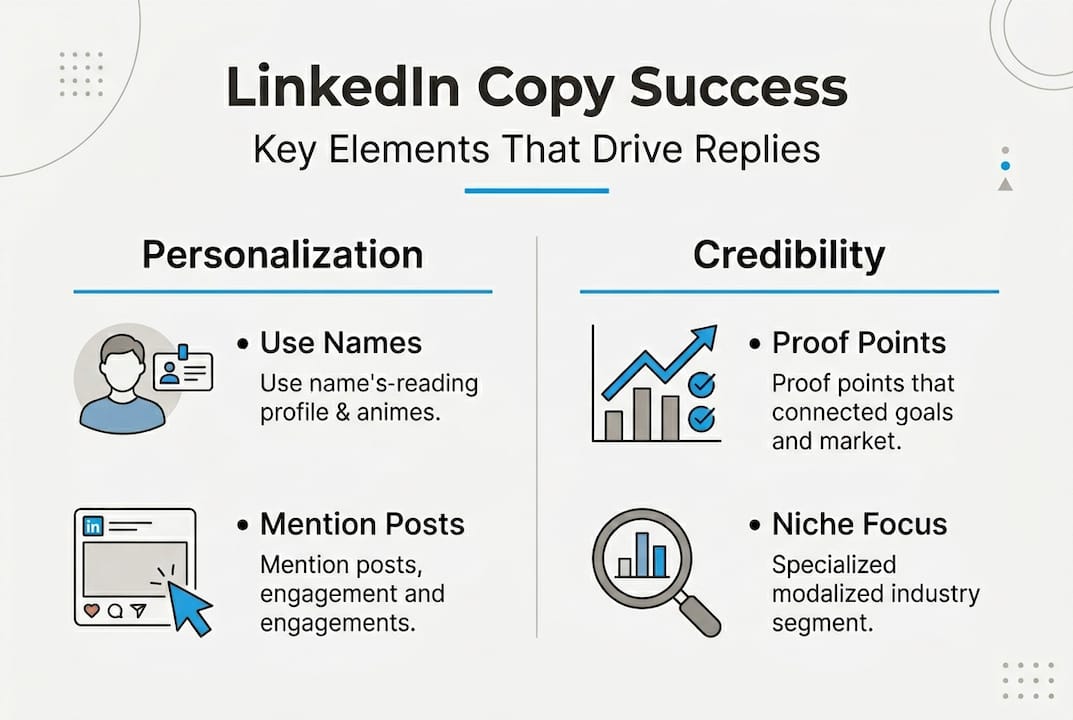
3. Credibility cues. Drop one or two specific proof points early. A relevant client outcome, a niche you specialize in, or a recognizable firm you have worked with reduces friction and makes your claim believable. Do not overload the message with credentials. One sharp detail beats a paragraph of qualifications.
4. A benefit-driven CTA. Weak CTAs ask for time. Strong CTAs offer value. “Would it be useful to see how we helped a firm like yours reduce their sales cycle by 30%?” outperforms “Can we jump on a call?” every time.
Here is a comparison of weak versus strong copy patterns:
| Element | Weak version | Strong version |
|---|---|---|
| Hook | “Hi [Name], I wanted to reach out…” | “Most [role] at [firm type] are dealing with X right now…” |
| Personalization | None | References their recent content or firm milestone |
| Credibility | “We are a leading agency” | “We helped [firm type] book 14 meetings in 30 days” |
| CTA | “Let’s connect” | “Worth a 15-minute look at what we found?” |
Pro Tip: Write your hook last. Draft the full message first, then go back and sharpen the opening line once you know exactly what value you are delivering.
For deeper guidance on structure, review outreach copy best practices and explore strategic LinkedIn messaging frameworks that consistently outperform templated approaches.
Copywriting strategies for multi-touch LinkedIn lead generation
After understanding what makes individual copy effective, we now focus on synergy across multiple LinkedIn channels. A single well-crafted DM is good. A coordinated sequence of posts, comments, and DMs that all reinforce the same message is far more powerful.
LinkedIn operates as a trust-building ecosystem. Prospects often see your content before they ever receive a direct message from you. That means your posts and comments are doing pre-sell work. When your DM arrives, it lands in a warmer context.
Combining copy across content, comments, and DMs delivers measurably better lead generation than relying on any single channel alone. The key is consistency in message and intentionality in tone.
Here is how to adapt your copy by channel:
- Posts: Educational and insight-driven. Establish authority without selling. Share a counterintuitive finding, a framework, or a short case study. The goal is to be remembered as a credible voice.
- Comments: Conversational and specific. Add genuine value to threads your prospects are active in. A sharp, relevant comment on a prospect’s post is often more powerful than a cold DM.
- DMs: Personal and direct. Reference shared context where possible. Keep it short, specific, and low-pressure. One clear ask per message.
Sequence matters. Prime with content first, then follow up with outreach. A prospect who has seen two or three of your posts before receiving your DM is far more likely to respond positively.
Pro Tip: Track which posts generate the most engagement from your target segment. Use those themes as the basis for your DM hooks. You are essentially letting your audience tell you what copy resonates before you invest in outreach.
For more tactical guidance, explore B2B outreach tips and see how customized LinkedIn campaigns integrate multi-channel copy into a single coherent strategy.
Statistic callout: Firms using coordinated multi-touch LinkedIn copy sequences report up to 3x higher appointment rates compared to single-channel DM-only approaches.
Optimizing and measuring copywriting for appointment setting
Having crafted and deployed multi-channel copy, it is crucial to optimize its effectiveness for appointment setting. Writing great copy is only half the job. The other half is knowing what is working, what is not, and why.
Testing hooks and CTAs rigorously is the most direct path to improving appointment setting outcomes. Most firms test too infrequently or change too many variables at once. Effective testing is disciplined and incremental.
Here is a simple framework for copy testing on LinkedIn:
| Test variable | What to measure | Success indicator |
|---|---|---|
| Hook variation | Open and read-through rate | Higher engagement on variant B |
| CTA phrasing | Response rate | More replies or clicks |
| Message length | Appointment conversion | Shorter copy, same or better results |
| Personalization depth | Reply quality | More qualified responses |
Follow this process for each test cycle:
- Isolate one variable per test. Change only the hook, or only the CTA, not both at once.
- Run each variant with a minimum of 50 to 100 sends before drawing conclusions.
- Track responses, click-throughs, and booked appointments separately for each variant.
- Document winning copy in a shared library your team can build on.
- Refresh winning copy every 60 to 90 days to prevent message fatigue.
Pro Tip: Do not just measure response rates. Measure appointment quality. A message that books more meetings with the wrong prospects is not a win. Filter your metrics by whether conversations converted to qualified opportunities.
Use LinkedIn campaign analytics to build a data-driven feedback loop, and pair that with strong content for qualified leads to ensure your copy attracts the right people from the start.
What most marketers miss about copywriting for LinkedIn lead generation
Here is the uncomfortable truth most LinkedIn lead generation guides will not tell you: volume is a trap. Firms that prioritize sending more messages over sending better ones consistently underperform. We have seen this pattern repeatedly across campaigns for professional services firms. The instinct to scale before optimizing is one of the most expensive mistakes in B2B outreach.
Copy overkill is real. When you send too many messages with mediocre copy, you do not just get low response rates. You damage your brand perception with the exact prospects you want to reach. A decision-maker who receives three generic messages from your firm in a month is less likely to engage with you, not more.
The firms that consistently win at LinkedIn appointment setting share one trait: they treat copy as a strategic asset, not a commodity. They invest in qualitative feedback from prospects, not just quantitative metrics. They ask why a message did not land, not just whether it did.
The real edge comes from building institutional knowledge around what resonates with your specific audience. That means documenting wins, analyzing losses, and iterating with purpose. Explore strategies that drive results to see what that disciplined approach looks like in practice.
Get expert help with your LinkedIn lead generation
If this guide has clarified one thing, it is that great LinkedIn copy is not accidental. It is built, tested, and refined with a clear understanding of your audience and your goals.
The Lead Lab specializes in exactly this kind of work for professional services firms. From crafting high-converting message sequences to managing multi-touch campaigns and tracking what actually drives appointments, the team handles the full copywriting and outreach process for you. You bring the expertise in your field. We bring the copy, the strategy, and the systems to turn LinkedIn into a consistent source of qualified meetings. Review our appointment setting success stories to see real results, then let’s talk about what a tailored campaign could look like for your firm.
Frequently asked questions
What is the most important element of LinkedIn lead gen copy?
The hook in the first 150 characters is most critical because it determines whether your message is read or ignored entirely.
How do you personalize LinkedIn messages at scale?
Use dynamic personalization templates built around role, industry, or recent activity, then test copy variants to find what drives the strongest replies and trust at volume.
How can you measure if copywriting is driving better lead generation?
Track response rates, connection rates, and appointment bookings attributed to specific copy changes using campaign analytics to isolate which variables are moving the needle.
Is automation harmful to LinkedIn lead gen copywriting?
Automation alone produces generic messages that underperform. Strategic copy plus automation is the combination that scales without sacrificing message quality or prospect trust.