
TL;DR:
- Generic outreach on LinkedIn often fails because it lacks relevance and personalization.
- Targeted messaging significantly improves response rates, lead quality, and sales cycle speed.
- Successful campaigns require genuine audience research, segment-specific content, and ongoing data analysis.
Most LinkedIn outreach campaigns fail before they even land in a prospect’s inbox. The message is too broad, the tone too salesy, and the value proposition too vague to earn a reply. For professional services firms, where trust and relevance are everything, generic outreach doesn’t just underperform. It actively damages your brand. Targeted messaging flips that equation by speaking directly to a specific person’s role, pain point, and context. This article walks you through what targeted messaging actually means, why it converts better, how to build campaigns that work, and how to measure results that matter.
Table of Contents
- What is targeted messaging and why does it matter?
- The business case: How targeted messaging improves conversion
- Building effective targeted messaging campaigns
- Measuring success and optimizing for ongoing results
- A fresh perspective: Why most targeted messaging misses the mark
- Put your targeted messaging to work: Next steps with The Lead Lab
- Frequently asked questions
Key Takeaways
| Point | Details |
|---|---|
| Targeted messaging advantages | Outreach tailored to audience segments significantly increases lead quality and conversion for B2B firms. |
| Segmentation drives success | Effective segmentation ensures messaging stays relevant and improves campaign results on LinkedIn. |
| Continual optimization | Measuring and adjusting campaigns leads to sustained B2B growth and smarter LinkedIn marketing. |
| Avoid common pitfalls | Personalization requires more than scripts—true relevance comes from deep market understanding. |
What is targeted messaging and why does it matter?
Targeted messaging means crafting outreach that speaks to a defined audience segment rather than blasting the same script to everyone in your contact list. On LinkedIn, this translates to personalizing your connection requests, follow-up notes, and InMails based on factors like industry, job title, company size, and the specific challenges your prospect is likely facing right now.
For professional services firms, this distinction is critical. A generic message that says “We help businesses grow” lands differently than one that says “We work with mid-sized accounting firms that want to reduce client acquisition costs.” The second version signals that you understand the prospect’s world. That recognition builds credibility before a single conversation takes place.
Why does generic outreach fail so consistently? A few reasons:
- It lacks relevance. Decision-makers receive dozens of connection requests weekly. A message that could apply to anyone gets ignored by everyone.
- It signals low effort. Professionals can spot a copy-paste template immediately, and it tells them you haven’t done your homework.
- It misses timing. Generic messages don’t account for where a prospect is in their buying journey, making them easy to dismiss.
- It dilutes your positioning. When you try to appeal to everyone, you appeal to no one.
“Targeted messaging is essential for professional service lead generation on LinkedIn, because relevance is the currency that earns attention in a crowded feed.” Strategic messaging for B2B leads requires a clear understanding of who you’re talking to and what they actually care about.
The benefits of getting this right are concrete. Higher response rates, more qualified conversations, shorter sales cycles, and better fit clients. If you want to go deeper on the mechanics, the personalized messaging guide breaks down the framework in detail.
Targeted messaging isn’t just a tactic. It’s a mindset shift that forces you to think about your prospect first and your pitch second.
The business case: How targeted messaging improves conversion
The gap between generic and targeted outreach isn’t subtle. It shows up clearly in the numbers that marketing leaders care most about: response rates, booked meetings, and pipeline value.

Consider the difference in outcomes when you segment your LinkedIn audience before reaching out versus sending the same message to a broad list:
| Outreach type | Avg. response rate | Meeting conversion | Lead quality score |
|---|---|---|---|
| Generic broadcast | 3% to 5% | 10% to 15% | Low |
| Targeted and segmented | 15% to 25% | 35% to 50% | High |
Those numbers represent a real operational difference. A firm sending 200 outreach messages per month with a 5% response rate gets 10 replies. The same firm with a 20% response rate gets 40. That’s four times the pipeline from the same effort.
Audience segmentation boosts LinkedIn lead generation effectiveness by ensuring your message reaches people who are actually positioned to say yes. Segmentation means dividing your target market into groups based on shared characteristics, then crafting messaging that speaks to each group’s specific context.
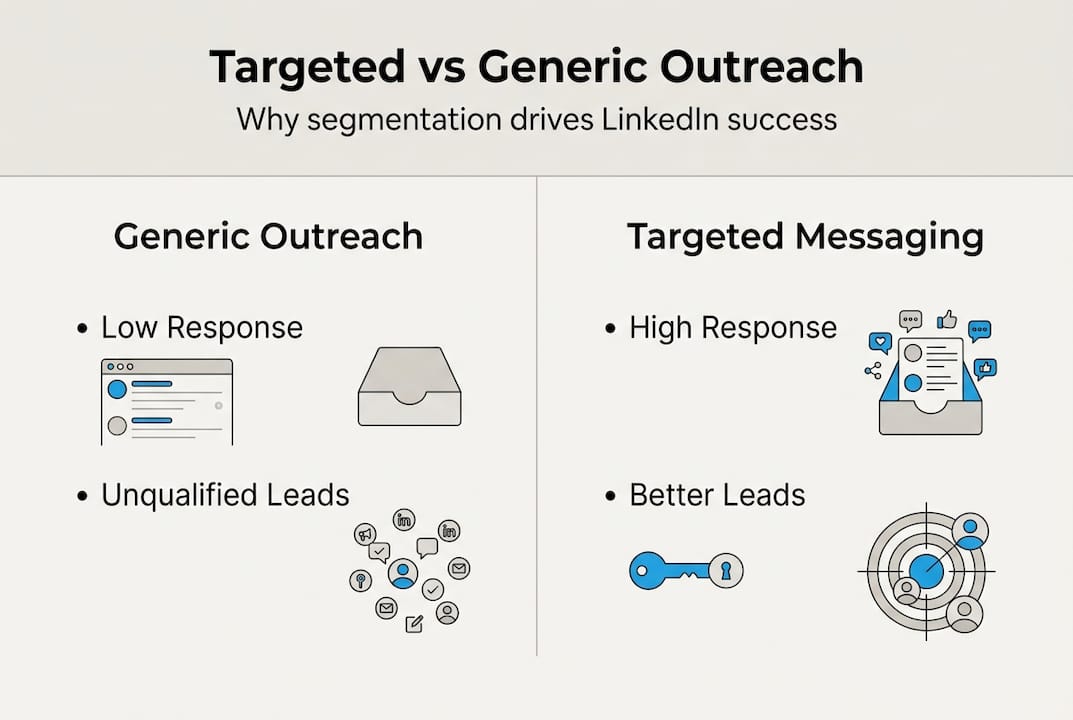
The quality improvement matters just as much as the volume. Targeted outreach tends to attract prospects who are already aligned with your service model, which reduces wasted time in discovery calls and speeds up the decision-making process. You spend less time educating and more time closing.
For firms focused on optimizing lead quality, the shift to targeted messaging often produces a compounding effect. Better leads generate better referrals. Better referrals generate better leads.
Pro Tip: Before you write a single message, build three to five distinct audience segments based on job title, industry, and company size. Then write separate message sequences for each. You’ll immediately see response rates climb because each message feels written for one person, not a crowd.
Building effective targeted messaging campaigns
Knowing that targeted messaging works is one thing. Building a campaign that actually executes it well is another. Here’s a practical sequence that professional services firms can follow:
- Define your audience segments. Start with your best existing clients. What do they have in common? Industry, revenue range, team size, and specific pain points are your starting filters.
- Research each segment. Understand the language they use, the challenges they face in 2026, and the outcomes they’re chasing. LinkedIn groups, industry reports, and job postings are goldmines for this.
- Craft segment-specific messages. Write connection requests and follow-up notes that reference the segment’s specific context. Mention their industry, acknowledge a common challenge, and offer a relevant insight.
- Test variations. Run A/B tests on subject lines, opening sentences, and calls to action. Even small changes in phrasing can shift response rates significantly.
- Refine based on data. After two to three weeks, review what’s working and cut what isn’t. Treat every campaign as a learning exercise.
| Element | Non-personalized | Personalized |
|---|---|---|
| Opening line | “I’d love to connect” | “I noticed you lead ops at a mid-size law firm” |
| Value prop | “We help businesses grow” | “We help law firms reduce client acquisition costs” |
| Call to action | “Let’s chat” | “Worth a 15-minute call this week?” |
High-impact LinkedIn messages are driven by clear, customized language that makes the prospect feel seen. The goal isn’t to impress them with your credentials. It’s to make them feel like you already understand their world.
For firms looking to scale this approach, customized LinkedIn outreach campaigns allow you to maintain personalization at volume without sacrificing quality.
Pro Tip: Avoid the trap of over-scripting. A message that sounds too polished reads as a template. Leave room for natural language, even a small imperfection, to signal authenticity.
Measuring success and optimizing for ongoing results
Launching a targeted messaging campaign is only half the job. What you do with the data afterward determines whether you improve or plateau.
The metrics that matter most for LinkedIn outreach campaigns are:
- Response rate: The percentage of recipients who reply to your message. Anything above 15% signals strong relevance.
- Connection acceptance rate: How many people accept your initial request. Low acceptance often means your profile or opening line needs work.
- Meeting conversion rate: Of those who respond, how many book a call? This tells you whether your follow-up sequence is compelling.
- Lead quality score: A subjective but important measure of whether the leads you’re generating actually fit your ideal client profile.
- Pipeline value generated: The dollar value of opportunities created from LinkedIn outreach over a set period.
Targeted prospecting enhances lead precision and campaign results by giving you cleaner data to act on. When you know exactly who you’re targeting, you can attribute results more accurately and make smarter adjustments.
Best practices for ongoing measurement include:
- Review campaign metrics weekly, not monthly. LinkedIn outreach moves fast, and waiting too long to course-correct wastes budget and momentum.
- Segment your reporting by audience group so you can see which segments respond best.
- Track message-level performance to identify which specific phrases or offers generate the most replies.
- Compare current performance against your own historical benchmarks, not just industry averages.
For practical tactics on improving your numbers, the LinkedIn messaging tips resource covers specific language patterns that drive more appointments.
Pro Tip: Make one change at a time when optimizing. If you adjust the opening line and the call to action simultaneously, you won’t know which variable drove the improvement. Incremental testing gives you cleaner insights.
A fresh perspective: Why most targeted messaging misses the mark
Here’s the uncomfortable truth: most firms think they’re doing targeted messaging, but they’re really just doing segmented broadcasting. They swap out the company name, maybe reference the industry, and call it personalized. Prospects see through this immediately.
True targeted messaging requires genuine curiosity about the person you’re reaching out to. It means reading their recent LinkedIn posts, noticing what they’ve commented on, and referencing something specific to them. That level of effort isn’t scalable at high volume without the right systems in place, which is why so many campaigns default to shallow personalization.
The firms that win on LinkedIn aren’t necessarily sending more messages. They’re sending better ones. They’ve invested time in understanding the real problems their prospects face, and their outreach reflects that understanding. Innovative LinkedIn outreach ideas often come from this kind of deep prospect research rather than clever copywriting tricks.
The lesson: stop optimizing your templates and start optimizing your understanding of your audience.
Put your targeted messaging to work: Next steps with The Lead Lab
If you’ve read this far, you already know that generic outreach is leaving pipeline on the table. The question is what you do next.
The Lead Lab builds done-for-you LinkedIn outreach campaigns designed specifically for professional services firms. From audience segmentation and message copywriting to response management and campaign analytics, every element is handled with precision. You can explore real campaign results in the Lead Lab portfolio to see what’s possible when strategy meets execution. If you prefer to learn before you commit, the Lead Lab webinars offer expert-led sessions on LinkedIn lead generation that you can access on your schedule. The next qualified meeting is closer than you think.
Frequently asked questions
What is targeted messaging on LinkedIn?
Targeted messaging is tailoring outreach to specific audience segments using personalized content and timing on LinkedIn for higher engagement. Strategic messaging for B2B leads is essential for professional services firms that want to stand out in crowded inboxes.
How can professional services firms measure messaging campaign success?
Firms should track response rates, conversion metrics, and lead quality to assess the impact of their LinkedIn outreach. Targeted prospecting enhances lead precision, making it easier to attribute results to specific campaign elements.
Are segmentation strategies important for LinkedIn marketing?
Yes, segmenting your LinkedIn audience leads to more relevant messaging and improved lead generation outcomes. LinkedIn segmentation strategies help firms move beyond broad targeting and connect with the right decision-makers.
What mistakes should be avoided in targeted LinkedIn messaging?
Avoid generic language, overused templates, and poor segmentation to ensure outreach resonates with prospects. High-impact LinkedIn messages depend on clear, customized language that speaks directly to each segment’s specific challenges.
2 responses