TL;DR:
- Personalized, relevant, concise messages with clear low-commitment asks significantly boost response rates.
- Effective outreach requires thorough pre-research of prospects to tailor messaging to their specific pain points.
- Relevance over volume is key; sending targeted, well-crafted messages builds long-term pipeline success.
Most LinkedIn outreach messages get ignored. Not because decision-makers are too busy, but because the messages landing in their inboxes are vague, generic, and self-serving. If you’re overseeing B2B lead generation for a professional services firm, this gap between sending and connecting is costing you real pipeline. Personalized and targeted outreach increases LinkedIn response rates significantly, yet most teams still rely on copy-paste templates that prospects can spot in seconds. This guide walks you through exactly how to write outreach messages that get read, get replies, and generate qualified leads.
Table of Contents
- What makes an effective outreach message?
- Preparation: What to do before you write
- Step-by-step guide: How to create high-performing outreach messages
- How to measure, optimize, and troubleshoot your outreach
- Our overlooked secret: Relevance over volume wins outreach in 2026
- Elevate your LinkedIn outreach with expert support
- Frequently asked questions
Key Takeaways
| Point | Details |
|---|---|
| Personalization matters most | Tailoring each message to the recipient dramatically improves LinkedIn outreach results. |
| Preparation drives success | Researching and segmenting your audience before writing ensures relevant and powerful outreach. |
| Quality over quantity | A focused, high-quality message beats sending hundreds of generic outreach attempts every time. |
| Continuous improvement | Regularly analyze your outreach metrics and adapt your messaging for ongoing gains in lead generation. |
What makes an effective outreach message?
With the importance established, it’s critical to understand what actually moves the needle in B2B LinkedIn outreach messaging. Most messages fail before the prospect even finishes reading the first sentence. The reasons are predictable: a vague opener about your company, no connection to the reader’s actual situation, and a call-to-action that asks for too much too soon.
Effective outreach follows a clear framework built on four pillars: personalization, relevancy, conciseness, and a specific, low-friction ask. Strip away any element and your response rate drops. Messages focused on clear value propositions yield measurably higher engagement than generic pitches.
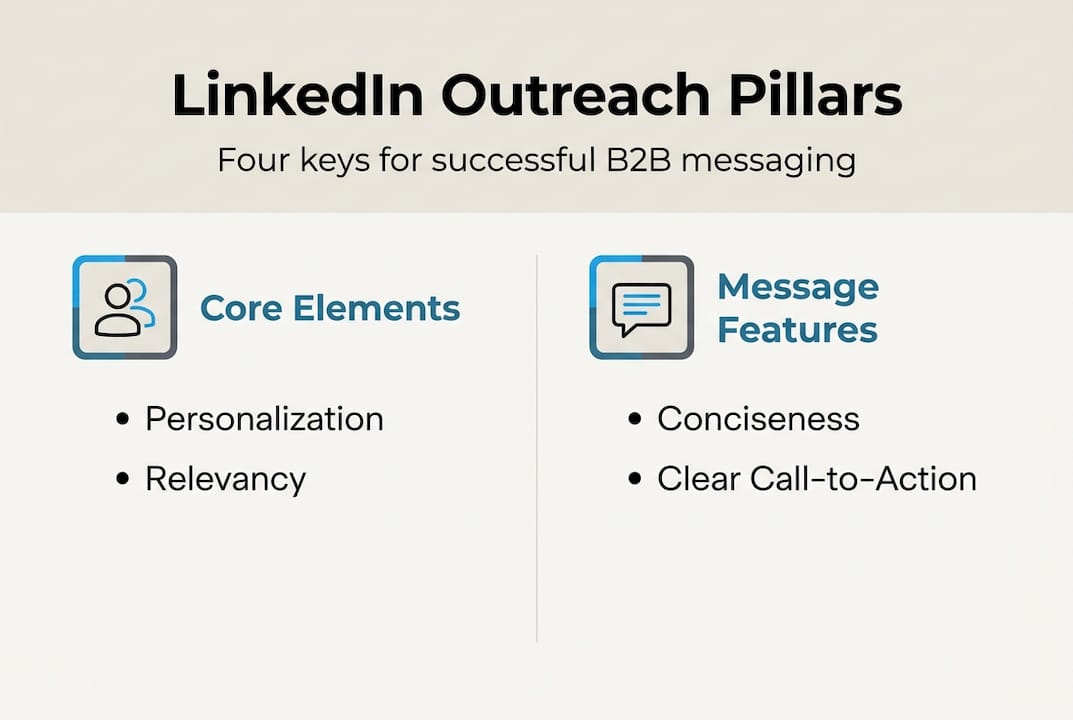
Here’s a quick comparison of what weak versus strong outreach looks like in practice:
| Element | Weak message | Strong message |
|---|---|---|
| Opening | “Hi, I wanted to reach out…” | References a specific post or shared challenge |
| Value | Lists company features | Speaks to a prospect’s known pain point |
| Ask | “Can we schedule a call?” | “Would a 15-minute chat on Thursday work?” |
| Tone | Formal and distant | Conversational and direct |
| Length | 200+ words | Under 150 words |
The strongest outreach messages share a few non-negotiable qualities:
- They open with something specific to the individual, not a generic compliment
- They state a relevant benefit or insight within the first two sentences
- They make a single, clear ask with low commitment required
- They avoid jargon and buzzwords that add length but subtract meaning
“The best outreach message feels like it was written for one person. Because it was.”
Understanding LinkedIn outreach fundamentals is the starting point. Once you have the principles down, you can build repeatable frameworks and explore outreach campaign ideas that scale without losing that personal touch.
Common pitfalls to avoid when first crafting messages include leading with your company name, sending connection requests with no message, and following up with the exact same text. Each of these signals to the prospect that you haven’t thought about them at all.
Preparation: What to do before you write
Now that you know what makes messaging work, ensure you’re setting up your outreach for success before typing the first word. Skipping the preparation phase is the single biggest mistake marketing leaders make. It’s tempting to jump straight into writing, but the research you do upfront is what makes personalization possible.
Successful outreach campaigns begin with precise audience segmentation and research. Start by defining your ideal target persona using LinkedIn Sales Navigator filters. Narrow by industry, company size, seniority level, and geography. The tighter your targeting, the more relevant your message can be.
Before writing a single word, run through this pre-message research checklist for each prospect:
- Review their recent LinkedIn posts and activity
- Note any shared connections or group memberships
- Identify their likely pain points based on role and industry
- Check their company news for recent wins, changes, or challenges
- Map your specific service offering to at least one of their known priorities
Here’s a practical reference for tools and preparation steps:
| Preparation step | Recommended tool | Time investment |
|---|---|---|
| Audience segmentation | LinkedIn Sales Navigator | 30-60 minutes setup |
| Prospect research | LinkedIn profile + company page | 5-10 minutes per prospect |
| Pain point mapping | Industry reports, prospect posts | 10-15 minutes per segment |
| Template creation | Google Docs or CRM | 1-2 hours upfront |
| Saved search lists | Sales Navigator saved searches | 15 minutes per campaign |
Once you’ve researched a prospect, map your value proposition to their specific context. Don’t lead with what you do. Lead with what they need. If a prospect recently posted about struggling to fill their sales pipeline, that’s your opening. Connect your offering to that exact challenge.

Pro Tip: Build a library of personalized templates organized by persona type and pain point. Pair these with saved search lists in Sales Navigator to dramatically reduce prep time per prospect without sacrificing relevance. Explore LinkedIn prospecting tips and optimizing outreach campaigns to sharpen your targeting further.
Step-by-step guide: How to create high-performing outreach messages
With your groundwork set, you’re ready to craft outreach messages that actually get replies. Here’s a proven step-by-step approach.
Strategic messaging frameworks improve response rates and the quality of interactions with decision-makers. Follow these seven steps every time:
- Start with a specific observation. Reference something real: a post they wrote, a company milestone, or a challenge common in their industry. This proves you did your homework.
- State your relevance in one sentence. Explain why you’re reaching out in a way that connects directly to their world, not yours.
- Deliver one clear insight or value point. Share something useful, a stat, a quick observation, or a result you’ve achieved for a similar firm. Keep it to two sentences maximum.
- Avoid feature lists. Don’t describe your service in detail. Focus on the outcome the prospect cares about.
- Make a single, low-commitment ask. “Would it be worth a 15-minute call this week?” works far better than “Can we schedule a demo?”
- Close with warmth, not pressure. End with something like “No worries if the timing isn’t right” to reduce friction and build goodwill.
- Keep the total message under 150 words. Every extra sentence reduces the chance of a reply.
Here’s a template you can adapt across industries:
“Hi [Name], I noticed your recent post on [topic] and it resonated. We work with [industry type] firms to [specific outcome], and I thought it might be relevant given [specific context]. Happy to share a quick insight if useful. Worth a 15-minute chat this week?”
Pro Tip: A/B test your opening line and call-to-action across two versions of the same campaign. Even small wording changes can shift response rates by 20% or more. Use strategic LinkedIn messaging principles to guide your testing, and review how to customize outreach campaigns for different audience segments. For deeper inspiration, explore LinkedIn messaging tips that consistently drive appointments.
How to measure, optimize, and troubleshoot your outreach
Your outreach is live. Now ensure you’re learning and improving with every message sent. Data is only useful if you act on it, and most teams collect metrics without ever changing their approach based on what the numbers reveal.
Ongoing measurement and optimization is key for improving outreach ROI. Start by setting clear benchmarks for your LinkedIn outreach:
- Connection acceptance rate: Aim for 30% or higher as a baseline
- Response rate: A well-targeted campaign should hit 15-25%
- Lead conversion rate: Track how many conversations turn into booked meetings
- Follow-up response rate: Measure separately to assess follow-up message quality
Use LinkedIn’s native analytics alongside your CRM to monitor these KPIs weekly. Look for patterns: which message versions perform best, which personas respond fastest, and which industries need a different approach.
Here’s a comparison of common outreach approaches and their typical outcomes:
| Approach | Response rate | Lead quality | Risk level |
|—|—|—|
| High-volume automation | Low (5-10%) | Poor | High (account flags) |
| Semi-automated with personalization | Medium (15-20%) | Good | Medium |
| Fully manual, hyper-targeted | High (25-35%) | Excellent | Low |
Common mistakes that hurt performance include over-automating sequences, sending identical follow-ups, and ignoring low response signals. If your acceptance rate drops below 20%, revisit your targeting. If responses drop after the first message, your follow-up needs new context or value.
Course-correct by testing one variable at a time. Change the opening line first. Then the CTA. Then the follow-up timing. Use outreach campaign optimization strategies to build a continuous improvement loop, and apply proven outreach tips to reset underperforming campaigns quickly.
Our overlooked secret: Relevance over volume wins outreach in 2026
Having covered both tactics and troubleshooting, it’s time to reflect on the deeper philosophy driving high-performing outreach. Most guides focus on increasing output. Send more messages. Automate more steps. Build bigger lists. We’ve seen where that leads, and it’s not a fuller pipeline. It’s a damaged brand reputation and a LinkedIn account on thin ice.
The firms generating the most consistent B2B pipeline from LinkedIn aren’t the ones sending the most messages. They’re the ones sending the right messages to the right people at the right moment. That requires discipline. It means saying no to blasting 500 generic connection requests and yes to crafting 50 messages that feel genuinely personal.
We’ve seen this approach build long-term pipelines for professional services clients who previously relied on referrals alone. The shift isn’t about technology. It’s about intention. Data without context is dangerous. Knowing that your response rate is 12% tells you something is off. Knowing why it’s off, because your messaging speaks to the wrong pain point for that persona, tells you how to fix it.
The uncomfortable truth is that most outreach fails not from lack of effort, but from lack of relevance. Understanding the value of outreach agencies that specialize in this kind of precision can be the difference between spinning your wheels and building real momentum.
Elevate your LinkedIn outreach with expert support
If you’re ready to put these outreach principles into practice with proven support, here’s how we can help. Crafting high-performing LinkedIn outreach at scale requires more than a good template. It requires a system, and that’s exactly what we build for professional services firms.
At The Lead Lab, we design and execute done-for-you LinkedIn outreach campaigns that combine precise targeting, personalized messaging, and continuous optimization. You can explore real results in our client portfolio or join one of our LinkedIn outreach webinars to see these strategies applied live. Whether you’re starting from scratch or scaling an existing effort, our team can help you turn LinkedIn into a reliable source of qualified leads and booked meetings.
Frequently asked questions
What is the ideal length for a LinkedIn outreach message?
Brevity and personalization increase response rates, so keep your initial message under 150 words. Concise, targeted messages consistently outperform longer ones in B2B LinkedIn outreach.
How many follow-up messages should I send after initial outreach?
Limit yourself to 1-2 follow-ups and always add new context or value in each one. Following up with value increases B2B meeting rates without crossing into spam territory.
Should I automate my LinkedIn outreach?
Automation can help you scale, but overuse leads to reduced response rates and account flags. Effective outreach depends on customization, not just automation, so prioritize manual, relevant messaging wherever possible.
How do I increase response rates for B2B LinkedIn outreach?
Personalize your intro, show clear value quickly, and tailor your call-to-action to each individual. Personalization and tailored value propositions consistently drive stronger B2B response rates across industries.
2 Responses