
Most marketing leaders at professional services firms treat lead nurturing as a fancy word for automated email sequences. Set it, forget it, and wait for the calendar invites to roll in. That assumption is costing you deals. Lead nurturing is the process of building relationships with potential customers by providing valuable content and communications tailored to their needs and stage in the buyer’s journey. For professional services, where trust is the currency and sales cycles stretch across months, nurturing is not a nice-to-have. It is the engine of sustainable B2B growth. This guide breaks down the frameworks, channels, and common mistakes that separate firms that grow from firms that stall.
Table of Contents
- What is lead nurturing? Definitions and core principles
- How lead nurturing works: Stages, segmentation, and touchpoints
- B2B lead nurturing methodologies for professional services
- Automation, personalization, and measurement: Tools for modern lead nurturing
- Common lead nurturing pitfalls and expert fixes
- How The Lead Lab helps you master lead nurturing
- Frequently asked questions
Key Takeaways
| Point | Details |
|---|---|
| Lead nurturing defined | It’s a structured process of guiding prospects with tailored content and communication until they are sales-ready. |
| Segmentation and personalization | Dividing leads and crafting personalized, multi-channel messages is crucial for B2B engagement and conversion. |
| LinkedIn’s unique B2B value | Effective LinkedIn outreach delivers direct access to key decision-makers for professional services firms. |
| Smart automation | Automation tools boost efficiency but require strategic personalization and real-time human intervention. |
| Common pitfalls to avoid | Generic messaging, timing errors, and weak sales-marketing alignment undermine nurturing ROI. |
What is lead nurturing? Definitions and core principles
Lead nurturing and lead generation are not the same thing, and conflating them is one of the most expensive mistakes a marketing leader can make. Generation attracts strangers to your brand. Nurturing converts those strangers into clients by building trust over time. The distinction matters because each requires a completely different strategy, budget allocation, and success metric.
At its core, lead nurturing is about guiding prospects by providing content and communications tailored to their stage in the buyer’s journey. For professional services firms, that journey is rarely linear. A CFO considering an outsourced finance function might engage with your content for six months before ever responding to an outreach message. Nurturing keeps you relevant throughout that window.
The essential elements of an effective nurturing program include:
- Segmentation: Grouping leads by industry, role, pain point, or behavior so messaging stays relevant
- Personalized touchpoints: Moving beyond first-name tokens to context-specific value
- Multi-channel methods: LinkedIn, email, phone, and content working together
- Staged messaging: Different messages for awareness, consideration, and decision stages
“Nurturing is not about selling. It is about being the most useful voice in the room when your prospect is ready to buy.”
For professional services, the payoff is not just more leads. It is higher-value clients, shorter sales cycles, and stronger retention because the relationship started with genuine value, not a pitch. Firms that invest in generating B2B leads on LinkedIn alongside structured nurturing programs consistently outperform those relying on cold outreach alone.
How lead nurturing works: Stages, segmentation, and touchpoints
Understanding the mechanics of nurturing separates firms that get results from those that just send emails. The buyer’s journey has three core stages, and each demands a different approach.
- Awareness stage: The prospect recognizes a problem but is not yet evaluating solutions. Your job here is education, not promotion. Thought leadership content, LinkedIn posts, and industry insights build credibility without triggering sales resistance.
- Consideration stage: The prospect is actively researching options. This is where case studies, comparison content, and personalized outreach become powerful. They want proof, not promises.
- Decision stage: The prospect is ready to choose. Testimonials, ROI calculators, and direct conversations with your team close the gap between interest and commitment.
Lead segmentation and workflows are the operational backbone of this process. Key mechanics include lead segmentation by buyer personas and stages, personalized multi-channel communications, marketing automation workflows, lead scoring, and progressive messaging. Without segmentation, you are sending the same message to a first-time visitor and a prospect who has downloaded three of your whitepapers. That is a missed opportunity every time.
Here is how channels map to stages for professional services firms:
| Stage | Primary channel | Content type | Goal |
|---|---|---|---|
| Awareness | LinkedIn posts, email | Articles, insights | Build visibility |
| Consideration | LinkedIn messages, email | Case studies, guides | Demonstrate value |
| Decision | Direct calls, LinkedIn DMs | Proposals, testimonials | Drive commitment |
Personalized LinkedIn messaging is particularly effective at the consideration stage because it combines professional context with direct access to decision-makers. LinkedIn also allows you to see exactly what a prospect engages with, giving you real-time signals to inform your next touchpoint. Pairing that with LinkedIn messaging workflows creates a system that scales without losing the personal feel that professional services buyers expect.
Pro Tip: Map your top five target accounts through each stage and assign specific outreach activities to each. A documented journey map turns vague intentions into a repeatable system.
B2B lead nurturing methodologies for professional services
Knowing the stages is one thing. Knowing which methodology to apply at each stage is where most firms fall short. B2B lead nurturing methodologies include new lead nurturing, MOFU nurturing, multi-channel cadences, and Account-Based Marketing, each serving a distinct purpose in the funnel.
New lead nurturing focuses on education and introducing your brand’s value without pressure. The goal is to move a cold contact from awareness to curiosity. Think welcome sequences, introductory content, and low-commitment invitations to engage.

MOFU (Middle-Of-Funnel) nurturing is triggered by prospect behaviors like downloading a guide, attending a webinar, or visiting your pricing page. These signals tell you the prospect is warming up. Your response should be faster, more specific, and more direct.
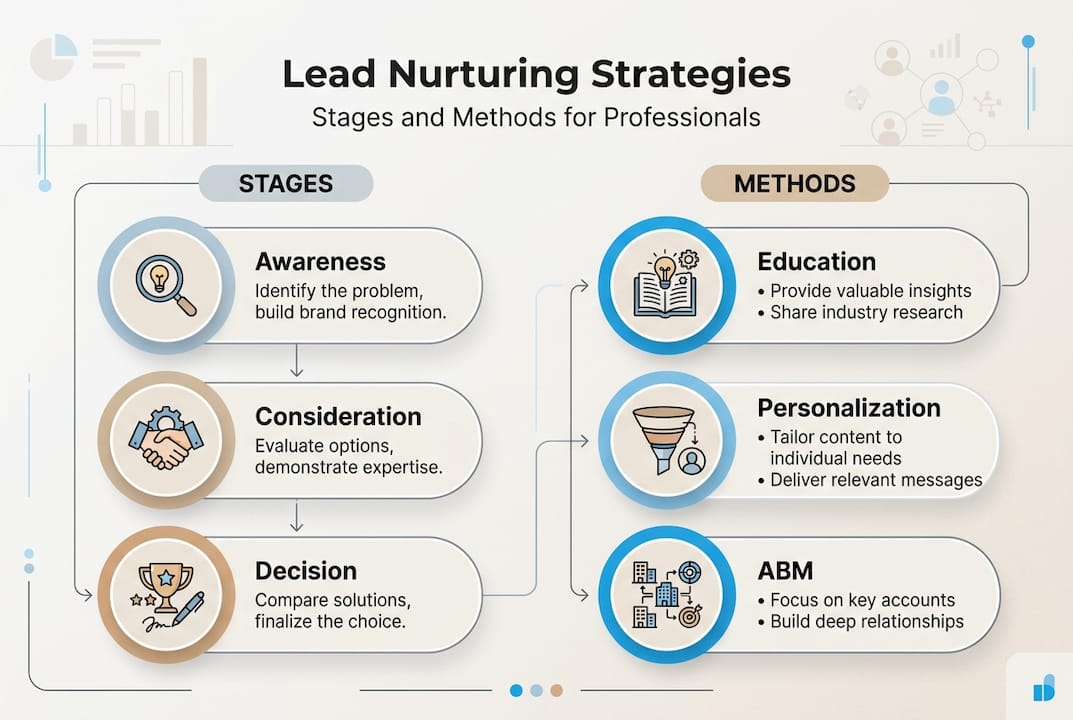
Account-Based Marketing (ABM) is the methodology that delivers the highest ROI for professional services firms targeting enterprise or high-value accounts. Instead of broadcasting to a wide audience, ABM builds tailored, multi-touch sequences for specific named accounts. Every message, every piece of content, and every outreach touchpoint is customized for that account’s industry, challenges, and stakeholders.
Here is a comparison of the three core methodologies:
| Methodology | Best for | Touchpoint volume | Personalization level |
|---|---|---|---|
| New lead nurturing | Cold or early-stage leads | Low (3-5 touches) | Moderate |
| MOFU nurturing | Behavior-triggered leads | Medium (6-10 touches) | High |
| ABM | High-value target accounts | High (16-21 touches) | Very high |
A 16-21-touch multi-channel mix is considered best practice for complex B2B sales. That sounds like a lot, but spread across LinkedIn, email, and calls over 8-12 weeks, it creates consistent presence without overwhelming your prospect.
Key activities to include in a professional services nurturing cadence:
- LinkedIn connection request with a personalized note
- Value-driven email with a relevant insight or case study
- LinkedIn content engagement (commenting on their posts)
- Follow-up message referencing a specific pain point
- Phone call or voice message for high-priority accounts
Targeted LinkedIn prospecting gives you the precision to identify exactly which accounts deserve ABM-level attention. Combine that with LinkedIn content for lead nurturing and you have a system that builds authority while simultaneously warming individual prospects.
Pro Tip: Use LinkedIn to add touchpoint diversity without adding pressure. A thoughtful comment on a prospect’s post counts as a touchpoint and builds familiarity without triggering sales resistance.
Automation, personalization, and measurement: Tools for modern lead nurturing
Automation is not the enemy of personalization. Used correctly, it is the infrastructure that makes personalization possible at scale. Platforms like HubSpot, Marketo, and Salesforce allow you to automate lead nurturing workflows that segment leads, trigger messages based on behavior, and score prospects based on engagement, all without manual intervention.
But automation without strategy produces noise. Generic messaging fails in complex B2B sales cycles because professional services buyers are sophisticated. They recognize templated outreach immediately, and it signals that you do not understand their business. The firms winning in 2026 are those using automation to handle timing and sequencing while investing human effort in the actual message content.
The ROI of automation is hard to ignore: companies leveraging marketing automation report 451% more qualified leads. That number reflects what happens when the right message reaches the right person at the right time, consistently.
Key metrics to track in your nurturing program:
- Conversion rate by stage: Where are leads dropping off?
- Time to conversion: How long does it take a lead to move from awareness to meeting booked?
- Engagement rate: Are your messages being opened, clicked, and replied to?
- Pipeline contribution: What percentage of closed deals touched a nurturing sequence?
Firms that measure these consistently report 20-50% conversion uplift within the first two quarters of a structured program. Optimizing outreach campaigns with this data turns your nurturing program from a cost center into a predictable revenue driver. Pair that with streamlined messaging workflows and you eliminate the manual bottlenecks that slow most teams down.
Pro Tip: Before you invest in any automation tool, audit your data. Dirty CRM data is the single biggest reason nurturing programs underperform. Clean data is the foundation everything else is built on.
Common lead nurturing pitfalls and expert fixes
Even well-resourced firms make predictable mistakes in their nurturing programs. Knowing what to watch for saves you months of wasted effort and budget.
The most common pitfalls include:
- Impersonal mass outreach: Sending the same message to 500 contacts and calling it nurturing. It is not. It is broadcasting, and it damages your brand with the very people you are trying to impress.
- Overwhelming cadence: Contacting prospects too frequently creates fatigue and opt-outs. Frequency should match the prospect’s stage and engagement level, not your pipeline pressure.
- Dirty data: Outdated contact information, duplicate records, and missing firmographic data make segmentation impossible and personalization laughable.
- Sales and marketing misalignment: Marketing nurtures a lead for weeks, then sales calls with zero context. The prospect feels like they are starting over. That disconnect kills deals.
“Avoiding pitfalls requires no personalization fixes, poor timing corrections, and data hygiene discipline. Success hinges on alignment and ongoing relationship-building.”
The fix for most of these issues is not a new tool. It is a shared definition of what a qualified lead looks like, a documented handoff process between marketing and sales, and a commitment to reviewing campaign performance monthly. Optimizing lead quality is an ongoing discipline, not a one-time project. Nurturing is not a campaign you launch and close. It is a system you build and continuously improve.
How The Lead Lab helps you master lead nurturing
Now that you have the strategy and the frameworks, execution is where most professional services firms hit a wall. Building a multi-channel nurturing system that combines LinkedIn outreach, personalized messaging, and data-driven optimization takes time, expertise, and consistent effort that most internal teams simply do not have capacity for.
The Lead Lab specializes in done-for-you LinkedIn outreach and lead nurturing programs built specifically for professional services firms. From targeted prospecting and message copywriting to response management and campaign analytics, every element is handled by a team that understands the nuances of B2B relationship building. You can explore the portfolio of lead nurturing successes to see the results firms like yours have achieved. If you are ready to build a nurturing system that actually converts, book a consultation and we will map out a strategy tailored to your firm’s goals.
Frequently asked questions
What’s the difference between lead generation and lead nurturing?
Lead generation attracts prospects to your brand, while lead nurturing develops those relationships and guides leads toward a buying decision through consistent, value-driven communication.
How many touchpoints are recommended for effective B2B lead nurturing?
A cadence of 16-21 multi-channel touchpoints mixing LinkedIn, email, and calls is considered best practice for complex B2B sales cycles.
Why is LinkedIn important in B2B lead nurturing for professional services?
LinkedIn provides direct access to professional decision-makers and enables personalized, context-driven outreach that integrates naturally into multi-channel nurturing cadences.
What’s a common reason lead nurturing campaigns fail?
Lack of personalization and poor alignment between marketing and sales are the most frequent causes of underperforming nurturing programs.
Does automation replace the human touch in lead nurturing?
No. While automation generates 451% more qualified leads at scale, human engagement remains essential for building the trust that closes complex B2B deals.
8 responses