
TL;DR:
- Professional services firms are increasingly investing in marketing automation to manage long sales cycles and complex relationships. Automation enhances pipeline velocity, personalized outreach, and real-time tracking, leading to significant lead generation improvements. Measuring pipeline velocity is crucial for assessing automation success rather than relying on vanity metrics.
Automation is no longer a luxury reserved for SaaS startups or enterprise tech firms. Professional services firms, from management consultancies to accounting practices and legal groups, are investing heavily in marketing automation to stay competitive in a crowded B2B landscape. 83% of B2B marketers expect their budgets to increase in 2026, with a growing share dedicated to AI and automation tools. This article walks you through the strategies, technologies, and metrics that make automation genuinely impactful for professional services firms navigating complex, relationship-driven sales cycles.
Table of Contents
- Why professional services firms are adopting automation in B2B marketing
- Core automation technologies reshaping B2B marketing
- Streamlining lead generation and nurturing: Automation in action
- Maximizing engagement through automation during extended sales cycles
- The crucial measurement shift: What most marketers miss about automation
- Take your B2B marketing automation further with The Lead Lab
- Frequently asked questions
Key Takeaways
| Point | Details |
|---|---|
| Budget shifts to automation | Professional services firms are allocating 5-10% of their rising marketing budgets to automation and AI tools. |
| Tools driving real impact | CRM and automation platforms can boost lead generation by up to 50% and streamline campaign management. |
| Pipeline velocity over vanity metrics | Measuring pipeline velocity is more meaningful than tracking open rates or clicks in long B2B cycles. |
| Personalization and engagement | Automation enables personalized outreach and keeps prospects engaged throughout protracted sales cycles. |
| Practical strategies available | Real-world tactics and tools exist for marketing leaders to automate lead generation and nurturing effectively. |
Why professional services firms are adopting automation in B2B marketing
Professional services marketing has always been relationship-first. Decisions move slowly, buyers are highly educated, and trust is earned over many touchpoints. That environment used to make automation seem like a poor fit. But the opposite is now true.
The firms that are winning new clients are not the ones working harder manually. They are the ones using smarter systems to stay relevant, responsive, and top of mind throughout months-long sales cycles. According to B2B marketing budget research, 83% of professional services marketers expect budget increases in 2026, with 5 to 10% of those budgets earmarked specifically for AI and automation tools. That is a meaningful signal about where strategic priority is heading.
“In professional services, the firms that automate thoughtfully are not replacing human relationships. They are protecting them by ensuring no prospect falls through the cracks.” — B2B Marketing Strategy Insight, Forrester 2026
So what is driving this shift? Several converging forces make automation a natural fit for professional services B2B marketing:
- Long sales cycles demand consistent follow-up. A partner at a mid-sized law firm or consulting group cannot personally follow up with 200 prospects every two weeks. Automation does this without fatigue.
- Complex relationships require structured nurturing. Buyers in professional services evaluate multiple vendors, consult internal stakeholders, and move through extensive due diligence. Automated workflows keep your firm visible at each stage without overwhelming your team.
- Pipeline tracking is now a board-level concern. Senior leaders want to see where deals are stuck, not just how many emails were opened. Automation tools feed data into dashboards that reveal real velocity.
- Personalization at scale is no longer optional. Clients expect communications that reflect their industry, role, and buying stage. Automation makes that possible without hiring a team of writers.
The metric that matters most in this environment is pipeline velocity, not open rates or clicks. Pipeline velocity measures how quickly qualified leads move through your funnel. For firms with sales cycles lasting six to eighteen months, tracking whether deals are progressing is far more actionable than knowing how many people viewed a newsletter.
| Challenge | Traditional approach | Automation-driven approach |
|---|---|---|
| Long sales cycles | Manual follow-up calls | Automated drip sequences with personalized triggers |
| Complex stakeholder mapping | Spreadsheet tracking | CRM workflows with role-based segmentation |
| Consistent brand presence | Ad hoc content distribution | Scheduled, behavior-triggered content delivery |
| Pipeline visibility | Monthly reporting | Real-time velocity dashboards |
| Lead quality scoring | Subjective judgment | AI-powered lead scoring based on engagement data |
The table above shows why automation is not just an efficiency play. It is a structural upgrade to how professional services firms manage relationships, track progress, and allocate team attention where it counts most.
Core automation technologies reshaping B2B marketing
Understanding the motivations for adopting automation is one thing. Knowing which tools actually deliver results is another. The technology landscape for B2B marketing automation has matured significantly, giving professional services firms a strong set of platforms to choose from.
The core stack typically includes three components: a CRM system, email and outreach automation, and AI-powered analytics tools. These work best when integrated rather than operated as separate silos.
Firms leveraging CRM and marketing automation together can boost lead generation by 20 to 50%, according to data from professional services lead generation research. That is not a marginal improvement. For a firm generating ten new client engagements per quarter, a 30% lift means three additional mandates without adding headcount.
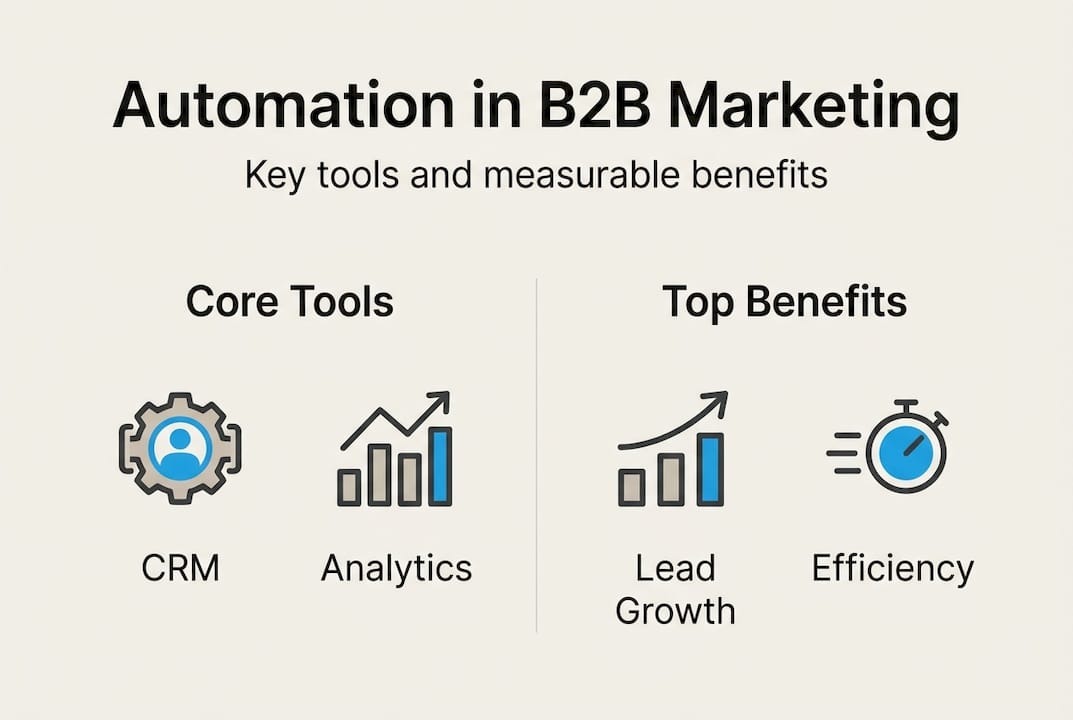
Here is how the major categories of automation software break down for professional services B2B use cases:
| Platform type | Key features | Primary outcome |
|---|---|---|
| CRM (e.g., HubSpot, Salesforce) | Contact management, deal tracking, workflow automation | Unified client data, pipeline visibility |
| Email automation (e.g., Marketo, Mailchimp) | Drip sequences, behavioral triggers, A/B testing | Consistent nurturing, higher open and reply rates |
| LinkedIn automation tools | Personalized outreach, connection sequencing | Qualified meeting generation |
| AI analytics platforms | Lead scoring, predictive insights, revenue attribution | Smarter prioritization, faster cycle times |
To get the most from these tools, professional services firms should follow a structured implementation sequence:
- Audit your existing contact database before activating any automation. Garbage in, garbage out. Segment your contacts by industry, title, and buying stage before any sequences go live.
- Choose a CRM as your data backbone. Every other tool should feed into and pull from your CRM. This creates a single source of truth for all prospect and client activity.
- Map your buyer journey before building workflows. Understand what content and touchpoints resonate at each stage of your sales process, then build automation to deliver those at the right moment.
- Integrate email, LinkedIn, and content platforms. Cross-channel presence reinforces trust. A prospect who receives a relevant article by email and a personalized LinkedIn message in the same week is far more likely to respond.
- Set up reporting dashboards from day one. Define your key metrics before you launch, so you have a baseline to measure against after the first 60 to 90 days.
Pro Tip: Avoid the temptation to use every platform feature at once. Start with one well-configured workflow, measure results for 30 days, then expand. Complexity kills adoption in professional services teams where marketing resources are often lean.
Streamlining lead generation and nurturing: Automation in action
With the right platforms in place, the next step is putting them to work in the two areas where professional services firms feel the most friction: generating qualified leads and keeping those leads engaged long enough to convert.
Automated lead nurturing is proven to drive higher conversion rates, particularly for firms with long sales cycles. The reason is straightforward. A prospect who downloaded a whitepaper six months ago and received no further communication is a lost opportunity. A prospect who received six relevant, personalized touchpoints in that same period is a warm conversation waiting to happen.
Here is a practical framework for automating your lead nurturing and follow-up process:
- Capture leads through gated content such as industry reports, webinars, or benchmarking tools. These prospects have already demonstrated intent.
- Trigger a welcome sequence immediately. Send a confirmation email followed by two or three related content pieces spaced three to five days apart. This establishes your expertise before any sales conversation begins.
- Score leads based on behavior. Visits to your pricing page, repeat downloads, or replies to emails should increase a lead’s score and trigger escalation to a human salesperson.
- Automate LinkedIn connection requests and follow-ups. Personalized outreach at scale is one of the most effective ways professional services firms generate qualified meetings without cold calling.
- Build re-engagement sequences for dormant leads. Prospects who went quiet after initial interest are not gone. A targeted sequence referencing a relevant industry trend or case study can revive conversations.
- Use scalable lead generation principles to ensure your system grows with your firm rather than requiring manual rebuilding every quarter.
The real payoff of automation here is not just boosting productivity for your marketing team, though that matters too. It is the consistency that automated systems deliver. Human follow-up is inconsistent by nature. People get busy, priorities shift, and leads fall through the cracks. Automation eliminates that variability.
Pro Tip: Segment your nurturing sequences by the prospect’s role, not just their company. A CFO at a private equity firm needs different content than a COO at a professional services consultancy, even if both are evaluating the same service. Data-driven segmentation is what separates broadcast email from genuine personalization.
Maximizing engagement through automation during extended sales cycles
Lead nurturing is just one piece of the picture. In professional services, the real challenge is maintaining meaningful engagement over six, twelve, or even eighteen months before a deal closes. Automation is uniquely suited to this because it operates continuously without burning out your team.

What makes sustained engagement so difficult for professional services firms? Several factors compound the challenge. Buying decisions involve multiple stakeholders, each with different concerns and timelines. Budgets shift. Internal champions change roles. Priorities get reshuffled by regulatory changes or market conditions. Without a systematic approach, even the warmest prospect can go cold simply because no one checked in at the right time.
Pipeline velocity is the metric that reveals whether your engagement is actually working. It measures how fast deals move through each stage of your pipeline. If deals are stalling at the proposal stage, you know to build more automated touchpoints that address common objections at that specific moment.
Here are five techniques for maintaining engagement throughout extended sales cycles using automation:
- Content drip campaigns tied to buying stages. Send thought leadership articles, case studies, or regulatory updates that align with where the prospect is in their decision process. Relevance beats volume every time.
- Automated check-ins at 30, 60, and 90-day intervals. A brief, personalized message acknowledging elapsed time and offering a new insight keeps your firm top of mind without being pushy.
- Event and webinar invitations triggered by engagement signals. If a prospect opens three consecutive emails, trigger an invitation to an exclusive roundtable or industry briefing. High-value events accelerate trust.
- Milestone-based outreach. Track publicly available signals like company funding rounds, leadership changes, or new service launches, then send automated congratulations or relevant offers within 24 hours.
- Re-engagement sequences for stalled deals. If a prospect has not interacted in 45 days, trigger a sequence that offers something new: a fresh perspective, an updated benchmark, or a short consultation.
Connecting these techniques to your outreach campaign optimization efforts ensures that every automated touchpoint is contributing to pipeline movement, not just inbox activity. For firms pursuing business automation for scalable growth, this kind of systematic engagement is the foundation of a repeatable, predictable revenue model.
“Firms that measure progress by pipeline velocity rather than top-of-funnel volume make faster, smarter decisions about where to invest their marketing resources.” — Forrester B2B Marketing Budgets Research 2026
The crucial measurement shift: What most marketers miss about automation
Here is the uncomfortable reality that most automation guides skip over. Many professional services marketers invest in automation, get impressive-looking reports full of open rates, click-throughs, and follower growth, and then wonder why the revenue number is not moving.
Vanity metrics are seductive because they are easy to produce and easy to celebrate. But in B2B professional services, an email with a 40% open rate that generates zero qualified conversations is worth less than a targeted sequence with a 15% open rate that books four discovery calls.
The real power of automation is not that it sends more emails. It is that it surfaces the right intelligence about which prospects are actually progressing through your pipeline. Strategic messaging for lead gen combined with velocity tracking gives you an honest picture of what is working.
We have seen firms at The Lead Lab pivot their entire reporting structure after realizing that their “most successful” email campaign had produced zero pipeline movement over three months. Pipeline velocity revealed the problem immediately. The messages were generating curiosity but not intent. The fix was not more automation. It was sharper segmentation and a content pivot toward decision-stage material.
Pro Tip: Build your automation dashboard around three core velocity signals: average days per pipeline stage, stage-to-stage conversion rates, and time from first contact to qualified meeting. Those three numbers will tell you more than any engagement report ever will.
Stakeholder pressure to show short-term wins can push marketers toward optimizing for clicks rather than conversations. Resist that pressure. Present pipeline velocity data to leadership with clear context about your sales cycle length, and you will earn far more credibility than if you show a chart of growing email subscribers.
“Measuring pipeline velocity over vanity metrics is not just good analytics practice. It is how professional services firms protect their investment in automation and demonstrate real business impact.”
Take your B2B marketing automation further with The Lead Lab
Applying these strategies effectively takes more than good intentions. It takes proven systems, the right platforms, and experience built across hundreds of professional services campaigns.
The Lead Lab specializes in done-for-you LinkedIn outreach and lead generation designed specifically for professional services firms. From targeted prospecting and personalized message sequencing to response management and campaign analytics, every service is built to move qualified leads through your pipeline faster. Explore the case studies portfolio to see how firms like yours have generated measurable results, and register for upcoming automation webinars to sharpen your strategy with expert guidance. Your next qualified meeting is closer than you think.
Frequently asked questions
How much of my marketing budget should I allocate to automation?
Industry research shows that 5 to 10% of marketing budgets at professional services firms are being focused on AI and automation tools, with 83% of those firms expecting budget increases in 2026. Use that as your baseline and adjust based on current sales cycle complexity and team size.
What is the most important metric for measuring automation effectiveness in B2B?
Pipeline velocity is widely recognized as the most valuable metric for professional services firms, particularly because it reflects real deal progression rather than surface-level engagement activity. Track how quickly leads move between pipeline stages to know if your automation is truly working.
Can automation really personalize B2B lead nurturing at scale?
Yes. Modern automation platforms use behavioral triggers, role-based segmentation, and AI-powered content recommendations to deliver personalized nurturing sequences that feel relevant to individual prospects, even when you are running campaigns across hundreds of contacts simultaneously.
What are some real-world examples of automation success in B2B marketing?
CRM and marketing automation platforms have consistently delivered a 20 to 50% lift in lead generation for professional services firms, according to research focused on this sector. The gains come from better segmentation, automated follow-up, and smarter lead scoring rather than simply sending more outreach.
3 Responses