
TL;DR:
- Multi-channel outreach engages prospects across multiple platforms for higher response rates.
- Consistent messaging and integration are essential for successful multi-channel campaigns.
- Ongoing data-driven optimization improves lead quality and conversion rates over time.
Most professional services firms are leaving pipeline on the table by relying on a single outreach channel. B2B buyers today interact across multiple touchpoints before they ever respond to a sales message, which means a LinkedIn-only or email-only approach misses the majority of your addressable market. Multi-channel outreach changes that equation entirely. This guide breaks down exactly what multi-channel outreach means, why it matters for professional services, the obstacles you will face, and how to build a strategy that consistently fills your pipeline with qualified meetings.
Table of Contents
- Defining multi-channel outreach for B2B engagement
- Obstacles and solutions in multi-channel outreach for professional services
- Key components of a high-performing multi-channel outreach strategy
- Measuring and optimizing your multi-channel outreach results
- Our take: What most guides miss about multi-channel outreach
- Ready to amplify your B2B outreach?
- Frequently asked questions
Key Takeaways
| Point | Details |
|---|---|
| Multi-channel outreach defined | Combining email, phone, social, and other platforms maximizes B2B engagement. |
| Avoid common pitfalls | Inconsistent messaging and poor integration can undermine outreach effectiveness. |
| Key campaign metrics | Monitor response rate, meetings booked, and conversions for each channel. |
| Iterate and improve | Continuous measurement and optimization are essential for ROI. |
Defining multi-channel outreach for B2B engagement
Multi-channel outreach combines multiple communication platforms to engage prospects across their preferred touchpoints rather than forcing them to respond on yours. For professional services firms, that typically means weaving together LinkedIn, email, phone calls, and sometimes direct mail into a coordinated sequence that builds familiarity and trust over time.
The difference between single-channel and multi-channel outreach is not just volume. It is about reinforcement. When a prospect sees your name on LinkedIn, then receives a relevant email, then gets a brief phone call referencing both, the cumulative effect is far greater than any single message could produce. Each touchpoint builds on the last, making your outreach feel less like cold contact and more like a natural professional introduction.
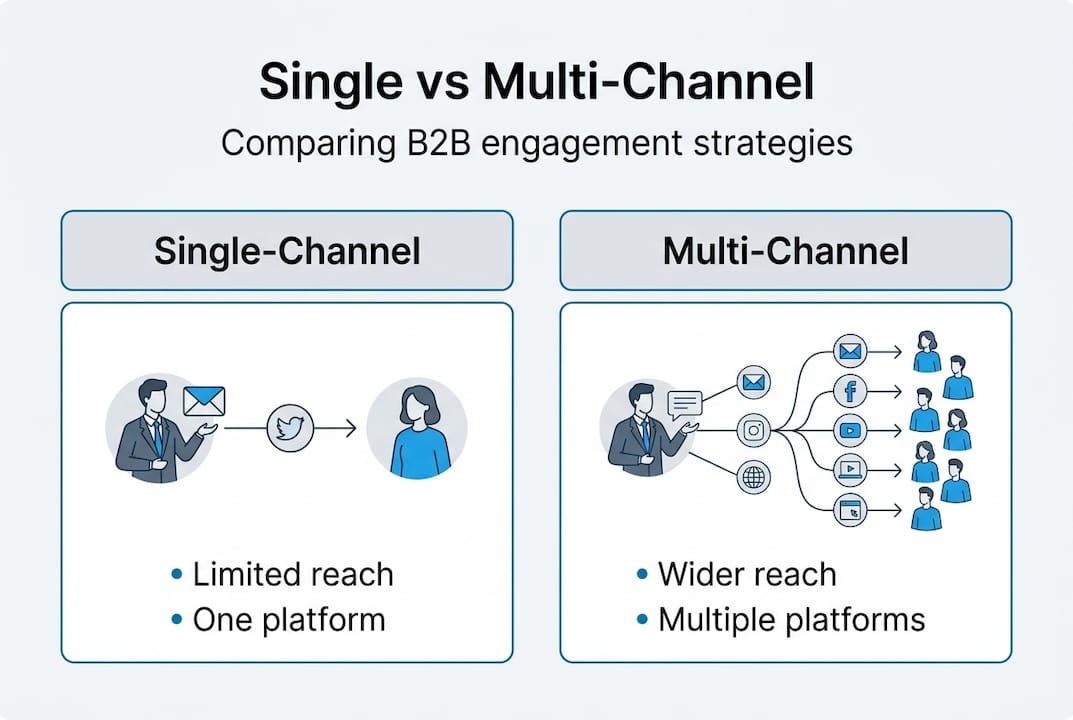
For professional services specifically, this matters because the sales cycle is longer and trust is the primary currency. A consultant or advisory firm cannot rely on a one-touch email blast. Buyers need multiple interactions before they feel confident enough to book a call. Multi-channel outreach creates those interactions systematically, not by accident.
Key benefits of multi-channel outreach:
- Broader reach across different platforms where your buyers spend time
- Higher engagement rates through repeated, varied touchpoints
- Message reinforcement that builds brand familiarity before the first real conversation
- Reduced dependence on any single platform’s algorithm or deliverability
- Better data collection across channels for smarter iteration
| Factor | Single-channel | Multi-channel |
|---|---|---|
| Reach | Limited to one platform | Spans multiple platforms |
| Engagement rate | Lower, single touchpoint | Higher, repeated exposure |
| Message reinforcement | Weak | Strong, layered |
| Data insights | Narrow | Richer, cross-channel |
| Pipeline resilience | Fragile | More stable |
Pro Tip: Consistency in tone and messaging across every channel is non-negotiable. If your LinkedIn message sounds formal and your email reads casual, prospects notice the disconnect. Develop a unified voice first, then adapt the format for each platform.
Understanding multi-channel campaign examples from firms similar to yours is one of the fastest ways to see what a coordinated sequence actually looks like in practice. And if internal bandwidth is a concern, exploring outsourcing outreach advantages can help you scale without overextending your team. Either way, the foundation is always high-impact B2B messaging that resonates with your specific buyer persona.
Obstacles and solutions in multi-channel outreach for professional services
Identifying typical obstacles like inconsistent messaging and lack of integration is key to making multi-channel outreach successful. Most firms stumble not because they lack effort, but because they run each channel in isolation. The result is a fragmented prospect experience that confuses rather than converts.
Common mistakes to avoid:
- Sending different value propositions on LinkedIn versus email
- Failing to track which channel a prospect responded to
- Overloading prospects with too many touchpoints in too short a timeframe
- Using generic templates that ignore the specific channel context
- Neglecting to update sequences based on response data
Here is a reality check worth sitting with: firms that use coordinated multi-channel sequences report significantly better conversion rates compared to single-channel campaigns. That gap is not because of more messages. It is because the messages work together.
“The biggest barrier to multi-channel success is not technology. It is the discipline to keep every channel aligned around a single, clear message for each prospect segment.”
The solution starts with alignment. Before you send a single message, map out what you want each prospect segment to understand after interacting with your outreach. That core message should thread through every channel, even if the format changes. LinkedIn might be a short connection note. Email might be a two-paragraph value pitch. A phone call might be a 30-second reference to both. Same story, different delivery.
Centralizing your data is the next critical step. When LinkedIn activity, email opens, and call logs live in separate tools, you cannot see the full picture of how a prospect is engaging. A CRM that aggregates all channel data gives your team the visibility to time follow-ups intelligently and avoid the embarrassment of contacting someone who already replied elsewhere.

Cross-channel sequencing, meaning a planned order of touchpoints across platforms, is where B2B LinkedIn outreach tips and B2B prospecting strategies converge into a real system. Think of it as choreography. Each move sets up the next. Pair that with strategic B2B messaging tailored to each stage of the sequence, and you have a repeatable engine.
Pro Tip: Not every channel works equally well for every segment. Test your sequence with a small cohort first, identify which channel gets the first response most often, and weight your future sequences accordingly.
Key components of a high-performing multi-channel outreach strategy
Successful outreach strategies use data-driven segmentation and tailored messaging across chosen channels. Without segmentation, you are broadcasting. With it, you are having targeted conversations at scale.
Here are the core components every high-performing multi-channel strategy needs:
- Audience segmentation: Group prospects by industry, role, firm size, or pain point. The more specific your segment, the more relevant your messaging can be.
- Channel selection: Choose two to three channels that match where your target segment actually spends time. Do not add channels for the sake of it.
- Personalized messaging: Write messages that speak directly to the segment’s specific challenges. Generic outreach gets ignored.
- Timing and sequencing: Define the exact order and spacing of touchpoints. A common B2B sequence is LinkedIn connection, email follow-up on day three, phone call on day seven.
- Technology integration: Use a CRM or outreach platform to automate sequencing, log responses, and surface insights.
- Tracking and reporting: Set up dashboards that show performance by channel, segment, and message variant so you can iterate fast.
| Channel sequence | Avg. engagement rate |
|---|---|
| LinkedIn only | 8-12% |
| LinkedIn + email | 18-24% |
| LinkedIn + email + phone | 28-35% |
| All channels + direct mail | 35-42% |
The data above reflects a consistent pattern: adding coordinated channels compounds results. But the key word is coordinated. Randomly mixing channels without a sequencing plan produces noise, not pipeline.
Timing matters more than most teams realize. Sending a LinkedIn message and an email on the same day can feel aggressive. Spacing them three to five days apart feels natural. The goal is to appear persistent without feeling pushy. Reviewing segmentation strategies specific to your industry will help you calibrate both the message and the timing for each audience group. Pair that with outreach optimization tips to refine your approach as data comes in.
Measuring and optimizing your multi-channel outreach results
Ongoing optimization of outreach campaigns can significantly boost lead quality and ROI. But optimization only works when you know what to measure and how to act on it.
Metrics to monitor by channel:
- LinkedIn: Connection acceptance rate, message reply rate, profile views after outreach
- Email: Open rate, click-through rate, reply rate, unsubscribe rate
- Phone: Connect rate, conversation rate, meeting booked rate
- Overall: Meetings booked per 100 prospects, pipeline generated per campaign, cost per qualified lead
The most important shift in mindset here is moving from vanity metrics to pipeline metrics. Open rates feel good, but meetings booked is what pays. Track both, but make decisions based on the latter.
Analyzing results means looking for patterns, not just totals. If LinkedIn has a 30% connection rate but only a 4% reply rate, your connection message is working but your follow-up is not. If email open rates are high but replies are low, the subject line is compelling but the body copy is falling flat. Each gap tells you exactly where to focus.
Statistic: Firms that actively optimize their outreach sequences see up to a 40% improvement in meeting conversion rates within the first 90 days of systematic testing.
Feedback loops are what separate firms that plateau from firms that keep improving. After every campaign cycle, review what worked, what did not, and update your templates and sequences accordingly. This is not a one-time exercise. It is a recurring discipline. Building scalable lead generation systems depends on this kind of continuous refinement. The firms that treat campaign optimization as a core competency consistently outperform those that set campaigns and forget them.
Our take: What most guides miss about multi-channel outreach
Here is the uncomfortable truth most playbooks skip: adding more channels does not automatically improve results. We have seen professional services firms chase every new platform, from WhatsApp to SMS to video prospecting, while their core LinkedIn and email sequences remained poorly integrated and underperforming.
The firms that consistently win at multi-channel outreach are not the ones using the most channels. They are the ones with the tightest feedback loops between channels. They know exactly what a prospect did on LinkedIn before the email went out, and they use that context to make the next message smarter.
Professional services is not SaaS or ecommerce. Your buyers are cautious, relationship-driven, and sensitive to anything that feels automated or impersonal. That means the bar for relevance is higher, not lower. Fewer, better-connected channels with genuinely personalized messaging will always outperform a spray-and-pray approach across six platforms.
Our honest recommendation: master two channels before you add a third. Get your LinkedIn and email sequences working together with clean data flow and consistent messaging. Then, and only then, layer in phone or direct mail. Build depth before you build breadth.
Ready to amplify your B2B outreach?
If this guide has clarified what multi-channel outreach should look like for your firm, the next step is putting it into practice with the right support behind you.
The Lead Lab solutions are built specifically for professional services firms that want coordinated, done-for-you outreach campaigns across LinkedIn and beyond. From prospect targeting and message copywriting to response management and analytics, we handle the execution so your team can focus on closing. Explore our client success stories to see how firms like yours have scaled their pipeline, or join one of our strategic webinars to go deeper on outreach strategy with our team.
Frequently asked questions
What channels are most effective for B2B multi-channel outreach?
LinkedIn and email are consistently the top performers for reaching B2B decision makers, with phone calls adding significant lift when layered in as a third touchpoint after initial digital engagement.
How do I keep messaging consistent across channels?
Use a central CRM or outreach platform and develop standardized message templates adapted for each channel’s format. Consistent messaging and integration are the foundation of any multi-channel campaign that actually converts.
How can I measure ROI from multi-channel outreach?
Track response rate, meetings booked, and conversion per channel, then map those numbers to pipeline growth. Optimizing campaigns and measuring results consistently improves both lead quality and return on your outreach investment.
Do I need marketing automation to succeed with multi-channel outreach?
Automation helps with sequencing and tracking, but your strategy and messaging framework matter most. Successful strategies rely on both smart technology and tailored, segment-specific messaging working together.
2 responses