
Most B2B leads never convert. Not because the product is wrong or the pitch is weak, but because the system behind the outreach was never built to scale. When professional services firms try to grow their pipeline by simply doing more, they often end up with more noise, not more clients. Scalable lead generation is not about volume. It is about building a process that produces consistent, qualified leads without breaking under pressure. This article walks you through what true scalability looks like, where most firms go wrong, and how to build a lead engine that actually holds up as you grow.
Table of Contents
- Defining scalable lead generation for professional services
- Key challenges when scaling: The quality vs. quantity dilemma
- The systems approach: Building a scalable lead engine
- LinkedIn outreach and multichannel strategies for scalable results
- A hard truth most leaders miss: Complexity beats brute force
- Unlock your scalable lead engine with expert support
- Frequently asked questions
Key Takeaways
| Point | Details |
|---|---|
| Quality beats quantity | Scalable lead generation prioritizes high-value leads, not just more leads. |
| Systems prevent bottlenecks | Automation and feedback loops enable teams to handle growth without overwhelm. |
| LinkedIn powers B2B scaling | Personalized LinkedIn outreach is essential for sustained, high-quality B2B leads. |
| Track and optimize | Constant measurement and adjustment ensure lead quality remains high as you grow. |
Defining scalable lead generation for professional services
The word “scalable” gets thrown around constantly, but few firms can explain what it actually means in practice. For professional services, scalable lead generation means your pipeline can grow without a proportional increase in cost, effort, or error rate. You are not just doing more of the same thing. You are building a system that replicates results reliably.
There is a critical difference between growing lead numbers and building a truly scalable process. Growing lead numbers is easy. Buy more ads, send more emails, connect with more people on LinkedIn. But scaling lead volume risks degrading lead quality unless processes are in place. More leads flowing into a broken system just means more wasted time for your sales team.
True scalability rests on three pillars:
- Quality: Every lead entering your pipeline should match your Ideal Customer Profile (ICP). An ICP is a detailed description of the type of client most likely to buy, stay, and refer. Without it, your team chases ghosts.
- Capacity: Your team and tools must handle increased volume without dropping the ball. This means defined workflows, clear handoffs, and enough automation to remove manual bottlenecks.
- Automation: Repetitive tasks like follow-up sequences, lead routing, and data entry should run without human intervention. Automation frees your team to focus on high-value conversations.
When any one of these pillars is weak, scaling creates problems instead of solving them. A firm that doubles its outreach without a defined ICP will see conversion rates fall. A firm that automates without quality controls will flood its CRM with junk data.
Process discipline is what separates firms that scale well from those that stall. This means documenting every step of your lead generation workflow, measuring what works, and cutting what does not. Strong lead nurturing strategies become essential here, because not every qualified lead is ready to buy immediately. A scalable system keeps them warm without requiring manual effort every time.
Pro Tip: Before you invest in any new outreach tool or channel, map your current lead flow on paper. Identify where leads drop off or slow down. Fixing those gaps first will multiply the return on any technology you add later.
Using lead scoring systems is one of the most effective ways to maintain quality as volume grows. Scoring assigns a numeric value to each lead based on fit and behavior, so your team always knows who to prioritize. Without it, every lead looks equally important, which means none of them get the attention they deserve.

Key challenges when scaling: The quality vs. quantity dilemma
Here is what actually happens when a firm decides to scale by simply increasing outreach volume. Conversion rates drop. Sales reps get fatigued chasing unqualified leads. Marketing spend rises but pipeline value stays flat. These are not edge cases. They are the predictable result of prioritizing quantity over quality.
Quality degrades at scale due to cost-chasing algorithms and capacity bottlenecks. Paid channels optimize for clicks and impressions, not for fit. Outreach sequences get blasted to broader audiences to hit volume targets. The result is a pipeline that looks full but performs poorly.
“More leads in a broken system does not mean more revenue. It means more noise for your team to sort through.”
Here is a comparison of what weak versus strong scaling looks like in practice:
| Factor | Weak scaling approach | Strong scaling approach |
|---|---|---|
| Lead targeting | Broad audience, low specificity | Tight ICP, high fit criteria |
| Outreach volume | Maximum sends, low personalization | Calibrated volume, personalized messaging |
| Conversion rate | Declines as volume rises | Stays stable or improves |
| Sales team experience | Overwhelmed, chasing cold leads | Focused on warm, qualified prospects |
| Cost per acquisition | Rises sharply | Stays predictable |
Signs your quality controls are weak include rising cost per lead without a matching rise in closed deals, sales reps consistently flagging leads as unqualified, and high unsubscribe or negative response rates in outreach campaigns. These are not just performance issues. They are signals that your system is not ready to scale.
Common pitfalls to avoid:
- Skipping multi-touch attribution, which tracks every interaction a lead has before converting
- Ignoring HINKLs (High Income, No Kids, Lots of Leisure), a shorthand for leads that look attractive on paper but have no real buying intent
- Failing to close the feedback loop between sales and marketing so that bad leads keep entering the pipeline
Learning to optimize outreach campaigns is not optional when you are scaling. It is the mechanism that keeps quality from sliding as volume increases. Some firms also find that using outreach agencies gives them a faster path to scalable quality because the systems are already built.
The systems approach: Building a scalable lead engine
A scalable lead engine is not a single tool. It is a set of connected processes that work together to attract, qualify, and convert leads consistently. Here is how to build one.
- Define your ICP precisely. Go beyond industry and company size. Include pain points, buying triggers, decision-making structure, and typical objections. The tighter your ICP, the better every downstream step performs.
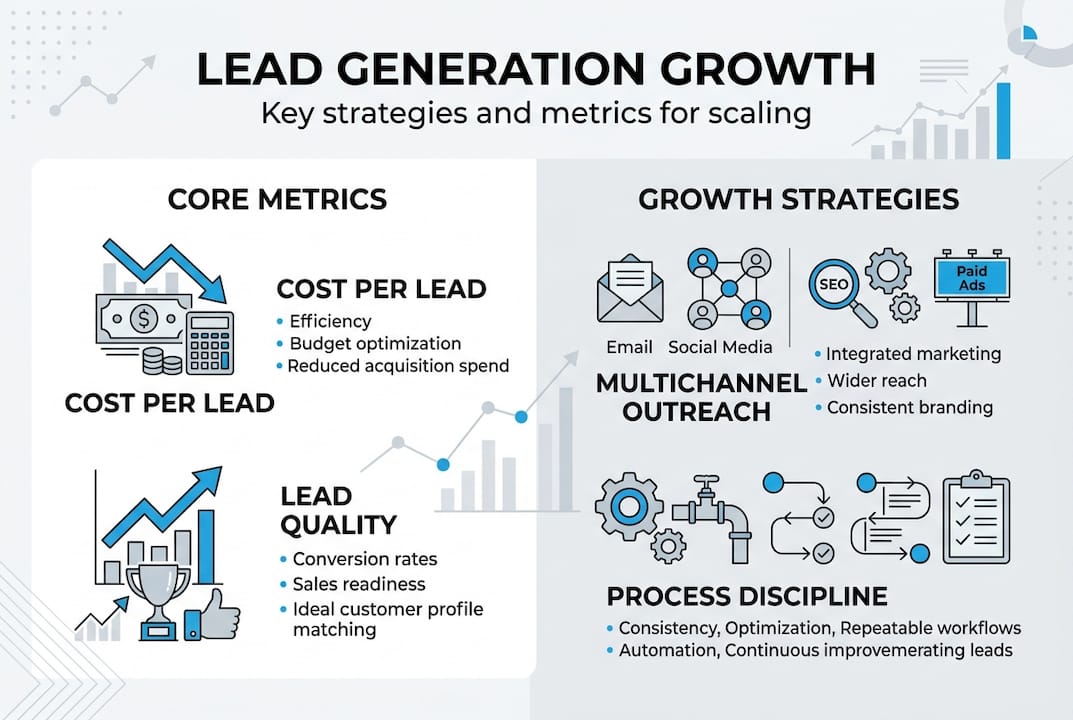
- Implement lead scoring. Assign points based on firmographic fit (company size, industry, role) and behavioral signals (email opens, content downloads, website visits). Strict ICP and fit-and-intent scoring, combined with automation and metrics like CPL and MQL-to-SQL conversion, are the foundation of reliable scaling.
- Automate your sequences. Use a CRM or marketing automation platform to trigger follow-up messages, assign leads to reps, and move prospects through stages without manual input.
- Measure pipeline health continuously. Track cost per lead, MQL-to-SQL conversion rate, and time-to-close. These numbers tell you where the system is working and where it is leaking.
- Build a sales and marketing feedback loop. Sales reps should flag lead quality weekly. Marketing should adjust targeting and messaging based on that input. This loop is what keeps quality high as volume grows.
| Metric | What it measures | Why it matters |
|---|---|---|
| Cost per lead (CPL) | Spend per new lead | Tracks efficiency of acquisition |
| MQL to SQL rate | Marketing to sales handoff quality | Reveals ICP and scoring accuracy |
| Source-to-close rate | Channel-level conversion | Identifies best-performing channels |
| Pipeline velocity | Speed of lead progression | Flags bottlenecks in the funnel |
Pro Tip: Set a monthly review where sales and marketing sit together to audit lead quality by source. Even a 30-minute meeting can surface patterns that save thousands in wasted spend.
Using strategic messaging for B2B at each funnel stage keeps engagement high without requiring your team to write every message from scratch. Pair that with the right LinkedIn outreach tips and you have a repeatable engine that compounds over time.
LinkedIn outreach and multichannel strategies for scalable results
For professional services firms, LinkedIn is not just one option among many. It is the highest-signal channel available for B2B outreach. Decision-makers are active there. Conversations happen in context. And the targeting capabilities let you reach exactly the right person at exactly the right company.
Aligning outreach channels like LinkedIn with your scalable systems improves lead quality and intent. That alignment is what separates firms that get consistent results from those that run campaigns and wonder why nothing sticks.
Here is how to execute a scaled LinkedIn outreach strategy that does not sacrifice quality:
- Personalize at scale. Use dynamic fields and research-based openers to make each message feel individual, even when sent in volume. Generic messages get ignored. Specific messages start conversations.
- Automate follow-up, not first contact. The first message should always feel human. Automation works best for follow-up sequences after initial engagement.
- Sequence across touchpoints. A connection request, followed by a value-add message, followed by a soft ask, outperforms a single cold pitch every time.
- Track response rates by segment. If one ICP segment responds at 3x the rate of another, that is a signal to shift your focus and resources.
Multichannel integration amplifies results. LinkedIn outreach paired with targeted email, relevant content, and occasional event invitations creates multiple opportunities for a prospect to engage. Not every buyer responds to the same channel, so meeting them in more than one place increases conversion without requiring a proportional increase in effort.
Knowing how to generate leads on LinkedIn with a systems mindset is a skill that compounds. Combine it with strong LinkedIn content strategies and your outreach becomes warmer because prospects already recognize your name before the first message lands.
Pro Tip: Before scaling your LinkedIn outreach, audit your profile and company page. Prospects check you out before responding. A weak profile kills conversion rates no matter how good your message is.
A hard truth most leaders miss: Complexity beats brute force
Most marketing directors we talk to have tried the volume approach. They sent more messages, ran more ads, hired more SDRs. And for a while, it felt like progress. But the returns diminished fast.
The firms that scale lead generation sustainably are not the ones doing the most. They are the ones doing the right things in the right order, with feedback loops that catch problems early. They embrace complexity in their systems so their outreach can stay simple and human.
Brute force outreach creates noise. Sophisticated systems create signal. The best teams we have seen treat their lead engine like a product, iterating constantly based on data, not gut feel. They invest in outreach campaign innovation not as a one-time project but as an ongoing discipline.
The uncomfortable truth is that most firms are not ready to scale. They have not defined their ICP tightly enough, their scoring is guesswork, and their sales and marketing teams barely talk. Fixing those foundations is less exciting than launching a new campaign, but it is the only thing that makes scaling work.
Unlock your scalable lead engine with expert support
Building a scalable lead generation system from scratch takes time, expertise, and ongoing refinement. Most marketing directors at professional services firms already have full plates. Adding the complexity of ICP definition, lead scoring, automation setup, and multichannel orchestration on top of existing responsibilities is a real challenge.
That is exactly where working with The Lead Lab accelerates results. We specialize in done-for-you LinkedIn outreach and lead generation campaigns built specifically for professional services firms. From targeted prospecting to personalized messaging and response management, every element is designed for quality at scale. You can see client results and explore how firms like yours have built consistent, qualified pipelines without burning out their teams. Reach out today to start the conversation.
Frequently asked questions
What does it mean to make lead generation scalable?
True scalability means you can increase lead flow without declining quality or overloading your team. Scalable lead gen requires systems to ensure quality is maintained even at high volumes.
How do you keep lead quality high as you scale outreach?
Leverage strict lead scoring, sales feedback, and automation to filter and prioritize leads as volume grows. Lead scoring and multi-touch attribution help mitigate quality drop-off at scale.
Is LinkedIn really effective for scalable B2B lead generation?
Yes, LinkedIn is a top-performing channel for sustained, high-quality B2B lead generation when backed by systems and personalization. LinkedIn is high-value for professional services firms seeking consistent pipeline growth.
What metrics should I watch when scaling my lead pipeline?
Track cost per lead, MQL to SQL rates, and source-to-close conversion rate for the most actionable insights. CPL and conversion rates are the clearest indicators of whether your scaling efforts are working or leaking.
9 responses