
TL;DR:
- Sales engagement involves structuring all interactions between a salesperson and a buyer throughout the entire sales cycle to maximize relevance and conversion. It is a multichannel, strategic process that requires measurement and continuous refinement to generate revenue effectively.
Sales engagement is the coordinated management of every interaction between a salesperson and a prospect across the entire buyer journey, from first outreach through close and beyond. Where sales enablement gives your team the tools and content to succeed, sales engagement is the execution layer: the calls, emails, LinkedIn messages, video touches, and in-person meetings that actually move deals forward. Salesforce describes it as multichannel, structured, and built for continual improvement. Understanding what sales engagement means in practice is the difference between a team that generates activity and one that generates revenue.
What is sales engagement and why does it matter?
Sales engagement covers every touchpoint a seller creates with a buyer, structured to maximize relevance and conversion at each stage of the sales cycle. It is not a single tactic or channel. It is the full architecture of how your team communicates, when they reach out, what they say, and how they respond to buyer signals.
The importance of sales engagement becomes clear when you look at what happens without it. Reps send sporadic emails, follow up inconsistently, and rely on memory rather than systems. Deals stall not because the product is wrong but because the communication rhythm broke down. Clari frames engagement as a full lifecycle process, from the moment a relationship is created through to conversion and ongoing account management. Treating it as a short-term outbound activity misses its strategic value entirely.
For sales professionals and business leaders in professional services, this matters because your buyers are high-value, time-poor, and skeptical of generic outreach. A structured engagement approach signals professionalism, builds trust faster, and shortens sales cycles by keeping the right message in front of the right person at the right time.
What are the key phases of sales engagement?

Sales engagement follows a predictable sequence of phases, each with distinct activities and goals. Understanding these phases helps you design outreach that matches where the buyer actually is, rather than where you wish they were.
Prospecting is the foundation. This phase involves building targeted lists, researching accounts, and identifying the right contacts within an organization. Effective prospecting means segmenting your prospects by industry, role, company size, and pain point before a single message is sent.
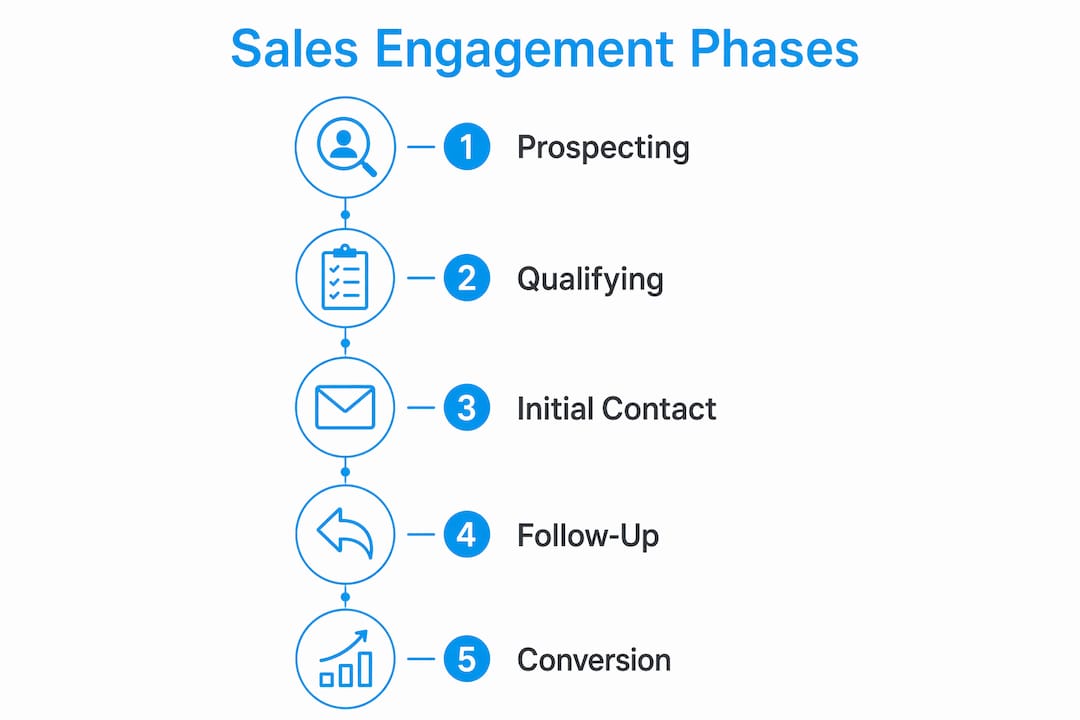
Qualifying follows immediately. Not every prospect deserves equal attention. Qualification filters your list by fit and intent, using criteria like budget, authority, need, and timeline. Reps who skip this phase waste time on contacts who will never convert.
Connecting is where most people think engagement begins, but it is actually the third phase. This includes the first email, LinkedIn connection request, cold call, or video message. Skylead documents how coordinating email, LinkedIn, call, and video touches in a timed sequence keeps buyers moving toward a decision rather than going cold between contacts.
Nurturing is the phase most teams underinvest in. After initial contact, the majority of deals require multiple follow-ups before a meeting is booked. Relationship management here means staying present without being pushy, sharing relevant content, and responding quickly when a prospect re-engages.
- Map every outreach activity to one of these four phases before you build a cadence
- Assign different message templates and channels to each phase based on buyer behavior data
- Set clear exit criteria for each phase so reps know when to advance, pause, or disqualify
Pro Tip: Personalization does not mean writing every email from scratch. It means using the right variable fields, referencing a prospect’s specific context, and matching the tone to the phase. Consistency at scale requires templates; conversion requires the human layer on top.
How do sales engagement platforms work?
A sales engagement platform (SEP) is the technology infrastructure that makes structured, multichannel outreach repeatable and measurable. SEPs centralize workflows, data, and insights so reps spend less time on manual coordination and more time on actual conversations.
The distinction between an SEP and a CRM matters. A CRM like Salesforce stores records and tracks deal status. An SEP executes outreach sequences against those records, automating the scheduling of touchpoints, logging activity, and surfacing analytics at the step level. VanillaSoft explains that SEPs are execution engines that orchestrate multi-step sequences against CRM data, reducing manual steps and increasing consistency across the team.
| Feature | Sales Engagement Platform | CRM | Marketing Automation |
|---|---|---|---|
| Multichannel outreach execution | Yes | No | Partial |
| Cadence and sequence management | Yes | No | No |
| Step-level engagement analytics | Yes | No | No |
| Contact record management | Partial | Yes | Partial |
| Lead nurturing at scale | Partial | No | Yes |
| CRM integration | Yes | Native | Yes |
The Salesforce Sales Engagement product, MassMailer, and VanillaSoft each approach this differently, but the core function is the same: remove the cognitive load of deciding what to do next and replace it with a system that tells reps exactly which action to take, on which contact, through which channel, and when.
Pro Tip: Before selecting an SEP, audit your current CRM data quality. An SEP running against incomplete or outdated contact records will automate bad outreach at scale. Clean data is the prerequisite, not the afterthought.
Sales engagement strategies and best practices
Effective sales engagement strategies share three characteristics: they are multichannel, they are timed deliberately, and they are measured against outcomes rather than activity. VanillaSoft defines a cadence as a structured plan with timing and triggers that guides sellers through each outreach step, treating the sequence as an operational system rather than a loose checklist.
A well-designed cadence for a B2B professional services firm might look like this: a personalized email on day one, a LinkedIn connection request on day three, a follow-up email referencing the connection on day five, a phone call on day eight, and a final value-add email on day twelve. Each step has a specific purpose, a defined message, and a clear trigger for what happens next. Multichannel outreach design at this level of specificity is what separates teams that book meetings from teams that send emails into silence.
The metrics you track determine the quality of your strategy. Salesforce ties engagement metrics directly to deal progression, emphasizing response rates, meeting bookings, opportunity creation, sales cycle duration, and win rates over raw send volume. A team sending 500 emails a week with a 2% response rate is underperforming a team sending 150 emails with a 14% response rate.
Best practices that consistently improve results:
- Write subject lines that reference a specific pain point or trigger event, not generic value propositions
- Limit cadences to 7 to 10 steps; beyond that, response rates drop sharply and brand perception suffers
- Use video messages in the middle of a cadence, not just at the start, to re-engage prospects who have gone quiet
- Review prospecting email examples from your highest-converting reps and build those patterns into templates for the whole team
- Avoid the most common pitfalls by auditing your LinkedIn outreach approach regularly
The biggest mistake most teams make is optimizing for volume before optimizing for quality. Fix the message before you scale the sequence.
Sales engagement vs. sales enablement: what is the difference?
Sales engagement and sales enablement are complementary disciplines that are frequently confused with each other. VanillaSoft summarizes the distinction clearly: enablement powers the message; engagement delivers it.
Sales enablement covers everything that equips a rep to have better conversations: battle cards, case studies, product training, competitive analysis, and content libraries. It answers the question, “Does my team have what they need to sell effectively?” Sales engagement covers the execution of those conversations: the sequences, channels, timing, and follow-up cadences that get those conversations in front of buyers.
A team with strong enablement but weak engagement has great content that nobody sees. A team with strong engagement but weak enablement books meetings it cannot convert. Both functions are necessary, and the most effective revenue teams treat them as integrated rather than separate.
- Enablement: content creation, training programs, playbooks, competitive intelligence
- Engagement: outreach sequences, cadence management, multichannel execution, response handling
- Integration point: the right content delivered through the right engagement sequence at the right stage
Pro Tip: Map your enablement assets to specific cadence steps. If you have a strong case study for a particular vertical, it should appear automatically at step four of the cadence for that segment, not sit in a shared drive waiting to be remembered.
How to measure and improve sales engagement effectiveness
Measuring sales engagement effectiveness requires tracking outcomes at the sequence step level, not just at the campaign level. Step-level analytics turn coaching into a diagnostic feedback loop, allowing targeted improvement at the exact cadence points where prospects disengage.
The metrics that matter most are tied directly to revenue progression rather than activity volume. Salesforce emphasizes outcome measures that link directly to deal advancement, which means your dashboard should prioritize the following:
| Metric | What it measures | What a decline signals |
|---|---|---|
| Response rate | Quality of messaging and targeting | Weak subject lines or wrong audience |
| Meeting booking rate | Effectiveness of the full cadence | Poor call-to-action or timing issues |
| Opportunity creation rate | Conversion from engaged to qualified | Qualification criteria need tightening |
| Sales cycle duration | Efficiency of the engagement process | Nurture sequences need more urgency |
| Win rate | Overall engagement quality | Misalignment between message and buyer need |
The diagnostic process works like this: identify the cadence step with the highest drop-off rate, analyze the message content and timing at that step, test one variable at a time (subject line, channel, send time, message length), and measure the change in response rate over a statistically meaningful sample. Automation in B2B outreach makes this kind of iterative testing practical at scale, since you can run parallel sequences against segmented lists without manual coordination.
The teams that improve fastest treat their cadences as living systems. They review performance data weekly, make targeted adjustments, and document what works so the entire team benefits from individual discoveries.
Key takeaways
Sales engagement is the execution layer of your revenue operation, and without a structured, multichannel approach tied to measurable outcomes, even the best-equipped sales team will underperform.
| Point | Details |
|---|---|
| Core definition | Sales engagement covers all buyer-seller interactions across the full sales lifecycle, not just outbound prospecting. |
| Platform function | Sales engagement platforms execute multi-step sequences against CRM data, reducing manual effort and improving consistency. |
| Engagement vs. enablement | Enablement equips reps with content and training; engagement delivers that content through structured outreach sequences. |
| Metrics that matter | Track response rates, meeting bookings, opportunity creation, and win rates rather than send volume or activity counts. |
| Optimization method | Analyze cadence performance at the step level to identify and fix the exact points where prospects disengage. |
Why I think most teams are still getting sales engagement wrong
After working with professional services firms on outreach strategy, the pattern I see most often is not a lack of tools or content. It is a lack of system. Teams invest in a CRM, add a sequencing tool, and then let individual reps build their own cadences from scratch. The result is inconsistency at scale: some reps book meetings consistently while others send hundreds of messages with almost no response, and nobody knows why.
The uncomfortable truth is that sales engagement only works when it is treated as an operational discipline, not a creative exercise. The best cadences I have seen are built on data from the worst-performing ones. You find the step where prospects stop responding, fix the message, test the change, and document the result. That feedback loop is what separates a team that improves quarter over quarter from one that keeps hiring more reps to compensate for a broken process.
I also think the industry underestimates how much buyer behavior has changed. Decision-makers in professional services receive more outreach than ever, and they have become highly skilled at filtering it out. Generic sequences with token personalization do not cut through anymore. What works is specificity: referencing a real trigger event, addressing a pain point that is genuinely relevant to their role, and following up with content that proves you understand their world. That level of relevance requires both good data and good judgment. No platform automates judgment. It can surface the signal; your team has to act on it intelligently.
The teams winning in 2026 are not the ones with the most sophisticated technology. They are the ones who have built a culture of testing, learning, and refining their engagement approach continuously.
— Toby
How Theleadlab helps you build a sales engagement system that converts
If you are a professional services firm that knows outreach matters but has not yet built a system that produces consistent results, Theleadlab is built for exactly that problem. The team designs done-for-you LinkedIn outreach campaigns that combine targeted prospecting, personalized messaging, and structured follow-up sequences to generate qualified meetings at scale.
Every campaign is built around your specific audience, your value proposition, and the engagement metrics that matter to your business. From prospect targeting and message copywriting through to response management and campaign analytics, Theleadlab handles the execution so your team can focus on the conversations that close. Explore what a structured engagement program looks like for your firm at The Lead Lab, or review client results to see the outcomes other professional services teams have achieved.
FAQ
What does sales engagement mean in practice?
Sales engagement refers to the structured coordination of all interactions between a salesperson and a prospect across every channel and stage of the sales cycle. It includes emails, calls, LinkedIn messages, video touches, and in-person meetings, organized into repeatable sequences designed to move buyers toward a decision.
How is a sales engagement platform different from a CRM?
A CRM stores contact records and tracks deal status, while a sales engagement platform executes outreach sequences against those records. SEPs automate multi-step cadences linked to CRM data, reducing manual effort and providing step-level analytics that a CRM alone cannot deliver.
What are the most important sales engagement metrics to track?
The metrics that correlate most directly with revenue outcomes are response rate, meeting booking rate, opportunity creation rate, sales cycle duration, and win rate. Tracking activity volume like emails sent tells you how busy your team is, not how effective it is.
What is the difference between a cadence and a sequence?
The terms are used interchangeably in most sales contexts. Both refer to a timed, multichannel series of outreach steps designed to engage a specific prospect segment. VanillaSoft defines a cadence as a structured plan with timing and triggers that guides sellers through each step of the outreach process.
How many touchpoints does an effective sales engagement cadence need?
Most high-performing B2B cadences contain between seven and ten touchpoints spread across two to three weeks. Fewer than five touchpoints typically underperforms because most prospects require multiple contacts before responding. More than ten touchpoints risks damaging brand perception without meaningfully increasing response rates.
Polymarket: что это, как работает и почему привлекает внимание
polymarket bot
Polymarket (или Полимаркет) — это одна из самых популярных децентрализованных платформ для ставок на исходы различных событий, работающая на базе блокчейна и криптовалют. В отличие от классических букмекерских контор, здесь пользователи торгуют акциями, которые отражают вероятность наступления определённых событий: от политических выборов и спортивных матчей до экономических показателей и культурных трендов. Официальный сайт платформы — polymarket.com, и только этот домен гарантирует безопасность ваших средств и данных.
Что такое Polymarket?
polymarket usa
Polymarket — это рынок предсказаний, где цена акции (от 0 до 1) показывает, как рынок оценивает вероятность того или иного исхода. Например, если акция стоит $0.70, значит, по мнению участников, вероятность события — 70%. Пользователи могут покупать доли «да» или «нет», а затем продавать их до момента завершения события, зарабатывая на разнице цен. Это делает процесс похожим на трейдинг, только вместо акций — реальные события.
Как работают ставки на Polymarket?
Polymarket ставки устроены так: вы выбираете интересующее событие, анализируете условия рынка (важно внимательно читать формулировки!), подключаете криптовалютный кошелёк и покупаете долю нужного исхода. Если ваш прогноз сбывается, вы получаете выплату. Если нет — теряете вложенные средства. Особенность платформы — высокая ликвидность на популярных рынках и возможность выйти из позиции в любой момент до финального расчёта.
Официальный сайт и безопасность
polymarket com
https://polymarketr.com
Полимаркет официальный сайт — только polymarket.com. Не используйте сторонние приложения, боты или «зеркала», чтобы не потерять доступ к кошельку и средствам. Для безопасности рекомендуется использовать отдельный кошелёк для экспериментов и не вводить сид-фразу нигде, кроме официального интерфейса.
Polymarket bot и автоматизация
На платформе нет официального Polymarket bot, но существует API, через который можно получать котировки, историю цен и статусы рынков. Это удобно для создания собственных аналитических инструментов, алертов и дашбордов. Однако любые сторонние боты или скрипты используйте с осторожностью — они могут быть небезопасны.
Почему Polymarket так популярен?
– Децентрализация: платформа не хранит ваши приватные ключи и не имеет доступа к вашим средствам.
– Широкий выбор рынков: политика, спорт, экономика, культура — всегда есть что-то интересное.
– Прозрачность: все расчёты и условия рынка открыты для пользователей.
polymarket crypto
– Глобальный доступ: платформа работает для пользователей из США, Великобритании и других стран.
Вывод
Polymarket — это современный инструмент для тех, кто хочет не просто делать ставки, а анализировать коллективные ожидания и зарабатывать на своих прогнозах. Главное — соблюдать правила безопасности, внимательно изучать условия рынков и использовать только официальный сайт