
TL;DR:
- Personalized prospecting involves researching individual signals to craft relevant outreach messages.
- Effective outreach requires tracking response, meeting, and conversion rates to optimize strategies.
- Genuine personalization focuses on actual situational context rather than superficial details or AI-generated surface data.
You send twenty LinkedIn messages. Maybe thirty. The replies trickle in at a dismal rate, and when they do arrive, they feel polite but disinterested. Sound familiar? The problem usually isn’t your offer. It’s that your messages weren’t built for the person reading them. A personalized prospecting process changes that by treating each high-value prospect as an individual with specific pressures, goals, and timing. In this guide, you’ll learn exactly how to build and execute that process, from researching your prospects to writing outreach that actually gets replies, to measuring and refining every step for better B2B lead generation results.
Table of Contents
- Understand personalized vs. targeted prospecting
- Gather actionable prospect insights
- Craft highly personalized LinkedIn outreach
- Review, test, and optimize your process
- Most leaders miss the real payoff of personalization
- Ready to supercharge your prospecting results?
- Frequently asked questions
Key Takeaways
| Point | Details |
|---|---|
| Personalization drives results | Customizing your outreach based on individual prospect signals leads to higher B2B response rates. |
| Quality over quantity | Sending fewer, well-researched messages outperforms high-volume, generic outreach every time. |
| Diagnose, don’t guess | Focus on research-driven pains and triggers, not just personal facts, for relevant LinkedIn prospecting. |
| Continuous improvement | Regularly review, test, and adapt your message templates to maximize effectiveness as response patterns shift. |
Understand personalized vs. targeted prospecting
Before you write a single message, you need to be honest about one thing: are you personalizing or just targeting? These two approaches are not interchangeable, and mixing them up is one of the most common reasons professional services outreach falls flat.
Targeted prospecting means crafting messages designed for broad resonance within a defined audience segment. You’re writing to a type of person, say, a VP of Operations at a mid-size consulting firm. The message fits many people in that role, but it isn’t built for any one of them specifically.
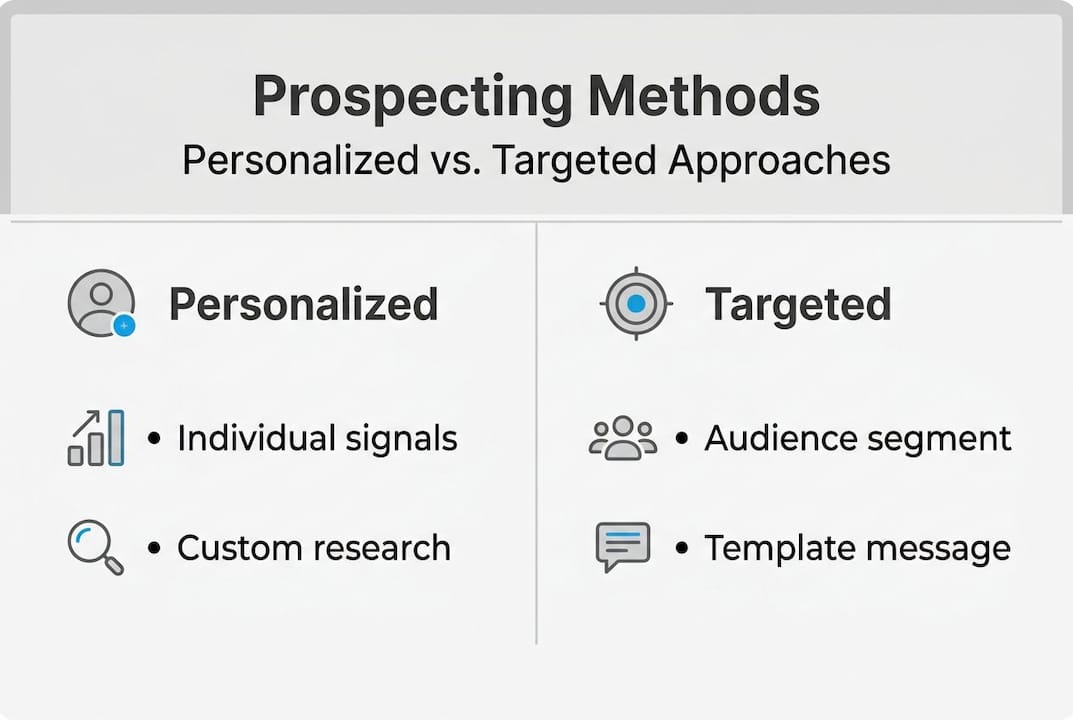
Personalized prospecting means doing individual research before you write a single word. You know that this specific VP just oversaw a company restructuring, recently posted about a hiring challenge, or just joined from a competitor. Your message reflects that knowledge.
As sales expert Jeb Blount puts it, the distinction between personalized and targeted messaging is fundamental: use targeted for scale, personalized for high-value. Both approaches have their place, but knowing when to use each is what separates average outreach from outreach that books meetings.
“Use targeted messaging for volume campaigns, and personalized messaging when the deal size or relationship warrants deeper research. Conflating the two wastes both time and opportunity.” — Jeb Blount
Here’s a quick comparison of both methods:
| Approach | Best for | Effort level | Expected response rate |
|---|---|---|---|
| Targeted | Volume, awareness, new segments | Low to medium | 5 to 15% |
| Personalized | High-value accounts, complex sales | High | 20 to 40%+ |
Pros and cons at a glance:
- Targeted pros: Scalable, faster to produce, good for broad awareness campaigns
- Targeted cons: Lower engagement, feels generic to prospects, weaker for premium deals
- Personalized pros: Higher reply rates, builds genuine rapport, better suited for professional services
- Personalized cons: Time-intensive, harder to scale without a system
If you want to go deeper on either approach, our personalized messaging guide breaks down what real personalization looks like in practice, while our targeted messaging best practices walks through when volume outreach still makes sense.
Gather actionable prospect insights
Personalization without research is just guesswork dressed up in a first name. Real personalization starts before you open your message editor. It starts with knowing what’s actually happening in your prospect’s world.

The signals that matter most are the ones that suggest immediate relevance: a new executive hire, a recent funding round, a company expansion, a public comment about a pain point, or a job posting that hints at an internal initiative. These are windows. They tell you that the timing is right and that your outreach has a reason to exist.
Here are five research steps that work for most professional services teams:
- Review their LinkedIn profile. Look for recent activity, job changes, shared articles, and comments. What are they publicly thinking about?
- Check their company’s news feed. Google News alerts and company press releases reveal funding, product launches, leadership changes, and acquisitions.
- Scan their company’s job postings. If they’re hiring five sales reps, they’re probably trying to scale. That’s your opening.
- Read their content. If your prospect writes or shares posts, those give you direct insight into their priorities and frustrations.
- Look at the company’s LinkedIn page. Recent updates, follower trends, and engagement can all signal organizational momentum.
| Signal type | Example | How to use in message |
|---|---|---|
| Funding round | Series B announcement | Reference growth goals and scaling challenges |
| New leadership | Just hired a new CMO | Mention fresh strategy and the need for new results |
| Job postings | Hiring a demand gen manager | Connect your service to what that hire is meant to solve |
| Public content | Posted about a specific pain | Open by addressing that exact challenge |
| Role change | Just promoted internally | Acknowledge the new scope and new pressures |
Pro Tip: Set up Google Alerts for your top 20 target accounts. You’ll get real-time signals delivered to your inbox, so you’re always researching with fresh information rather than stale profile data.
One critical warning: shallow AI-driven personalization actually backfires. Over-personalization or bad AI outputs can harm response rates when they focus on surface facts instead of real issues. Mentioning that you noticed someone went to the same university or liked a post three months ago is not personalization. It’s noise. Stick to signals that genuinely connect to your value proposition. Our guide on B2B prospecting strategies covers how to qualify those signals before you ever write a word.
Craft highly personalized LinkedIn outreach
You’ve done the research. Now comes the part most teams rush: the message itself. Writing outreach that stands out on LinkedIn takes structure and discipline. The goal is to show your prospect that you understand their world before you ask them for anything.
Here’s a simple four-part framework that works well for professional services outreach:
- Opening: Reference the specific signal you found. Keep it one sentence, and make it about them, not you.
- Context: Connect that signal to a broader challenge you understand well. Show that you recognize the pattern.
- Value: Briefly explain what you do and why it’s relevant to their specific situation. This is not a product pitch. It’s a relevance statement.
- CTA: Ask one clear, low-friction question. “Would it make sense to connect?” works better than “Book a 30-minute demo.”
Before: “Hi Sarah, I help companies improve their LinkedIn outreach. Would love to connect and share how we’ve helped similar businesses.”
After: “Hi Sarah, saw that [Company] just hired a new Head of Sales and that you’ve been posting about pipeline quality. A lot of growing professional services firms find that their outreach volume goes up but meeting quality drops during transitions like this. We help teams fix that with targeted LinkedIn campaigns. Worth a quick conversation?”
The difference is obvious. One is about you. One is about her.
As the research on AI and personalization pitfalls confirms, bad personalization is worse than none. A message that mentions irrelevant details just to seem personal reads as automated, and that kills trust fast.
Pro Tip: Write five outreach messages this week instead of fifty. Track reply rates carefully. One message that gets four replies beats fifty that get two. Quality scales better than volume once you know what works.
For more message-level guidance, explore our resources on customized LinkedIn outreach campaigns and our LinkedIn prospecting checklist for a step-by-step review before you hit send.
Review, test, and optimize your process
Sending great messages is only half the work. The other half is knowing what’s actually happening after you send them. Without a review system, you’re flying blind, and your best guesses replace what should be real insights.
Start by tracking three core metrics every week:
- Response rate: What percentage of prospects reply to your first message?
- Meetings booked: Of those who reply, how many convert to an actual conversation?
- Conversion rate: Of meetings held, how many move forward in your pipeline?
Here are four steps to analyze and improve your outreach sequences:
- Review your last 20 messages. Group them by which signal type you used. Which signals produced the most replies?
- Identify the message section where replies drop off. If you’re getting opens but no responses, your CTA may be the problem. If responses are warm but meetings aren’t booking, the problem is often the value statement.
- Run A/B tests on one variable at a time. Change only the opening line, then measure. Change only the CTA, then measure. Testing multiple variables at once makes it impossible to know what’s working.
- Collect feedback from early prospects. Ask the ones who did reply what caught their attention. Their answers will reshape your approach faster than any spreadsheet.
As Jeb Blount’s work on measurement strategies for prospecting confirms, personalization effectiveness increases when strategies are verified and scaled using real data and feedback.
| Common mistake | How to avoid it |
|---|---|
| Sending identical messages to everyone | Segment by signal type before writing |
| Testing too many variables at once | Change one element per test cycle |
| Ignoring reply quality | Track meeting conversion, not just response rate |
| Giving up after low initial responses | Run 30-message batches before drawing conclusions |
Once you know what works, you scale it. Our articles on LinkedIn segmentation strategies and scalable lead generation can help you build that growth framework without losing the personalization that got you results in the first place.
Most leaders miss the real payoff of personalization
Here’s something we see constantly: marketing and sales leaders invest in personalization tools, set up data integrations, and then celebrate because their messages now include the prospect’s first name and company. That’s not personalization. That’s mail merge with extra steps.
Real personalization delivers ROI when it’s rooted in what’s actually happening for the prospect right now. Not their job title. Not their industry. Their specific situation, pressure, or trigger. The leaders who get this right build outreach that reads like it came from someone who actually did their homework.
As the diagnosis over generic personalization framework argues, personalization delivers real ROI when rooted in situational context, not just variable insertion. The teams who figure this out stop competing on volume and start winning on relevance.
Pro Tip: Build a simple trigger library: a list of 8 to 10 signals your ideal prospects commonly show, paired with an opening line for each. You’ll write faster, stay genuine, and never resort to shallow personalization again.
Our personalized messaging explained resource is a good place to stress-test your current approach against what genuinely moves the needle.
Ready to supercharge your prospecting results?
If you’ve read this far, you already know that generic outreach isn’t working. The next step is putting a real system behind these strategies, one that’s built for your firm and your market.
At The Lead Lab, we build personalized prospecting services that do exactly this: research-driven targeting, custom message frameworks, and campaigns managed end to end so your team focuses on conversations, not cold outreach. You can browse real client results to see what’s possible, or join our latest prospecting webinars to get actionable strategies from our team directly. Let us help you turn LinkedIn into a consistent, qualified pipeline.
Frequently asked questions
What is a personalized prospecting process?
A personalized prospecting process tailors outreach messages based on individual research and clear prospect signals for higher engagement. Unlike broad targeting, it focuses on individual research signals rather than audience-wide relevance.
Why is bad personalization worse than generic outreach?
Poorly personalized or obviously automated messages lower response rates and harm credibility in B2B lead generation. Bad AI outputs signal inauthenticity, which erodes trust faster than a plain, honest generic message would.
How do you research prospects for personalized outreach?
Gather actionable signals like role shifts, recent company news, or public pain points using LinkedIn, press releases, or company websites. The best messages focus on diagnosis of pain, not generic surface facts.
How can you measure prospecting success?
Track your response rates, meetings booked, and conversions to test and improve outreach effectiveness. Personalization effectiveness increases when strategies are verified and scaled using real data and feedback.
One Response