
TL;DR:
- Segmentation improves professional services marketing by tailoring messages to the right audience.
- Layering firmographic, behavioral, technographic, and needs-based models boosts lead quality and conversions.
- Regularly reviewing and updating segments ensures alignment with market shifts and client growth.
Broad outreach feels productive until you look at the numbers. When every prospect gets the same message, conversion rates stall, ad budgets evaporate, and your sales team spends hours chasing leads that were never going to close. For professional services firms, where relationships and trust drive every deal, this problem hits harder than in most industries. Segmentation fixes this by letting you match the right message to the right prospect at exactly the right stage of their journey. This article breaks down why segmentation works, which models deliver results, and how to build a framework that fills your pipeline with qualified appointments.
Table of Contents
- Why segmentation matters for professional services
- Core segmentation models: firmographic, behavioral, technographic & needs-based
- Business impact: how segmentation boosts lead quality and sales conversion
- Implementing segmentation: steps and strategies for professional services
- A fresh perspective: what most segmentation advice misses for professional services
- Ready to put segmentation into practice?
- Frequently asked questions
Key Takeaways
| Point | Details |
|---|---|
| Segmentation drives pipeline | Focusing on segmented groups increases lead quality and appointment rates over broad targeting. |
| Layered models work best | Combining firmographic, behavioral, technographic, and needs-based segmentation delivers optimal results. |
| Business impact is proven | Professional services firms using segmentation with ICPs can see up to 25% higher bid win rates. |
| Start simple, iterate fast | Effective segmentation frameworks are living processes that benefit from regular review and refinement. |
Why segmentation matters for professional services
Professional services marketing operates on a fundamental tension. You need volume to build a healthy pipeline, but you also need precision because one misaligned meeting can waste hours of senior billable time. Broad targeting promises both and delivers neither.
When you cast a wide net on LinkedIn or through email, you burn budget on prospects who lack the authority, budget, or urgency to buy. Worse, generic messaging signals to high-value decision-makers that you do not understand their specific situation. That perception is almost impossible to reverse, especially in industries like management consulting, legal services, or financial advisory, where reputation travels fast.
“Behavioral segmentation outperforms firmographic alone, and high-performing organizations consistently use needs-based segmentation to craft sharper messaging and prioritize the right accounts.” Umbrex Sales Strategy Playbook
Segmented campaigns work because they shrink the gap between what you offer and what your prospect needs to hear. Instead of one generic pitch, you run multiple tailored messages aimed at distinct groups. The result is higher reply rates, more discovery calls booked, and a shorter path from first contact to signed agreement.
The lift is especially pronounced when you combine segmentation with a well-defined Ideal Customer Profile, or ICP. An ICP tells you who your best clients are. Segmentation tells you how to talk to them at different points in the buying journey. Together they give you a targeting engine, not just a contact list.
Good targeted LinkedIn prospecting starts with knowing which segments exist in your market before you write a single message. Without that foundation, even compelling copy lands flat because it is aimed at the wrong person.
Common pitfalls that undermine segmentation efforts include:
- Using only one data dimension. Firmographic data alone (company size, industry) misses behavioral signals that reveal buying intent.
- Creating too many segments. Over-segmentation stretches your content team and reduces the statistical significance of any single test.
- Setting segments once and forgetting them. Markets shift, and a segment that drove pipeline last year may be dormant today.
- Ignoring negative segments. Knowing who is not a fit is equally valuable and prevents wasted outreach.
Digital marketing tips for consultants consistently reinforce the same lesson: specificity drives growth. When your message reflects the reality of a prospect’s world, they notice. That attention is the first step toward a booked meeting.
Core segmentation models: firmographic, behavioral, technographic & needs-based
Not all segmentation is equal. Four primary models exist in B2B marketing, and understanding what each reveals about your prospects is essential before you decide which to prioritize.
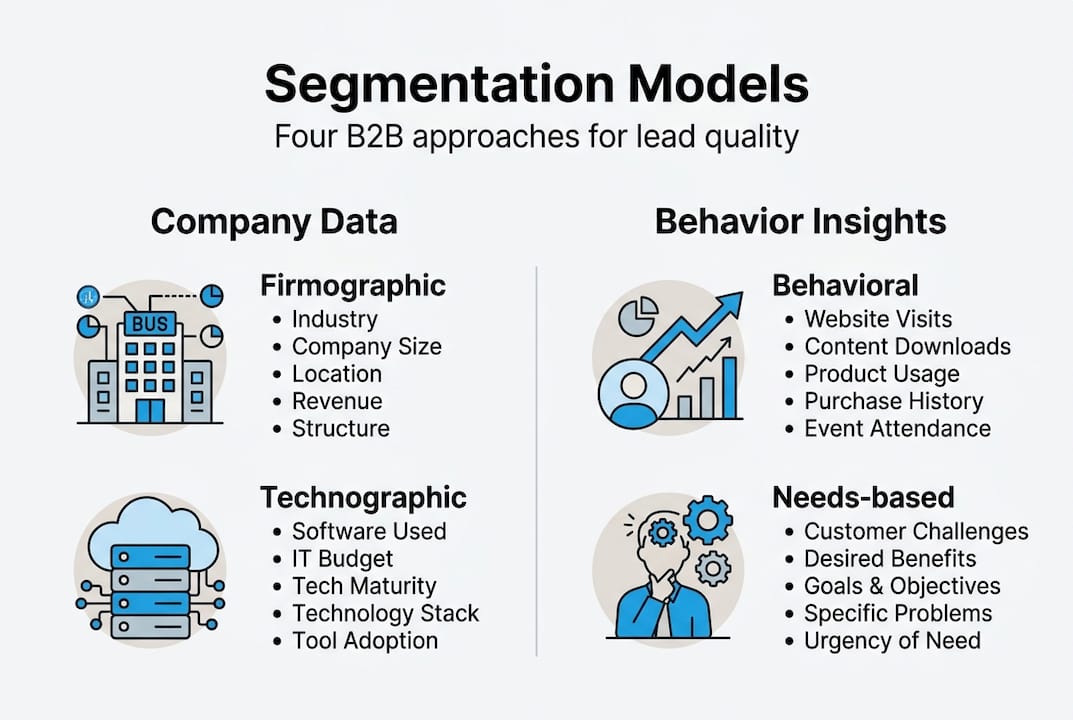
Market segmentation in B2B covers the key methodologies: firmographic (industry, company size, revenue, geography), behavioral (engagement history, content consumption, purchase patterns), technographic (software tools and platforms a company uses), and needs-based (the specific outcomes or pain points driving their buying decision). Each model gives you a different lens.
| Segmentation model | What it reveals | Best used for |
|---|---|---|
| Firmographic | Who the company is | Initial list building and targeting |
| Behavioral | How they engage | Prioritizing warm leads |
| Technographic | What tools they use | Positioning against competitors |
| Needs-based | Why they would buy | Crafting message and offer |
Firmographic data is the easiest to collect and the most widely used. But it also delivers the weakest signal on its own. Knowing a firm has 200 employees in the financial services sector tells you almost nothing about whether they need your services right now.
Behavioral segmentation closes that gap. When a prospect downloads a whitepaper, attends a webinar, or visits your pricing page multiple times, they are signaling intent. This data is gold for prioritizing outreach and timing follow-ups. Behavioral signals let you move high-intent prospects to the top of your sequence before they reach a competitor first.
Technographic segmentation is underused in professional services but highly effective. If you provide a compliance consulting service and you know a prospect runs a specific legacy software platform, you can lead with a message about the compliance risks of that system. Relevance goes through the roof. You can read more about how SEO and technographics intersect in digital strategy for service businesses.
Needs-based segmentation is the most powerful and the hardest to execute. It requires actual knowledge of your prospects’ motivations, often gathered through interviews, surveys, or CRM analysis of existing clients. But when you segment by need, every message feels personal. You are not describing your service. You are describing their problem.
The winning approach layers all four models together. Start with firmographic data to build your list, apply technographic filters to sharpen it, use behavioral signals to rank priority, and then craft your message around the dominant need of each segment.
LinkedIn segmentation strategies work best when you treat these models as complementary rather than competing. And when you are clear on your segments, targeting ideal B2B clients becomes far more systematic than intuitive.
Pro Tip: Start with needs-based segmentation as your headline message, then layer firmographic and behavioral data to determine which prospects receive which version. This approach keeps your content focused on value while your data ensures it lands with the right people.
Business impact: how segmentation boosts lead quality and sales conversion
Segmentation is not just a tactic. It is a pipeline multiplier. The downstream effects show up in metrics that matter to leadership: appointment rates, proposal-to-close ratios, deal size, and time to revenue.

The evidence is compelling. Professional services firms that combine ICP with segmentation for pipeline efficiency show measurable results, with high-performing organizations reporting a 25% increase in bid win rates through focused, segmentation-driven prospecting.
| Metric | Without segmentation | With segmentation |
|---|---|---|
| Outreach reply rate | 3 to 5% | 12 to 18% |
| Appointments per 100 contacts | 2 to 4 | 8 to 14 |
| Average sales cycle length | 90 to 120 days | 60 to 80 days |
| Proposal win rate | 20 to 25% | 35 to 45% |
These numbers shift because segmentation changes the quality of every interaction in your pipeline, not just the top of the funnel.
Three core mechanisms explain why segmentation delivers these outcomes:
-
Message relevance increases response rates. When a prospect reads a message that mirrors their actual situation, they respond. Personalization at the segment level requires far less effort than one-to-one customization but delivers much of the same effect. Your scalable lead generation strategies depend on this balance.
-
Qualified meetings replace volume meetings. A segmented campaign filters out low-fit prospects before they enter your calendar. Your team spends time with decision-makers who have the right problem, the right budget, and the right timeline. Fewer meetings, better outcomes.
-
Sales cycles shorten because objections are pre-handled. When you know a segment’s primary concern before the first call, you can address it in your outreach, your case studies, and your qualification questions. By the time a prospect sits down with your team, they are already half-sold. Personalized B2B prospecting at the segment level makes this possible without requiring custom research for every individual.
The compounding effect is significant. Firms that invest in segmentation early see pipeline velocity increase quarter over quarter because each campaign generates better data, which sharpens the next campaign. This feedback loop is what separates firms with predictable revenue from those constantly restarting from scratch.
Look at this from a market segmentation for B2B perspective: the goal is not to reach more people. It is to reach the right people at the right moment with something worth reading. That precision is what converts a contact into a conversation.
Implementing segmentation: steps and strategies for professional services
Understanding segmentation in theory is easy. Building and sustaining it in practice is where most firms stall. Here is a proven stepwise process to get your segmentation framework running and generating results.
Step-by-step segmentation implementation:
-
Define your goal before you define your segments. Are you targeting more qualified discovery calls? Faster close rates on mid-market accounts? Reactivation of lapsed clients? Your goal determines which segmentation model to prioritize and what success looks like.
-
Audit your existing client base. Pull your top 20 clients and identify what they have in common. Look at industry, company size, the pain point that prompted them to hire you, and the channel that brought them in. This audit surfaces your natural segments and validates your ICP before you build anything new.
-
Choose your primary segmentation dimensions. For most professional services firms, starting with firmographic plus needs-based is the fastest path to a working framework. Add behavioral data once your CRM or marketing automation system is capturing engagement signals reliably.
-
Map your messaging to each segment. Write out the core problem, the desired outcome, and the primary objection for each segment. Every piece of outreach, every LinkedIn message, and every email sequence should address these three points directly.
-
Launch, measure, and refine. Run each segment as a separate campaign with distinct tracking. Measure reply rates, appointment rates, and pipeline contribution by segment. Lead nurturing strategies vary significantly by segment, so your nurture sequences should adapt based on what each group responds to.
-
Review segments on a quarterly cadence. Markets change, your service evolves, and prospect behaviors shift. A segment that produced strong results in Q1 may need a messaging refresh or a structural change by Q3.
Common pitfalls to avoid during implementation:
- Poor data quality. Garbage in, garbage out. If your CRM contains outdated job titles or incorrect company data, your segments will be built on a flawed foundation. Dedicate time to data hygiene before you launch.
- Over-segmentation. If you create 15 micro-segments, you will not have enough volume in any single group to run statistically meaningful tests. Start with three to five well-defined segments and expand from there.
- Misaligned content. Segmenting your list but sending the same content to every group defeats the purpose. Each segment needs its own message angle, even if the underlying offer is identical.
Pro Tip: Treat your segmentation framework as a living document, not a one-time project. After every major campaign, schedule a 30-minute review to update segment definitions based on what the data showed. Firms that do this consistently see compounding improvements in campaign performance across every outreach campaign idea they run.
The key methodologies for B2B segmentation work best when your team treats them as a system, not a checklist. Combine that discipline with good SEO for lead generation practices and your inbound pipeline will reinforce everything your outbound campaigns build.
A fresh perspective: what most segmentation advice misses for professional services
Most segmentation guides borrow from the B2C playbook. They focus on creating tightly defined personas, building elaborate decision trees, and scaling each micro-segment independently. That approach works when you are selling software subscriptions or consumer goods. It fails in professional services, and here is why.
In high-trust, high-value B2B relationships, a single client can move between segments over time. The CFO you first engaged as a cost-reduction prospect becomes a strategic advisory client 18 months later. Rigid segment walls prevent your team from recognizing and acting on that evolution. You end up sending the wrong message to someone who has grown past the problem your original segment was built around.
The counterintuitive truth is that micro-segmentation, the idea that smaller and more precise segments always win, often damages relationship-building in professional services. Clients feel boxed in. The relationship loses the adaptive quality that makes high-value consulting and advisory engagements so sticky.
The better model is a living segmentation framework: clear enough to guide messaging and targeting, flexible enough to accommodate relationship growth. Think of your segments as starting points for a conversation, not permanent labels. Review them, challenge them, and update them based on what clients and prospects tell you, not just what your data implies.
Understanding quality B2B prospecting strategies means recognizing that the best segment is the one your team actually uses and updates. A sophisticated framework that sits in a spreadsheet is worth nothing. A simple, adaptable framework your whole team trusts is worth everything.
Ready to put segmentation into practice?
Understanding segmentation is the starting point. Executing it consistently across every campaign, every LinkedIn sequence, and every follow-up message is where the real work happens.
At The Lead Lab, we build done-for-you LinkedIn outreach campaigns grounded in the exact segmentation principles covered in this article. Every campaign we run starts with prospect targeting built around your ICP and layered segmentation models so your pipeline fills with qualified meetings, not noise. Explore our success stories to see how firms like yours have turned segmentation strategy into measurable revenue growth. And if you want to go deeper, our segmentation webinars walk through live campaign builds, real data, and the frameworks we use every day.
Frequently asked questions
What does it mean to segment prospects?
Segmenting prospects means dividing your leads into groups based on shared characteristics so you can target them more effectively. The main approaches include firmographic, behavioral, technographic, and needs-based methods, often combined for sharper results.
How does segmentation improve lead quality in professional services?
Segmentation helps you target the right decision-makers with tailored messaging, leading to higher appointment rates and more qualified opportunities. High-performing organizations that combine ICP with segmentation report 25% higher bid win rates than firms relying on broad targeting.
What are the best segmentation methods for B2B firms?
The most effective B2B segmentation methods are firmographic, behavioral, technographic, and needs-based, and they work best when layered together rather than applied in isolation.
Why is needs-based segmentation important?
Needs-based segmentation aligns your offer with what prospects value most, increasing campaign effectiveness and appointment quality. High-performing firms rely on needs-based segmentation for sharper messaging precisely because it speaks directly to buyer motivation rather than just company demographics.
Should segments be reviewed and updated over time?
Yes, prospect segments should be revisited regularly to stay aligned with changing markets, new data signals, and the natural evolution of client relationships within your pipeline.