TL;DR:
- LinkedIn outreach in 2026 requires advanced segmentation, personalized messaging, and a robust tech stack to succeed. Firms that experiment boldly and focus on long-term engagement outperform those relying on outdated templates and generic strategies. Effective measurement, continuous optimization, and tailored content are key to building sustainable LinkedIn lead generation systems.
LinkedIn outreach in 2026 looks nothing like it did three years ago. The platform is more crowded, buyers are more skeptical, and the generic connection request followed by an immediate pitch lands about as well as a cold fax. Professional services firms are leaving serious revenue on the table by clinging to outdated playbooks. This guide gives you specific, practical strategies, including the tools, segmentation methods, and campaign formats that are actually moving the needle right now, so you can build a system that consistently converts LinkedIn activity into qualified meetings and closed deals.
Table of Contents
- What you need to engage leads in 2026
- Segmenting and qualifying LinkedIn leads
- Crafting personalized outreach campaigns
- Measuring, optimizing, and scaling engagement efforts
- Why lead engagement on LinkedIn in 2026 rewards bold experimentation
- Take your LinkedIn engagement further with The Lead Lab
- Frequently asked questions
Key Takeaways
| Point | Details |
|---|---|
| LinkedIn leads B2B ROI | LinkedIn now outperforms all other platforms for B2B return on ad spend and budget allocation. |
| Segmentation is critical | Segmenting and qualifying your LinkedIn leads boosts response and conversion rates remarkably. |
| Personalization drives results | Custom campaigns tailored to buyer journeys greatly improve engagement in 2026. |
| Continuous optimization | Ongoing measurement and adjustment are required for scalable, lasting engagement. |
| Experiment for growth | Marketing leaders who innovate and test new tactics consistently see the strongest gains. |
What you need to engage leads in 2026
Before you redesign your outreach approach, you need to make sure the right infrastructure is in place. Attempting advanced personalization without the correct tools and team support is like trying to run a data-driven ad campaign with a spreadsheet and a hunch.
Tools, team, and baseline skills
LinkedIn outperforms all platforms for B2B ROAS at 121%, with B2B marketers allocating 41% of their paid social budgets here. That level of investment demands an equally serious operational setup.
Here is what your tech stack must include at minimum:
- CRM platform: Syncing LinkedIn activity to your CRM lets you track every touchpoint and identify where leads stall. Without this, you are essentially guessing.
- LinkedIn Sales Navigator: This gives you advanced search filters, intent signals, and lead lists that basic LinkedIn simply cannot match.
- Outreach automation platform: Used responsibly and within LinkedIn’s usage limits, automation handles connection request queues, follow-up scheduling, and response tracking.
- Analytics dashboard: Whether built into your CRM or a standalone tool, you need a single view of reply rates, conversion by message variant, and pipeline progress.
Team composition matters just as much as your tools. You need at minimum a content creator who understands professional services messaging, an outreach specialist who manages daily activity and responses, and an analyst who interprets campaign data and recommends changes. Trying to stack all three roles onto one overwhelmed team member is a fast path to burnout and mediocre results.
On skills, three are non-negotiable: professional copywriting (not marketing fluff, but precise, empathetic messaging), data interpretation (reading what your metrics actually mean versus vanity numbers), and segmentation expertise (understanding how to split your audience so each message feels tailored rather than broadcast). You can strengthen all three through lead nurturing for professional services frameworks that translate these principles into repeatable practice.
| Infrastructure area | Basic level | Advanced level |
|---|---|---|
| CRM integration | Manual entry, weekly updates | Automated sync, real-time tagging |
| Outreach tooling | Manual messages, no tracking | Automated sequencing with analytics |
| Analytics | Spreadsheet tracking | Dashboard with attribution modeling |
| Team structure | One generalist | Specialist roles per function |
Pro Tip: Run a quarterly tech stack audit. Tools that were category leaders 18 months ago may now have more capable, better-integrated alternatives. Staying current here directly protects your outreach performance.
Segmenting and qualifying LinkedIn leads
Having the right tools is only useful if you are pointing them at the right people. Unfocused outreach is the number one reason professional services firms see low reply rates despite high message volumes.

Why segmentation changes the math
B2B buyer journeys now average 272 days from first contact to close. That is a long time to sustain relevance across multiple touchpoints. Without sharp prospect segmentation for lead quality, your messaging quickly becomes generic noise across that entire journey.
Basic segmentation relies on static profile attributes: job title, company size, industry, and geography. It is a reasonable starting point, but it does not account for where someone is in their buying cycle or how engaged they already are with your content.
Advanced segmentation layers in dynamic signals: how often a prospect engages with your posts, whether they have visited your company page, what content they interact with across LinkedIn, and third-party intent data showing active research behavior in your category. This is the level you need to compete in 2026.
Here is a step-by-step process to build your segmentation system:
- Define your core segments. Start with three to five clearly differentiated buckets based on role, industry, and buying stage. For example: “Senior consultants at mid-market financial services firms actively seeking operational efficiency tools.”
- Tailor your content and connection requests per segment. A partner at a law firm responds to different language and pain points than a VP of operations at a logistics company. Write separate message variants for each segment, not a single template with a swapped-in first name.
- Score leads over time based on engagement. Assign point values to specific behaviors: connecting adds 5 points, replying to a message adds 15, clicking a content link adds 10, visiting your profile adds 3. Review scores weekly and prioritize your highest-value prospects for direct outreach.
These LinkedIn segmentation strategies give you a sharper view of where each prospect sits in their decision process, which directly improves your conversion rates.
| Segmentation type | Data used | Typical outcome |
|---|---|---|
| Basic (static) | Job title, industry, company size | Moderate reply rates, low conversion |
| Advanced (dynamic) | Engagement history, intent signals, content behavior | Higher reply rates, faster qualification |
Pro Tip: Do not rely solely on profile views to qualify leads. Someone who views your profile once may be mildly curious. Someone who has viewed your profile, engaged with two posts, and clicked your content offer over 30 days is showing genuine buying intent.
Crafting personalized outreach campaigns
With your segments defined and your leads scored, execution becomes the priority. How you reach out determines whether a qualified prospect engages or ignores you entirely.
Campaign formats that actually work
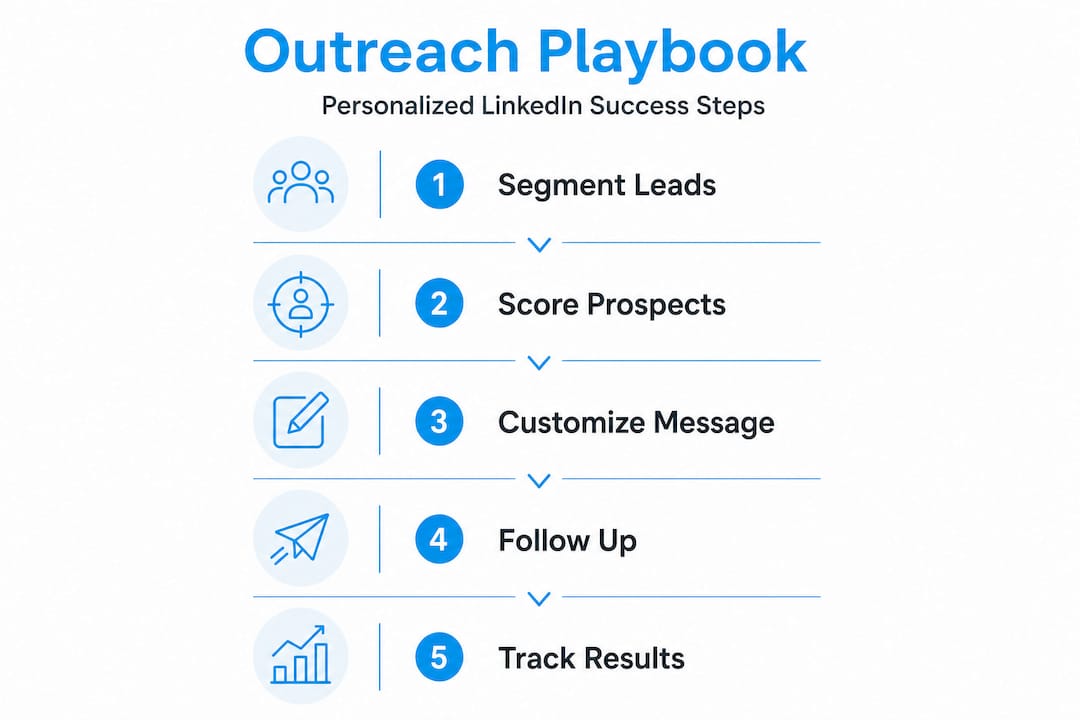
The most effective LinkedIn outreach campaigns in 2026 share one trait: they feel like they were made for a specific person, not a list of 500. Here are the campaign types driving the strongest results in professional services:
- Personalized video messages: A 45 to 60 second video that references something specific about the recipient’s business or recent LinkedIn activity. These cut through written message fatigue and show effort most competitors simply will not put in.
- Poll engagement campaigns: Post a relevant industry poll, then follow up with everyone who responded. You already know their opinion, which gives you a natural, non-pushy conversation starter.
- Mutual group outreach: Connecting through shared LinkedIn groups adds context and reduces the “who is this stranger” friction that kills cold outreach.
- Content offer sequences: Share a genuinely useful resource (a short guide, a benchmark report, a case study) rather than pitching your service. Build value before you ask for time.
- Micro-survey follow-ups: After an initial connection, ask a single, easy-to-answer question about a challenge they face. Responses give you both data and a reason to continue the conversation.
“Generic connection requests tell prospects that you haven’t done your homework. In a 272-day B2B journey with dozens of touchpoints, every message is either building trust or burning it. There is no neutral.”
Because 81% of LinkedIn buyer journeys are controlled by marketers rather than sales reps, the content and messaging you design carries enormous weight. You are not just supporting a sales conversation; you are often leading it.
Strong LinkedIn messaging templates give you reusable starting points, but the real skill is knowing how to customize them for each segment. Pair that with customized LinkedIn outreach approaches that reflect your firm’s specific voice and value proposition.
For firms looking to go further, exploring creative LinkedIn outreach ideas beyond standard text messages can meaningfully differentiate your campaigns from every other firm in your prospect’s inbox.
Pro Tip: Vary your follow-up frequency based on lead score. A high-scoring, highly engaged lead can handle a follow-up after three days. A prospect who only just connected and has not yet interacted with your content needs more patience, perhaps a two-week gap with a value-add in between.
Measuring, optimizing, and scaling engagement efforts
Launching a campaign is the beginning, not the end. The firms that consistently win on LinkedIn in 2026 treat every campaign as a source of data to learn from and build on.
The metrics that matter
Not all metrics tell the same story. Here is what to track closely:
- Reply rate: Your first indicator of message relevance. Anything below 15% on a targeted segment signals a messaging or audience problem.
- Content engagement rate: Likes and comments on your posts show whether your content strategy is resonating with the audience you are trying to reach.
- Lead-to-meeting conversion rate: The ultimate measure of whether your outreach is generating qualified pipeline, not just activity.
- Return on ad spend (ROAS): For paid LinkedIn campaigns, LinkedIn outperforms every platform at 121% ROAS. Regular outreach campaign optimization is what keeps your performance above that benchmark over time.
Given the 272-day average buyer journey, your measurement window needs to match reality. Evaluating a LinkedIn campaign after 30 days and declaring it a failure is a mistake many firms make. Build your analytics around 90-day and 180-day performance views in addition to monthly snapshots.
Common mistakes that erode performance include over-automation (sending high volumes of messages with no personalization and triggering LinkedIn’s restrictions), failing to test message variants before scaling them, and measuring inputs like connection request volume rather than outputs like qualified meetings booked.
Effective automation for lead engagement is not about removing the human element. It is about removing repetitive administrative tasks so your team can focus on the high-value interactions that actually close deals. And when your systems are dialed in, scalable lead generation tactics let you expand reach without sacrificing message quality. Knowing exactly which LinkedIn outreach mistakes to avoid keeps your account healthy and your pipeline growing.
Key stat: LinkedIn’s 121% B2B ROAS is not a guaranteed floor. It is a platform-wide average. Firms that consistently test, optimize, and personalize outperform it. Firms that set campaigns and forget them fall well below it.
Why lead engagement on LinkedIn in 2026 rewards bold experimentation
Here is something most guides on LinkedIn outreach will not tell you directly: the templates everyone is using right now are already losing their edge. The outreach frameworks that drove strong results in 2021 and 2022 have been copied so many times that even well-written versions of them now feel predictable to seasoned buyers.
What we have seen consistently is that the marketers generating the best results in 2026 are the ones running structured experiments rather than following playbooks. They are testing message length, format, call-to-action placement, and even the absence of a call-to-action entirely. One counterintuitive finding that shows up repeatedly: shorter, less polished messages often outperform carefully crafted, heavily formatted ones. A two-sentence message that reads like it came from a real person tends to get more replies than a five-paragraph message that looks like a marketing department signed off on it.
The other area where bold firms are pulling ahead is in directly asking their leads what content they want. Simple, honest questions like “What would actually be useful to you right now?” or “What’s the biggest challenge your team is navigating this quarter?” create dialogue instead of a one-directional pitch. And dialogue is where professional services relationships are built.
Failures teach faster than wins. If a campaign gets a 4% reply rate, the temptation is to move on quickly. But sitting with that failure and interrogating what specifically did not land, the opening line, the offer, the timing, the segment, is what builds the judgment that compounds over time. Explore outreach experiments that work to see which unconventional approaches are proving out in practice.
The marketers who treat 2026 as a period of aggressive testing rather than careful template-following are building a durable advantage. The gap between the best and average LinkedIn engagement programs is widening, not narrowing.
Take your LinkedIn engagement further with The Lead Lab
You now have a clear picture of what effective LinkedIn lead engagement looks like in 2026, from building the right tech stack to running segmented, personalized campaigns that account for long buyer journeys. The challenge for most professional services firms is execution: finding the time, expertise, and consistency to run these systems well.
The Lead Lab specializes in done-for-you LinkedIn outreach and lead generation built specifically for professional services firms. Whether you want to see what a fully managed campaign looks like or need inspiration from real-world results, explore our success portfolio to see how firms like yours have translated these strategies into qualified meetings and measurable pipeline. You can also join our live LinkedIn webinars to get practical, up-to-date guidance directly from our team. The next step toward stronger engagement is closer than you think.
Frequently asked questions
What makes LinkedIn the top platform for B2B engagement in 2026?
LinkedIn delivers a 121% ROAS and captures 41% of B2B paid social budgets, outperforming every other platform for business-to-business marketing returns.
How long does the average LinkedIn B2B buyer journey take?
The average B2B buyer journey on LinkedIn now spans 272 days, meaning sustained, well-sequenced engagement across months is essential for conversion.
Which outreach campaign types work best for professional services?
Personalized video messages, micro-surveys, and tailored content offers consistently generate the highest engagement rates for professional services firms on LinkedIn in 2026.
What are the most important metrics for LinkedIn lead engagement?
Reply rate, content engagement, qualified lead-to-meeting conversion, and ROAS are the four metrics that give you the clearest picture of outreach performance and where to adjust.