
TL;DR:
- Static prospect lists quickly become outdated and ineffective without context or timing.
- Layered, trigger-based prospecting integrates discovery, enrichment, and event signals to scale meaningful outreach.
If you’ve ever watched a week’s worth of outreach land in silence, you already know the problem. Static prospect lists, built once and blasted repeatedly, are one of the most expensive inefficiencies in professional services business development. Multi-layer prospecting and enrichment paired with meaningful triggers is what separates firms that consistently fill their calendars from those constantly starting over. This article walks you through that exact process: from discovery to enrichment to trigger-based outreach, so your LinkedIn lead generation finally scales without sacrificing quality.
Table of Contents
- What makes prospecting scalable for professional services?
- Tools and data sources for scalable LinkedIn prospecting
- Step-by-step scalable prospecting workflow
- Common pitfalls and how to avoid them
- Results and metrics: What to expect from a scalable process
- Why scalable prospecting is more than automation
- Scale your prospecting with The Lead Lab
- Frequently asked questions
Key Takeaways
| Point | Details |
|---|---|
| Multi-layer prospecting | Efficient lead generation relies on Discovery, Enrichment, and Trigger phases working together. |
| Trigger quality matters | Prospecting scales best when outreach sequences launch on meaningful prospect changes, not static lists. |
| Data enrichment is essential | Enriching prospect lists before outreach prevents wasted time and improves response rates. |
| Avoid common mistakes | Regular audits and verification steps help maintain the relevance and effectiveness of your process. |
| Measure and improve | Tracking metrics like qualified meetings and response rates ensures ongoing scalability and performance. |
What makes prospecting scalable for professional services?
Static lists feel efficient right up until they aren’t. You build a list, load it into a sequence, and send 500 connection requests. Two weeks later, you’ve got a handful of polite declines and a lot of silence. The problem isn’t your offer. It’s the approach. A list without context is just a spreadsheet.
Scalable lead generation for professional services firms works differently. It operates in three distinct layers that feed into each other continuously: Discovery, Enrichment, and Trigger. Each layer serves a specific function, and skipping any one of them breaks the whole chain.
Here’s how each layer works in practice:
- Discovery is where you identify the right profiles based on firmographic and demographic criteria. Think job title, company size, industry, geography, and seniority level.
- Enrichment is where you add context. You verify contact details, overlay company data like growth signals, recent hires, and tech stack, and score prospects by fit.
- Trigger is where you act. Instead of reaching out to everyone on the list at once, you launch sequences only when something meaningful changes for a prospect.
As the research on OSINT-based workflows makes clear, trigger quality determines scale. It’s not about adding a first name token to a generic message. It’s about reaching the right person at the right moment because your data told you something changed.
Here’s a direct comparison of static versus layered prospecting:
| Factor | Static list approach | Layered trigger-based approach |
|---|---|---|
| Timing of outreach | Fixed, regardless of prospect context | Launched when meaningful change occurs |
| Personalization depth | Surface level (name, company) | Contextual (trigger event, enriched data) |
| Data freshness | Degrades over time | Refreshed continuously |
| Response rates | Typically low and declining | Higher due to relevance |
| Scalability | Limited by manual capacity | Scales with automated triggers |
Building a client-focused prospect list requires understanding that the list itself is just the starting point, not the deliverable. For professional services firms where relationships drive revenue, this distinction matters enormously.
Tools and data sources for scalable LinkedIn prospecting
Now that we’ve defined scalable prospecting, let’s break down what tools and data sources you’ll need at each layer.

The Discovery phase relies heavily on LinkedIn Sales Navigator, which lets you filter by role, seniority, industry, company headcount, geography, and even recent activity. Sales Navigator’s saved search alerts are underused by most firms. Set them up correctly and they push new matching profiles to you automatically every week. That’s passive discovery at scale.
For Enrichment, you need company databases and OSINT (open-source intelligence) feeds that overlay context on each raw profile. Tools like Apollo.io, Clearbit, and Hunter.io verify emails and add company financials, recent funding data, and technology stack information. Crunchbase and PitchBook track funding rounds in real time. LinkedIn’s own activity feed surfaces content signals, like a prospect posting about a challenge your firm solves.
For Triggers, you’re looking for event-based criteria that signal buying readiness or receptivity. The most effective categories are:
- Job changes: A new VP of Operations at a target company is often actively auditing vendors and processes.
- Funding rounds: Series A and B companies are typically hiring and scaling, which creates demand for professional services.
- Tech stack shifts: A company migrating to a new CRM or data platform often needs implementation support or adjacent services.
- Hiring signals: Rapid headcount growth in a specific department indicates investment in that function.
- Content engagement: A prospect liking or commenting on content related to your service area signals active interest.
As one OSINT workflow study puts it plainly, discovery without triggers is just a list, and triggers without enrichment are just noise. Both have to be present.
For LinkedIn-specific outreach, you’ll also need tools that support generating leads with LinkedIn through compliant automation. Platforms like Dripify, Expandi, or Waalaxy can handle connection requests, follow-ups, and message sequences within LinkedIn’s usage limits. Pairing them with your enrichment stack creates a powerful, semi-automated pipeline.
Connecting these tools is where automation in B2B marketing delivers real leverage. Zapier or Make (formerly Integromat) can bridge your CRM, enrichment tools, and LinkedIn automation platforms so that a trigger event automatically queues a personalized outreach sequence without manual intervention.
| Phase | Tool examples | Key function |
|---|---|---|
| Discovery | LinkedIn Sales Navigator, Apollo.io | Profile search and list building |
| Enrichment | Clearbit, Hunter.io, Crunchbase | Contact verification, company data overlay |
| Trigger monitoring | PitchBook, LinkedIn alerts, G2 intent data | Event detection and sequence activation |
| Outreach automation | Dripify, Expandi, Waalaxy | Compliant LinkedIn sequence delivery |
Pro Tip: Integrate your enrichment tools into your CRM before you build any outreach sequences. Enriched data should populate prospect records automatically. If you’re manually copying data between platforms, you’ll create bottlenecks that undermine the entire scalable system you’re trying to build. Targeted prospect lists built with enrichment baked in from the start convert at significantly higher rates than those assembled manually.
Step-by-step scalable prospecting workflow
Let’s put the pieces together and walk through the workflow from start to finish.
The OSINT-based B2B workflow is explicitly layered: Discovery, Enrichment, Trigger, where trigger events fire sequences automatically rather than on a fixed schedule. Here’s how to execute each step:
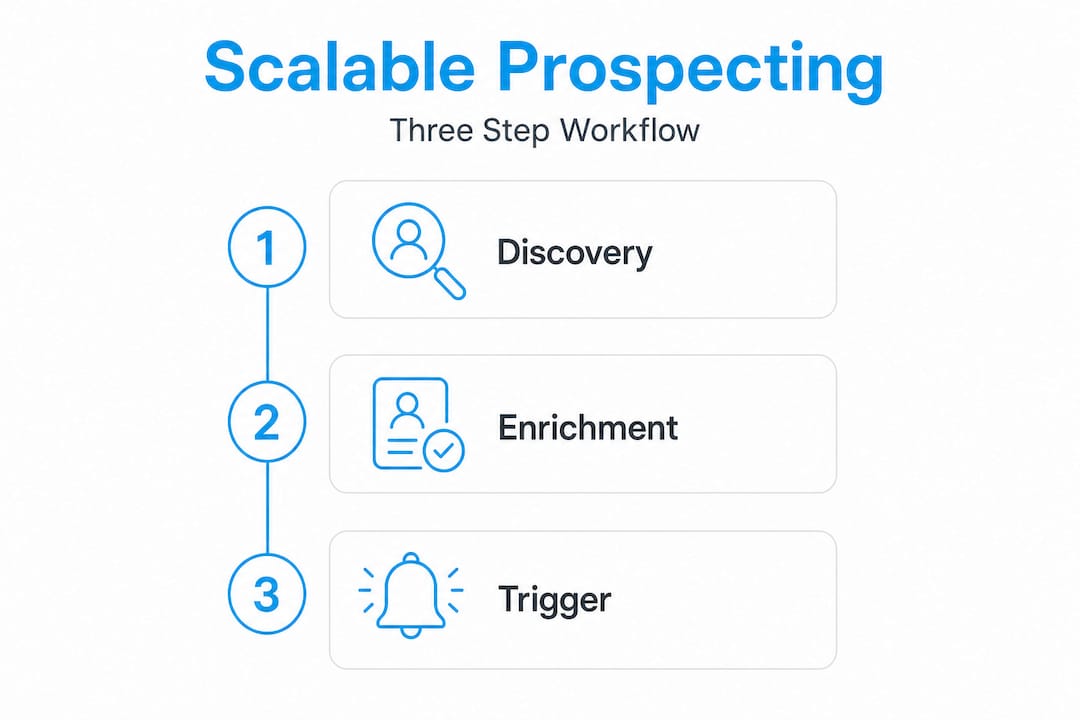
Step 1: Discovery. Define your Ideal Customer Profile (ICP) with precision. For a professional services firm, this typically means job title (decision-making level), company size (employee count and revenue range), industry vertical, and geography. Use LinkedIn Sales Navigator’s saved search function to create standing queries that surface new matches weekly. Export these profiles to your CRM or a staging spreadsheet. This is your raw discovery layer. It’s incomplete without enrichment.
Step 2: Enrichment. For each discovered profile, run enrichment to verify and expand what you know. At minimum, verify the email address and direct phone if relevant. Add company-level context: recent funding, headcount growth trends, technology stack, and any recent news mentions. Score each prospect against your ICP criteria. Profiles that score above your threshold move forward. Those that don’t get tagged for a follow-up cycle rather than immediate outreach. This scoring step is where most firms cut corners, and it’s exactly where response rates start to collapse.
Step 3: Trigger definition. Rather than setting a launch date for your outreach, define the trigger conditions that qualify a prospect for immediate sequencing. Reference your list of high-value B2B sales triggers and map the top three to five that are most relevant to your service offering. Set up monitoring alerts in LinkedIn, Google Alerts, or your enrichment platform to notify you when these events occur for prospects in your database.
Step 4: Trigger-based sequence activation. When a trigger fires, a personalized outreach sequence launches automatically. The first message references the trigger event directly, connecting it to the value your firm provides. A new Head of Finance at a target company doesn’t need a generic intro. They need a message that acknowledges their new role and positions your service as relevant to the priorities a finance leader in that position typically faces. That’s the difference between personalized prospecting and bulk outreach.
Step 5: Follow-up cadence. Build a structured follow-up sequence of three to five touchpoints over two to three weeks. Each message should add value or shift the angle slightly, not just re-ask for a meeting. Share a relevant insight, reference something they’ve published, or mention a result you’ve achieved for a similar firm.
“Triggers without enrichment are just noise.” Make sure every sequence that fires is backed by verified data and a clear reason to reach out.
Use your LinkedIn prospecting checklist to verify each prospect record before the sequence activates. A missing job title or unverified company size can mean your “personalized” message lands completely off the mark.
Pro Tip: Always verify enrichment data before triggering any sequence. Set a 48-hour delay between enrichment completion and sequence launch. This window gives your system time to catch data errors before they become wasted outreach or, worse, a message that embarrasses your firm in front of a key prospect.
Common pitfalls and how to avoid them
Having mapped out the workflow, let’s tackle common issues you’ll want to avoid.
The biggest mistake firms make is treating their prospect database as a finished product. A list built six months ago is already degrading. People change roles, companies get acquired, and contact details go stale. The fact that discovery without triggers is just a list also means a stale list is worse than no list. You’re reaching out to the wrong person at the wrong company with no reason to engage.
Common pitfalls and how to avoid them:
- Launching sequences without verifying enrichment. Always run a data quality check before a sequence activates. A bounce rate above 5% on LinkedIn connection requests can trigger platform restrictions.
- Treating all triggers as equally valuable. A job change at a company that just went through layoffs is a very different signal than a job change at a company that just closed a Series B. Weight your triggers by context, not just event type.
- Overloading outreach volume. More sequences running simultaneously doesn’t mean more meetings. LinkedIn limits daily connection requests to roughly 100 per account. Exceeding safe thresholds risks account restrictions that shut down your entire outreach operation.
- Skipping the ICP scoring step. Not every enriched profile deserves a sequence. Precision in LinkedIn prospecting means being deliberate about who you contact, not just how many you contact.
- Using the same message template for all triggers. A funding trigger warrants a different message angle than a job change trigger. Your customized outreach campaigns should have template variations mapped to each trigger type.
Pro Tip: Set up a monthly list audit as a standing task in your workflow. Review your database for stale records, changed job titles, and companies that have gone through major transitions. A clean list is a productive list. Firms that skip this step often find their outreach becoming progressively less effective without understanding why. Review your cold email workflow practices alongside your LinkedIn audits to ensure consistency across channels.
Results and metrics: What to expect from a scalable process
With pitfalls addressed, it’s time to look at how a scalable framework changes your results and what you should track.
Trigger quality is essential to scaling outcomes in prospecting. When your sequences fire on meaningful signals rather than arbitrary timing, response rates improve and so does the quality of those responses. You’re not just getting more replies. You’re getting replies from prospects who are genuinely in a relevant context.
Here’s what the data typically looks like when comparing approaches:
| Metric | Static list approach | Trigger-based approach |
|---|---|---|
| Connection acceptance rate | 15 to 25% | 30 to 45% |
| Reply rate to initial message | 2 to 5% | 8 to 15% |
| Qualified meeting conversion | 1 in 50 contacts | 1 in 15 to 20 contacts |
| Time to first meeting | 4 to 6 weeks | 1 to 3 weeks |
| List decay rate (data going stale) | High, unmanaged | Low, with regular enrichment |
These are not guaranteed outcomes. They’re directional benchmarks that reflect what firms consistently report when they shift from static to trigger-based prospecting. Your actual numbers will depend on ICP clarity, message quality, and how well-tuned your trigger definitions are.
Verification steps to maintain scalability:
- Review connection acceptance rates weekly and investigate any sharp drops.
- Track reply rate by trigger type to identify which events drive the strongest engagement.
- Monitor qualified meeting rates monthly and compare against the previous quarter.
- Audit enrichment data completeness quarterly. Flag records with more than two missing fields.
- Review sequence performance by template variant to optimize message copy continuously.
The proven B2B prospecting strategies that consistently deliver results share one characteristic: they treat prospecting as a system, not a campaign. A campaign ends. A system improves over time.
Why scalable prospecting is more than automation
Most conversations about scalable prospecting quickly become conversations about automation tools. Which platform do you use? How many sequences can it run simultaneously? Can it auto-accept connection requests? These are the wrong questions.
Here’s the uncomfortable reality: automation without quality triggers is actually worse than doing nothing at scale. Every low-relevance message you send at volume trains your market to ignore you. It signals that you’re a firm that values throughput over relationships. In professional services, that reputation is hard to recover from.
Real scalability comes from data-driven triggers, not bulk volume. When you reach out to a prospect because your system detected they just hired a VP of Strategy and your firm specializes in strategic advisory, that’s not automation. That’s intelligence. The automation just delivers the message. The automation transforms B2B marketing conversation only makes sense when the underlying trigger and enrichment infrastructure is already in place.
The firms we see consistently booking qualified meetings aren’t necessarily sending the most outreach. They’re sending the most relevant outreach. They’ve invested time in defining triggers that actually correlate with buying behavior, enriching their data rigorously, and building sequences that speak directly to the context each trigger creates. That integration of trigger, enrichment, and personalized message is what produces sustainable lead generation, not the volume of sequences running at any given moment.
If you’re evaluating a prospecting approach or a vendor, the question to ask is not “how many contacts can we reach?” It’s “what triggers will fire our sequences, and how do we know those triggers predict receptivity?” That single question separates scalable prospecting from expensive spam.
Scale your prospecting with The Lead Lab
If you’re ready to move from static lists to a trigger-based prospecting system that actually fills your pipeline, the steps above give you the framework. But building and managing that infrastructure alongside client delivery is a significant operational load for most professional services firms.
At The Lead Lab, we build and manage done-for-you LinkedIn outreach campaigns that apply exactly this Discovery, Enrichment, and Trigger methodology. From ICP definition and prospect targeting to message copywriting, response management, and campaign analytics, our team handles the entire process so your partners and business development leads can focus on closing, not prospecting. Explore our client portfolio to see real outcomes for firms like yours, or join one of our Lead Lab webinars to see how trigger-based prospecting works in practice before committing to a campaign.
Frequently asked questions
How is a scalable prospecting process different from using bulk lists?
A scalable prospecting process uses enrichment and triggers to launch outreach only when prospects show meaningful changes, reducing wasted effort compared to bulk static lists that ignore context and timing entirely.
What triggers are most effective for prospecting on LinkedIn?
Triggers like job changes, funding rounds, and tech stack shifts are consistently the strongest signals for launching relevant outreach sequences because they indicate an active transition period when new vendor relationships are often formed.
What metrics should decision-makers track to verify scalable prospecting results?
Key metrics include qualified meeting rates, reply rates by trigger type, and connection acceptance rates. Trigger quality directly impacts all three, so tracking them by trigger category reveals which signals are worth prioritizing.
How often should prospect lists be enriched or refreshed?
Prospect lists should be enriched and reviewed at least monthly, with a full audit quarterly. Discovery without triggers is just a list, and stale data undermines both the trigger logic and the personalization that makes outreach relevant in the first place.