
TL;DR:
- High-quality copywriting is essential for effective LinkedIn outreach, as it shapes first impressions and trust.
- Effective outreach includes specific openers, clear value propositions, easy asks, and a warm, professional tone.
- Treat copywriting as an ongoing process requiring testing, data analysis, and continuous refinement for best results.
Most marketing leaders at professional services firms have tried to solve their LinkedIn lead generation problem by sending more messages, buying better tools, or automating everything in sight. The results are usually disappointing. The truth is, volume and technology are just delivery mechanisms. What actually determines whether a prospect replies, books a call, or ignores you entirely is the quality of your copy. This guide breaks down the copywriting strategies that drive real LinkedIn outreach results, from first impressions to scalable multi-touch sequences, so you can generate qualified leads with confidence.
Table of Contents
- Why copywriting is the linchpin of LinkedIn outreach
- Core elements of high-converting outreach copy
- Common pitfalls: What to avoid in your LinkedIn messages
- Applying copywriting frameworks for outreach at scale
- What most LinkedIn outreach playbooks miss: Copywriting is a feedback loop, not a one-off task
- Elevate your LinkedIn outreach strategy with The Lead Lab
- Frequently asked questions
Key Takeaways
| Point | Details |
|---|---|
| Copywriting drives engagement | High-quality copy separates you from noise and opens doors for professional leads. |
| Personalization matters most | Tailoring messages to each segment outperforms generic outreach every time. |
| Avoid common pitfalls | Stay away from long messages, ALL CAPS, and feature lists to maintain authenticity. |
| Scale carefully with frameworks | Use tested templates and adapt with real data to balance automation and personalization. |
| Copywriting is iterative | Continuously analyze and improve your outreach messages for maximum LinkedIn success. |
Why copywriting is the linchpin of LinkedIn outreach
Having exposed the misconception around outreach, we now explore why message quality, driven by strategic copywriting, is the true linchpin of any successful LinkedIn campaign.
Your LinkedIn message is often the very first direct interaction a prospect has with your brand. Before they visit your website, before they read your case studies, before they ever speak to your team, they read your message. That first impression either opens a door or closes it permanently. A poorly written opener signals that you did not do your research, do not understand their business, or are simply blasting everyone with the same template.
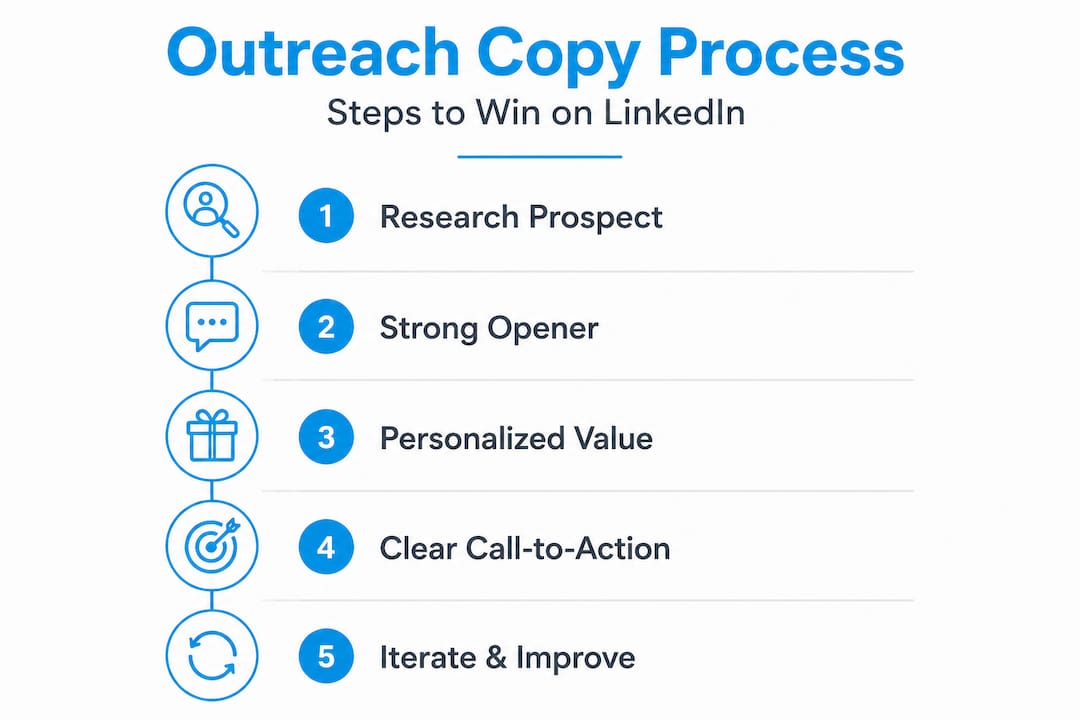
The average LinkedIn user receives dozens of connection requests and InMail messages every week. Most of them sound identical: “Hi [Name], I came across your profile and thought we could connect.” That kind of generic copy blends into the background noise. Strong copy, on the other hand, stands out because it is specific, relevant, and shows the prospect that you understand their world. For professional services firms, where trust and credibility are everything, this distinction is not just nice to have. It is essential.
Poor copy carries real risks beyond just low reply rates. Messages that feel impersonal, overly salesy, or irrelevant can get flagged as spam, which damages your LinkedIn account’s standing. They can also create a lasting negative impression of your brand. A prospect who dismisses your outreach today is far less likely to engage with your content or respond to future campaigns.
Here is what great LinkedIn outreach copy actually does:
- Opens with a specific, relevant observation about the prospect’s business or role
- Communicates a clear and credible value proposition in plain language
- Asks for something small and easy to say yes to
- Sounds like a human being wrote it, not a bot
Automation can scale outreach, but risks perception as spam if not paired with authentic, thoughtfully written copy. This is why LinkedIn outreach tips that focus on message quality consistently outperform those that focus purely on volume. You can also draw inspiration from content ideas for lead growth to inform the themes and angles that resonate with your audience.
“The best outreach message is the one that makes the reader feel like you wrote it specifically for them, because you did.”
Pro Tip: Personalization does not mean inserting a first name into a template. It means referencing something specific about the prospect’s recent activity, company milestone, or stated challenge. Even one tailored sentence can dramatically increase your reply rate.
Core elements of high-converting outreach copy
With an understanding of the why, let us clarify exactly which copywriting elements drive high-performing outreach on LinkedIn.
Every effective LinkedIn message shares a set of core structural elements. Understanding these components lets you build copy that consistently performs across different audience segments and campaign goals.
-
An attention-grabbing opener. Your first sentence must earn the second. For professional services prospects, the most effective openers reference a specific trigger, such as a recent company announcement, a shared connection, or a challenge common to their industry. Avoid starting with “I” or anything that centers your company before you have earned their attention.
-
A crystal-clear value proposition. Prospects do not care about your firm’s credentials until they understand what is in it for them. State the specific outcome you help clients achieve, and connect it directly to a challenge they are likely experiencing right now. Be concrete. “We help mid-size consulting firms generate 15 qualified meetings per month” is far stronger than “We specialize in B2B lead generation.”
-
An easy, low-friction ask. Your call to action should feel like the obvious next step, not a commitment. Asking for a 15-minute call is more effective than asking for a demo. Asking “Would this be relevant to you?” is more effective than “Let’s schedule a meeting.” The easier you make it to say yes, the more replies you will get.
-
The right tone and brevity. LinkedIn is a professional network, but it is still social. Your copy should sound like a confident, knowledgeable peer reaching out, not a sales script. Keep messages under 150 words whenever possible. Avoid ALL CAPS, emoji overload, long messages, and feature-dumping, since LinkedIn’s message environment rewards warmth and concision over volume and noise.
Here is a quick comparison of strong versus weak LinkedIn message openers:
| Type | Example | Why it works or fails |
|---|---|---|
| Strong opener | “Saw your firm just expanded into the Northeast market — congrats. We work with firms at exactly this stage to accelerate their pipeline.” | Specific, relevant, timely |
| Weak opener | “Hi [Name], I’d love to connect and share how we help businesses grow.” | Generic, self-centered, forgettable |
| Strong opener | “Your recent post on client retention really resonated — it’s a challenge we hear constantly from [industry] leaders.” | Shows attention, builds rapport |
| Weak opener | “We are a leading provider of marketing solutions for B2B companies.” | Feature-first, no prospect relevance |
Learning to craft impactful LinkedIn messages is a skill that compounds over time. The more you test and refine, the sharper your instincts become. Studying proven LinkedIn copywriting strategies alongside principles from high-converting landing pages can give you a broader toolkit for persuasion across channels.
Pro Tip: Create two or three message variants for each target segment and run them simultaneously. After 50 to 100 sends, compare reply rates and refine the winner. This simple A/B approach removes guesswork and builds a library of proven copy over time.
Common pitfalls: What to avoid in your LinkedIn messages
Knowing what works means also seeing which common errors to avoid. Here is what hampers most campaigns before they ever gain traction.
Even marketing leaders who understand copywriting fundamentals often fall into predictable traps when writing LinkedIn outreach at scale. The pressure to move fast, the temptation to automate everything, and the lack of a structured review process all contribute to copy that underperforms.

ALL CAPS, emoji overload, long-winded messages, and feature-dumping are among the most common mistakes, and they all share the same root cause: prioritizing what you want to say over what the prospect needs to hear. These habits diminish results and erode the authenticity that professional services buyers expect.
Here is a before-and-after example to make this concrete:
Before (ineffective): “Hi Sarah, I’m reaching out because our award-winning platform offers AI-powered lead generation, CRM integration, automated follow-ups, email sequencing, analytics dashboards, and more. We’ve helped 500+ companies. Can we book a call this week?”
After (effective): “Hi Sarah, noticed your team recently launched a new service line — that’s usually when pipeline pressure really kicks in. We help consulting firms like yours build a steady flow of qualified meetings without adding headcount. Worth a quick chat?”
The difference is stark. The second version is shorter, more specific, and focused entirely on the prospect’s situation.
Here is a checklist of the most damaging pitfalls to avoid:
- Writing messages longer than 150 words in your initial outreach
- Opening with your company name or credentials
- Listing features instead of outcomes
- Using aggressive or pushy language in the first message
- Sending identical copy to every segment without adjustment
- Skipping follow-up sequences entirely or following up too aggressively
- Ignoring the tone and etiquette norms of LinkedIn’s platform culture
Message sequencing matters just as much as the initial message. A well-timed follow-up that adds new value, such as a relevant insight or a brief case study, can convert prospects who did not reply the first time. Reviewing LinkedIn messaging tips can help you build sequences that feel natural rather than pushy. You can also study service page copy examples to see how persuasive structure translates across different formats.
Applying copywriting frameworks for outreach at scale
With mistakes to avoid in mind, here is how to operationalize best-in-class copywriting for consistent and scalable outreach.
Scaling LinkedIn outreach without sacrificing quality is one of the biggest challenges marketing leaders face. The solution is not to choose between personalization and efficiency. It is to build a system that delivers both.
Two of the most effective frameworks for LinkedIn outreach copy are AIDA and PAS.
AIDA (Attention, Interest, Desire, Action) works well for cold outreach to prospects who have no prior awareness of your firm. You grab their attention with a specific observation, build interest by connecting to a relevant challenge, create desire by hinting at a clear outcome, and close with a simple ask.
PAS (Problem, Agitate, Solution) is particularly powerful for professional services, where prospects often feel the pain of a specific challenge but have not yet connected it to a solution. You name the problem, briefly amplify why it matters, and position your service as the logical next step.
Here is how to build and scale this process:
- Define your audience segments. Group prospects by industry, company size, job title, or growth stage. Each segment will have distinct pain points and language preferences.
- Write two to three message variants per segment using your chosen framework. Keep each variant under 150 words and test different openers.
- Set up a structured sequence. A typical high-performing sequence includes a connection request with a brief note, a follow-up value message two to three days after connecting, and a soft ask or insight-led message five to seven days later.
- Track reply rates by variant and segment. Use this data to identify which combinations of audience, framework, and tone drive the best results.
- Iterate monthly. Refresh copy based on what the data tells you, not what feels right intuitively.
Automation scales outreach, but risks spam perception versus manual authenticity, which is why LinkedIn’s message limits exist and why warmup strategies are essential for any campaign that uses automation tools. Building customized outreach campaigns around these frameworks gives you structure without sacrificing the human feel that converts. Pairing this with strategic messaging for lead gen ensures your copy aligns with your broader pipeline goals. For additional context on scaling content-driven outreach, marketing tips for consultants offer useful parallels.
Pro Tip: Segment audiences for micro-personalization at scale by creating a “personalization token” for each segment. This is one specific, verifiable detail about that audience group (a regulatory change, a common growth challenge, a recent industry trend) that you weave into every message for that segment. It feels personal without requiring individual research for every prospect.
What most LinkedIn outreach playbooks miss: Copywriting is a feedback loop, not a one-off task
Here is the insight that separates top-performing outreach programs from everyone else: most teams treat copywriting as a setup task. They write their templates, launch the campaign, and move on. The copy stays static for months, sometimes indefinitely, while the market, the audience, and the competitive landscape keep shifting.
The firms that consistently generate high-quality leads on LinkedIn treat copywriting as an ongoing discipline. They review reply rates every two weeks. They pay attention to the language prospects use when they do reply, because that language is a goldmine for refining future messages. They track which messages generate curious questions versus which ones generate polite brush-offs. They notice when a message that worked six months ago stops performing and ask why.
This feedback loop is where the real competitive advantage lives. It is not in having the cleverest opener or the most sophisticated automation stack. It is in the willingness to learn from real data and adapt faster than your competitors.
Sentiment matters too. A low reply rate is one signal, but the quality of replies tells you even more. If prospects are replying with “not right now” instead of “not interested,” your copy is doing its job on relevance but missing on timing. If they are asking clarifying questions, your value proposition may be unclear. Each response pattern points to a specific copy adjustment.
The teams we see winning consistently at generating LinkedIn leads are the ones who treat every campaign as a learning experiment, not a finished product. They combine creative instinct with data discipline, and they never stop testing.
Elevate your LinkedIn outreach strategy with The Lead Lab
Effective copywriting is not just a nice-to-have for LinkedIn outreach. It is the single biggest lever you have for improving lead quality, reply rates, and ultimately ROI from your campaigns. Every word in your outreach sequence either builds trust or erodes it.
If you are ready to move from theory to results, The Lead Lab specializes in exactly this. As LinkedIn outreach experts, we build done-for-you campaigns that combine precision targeting with copy that actually converts. Explore our LinkedIn outreach success stories to see what strategic messaging delivers for professional services firms like yours. You can also join our LinkedIn outreach webinars to learn directly from specialists who run these campaigns every day. Your next qualified meeting starts with better copy.
Frequently asked questions
What is the single biggest copywriting mistake in LinkedIn outreach?
Sending long messages and feature-dumping in your opening message is the fastest way to lose a prospect’s attention and get ignored. Keep your first message short, specific, and focused on their situation rather than your capabilities.
How should I adjust my copy for different LinkedIn audiences?
Segment your audience by industry, role, or growth stage and tailor your opener and value proposition to reflect their specific pain points and language. A CFO at a law firm responds to very different triggers than a marketing director at a consulting firm.
Does LinkedIn limit how many messages I can send?
Yes, LinkedIn applies message limits to prevent spam behavior, which is why starting with a warmup strategy is essential for any outreach program that plans to scale sustainably.
Is automation safe for LinkedIn outreach if I use good copy?
Automation scales but risks spam perception versus manual authenticity, so even excellent copy needs to be deployed thoughtfully, with proper warmup protocols and realistic daily send volumes to stay within safe limits.
How often should I update my LinkedIn outreach templates?
Review your templates at least every four to six weeks using reply rate data, prospect feedback, and any shifts in your target market’s priorities. Fresh, relevant copy consistently outperforms static templates that have not been tested or refined.
Recommended
- Craft High-Impact Outreach Messages for LinkedIn B2B Leads – The Lead Lab
- Maximize LinkedIn Leads With Proven Copywriting Strategies – The Lead Lab
- What is bespoke outreach? Custom LinkedIn strategies for leads – The Lead Lab
- Innovative outreach campaign ideas to supercharge LinkedIn leads – The Lead Lab
- Blog – SalesNavSplit