
TL;DR:
- Modern B2B prospecting relies on targeted research, personalization, and a multi-phase process.
- Data quality, privacy compliance, and AI tools are critical for successful outreach in 2026.
- Combining LinkedIn, email, and phone with intentional sequencing improves prospects’ engagement.
Most people still picture B2B prospecting as a rep dialing down a cold list, hoping someone picks up. That picture is outdated. Today’s most effective professional services firms treat prospecting as a systematic outbound process built on targeted research, precision targeting, and personalized outreach at every stage. The difference between firms that fill their pipeline consistently and those that scramble for referrals comes down to process. This guide breaks down exactly what B2B prospecting involves in 2026, how to execute it step by step, what modern challenges you need to navigate, and which strategies actually deliver qualified meetings.
Table of Contents
- Understanding B2B prospecting: Definition and essentials
- The B2B prospecting framework: Step-by-step process
- AI, data, and compliance: Modern challenges and winning strategies
- Multi-channel prospecting: LinkedIn outreach and beyond
- Why precision and personalization now outrank mass outreach
- Take your B2B prospecting to the next level
- Frequently asked questions
Key Takeaways
| Point | Details |
|---|---|
| Precise targeting matters | Defining and finding your ideal customer profile unlocks better B2B campaigns. |
| Personalization is key | Customizing messages across channels leads to higher response rates and sales-readiness. |
| Data quality drives success | Up-to-date, accurate data is essential—bad data can ruin 67% of campaigns. |
| Multi-channel outreach wins | Combining LinkedIn, email, and phone maximizes prospecting effectiveness. |
| Ethics and compliance first | Following privacy laws and using AI responsibly protect your reputation and results. |
Understanding B2B prospecting: Definition and essentials
B2B prospecting is not about blasting messages to everyone who fits a vague job title. It is a defined outbound process that moves through five core phases: identifying your ideal customer profile (ICP), researching target companies and contacts, executing personalized multi-channel outreach, qualifying leads, and nurturing them until they are ready to buy.
For professional services firms, this process matters more than almost any other growth activity. You cannot rely solely on referrals and inbound content to build a predictable pipeline. Scalable lead generation requires a repeatable outbound engine that you control, not one that depends on word of mouth.
Here is what each core component delivers:
- ICP identification: Defines exactly who you are targeting so no effort is wasted on poor-fit accounts
- Research: Surfaces the right contacts, their pain points, and relevant company signals before you reach out
- Personalized outreach: Increases reply rates by speaking directly to the prospect’s specific situation
- Qualification: Filters out low-intent contacts early, protecting your team’s time
- Nurturing: Keeps warm leads engaged until they are ready to have a real conversation
Multiple touchpoints over time are not optional. Buyers in professional services rarely respond to a single message. Consistent, value-driven follow-up is what separates a closed deal from a missed opportunity. Strong lead nurturing strategies are what turn initial interest into booked meetings.
“B2B prospecting is not a one-touch event. It is a structured, multi-phase process that demands research, personalization, and patience before a prospect becomes a qualified lead.”
| Prospecting phase | Primary goal | Key output |
|---|---|---|
| ICP definition | Narrow your target market | Documented ideal client profile |
| Research | Understand each prospect | Contact list with context |
| Outreach | Start the conversation | Replies and meeting requests |
| Qualification | Assess fit and intent | Qualified or disqualified leads |
| Nurturing | Build trust over time | Sales-ready pipeline |
The B2B prospecting framework: Step-by-step process
Knowing the components is one thing. Executing them in a repeatable sequence is what actually builds pipeline. Here is how a modern B2B prospecting process works from start to finish.
- Define your ICP and build your prospect list. Start with firmographic data: industry, company size, revenue range, geography, and tech stack. Then layer in psychographic signals like growth stage or recent funding. This step determines the quality of everything that follows.
- Research companies and key decision-makers. Go beyond job titles. Look at recent LinkedIn activity, company news, job postings, and pain points specific to their sector. This research is what makes personalization possible.
- Initiate contact across channels. Email, LinkedIn, and phone each play a role. Sequence them intentionally. A LinkedIn connection request followed by a personalized message, then a follow-up email, outperforms any single-channel approach. Use insights from your research to optimize outreach campaigns for each segment.
- Qualify leads using a structured framework. BANT (Budget, Authority, Need, Timeline) and CHAMP (Challenges, Authority, Money, Prioritization) are the two most common. CHAMP works especially well in professional services because it leads with the prospect’s challenges rather than your budget question.
- Nurture until sales-ready. Most prospects are not ready to buy on first contact. Strategic messaging delivered consistently over weeks keeps you top of mind without being pushy.
Professional services face longer buying cycles and more stakeholders than most B2B categories. A single decision often involves a managing partner, a department head, and a procurement contact. Your process needs to account for that complexity from step one.

Pro Tip: Automate repetitive tasks like follow-up scheduling and CRM logging, but write every message as if it were sent by hand. Automation that feels automated gets ignored.
| Step | Key outcome | Common mistake |
|---|---|---|
| ICP definition | Focused target list | Too broad, wastes resources |
| Research | Personalized context | Skipping this step entirely |
| Outreach | Replies and engagement | Single channel, single touch |
| Qualification | Filtered pipeline | Qualifying too late |
| Nurturing | Sales-ready leads | Giving up after 2 touches |
AI, data, and compliance: Modern challenges and winning strategies
Following a solid framework creates consistency. But in 2026, the gap between average and outstanding results comes down to how well you handle data quality, AI tools, and privacy compliance.
Here is the uncomfortable truth: bad data kills 67% of prospecting campaigns before they have a chance to work. Outdated email addresses, wrong job titles, and stale company data mean your carefully crafted messages never reach the right person. Data hygiene is not a nice-to-have. It is the foundation of every campaign.
What winning teams do differently in 2026:
- Verify contact data before any outreach begins, using tools that check mobile numbers and work emails in real time
- Use AI for personalization signals, not mass templating. AI should help you identify what to say, not replace the thinking behind it
- Adopt privacy-first tactics by respecting opt-out requests immediately and staying compliant with GDPR, CAN-SPAM, and CASL depending on your markets
- Segment ruthlessly so each outreach sequence speaks to a specific pain point, not a generic value proposition
- Audit your CRM regularly to remove dead contacts and update company information
Precision ICP targeting combined with ethical AI-powered personalization consistently outperforms high-volume spray-and-pray tactics. The math is simple: a 15% reply rate on 100 targeted prospects beats a 1% reply rate on 2,000 generic contacts every time, and it protects your sender reputation in the process.
Pro Tip: Before launching any AI-assisted sequence, audit your prospect list for data accuracy. One clean list outperforms three dirty ones.
The firms that invest in personalized messaging and treat quality data as a strategic asset see measurably better results. And those that integrate CRM lead generation systems properly can track every touchpoint to continuously improve their approach.
Multi-channel prospecting: LinkedIn outreach and beyond
No single channel wins alone. The most effective B2B prospecting sequences in 2026 combine LinkedIn, email, and phone in a deliberate order, with each touchpoint building on the last.
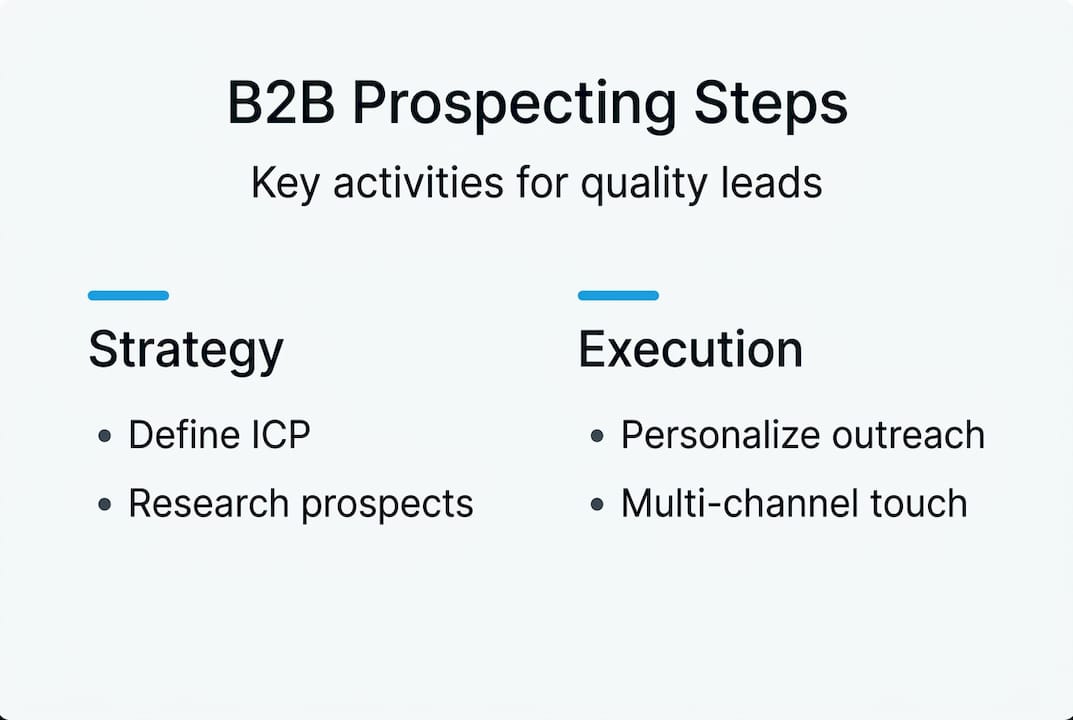
Multi-channel sequences work because different buyers respond to different channels at different times. Some prospects reply to a LinkedIn message within hours. Others only engage after they have seen your name in their inbox twice. Covering multiple channels means you meet them where they are.
Here is a proven sequence for professional services outreach:
- Connect on LinkedIn with a short, context-specific note (no pitch)
- Send a LinkedIn message within 48 hours of connection, referencing something specific about their work
- Follow up with a personalized email three days later
- Make a brief phone call if no response after seven days
- Send a final LinkedIn message or email with a clear, low-friction call to action
For professional services, LinkedIn is the highest-leverage channel. Decision-makers are active there, their roles and responsibilities are visible, and the platform’s context makes personalization natural. Check out LinkedIn outreach tips and LinkedIn outreach in 2026 for channel-specific tactics.
“Inbound leads convert at 14.6%, outbound at 1.7% — but outbound gives you control over who enters your pipeline and when.”
| Channel | Strengths | Limitations |
|---|---|---|
| High-quality targeting, professional context | Volume limits, slower pace | |
| Scalable, trackable, easy to sequence | High competition in inboxes | |
| Phone | Direct, human, high-intent signal | Low answer rates, time-intensive |
For targeted LinkedIn prospecting and practical tactics to generate leads on LinkedIn, the key is always the same: sequence intentionally, personalize every touch, and lead with value before asking for anything.
Why precision and personalization now outrank mass outreach
Here is what most marketing teams still get wrong: they treat personalization as a finishing touch rather than the foundation. They build a sequence, then add a first name and a company name and call it personalized. That approach stopped working years ago, and in 2026 it actively hurts your results.
Spray and pray has failed not just because buyers are savvier, but because inboxes and LinkedIn feeds are more saturated than ever. Generic outreach signals to a prospect that you did not bother to understand their business. That first impression is almost impossible to recover from.
The firms that consistently outperform their peers do something counterintuitive: they send fewer messages. They spend more time on research, tighten their ICP, and write outreach that speaks directly to a specific challenge the prospect is facing right now. The result is higher reply rates, better-quality conversations, and a pipeline full of prospects who actually fit.
The hard-won lesson we see repeatedly: teams invest in automation tools before they invest in data quality and message research. That order is backwards. Automation amplifies whatever you put into it. If your data is stale and your messages are generic, automation just means you fail faster and at greater scale.
Invest first in a clean list, a sharp ICP, and personalized messaging that reflects genuine research. Then automate the delivery. Professional services firms especially need this approach because credibility is everything in their category. One poorly targeted message to a senior partner can close a door permanently.
Take your B2B prospecting to the next level
If the framework above makes sense but execution feels like the hard part, you are not alone. Building a consistent, compliant, personalized prospecting engine takes time, expertise, and the right tools working together.
At theleadlab.com/, we build done-for-you B2B prospecting solutions designed specifically for professional services firms. From ICP definition and data sourcing to LinkedIn outreach, message copywriting, and response management, we handle the full process so your team can focus on closing. Browse our success stories to see how firms like yours have filled their pipelines with qualified meetings. And if you want to sharpen your skills further, join our live prospecting webinars for real-time strategy and Q&A with our team.
Frequently asked questions
What is the difference between B2B prospecting and lead generation?
B2B prospecting is the proactive outbound process of identifying and reaching out to specific potential customers, while lead generation is a broader term that includes inbound tactics like content marketing, paid ads, and SEO designed to attract interest.
How many outreach attempts does B2B prospecting typically require?
Most reliable results come from 4 to 6 touchpoints spread across LinkedIn, email, and phone, since few prospects respond to a single message regardless of how well it is written.
Why does bad data hurt B2B prospecting so much?
Inaccurate or outdated contact data means your messages never reach the right person, which is why bad data causes 67% of prospecting campaigns to fail before generating a single qualified lead.
How does LinkedIn fit into multi-channel B2B prospecting?
LinkedIn is the highest-quality channel for professional services prospecting because it provides targeted, personalized outreach in a professional context where decision-makers are actively engaged and roles are clearly visible.
What is the compliance risk with AI-powered prospecting?
Using AI to scrape private data or run non-compliant automation can breach privacy regulations like GDPR and CAN-SPAM, resulting in legal penalties and lasting damage to your brand’s sender reputation.
2 responses