
TL;DR:
- Message sequencing ensures messages are delivered and processed in the correct order to maintain campaign integrity.
- Most lead generation campaigns benefit from causal ordering, which preserves logical dependencies while allowing parallel processing.
Message sequencing is defined as the practice of arranging messages so they are delivered and processed in a specific, intended order, preserving data integrity and communication accuracy across every touchpoint. For marketing professionals running lead generation campaigns, this concept governs whether a prospect receives a connection request before a pitch, or whether a follow-up fires before an introduction lands. Get the order wrong and you do not just annoy a prospect. You corrupt the logic of your entire campaign.
The industry term for this practice in technical systems is message ordering, and understanding message sequencing explained through both a technical and marketing lens gives you a real advantage when designing outreach workflows.
What is message sequencing and how does it work technically?
Message sequencing works by assigning each message a unique identifier that tells the system where it belongs in a chain. Message brokers like Azure Service Bus assign a gap-free 64-bit integer called a SequenceNumber to each message. This number guarantees arrival order and serves as a reliable unique identifier, outperforming timestamps in accuracy under high message rates.

Timestamps alone fail under pressure. Clock skew between servers and low resolution at high throughput mean two messages sent milliseconds apart can receive identical or reversed timestamps. Sequence numbers eliminate that ambiguity entirely.
Beyond numbering, sequence numbers and timestamps also support business requirements like deadline scheduling and workload management. Scheduled messages receive their sequence numbers upon activation, while timestamps track the exact enqueue time. Together, they give systems a complete audit trail of message history.
Sessions take sequencing one step further. A session does not just guarantee that messages arrive in order. It guarantees they are processed in order. For a lead nurturing campaign, that distinction matters enormously. Delivery order means nothing if your automation platform processes a “meeting booked” event before it processes the “reply received” event that triggered it.
Pro Tip: Always verify whether your marketing automation platform guarantees processing order, not just delivery order. Many platforms confirm delivery sequencing but leave processing order to the consumer application.
What are the main tiers of message ordering guarantees?
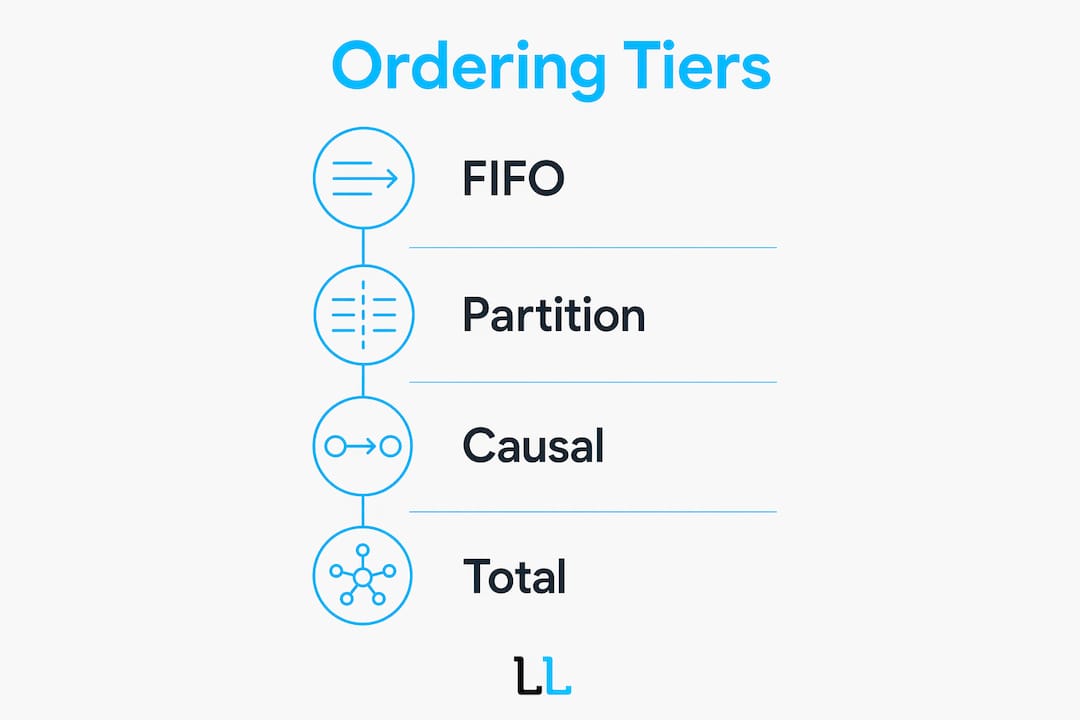
Not all sequencing is equal. Systems offer four distinct tiers of ordering guarantees, each with different performance trade-offs.
FIFO (First-In, First-Out) is the simplest guarantee. Messages are processed in the exact order they arrive. It works well for low-volume, single-channel campaigns but does not scale easily across distributed systems.
Partition-based ordering is the approach used by systems like Apache Kafka. Global ordering is sacrificed for throughput by guaranteeing order only within partitions, shifting reordering responsibility to consumers. In practice, this means messages grouped by a partition key (such as a prospect ID) stay ordered, but messages across different groups can interleave. For most B2B campaigns, this is acceptable because each prospect’s journey is independent.
Causal ordering focuses on logical dependencies rather than strict arrival time. Causal ordering allows parallel processing of unrelated message sequences while preserving logical dependencies, which suits B2B lead generation workflows by preventing performance bottlenecks. If two prospects are in different stages of a funnel, their message chains can run in parallel without interference.
Total ordering enforces a single global sequence across all messages. It sounds ideal but creates serious performance problems. Total ordering is difficult and costly due to latency and single-point bottlenecks. For high-volume campaigns, forcing total order means every message waits in a single queue, destroying throughput.
| Ordering tier | Key characteristic | Best use case |
|---|---|---|
| FIFO | Strict arrival order | Simple, single-channel workflows |
| Partition-based | Order within groups only | High-volume multi-prospect campaigns |
| Causal | Preserves logical dependencies | B2B nurturing with parallel sequences |
| Total ordering | Global single sequence | Low-volume, compliance-critical systems |
The right tier depends on your campaign’s complexity and volume. Most B2B lead generation workflows perform best with causal ordering.
What message types appear in system and sequence diagrams?
Sequence diagrams are the standard tool software architects use to map how systems communicate. They show which component sends a message, which receives it, and what type of interaction occurs. Sequence diagrams define messages as synchronous, asynchronous, or return messages, and understanding these types is essential for preventing blocked execution in real-time marketing systems.
Synchronous messages require the sender to wait for a reply before continuing. Think of a CRM checking whether a contact record exists before writing a new lead entry. The system pauses until it gets confirmation.
Asynchronous messages are fire-and-forget. The sender dispatches the message and moves on without waiting for a response. Most marketing automation triggers work this way. When a prospect clicks a link, the system fires an event and immediately continues tracking other activity.
Return messages travel back to the original sender in response to a synchronous call. They close the loop and confirm the action was completed.
Understanding these three types helps you design better lead nurturing workflows. A campaign that relies on synchronous calls for every step will stall under load. Replacing non-critical confirmations with asynchronous messages keeps the pipeline moving without sacrificing accuracy.
Pro Tip: Map your campaign’s message flow as a sequence diagram before building it. Identifying synchronous dependencies early prevents bottlenecks that only appear at scale.
What should marketing professionals know about sequencing in lead generation?
The most common sequencing failure in marketing campaigns is processing events out of order. Choosing an incorrect sequencing strategy in distributed systems can cause application failures, such as processing a “deleted” event before its “created” event. In a campaign context, this translates to sending a follow-up message before the initial connection request has been accepted, or triggering a “deal closed” notification before the proposal has been sent.
Duplicate messages are the second major pitfall. Network retries are unavoidable in any distributed system, and they generate duplicates. Idempotency in consumer logic is critical since network retries inevitably cause duplicate messages. Consumers should detect duplicates to prevent data corruption. For marketers, this means your automation platform must check whether an action has already been taken before executing it again. Sending the same LinkedIn connection request twice to the same prospect is not just inefficient. It signals poor campaign management to the recipient.
A third consideration is payload-level validation. Embedding sequence numbers in the message payload allows consumers to detect missed or out-of-order messages independently, enhancing data integrity. This approach adds fault tolerance even when broker-level guarantees are insufficient. For marketing automation, this translates to tagging each campaign touchpoint with a step number so your system can verify the correct sequence was followed before triggering the next action.
Practical steps for marketing professionals designing sequenced campaigns:
- Group messages by prospect ID. Use partition-based ordering so each prospect’s journey stays intact without slowing down the entire pipeline.
- Identify causal dependencies. Map which messages must follow others logically, not just chronologically. A proposal should never fire before a discovery call is logged.
- Build idempotent triggers. Every automation action should check for prior execution before firing. This prevents duplicates from corrupting your CRM data.
- Avoid total ordering at scale. Forcing a single global queue across thousands of prospects creates bottlenecks. Use causal ordering for scalable lead generation instead.
- Monitor for gaps. If your platform supports sequence numbers, log them. A gap in the sequence indicates a missed message that could break downstream campaign logic.
The key question is not whether ordering is supported but what level of ordering guarantees fit the business case. Exactly-once delivery is often unachievable without idempotent logic built into the consumer. Marketers who understand this stop blaming their platforms for duplicate sends and start designing campaigns that handle them gracefully.
Multichannel campaigns add another layer of complexity. When a prospect receives messages across LinkedIn, email, and retargeting ads, each channel runs its own message queue. Without a shared sequencing layer, a prospect can receive a cold email before the LinkedIn connection request that was supposed to precede it. Coordinating B2B outreach messaging across channels requires either a central orchestration layer or strict causal ordering rules applied at the campaign level.
Key Takeaways
Effective message sequencing in lead generation requires causal ordering, idempotent consumer logic, and payload-level validation to prevent out-of-order processing and duplicate actions from corrupting campaign data.
| Point | Details |
|---|---|
| Sequence numbers beat timestamps | Broker-assigned 64-bit integers guarantee message order more reliably than timestamps under high throughput. |
| Causal ordering fits most B2B campaigns | It preserves logical dependencies while allowing parallel processing, avoiding the bottlenecks of total ordering. |
| Idempotency prevents duplicate damage | Consumer logic must check for prior execution before acting to stop network retries from corrupting CRM data. |
| Processing order matters more than delivery order | A message arriving first means nothing if your platform processes it after a dependent event. |
| Payload-level sequence numbers add fault tolerance | Tagging touchpoints with step numbers lets your system detect gaps even when broker guarantees fall short. |
Why most marketers underestimate message sequencing
Most marketers treat message sequencing as a technical problem they can hand off to a developer. That is a mistake I have seen play out repeatedly. The developer builds a system that delivers messages in order. The marketer designs a campaign that assumes perfect order. Then a network retry fires a duplicate follow-up, a prospect gets two identical messages on the same day, and the campaign’s credibility collapses.
The real issue is that marketers and engineers often talk past each other on this topic. Engineers think in terms of FIFO queues and partition keys. Marketers think in terms of touchpoint timing and prospect experience. Both are correct. Neither is complete without the other.
What I have found works is mapping the campaign as a sequence diagram before writing a single line of automation logic. When you visualize which messages depend on which, the causal ordering requirements become obvious. You stop asking “when should this send?” and start asking “what must be true before this sends?” That shift in thinking produces campaigns that are far more resilient to the technical failures that distributed systems inevitably produce.
The other lesson worth internalizing is that outreach mistakes rooted in poor sequencing are almost always invisible to the marketer until they have already damaged a relationship. A prospect who receives a proposal before a discovery call has been scheduled does not usually tell you why they went cold. They just do. Sequencing discipline is the difference between a campaign that converts and one that quietly bleeds leads.
— Toby
How The Lead Lab builds sequencing into every campaign
Sequencing-aware campaign design is not a feature most agencies advertise. The Lead Lab builds it into every outreach workflow from the start, because the order in which a prospect hears from you is as important as what you say.
Every campaign The Lead Lab runs maps causal dependencies before any automation is configured. Connection requests, follow-ups, and value messages each fire based on what has already happened, not just on a timer. The campaign portfolio shows how this approach produces consistent, qualified meetings for professional services firms across industries. If your current outreach is sending the right messages in the wrong order, The Lead Lab can redesign your workflow so every touchpoint lands exactly when it should.
FAQ
What is message sequencing in simple terms?
Message sequencing is the practice of ensuring messages are delivered and processed in a specific, intended order. In marketing, it means each campaign touchpoint fires at the right moment based on what the prospect has already experienced.
Why does message order matter in lead generation?
Out-of-order messages can trigger the wrong action at the wrong time, such as sending a proposal before a discovery call is logged. This damages prospect relationships and corrupts CRM data.
What is the difference between FIFO and causal ordering?
FIFO processes messages in strict arrival order, which limits scalability. Causal ordering preserves logical dependencies between related messages while allowing unrelated sequences to run in parallel, making it better suited for high-volume B2B campaigns.
How do duplicate messages affect marketing campaigns?
Network retries in distributed systems inevitably produce duplicate messages. Without idempotent consumer logic, your automation platform can fire the same action twice, sending duplicate outreach and corrupting lead records.
What is a sequence diagram and why should marketers care?
A sequence diagram maps how system components exchange messages, showing synchronous, asynchronous, and return message types. Marketers who map their campaigns this way identify bottlenecks and causal dependencies before they cause live campaign failures.