
TL;DR:
- Account-based marketing targets high-value accounts with personalized campaigns to increase ROI and efficiency. It involves selecting accounts based on ideal customer profiles, creating tailored outreach, and aligning sales and marketing teams around specific goals. Different models range from one-to-one to one-to-many, using automation and real-time signals to optimize engagement and sales cycles.
Account-based marketing (ABM) is defined as a B2B strategy that targets specific high-value accounts with personalized campaigns, treating each account as its own market. Unlike broad lead generation, ABM aligns sales and marketing teams around a shared list of priority accounts, then builds tailored outreach for each one. Mature ABM programs deliver 21–200% higher ROI than traditional marketing approaches. That gap exists because ABM concentrates resources where conversion probability is highest, rather than spreading budget across unqualified leads.
What is account based marketing and how does it work?
ABM flips the traditional marketing funnel by selecting target accounts first, then building campaigns around them. Traditional demand generation casts a wide net and filters leads afterward. ABM reverses that sequence entirely. You identify who you want to win, then create the messaging and tactics to win them.
The process, formalized by Bev Burgess at ITSMA in 2003, follows four coordinated steps:
- Build your Ideal Customer Profile (ICP). Define the firmographic, technographic, and behavioral traits of your best-fit accounts. Industry, company size, tech stack, and growth signals all feed this profile.
- Select target accounts. Use your ICP to build a named account list. Prioritize accounts by revenue potential, strategic fit, and likelihood to buy.
- Execute personalized engagement. Develop tailored content, outreach sequences, and sales plays for each account or account cluster. Personalized prospecting at this stage drives significantly higher response rates than generic campaigns.
- Measure at the account level. Track engagement scores, pipeline velocity, and deal progression per account, not per individual lead.
The critical shift here is that ABM treats buying committees as units, not individuals. A typical B2B deal involves multiple stakeholders. ABM coordinates marketing and sales to engage all of them simultaneously, which shortens deal cycles and reduces the risk of a single gatekeeper blocking progress.
Pro Tip: Integrate real-time intent signals, such as web visits, content downloads, and job change alerts, into your account selection and engagement triggers. Accounts showing active buying signals convert at a much higher rate than accounts selected purely on firmographic fit.

What are the main types of account based marketing?
ABM program types fall into three distinct models, each suited to a different account volume and resource level.
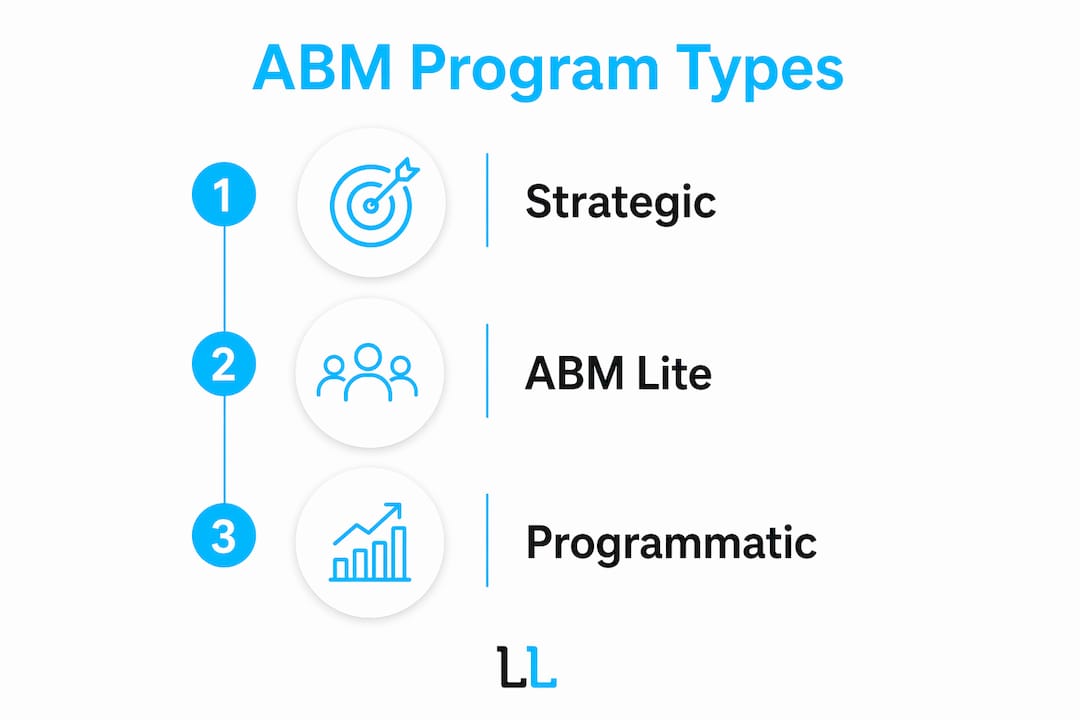
| ABM Type | Scale | Personalization | Best for |
|---|---|---|---|
| Strategic (one-to-one) | 5–50 accounts | Fully bespoke content and outreach per account | Enterprise deals with very high contract values |
| ABM Lite (one-to-few) | 50–500 accounts | Customized by account cluster or segment | Mid-market accounts with shared characteristics |
| Programmatic (one-to-many) | 500+ accounts | Automated personalization at scale with AI | High-volume account lists requiring consistent touchpoints |
Strategic ABM delivers the deepest personalization. A professional services firm pursuing five Fortune 500 accounts might build a dedicated microsite, custom research report, and executive briefing for each one. The investment is high, but so is the deal value.
ABM Lite groups accounts by shared traits, such as industry vertical or company size, and customizes messaging at the segment level. This model works well for firms with a defined mid-market segment and a repeatable sales motion.
Programmatic ABM uses automation and AI to deliver personalized content and outreach across hundreds or thousands of accounts simultaneously. It sacrifices some depth for scale, but modern AI tools have narrowed that gap considerably. Automation in B2B marketing now makes programmatic ABM viable even for smaller teams.
What are the benefits of account based marketing?
ABM produces measurable gains across every stage of the B2B revenue cycle. The ROI advantage is the most cited benefit, but the operational improvements are equally significant.
- Higher win rates. Personalized, account-specific campaigns resonate more deeply with buying committees than generic content.
- Shorter sales cycles. Coordinated sales and marketing engagement moves accounts through the pipeline faster.
- Better budget efficiency. Resources concentrate on accounts most likely to close, eliminating waste on unqualified leads.
- Stronger customer relationships. Accounts feel understood rather than marketed at, which builds trust before the first sales call.
- Expanded lifetime value. ABM applies equally to upsell, cross-sell, and renewals, not just new customer acquisition.
The ROI data is worth pausing on. A quarter of organizations running mature ABM programs report 51–200% higher returns compared to traditional marketing. That is not a marginal improvement. It reflects what happens when every marketing dollar targets an account already identified as a strong fit.
Sales and marketing alignment is another underrated benefit. ABM forces both teams to agree on which accounts matter, what success looks like, and how to engage each stakeholder. That shared clarity reduces friction and accelerates decisions across the entire revenue team.
How to implement an effective ABM strategy
Execution separates ABM programs that deliver results from those that stall after the first campaign. The foundation is an accurate ICP. Without it, your account list will include poor-fit targets that drain resources and distort your metrics.
Start by analyzing your best existing customers. Look for patterns in industry, company size, tech stack, buying process, and the problems they hired you to solve. Use those patterns to define your ICP, then apply it to build your initial target account list. Proven ways to target ideal clients in B2B consistently point back to this step as the highest-leverage activity in the entire program.
Sales and marketing alignment is the second critical requirement. Both teams must share account-level KPIs rather than separate lead-based metrics. Shifting from lead-based KPIs to Marketing Qualified Accounts and account engagement scores is one of the most common stumbling blocks for teams new to ABM. Agree on definitions, shared dashboards, and joint account reviews before launching campaigns.
Key implementation steps include:
- Define your ICP with firmographic, technographic, and behavioral criteria.
- Build a tiered account list segmented by strategic value and ABM model (one-to-one, one-to-few, one-to-many).
- Create account-specific content including personalized messaging, case studies relevant to the account’s industry, and tailored outreach sequences.
- Align sales and marketing on shared account goals, engagement cadences, and pipeline metrics.
- Track account engagement scores rather than individual lead counts to measure program health.
Pro Tip: Use inbound marketing as your ABM foundation. Content that attracts organic traffic also reveals which accounts are actively researching your solutions. Those inbound signals feed directly into your account prioritization and engagement triggers.
Common pitfalls include selecting too many accounts at launch, skipping the ICP validation step, and measuring ABM with legacy lead-generation metrics. Start with a focused pilot of 20–50 accounts, prove the model, then expand.
How does ABM complement other marketing strategies?
ABM is not a replacement for inbound or outbound marketing. It works best as a coordinating layer that directs resources toward the accounts your other channels have already identified as high-value. Inbound marketing feeds intelligence into ABM by surfacing which accounts engage with your content, attend your webinars, or search for your solutions.
The technology stack powering ABM has changed significantly. Early ABM programs relied on manual research and spreadsheet-based account tracking. ABM has evolved into an AI-driven operating model that uses real-time signals, automated orchestration, and account-level measurement to run programs at a scale that was previously impossible without large teams.
| Technology Component | Function in ABM |
|---|---|
| Intent data platforms | Identify accounts showing active buying signals |
| CRM and MAP integration | Sync account data between sales and marketing systems |
| AI personalization tools | Generate account-specific content and messaging at scale |
| Account engagement scoring | Measure and prioritize accounts by engagement depth |
| LinkedIn outreach automation | Deliver personalized messages to key stakeholders within target accounts |
LinkedIn deserves specific attention for professional services firms. Customized LinkedIn outreach reaches decision-makers directly within their professional context, making it one of the highest-converting channels for ABM execution. Combining intent data with LinkedIn automation creates a feedback loop where the most engaged accounts receive the most tailored outreach.
For firms exploring ABM in professional services sectors like accounting or consulting, SEO strategies for CPAs offer a useful parallel: both disciplines require precise audience targeting and consistent content relevance to build trust with high-value clients.
Key Takeaways
Account-based marketing delivers superior B2B results because it concentrates sales and marketing resources on pre-selected, high-fit accounts rather than filtering leads after the fact.
| Point | Details |
|---|---|
| ABM definition | ABM treats each high-value account as its own market with tailored campaigns and coordinated sales engagement. |
| ROI advantage | Mature ABM programs deliver 21–200% higher ROI than traditional marketing, according to Forrester-aligned research. |
| Three ABM models | Strategic, ABM Lite, and Programmatic differ in scale and personalization depth; choose based on account volume and deal value. |
| Sales-marketing alignment | Shared account-level KPIs, not lead counts, are the measurement standard that makes ABM programs succeed. |
| Technology accelerates ABM | AI-driven intent data, engagement scoring, and LinkedIn automation now make ABM viable for teams of any size. |
Why ABM is the most misunderstood strategy in B2B marketing
Most teams I see adopt ABM for the wrong reason. They hear “personalization at scale” and assume it means writing custom subject lines for 10,000 contacts. That is not ABM. That is email marketing with extra steps.
The real power of ABM is the account selection decision. Choosing which 50 accounts to pursue with full resources is a strategic act that forces your sales and marketing teams to agree on what a great customer actually looks like. That conversation alone is worth more than most campaigns.
The second thing teams consistently underestimate is the measurement shift. Dropping lead-based metrics feels uncomfortable at first. Pipeline contribution per account and account engagement scores look unfamiliar on a dashboard. But those metrics tell you something lead counts never could: whether the right people at the right companies are paying attention to you.
I have also watched ABM programs fail because they stopped at acquisition. ABM applied to upsell and renewal cycles is where some of the highest returns actually live. Your existing customers are already in your ICP. They already trust you. Running coordinated, personalized campaigns to expand those relationships is ABM at its most efficient.
The firms that get the most from ABM treat it as an operating model, not a campaign type. They build the ICP, align the teams, instrument the data, and run the program continuously. The results compound over time in a way that one-off campaigns never do.
— Toby
How The Lead Lab helps you build and run ABM programs
Running a real ABM program requires more than a target account list. It requires precise ICP definition, personalized outreach at scale, and the sales-marketing alignment to act on every signal your accounts send.
The Lead Lab specializes in exactly this work for professional services firms. From defining your ideal accounts to building and executing tailored LinkedIn campaigns that reach the right stakeholders, The Lead Lab handles the execution so your team can focus on closing. The agency’s done-for-you model covers prospect targeting, message copywriting, response management, and campaign analytics. If you want to see what a focused ABM program looks like in practice, the client portfolio shows the results across multiple professional services sectors.
FAQ
What is the account based marketing definition?
Account-based marketing is a B2B strategy that treats individual high-value accounts as distinct markets, using personalized campaigns and coordinated sales and marketing engagement to win and grow those accounts.
How does ABM differ from traditional marketing?
Traditional marketing generates broad leads and filters them afterward. ABM selects target accounts first, then builds tailored campaigns specifically for those accounts, which produces higher conversion rates and shorter deal cycles.
What are the three types of ABM programs?
The three types are Strategic (one-to-one), ABM Lite (one-to-few), and Programmatic (one-to-many). They differ in the number of accounts targeted and the depth of personalization applied to each.
What metrics should you use to measure ABM success?
ABM programs measure success with account-level metrics including Marketing Qualified Accounts, account engagement scores, pipeline velocity per account, and deal win rates. Lead volume counts are not a reliable ABM performance indicator.
Can small teams run an effective ABM program?
Yes. AI-driven tools for intent data, engagement scoring, and LinkedIn outreach automation make ABM accessible to smaller teams. Starting with a focused list of 20–50 accounts and a clear ICP is the most practical entry point.