TL;DR:
- A sales funnel is a step-by-step framework that guides prospects from initial contact to a closed deal, whether deliberately designed or not. It consists of stages like awareness, interest, decision, and action, with intentional structure improving conversion rates. Automation enhances efficiency by using software to move leads through stages faster, but it requires a proven manual process for effectiveness.
A sales funnel is defined as the step-by-step framework that moves prospects from first contact with your brand through to a closed deal. Every business has one, whether they’ve designed it deliberately or not. The difference between a funnel that converts and one that leaks is intentional structure. Tools like Salesforce, HubSpot, and Monday.com have built entire product lines around this concept because the AIDA model, which originated in 1924, still holds up as the backbone of modern customer acquisition strategy.
What is a sales funnel and how does it work?
A sales funnel is a visual roadmap of the customer journey, typically divided into four key stages: Awareness, Interest, Decision, and Action. Most models outline 3–6 stages, evolving from initial discovery through to purchase and, in modern versions, retention. The “funnel” shape is intentional. A large pool of prospects enters at the top, and a smaller, more qualified group exits at the bottom as paying customers.
Each stage serves a distinct purpose. Awareness is where a prospect first encounters your brand, often through content, ads, or referrals. Interest is where they engage more deeply, reading case studies, watching demos, or signing up for a newsletter. Decision is where they compare options and evaluate your offer. Action is the moment they buy, book, or sign.
The funnel also reveals where you lose people. If 500 prospects enter Awareness but only 10 reach Action, the drop-off points between stages tell you exactly where your process breaks down. CRM platforms like Salesforce and HubSpot use funnel visualization dashboards to surface these gaps in real time.
Pro Tip: Map your funnel stages against your actual sales data before you build anything new. You will almost always find that the biggest drop-off is not where you assumed it was.
Sales funnel stages: goals and tactics
| Stage | Primary Goal | Common Tactics |
|---|---|---|
| Awareness | Generate visibility | SEO, LinkedIn outreach, paid ads |
| Interest | Build engagement | Email sequences, webinars, content |
| Decision | Overcome objections | Case studies, demos, proposals |
| Action | Close the deal | Offers, follow-ups, contracts |
| Retention | Drive repeat business | Onboarding, upsells, advocacy programs |
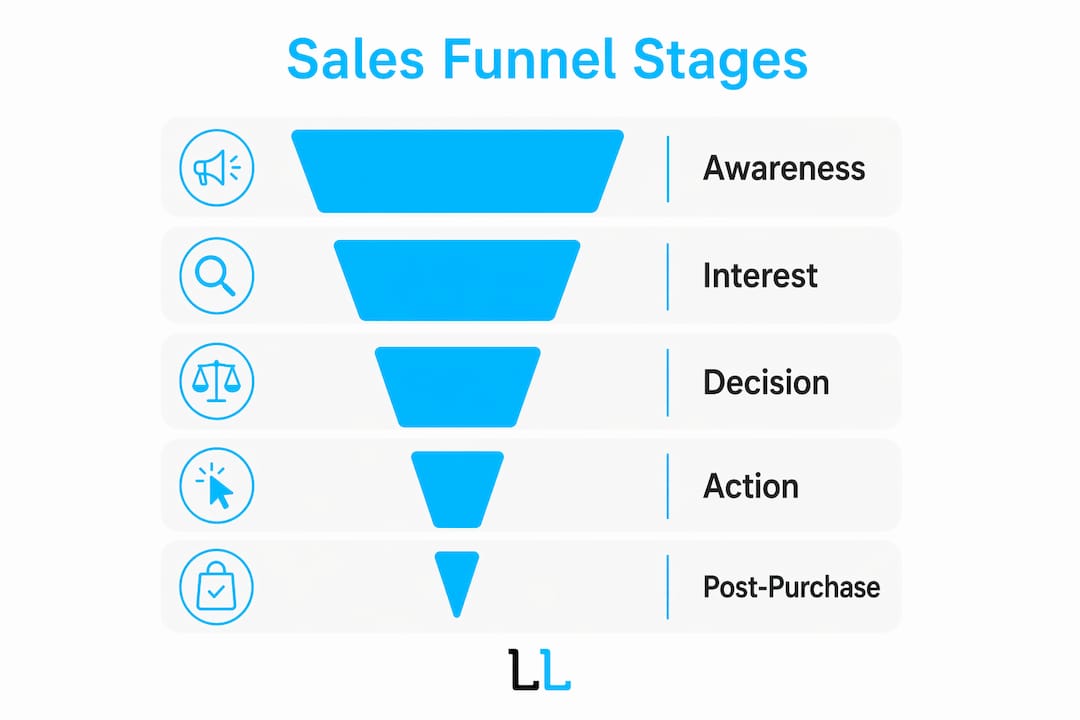
One detail most guides skip: prospects rarely move linearly through these stages. A prospect might jump from Awareness to Decision after reading one strong case study, or fall back from Interest to Awareness after a competitor catches their attention. Flexible nurturing strategies account for this reality.
How does sales funnel automation work?
Sales funnel automation is defined as the use of software to move prospects through funnel stages with minimal manual effort, using tools like email sequences, SMS follow-ups, chatbots, and AI lead scoring. Automation follows a 7–9 step process in most modern implementations, reducing routine manual outreach so your sales team can focus on closing deals rather than chasing cold leads.

A typical automated funnel works like this. A prospect fills out a lead capture form on your website. That action triggers a CRM workflow in a platform like HubSpot or Monday.com. The system tags the lead, assigns a score based on behavior, and fires off a personalized email sequence. If the lead clicks a pricing page, the system escalates them to a sales rep automatically.
Automation enables faster, personalized follow-ups and improves conversion rates by removing the delays that kill deals. A lead contacted within five minutes of showing intent converts at a dramatically higher rate than one contacted 24 hours later. Automation makes that five-minute window achievable at scale.
Automation best practices
- Define your manual funnel process completely before you automate a single step.
- Segment your leads by behavior, industry, and stage before building sequences.
- Use AI lead scoring to prioritize outreach on the highest-intent prospects.
- Test each automated touchpoint individually before running the full sequence.
- Review automation performance monthly and cut sequences that underperform.
The biggest mistake entrepreneurs make with sales funnel automation is deploying it too early. Over-automation without a proven manual process scales your mistakes, not your results. If your manual funnel converts poorly, automation will simply deliver that poor experience faster and to more people.
Pro Tip: Run your funnel manually for at least 30 days before automating. Document every touchpoint, message, and objection. That documentation becomes your automation blueprint.
Sales funnel vs. marketing funnel: what’s the difference?
A marketing funnel and a sales funnel are not the same thing, though most businesses treat them as interchangeable. The marketing funnel focuses on top-of-funnel awareness and education, attracting and nurturing a broad audience until they are ready to engage with sales. The sales funnel picks up from that point, focusing on moving qualified leads through evaluation and closing.
The practical implication is that marketing owns the top of the funnel and sales owns the bottom. When these two teams do not share data, leads fall through the gap between them. The solution most high-performing organizations use is a combined “revenue funnel” that tracks the full journey from first click to signed contract.
Marketing funnel vs. sales funnel at a glance
| Dimension | Marketing Funnel | Sales Funnel |
|---|---|---|
| Primary focus | Awareness and education | Qualification and closing |
| Key activities | Content, SEO, paid ads | Demos, proposals, follow-ups |
| Owned by | Marketing team | Sales team |
| Success metric | Lead volume and quality | Conversion rate and revenue |
| Entry point | Cold audience | Marketing-qualified lead |
The revenue funnel concept matters most for professional services firms where the sales cycle is long and trust-building is critical. Lead generation strategies on LinkedIn, for example, often blend marketing and sales activities in a single outreach sequence, making the distinction between the two funnels less rigid in practice.
How to build an effective sales funnel for your business
Building a sales funnel that actually converts starts with defining the problem your product or service solves and for whom. Effective sales funnels must be tailored to your specific industry, sales cycle length, and product complexity. A generic template borrowed from a SaaS company will not work for a consulting firm with a 90-day sales cycle.
Follow this sequence to build yours:
- Define your ideal customer. Identify the specific problem they have, the language they use to describe it, and the objections they raise before buying.
- Map your stages. Decide how many stages your funnel needs based on your sales cycle. A transactional B2C product might need three stages. A complex B2B service might need six.
- Build your offers for each stage. A top-of-funnel offer might be a free guide or LinkedIn post. A mid-funnel offer might be a case study or discovery call. A bottom-funnel offer is your proposal or pricing conversation.
- Qualify leads early. Use intake forms, scoring criteria, or a brief qualification call to filter out prospects who are not a fit before investing significant time.
- Nurture with intent. Lead nurturing strategies for professional services require personalization. A sequence of five generic emails will not move a CFO closer to a decision.
- Track your metrics. Measure conversion rate at each stage, average deal cycle length, and cost per acquisition. These three numbers tell you where to focus improvement.
For B2B funnels specifically, prospect segmentation is one of the highest-leverage activities you can invest in. Sending the same message to a startup founder and a Fortune 500 VP produces weak results for both. Segment by company size, role, and buying stage, then tailor your messaging accordingly.
Post-purchase engagement is the stage most entrepreneurs skip entirely. Upselling, referral programs, and advocacy campaigns extend the funnel into a continuous growth cycle. Ignoring retention means you are constantly refilling a leaky bucket instead of building a compounding asset.
Pro Tip: Conversion rate optimization at the bottom of your funnel delivers faster ROI than generating more top-of-funnel traffic. Fix your close rate before you spend more on ads.
Key takeaways
A well-structured sales funnel is the single most reliable mechanism for turning consistent lead flow into predictable revenue.
| Point | Details |
|---|---|
| Funnel stages drive clarity | Map Awareness, Interest, Decision, and Action stages to identify where prospects drop off. |
| Automation amplifies proven processes | Build and validate your manual funnel before deploying CRM or email automation tools. |
| Marketing and sales funnels differ | Marketing generates leads; sales converts them. Align both teams around a shared revenue funnel. |
| Customization beats templates | Tailor funnel stages and nurturing intensity to your sales cycle length and product complexity. |
| Retention extends the funnel | Post-purchase engagement through upsells and advocacy programs compounds revenue over time. |
The funnel model i’ve changed my mind about
I spent years treating the sales funnel as a linear pipeline. Prospect in, deal out. It felt clean and manageable. What I’ve learned from working with professional services firms is that the linear model flatters the seller and ignores the buyer.
Real buyers circle back. They revisit your content weeks after going quiet. They forward your proposal to a colleague who raises new objections. They say yes in principle and then go dark for a month. The flywheel model from HubSpot captures this better because it treats customer advocacy as a growth input, not a bonus outcome.
My honest view on automation: most businesses automate too fast. They see a tool like Monday.com or a CRM workflow and assume the technology will fix a conversion problem that is actually a messaging problem. Automation is an amplifier. If your message does not resonate manually, it will not resonate at scale either.
What actually works is building the funnel by hand first, learning where conversations stall, and then automating the parts that are already working. That approach takes longer upfront but produces automation that feels personal rather than mechanical. And in professional services, where trust is the product, that distinction is everything.
— Toby
How the lead lab helps you build funnels that convert
Understanding the theory of a sales funnel is one thing. Building one that generates qualified meetings for your professional services firm is another challenge entirely.
The Lead Lab specializes in done-for-you LinkedIn outreach campaigns that function as a fully structured lead generation funnel, from targeted prospect identification through to booked discovery calls. Every campaign includes prospect targeting, personalized message copywriting, response management, and campaign analytics so you can see exactly where leads are converting and where they are not. If you want to see what a scalable lead generation system looks like in practice, explore The Lead Lab’s client results or visit The Lead Lab to request a consultation.
FAQ
What is the sales funnel definition in simple terms?
A sales funnel is the structured path a prospect follows from first discovering your brand to making a purchase. Most models use 3–6 stages, with Awareness, Interest, Decision, and Action being the most common framework.
What is sales funnel automation?
Sales funnel automation uses software to move leads through funnel stages automatically via email sequences, SMS, chatbots, and AI lead scoring. Automation reduces manual tasks and enables faster follow-ups, but it works best when applied to a funnel that already converts manually.
How does a sales funnel differ from a marketing funnel?
A marketing funnel focuses on generating and educating a broad audience, while a sales funnel focuses on converting qualified leads into paying customers. The two funnels overlap to form a combined revenue funnel that tracks the full customer journey.
How many stages should a sales funnel have?
The right number depends on your product complexity and sales cycle length. Simple B2C products often need three stages, while complex B2B services may require five or six. Generic templates frequently fail because they do not account for industry-specific buyer behavior.
What metrics should i track in a sales funnel?
Track conversion rate at each stage, average sales cycle length, and cost per acquisition. These three metrics reveal exactly where your funnel is performing and where it needs attention.