
TL;DR:
- A sales cycle is a repeatable process guiding sales from initial contact to deal closure and expansion. Top teams cut cycle length by 30-40% through disciplined prospecting, data use, and clear stage criteria. Proper cycle management enables predictable revenue and more accurate forecasting.
A sales cycle is defined as the repeatable, stage-gated sequence a sales team follows to move a prospect from first contact to closed deal and beyond. Every B2B sales organization runs one, whether they have named it or not. The difference between teams that hit quota consistently and those that miss it often comes down to how deliberately they manage each stage. The median B2B sales cycle runs 84 days, and top performers cut that by 30–40% through disciplined prospecting and data use. Understanding the sales cycle is not an academic exercise. It is the operational foundation of predictable revenue.
Sales cycle explained: what it is and why it matters
A sales cycle is the structured, repeatable process that guides a salesperson from identifying a potential buyer to closing a deal and expanding the relationship. The industry standard term is “sales cycle,” though sales teams also refer to it as the “sales process” when describing the internal playbook that governs each stage.
The sales cycle differs from two concepts teams often confuse it with. The sales funnel is a marketing concept that describes how a large pool of prospects narrows to a smaller group of buyers. The sales pipeline is a snapshot of where active deals sit at any given moment. The sales cycle is the operational infrastructure underneath both. It defines what must happen, in what order, for a deal to advance.
Without a defined sales cycle, sales become ad hoc efforts that block reliable forecasting and repeatable wins. That is the core problem. When every rep handles deals differently, revenue becomes unpredictable and coaching becomes guesswork.
The sales cycle also matters for forecasting accuracy. When stage definitions are clear and consistently applied, managers can predict close dates with real confidence. A deal in Stage 4 with defined exit criteria met means something specific. A deal “almost closed” with no criteria means nothing.
What are the typical stages of a sales cycle?
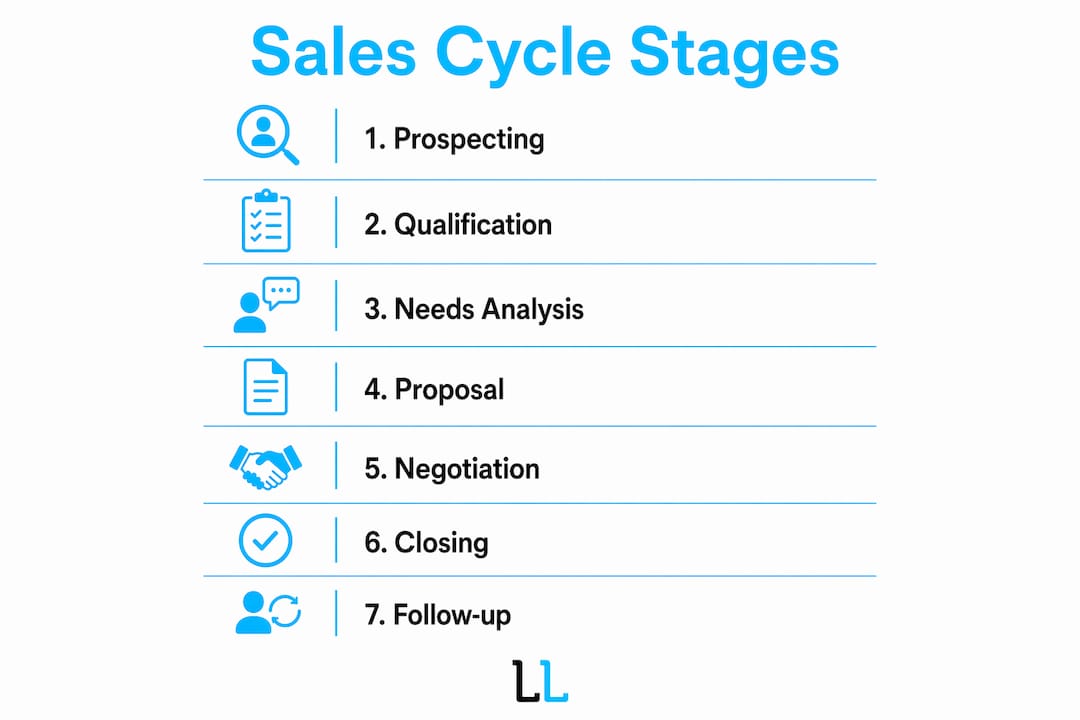
Most high-performing sales organizations use 5–7 stages, with strict entry and exit rules carrying more weight than the number of stages itself. The labels vary by company, but the sequence and discipline stay consistent.
The seven most common stages are:
- Prospecting. The rep identifies potential buyers who fit the ideal customer profile. The goal is volume with targeting, not random outreach. Techniques like signal-based prospecting and enriched contact data sharpen this stage significantly.
- Qualification. The rep determines whether the prospect has the budget, authority, need, and timeline to buy. Deals that fail qualification here save the team weeks of wasted effort later.
- Discovery. The rep uncovers the prospect’s specific pain points, business goals, and decision process. This stage sets up every conversation that follows.
- Presentation. The rep presents a tailored solution. Generic demos lose deals. The best presentations tie directly back to what discovery surfaced.
- Objection handling. The rep addresses concerns around price, timing, competition, or internal priorities. Objections at this stage are normal and expected.
- Negotiation and closing. Both sides agree on terms. This stage includes legal review, security assessments, and procurement sign-off in enterprise deals.
- Post-sale expansion. The rep or account manager works to retain and grow the account. This stage is where customer lifetime value is built.
Pro Tip: Map the buyer’s full decision process during discovery, including legal and security reviews. Deals that hit unexpected procurement steps in the final stage almost always stall because the rep never asked about the “paper process” early on.
Each stage needs a clear exit criterion. “The prospect seemed interested” is not an exit criterion. “The prospect confirmed budget, named the decision-maker, and agreed to a demo” is. The difference between these two definitions is the difference between a healthy pipeline and a pipeline full of wishful thinking.
How does sales cycle length vary by deal complexity?
Sales cycle length is not fixed. SMB SaaS deals can close in days or weeks, while enterprise contracts routinely take 3–12 months. That range reflects real differences in buying complexity, not just sales team speed.

The single biggest driver of longer cycles is buying committee size. The average B2B buying committee includes 6.8 stakeholders. Each additional stakeholder adds review time, competing priorities, and the risk of internal disagreement. A deal that one champion loves can stall for months waiting for a CFO to approve it.
| Deal type | Typical cycle length | Key complexity driver |
|---|---|---|
| SMB SaaS | Days to 4 weeks | Single decision-maker, low contract value |
| Mid-market | 1–3 months | Small committee, moderate procurement process |
| Enterprise | 3–12 months | Large buying committee, legal and security review |
Procurement processes add another layer. Enterprise buyers often require vendor security questionnaires, legal redlines, and multi-level budget approvals before a contract can be signed. These steps are not negotiable. Reps who treat them as surprises extend their own cycles unnecessarily.
The important distinction is between genuine complexity and internal inefficiency. A six-month enterprise deal with a 12-person buying committee is genuinely complex. A six-month deal with a single buyer and no procurement process is a sign of a broken sales cycle. Cycle compression means removing the wasted time, not rushing the buyer through steps they actually need.
What practices improve sales cycle performance?
Improving the sales cycle comes down to operational discipline, not tricks. The teams that consistently compress their cycles do four things well.
-
Define entry and exit criteria for every stage. A deal does not advance because a rep says it does. It advances when specific conditions are met. Deals that skip exit criteria stall in later stages and corrupt forecast accuracy. Build a one-page stage definition document and enforce it in every pipeline review.
-
Separate the sales cycle from the sales methodology. The cycle defines what happens and when. Sales methodologies like MEDDPICC and SPIN define how reps execute within each stage. Confusing the two leads to inconsistent application of both. Use the cycle as the skeleton and the methodology as the muscle.
-
Apply multi-threading from the start. Single-threaded deals, where the rep has one contact at the buyer’s company, are fragile. If that contact leaves, changes roles, or loses internal support, the deal dies. Build relationships with multiple stakeholders during discovery and presentation. This is especially critical in enterprise deals with large buying committees.
-
Use enriched data for prospecting and qualification. Reps who qualify leads with better data spend less time on prospects who will never buy. Better qualification at the top of the cycle compresses every stage that follows.
Pro Tip: Run a monthly “stage audit” where every deal in the pipeline must prove it meets the exit criteria for its current stage. Deals that cannot prove it get moved back. This one practice eliminates pipeline inflation and makes forecasts dramatically more accurate.
A common pitfall is adding too many stages. Teams that build 12-stage cycles often do so to feel thorough. The result is confusion about where deals actually sit and friction in every pipeline review. Five to seven stages with clear rules outperform twelve stages with vague ones every time.
How does the sales cycle improve forecasting and pipeline management?
The sales cycle is operational infrastructure. A defined sales cycle makes revenue repeatable and forecastable in a way that ad hoc selling never can. This is the most underappreciated benefit of cycle management.
When every rep follows the same stage definitions, managers can read the pipeline with confidence. A deal in Stage 5 means the same thing across the entire team. That consistency is what makes forecast calls meaningful rather than a collection of individual opinions.
Cycle data also reveals where deals stall. If 60% of deals that reach Stage 3 never make it to Stage 4, that is a discovery problem, not a closing problem. Fixing the right stage with the right intervention is only possible when you have consistent stage data to analyze. Without it, sales leaders apply generic fixes to unknown problems.
Practical applications of cycle data include:
- Identifying the average time deals spend in each stage and flagging outliers for coaching.
- Calculating sales velocity, which combines deal count, average deal size, win rate, and cycle length into a single revenue-per-day metric.
- Spotting seasonal patterns in cycle length that affect quarterly forecasting.
- Aligning prospect segmentation to cycle stage so that outreach matches where the buyer is in their decision process.
Separating cycle definition from methodology application helps teams maintain clear operational discipline while still optimizing their selling tactics. The cycle tells you where a deal is. The methodology tells you what to do about it.
Key Takeaways
A well-defined sales cycle is the single most reliable foundation for consistent revenue, accurate forecasting, and faster deal closure across any B2B sales team.
| Point | Details |
|---|---|
| Define the cycle clearly | A sales cycle is a repeatable, stage-gated process from first contact to closed deal and expansion. |
| Use 5–7 stages with exit criteria | Stage count matters less than enforcing clear entry and exit rules at every step. |
| Cycle length reflects deal complexity | Enterprise deals run 3–12 months due to buying committees averaging 6.8 stakeholders. |
| Compress cycles by removing waste | Top performers cut cycle length by 30–40% through better data and prospecting, not by rushing buyers. |
| Use cycle data to fix the right problems | Stage-level analytics reveal exactly where deals stall, so fixes target the real bottleneck. |
Why most sales teams get the cycle wrong
The most common mistake I see is treating the sales cycle as a labeling exercise. Teams spend a day naming their stages, add them to the CRM, and then never enforce them. Six months later, the pipeline is full of deals that have been “in negotiation” for three months with no actual negotiation happening.
The second mistake is conflating the sales cycle with a sales methodology. MEDDPICC is a qualification framework. SPIN is a questioning technique. Neither is a sales cycle. When teams mix these up, they end up with a 10-step “cycle” that is really a checklist of tactics with no clear stage logic. Reps get confused, managers get inconsistent data, and forecasts become fiction.
What actually works is treating the sales cycle as living infrastructure. You build it, you enforce it, and then you measure it. Every quarter, you look at where deals stall and ask why. You adjust the exit criteria, update the coaching, and run the cycle again. The teams I have seen do this consistently are the ones that hit quota in down markets and blow past it in good ones.
The appointment setting process is a good example of where cycle discipline pays off early. Reps who treat the first meeting as a qualification checkpoint, not just a relationship call, enter discovery with far better information. That single habit compresses every stage that follows.
— Toby
How The Lead Lab supports your sales pipeline
Building a sales cycle is one thing. Filling it with qualified prospects consistently is another challenge entirely.
The Lead Lab specializes in done-for-you LinkedIn outreach and lead generation for professional services firms. The team handles targeted prospecting, personalized message copywriting, response management, and campaign analytics so your sales team spends time on qualified conversations, not cold list building. Every campaign is built around your ideal buyer profile and designed to deliver meetings that fit your cycle’s qualification criteria from the first call. Visit The Lead Lab to see how the service works, or review the client portfolio to see results from firms in your space.
FAQ
What is a sales cycle in simple terms?
A sales cycle is the repeatable sequence of steps a sales team follows to turn a prospect into a paying customer. It typically runs from prospecting through to closing and post-sale expansion.
How long does a typical B2B sales cycle last?
The median B2B sales cycle is 84 days, but length varies widely. SMB deals can close in days or weeks, while enterprise deals often take 3–12 months depending on buying committee size and procurement complexity.
What is the difference between a sales cycle and a sales funnel?
The sales funnel is a marketing concept showing how prospects narrow toward a purchase. The sales cycle is the operational process sales teams follow to move individual deals through defined stages to close.
How many stages should a sales cycle have?
Most high-performing teams use 5–7 stages. The number matters less than having clear entry and exit criteria for each stage to prevent deals from stalling or advancing prematurely.
How can sales teams shorten their sales cycle?
Top performers reduce cycle length by 30–40% through better prospecting data, stricter qualification, and multi-threading across the buying committee. Removing internal inefficiencies, not rushing buyers, is what compresses the cycle.