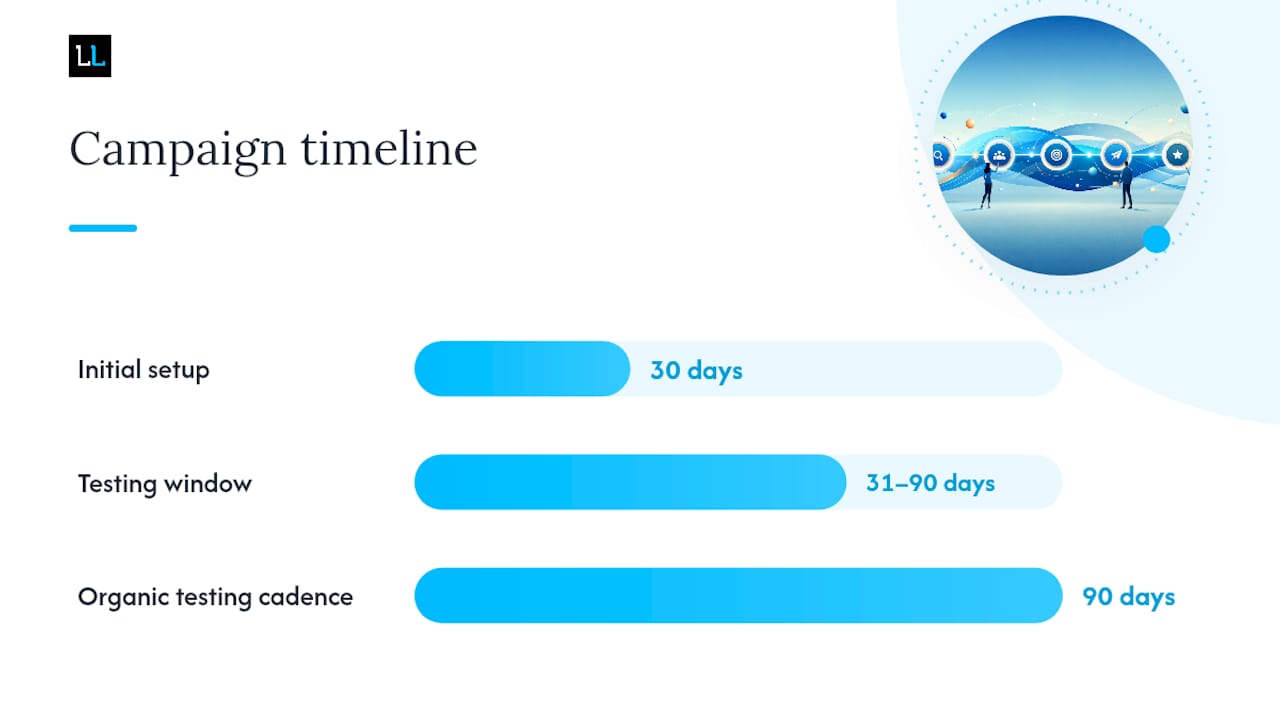
The most effective LinkedIn marketing plan for businesses combines an optimized Company Page, executive-led content, ABM-style paid campaigns using LinkedIn Campaign Manager and Lead Gen Forms, and a 90-day organic testing cadence. Get those four elements working together and you have a repeatable system for qualified B2B leads, not just impressions.
Here is what to do in the first 30 days:
- Complete your Company Page (banner, keyword-rich tagline, About section, services tab, and a custom CTA button)
- Identify 2–3 executives who will post consistently, and set up their profiles with value-proposition headlines
- Install the LinkedIn Insight Tag on your website and connect it to your CRM
- Define your ICP: job title, seniority, company size, and industry
- Set a baseline budget for one test campaign, even $1,500–$3,000/month, to generate early data
Then spend days 31–90 testing content formats, refining targeting, and measuring cost-per-lead against your pipeline benchmarks. The Lead Lab’s done-for-you outreach service is worth considering once you have validated your ICP and want to scale without adding headcount.
Pro Tip: Executive posts consistently outperform Company Page posts in organic reach. Get one or two leaders posting before you invest heavily in paid ads — their content will warm your audience and lower your ad CPCs.
Key Takeaways
Marketing on LinkedIn for businesses works when you combine an optimized Company Page, executive-led content, ABM-style paid campaigns, and CRM-first measurement into a single, coordinated system.
| Point | Details |
|---|---|
| Optimize Page and exec profiles | Complete every field with buyer-facing language and keywords before running any paid campaigns. |
| Define your ICP tightly | Job title, seniority, company size, and industry must be set before targeting or outreach begins. |
| Run a 90-day organic test | Post 3–5x per week from your Page and 1–3x per week from executives; track which formats generate ICP comments. |
| Use Lead Gen Forms for cold audiences | Lead Gen Forms convert well for cold campaigns but require immediate CRM sync and follow-up to maintain quality. |
| Integrate Insight Tag and CRM from day one | Without conversion tracking and CRM sync, you cannot measure pipeline influence or optimize CPL. |
| Consider The Lead Lab for faster pipeline | The Lead Lab’s done-for-you outreach delivers qualified meetings with verified accounts, personalized messaging, and full CRM integration. |
Table of Contents
- Why LinkedIn works differently for business marketing
- How do you set goals and KPIs that actually measure pipeline?
- How do you optimize your Company Page and executive profiles for discovery?
- What content strategy actually works on LinkedIn in 2026?
- How do organic engagement and outreach build your LinkedIn funnel?
- What do you need to know about LinkedIn paid ads and Campaign Manager?
- How do you measure LinkedIn performance and set up proper attribution?
- What are realistic timelines and budgets for LinkedIn marketing results?
- What mistakes kill LinkedIn marketing results?
- When should you outsource LinkedIn marketing, and what should a good agency deliver?
- What actually moves the needle on LinkedIn, from an agency perspective
- The Lead Lab delivers qualified meetings, not just LinkedIn activity
- Sources
Why LinkedIn works differently for business marketing
LinkedIn is not just another social channel with a professional coat of paint. The targeting precision is categorically different from Meta or Google. You can reach a VP of Finance at a 500-person SaaS company in Austin, Texas, and exclude anyone outside that exact profile. No other platform gives you that combination of professional intent and demographic specificity at scale.
According to Sprout Social, LinkedIn is the leading platform for B2B marketing, consistently delivering higher lead quality than generalist social platforms for B2B marketers. That tracks with what practitioners see in the field: the audience is on LinkedIn because they are thinking about work, not scrolling to unwind.
A few platform strengths that matter for business marketing:
- Professional targeting signals: Job title, function, seniority, company size, industry, and skills are first-party data points LinkedIn members fill in themselves, making them more reliable than inferred behavioral data
- Audience intent: Members are in a professional mindset, which means content about business problems, industry trends, and career growth lands differently than it would on Instagram
- Organic and paid complement each other: Organic content builds trust and warms audiences; paid campaigns reach cold accounts at scale. Running both together lowers your cost-per-lead over time
- Thought leadership at scale: LinkedIn Newsletters, long-form Articles, and Thought Leader Ads let you position executives as credible voices in your niche, which shortens sales cycles
- B2B lead generation: LinkedIn’s ad platform is built specifically for B2B objectives, with Lead Gen Forms, account-based targeting, and CRM integrations that generalist platforms do not offer natively
The organic/paid combination is where most businesses leave money on the table. They either post content and hope, or run ads without any organic presence to back them up. The businesses that win on LinkedIn treat both channels as one system.
How do you set goals and KPIs that actually measure pipeline?
Vanity metrics are LinkedIn’s biggest trap. Follower counts and impressions feel good but tell you nothing about revenue. Before you post a single piece of content or spend a dollar on ads, map your LinkedIn objectives to business outcomes.
The four primary objectives for B2B LinkedIn marketing are lead generation, pipeline influence, brand awareness, and recruitment. Each one needs different KPIs and a different measurement setup.
| Metric | What it measures | Business goal |
|---|---|---|
| Lead form completions | Volume of inbound leads from paid campaigns | Lead generation |
| Cost-per-lead (CPL) | Efficiency of paid spend | Lead generation / budget management |
| Engagement rate | Content resonance (likes, comments, shares / impressions) | Brand awareness / thought leadership |
| Click-through rate (CTR) | Ad creative and copy effectiveness | Traffic / pipeline influence |
| Pipeline influenced | Revenue opportunities touched by LinkedIn activity | Pipeline / revenue |
| Follower growth rate | Audience building over time | Brand awareness |
| ICP match rate | Percentage of leads matching your ideal customer profile | Lead quality |
For a 30-day window, focus on setup metrics: Insight Tag firing correctly, baseline engagement rate on organic posts, and first campaign data (impressions, CTR, CPL). By 90 days, you should have enough data to compare CPL across ad types and identify which content formats drive the most qualified traffic. At 180 days, pipeline influence becomes the primary lens, which requires CRM integration and multi-touch attribution.
Hootsuite’s LinkedIn marketing guide frames this well: a strategic LinkedIn program ties every activity back to a measurable business outcome from day one. That means your KPIs need to be set before the first campaign launches, not retrofitted after.
Two metrics that require CRM integration to measure properly: pipeline influenced and ICP match rate. Without syncing LinkedIn conversions to HubSpot, Salesforce, or Microsoft Dynamics, you are flying blind on whether your leads are actually turning into revenue.
How do you optimize your Company Page and executive profiles for discovery?
Your Company Page and your executives’ personal profiles are the first things a prospect checks after seeing your content or ad. If either looks incomplete or generic, you lose the click. Here is what to get right.
Company Page essentials
- Banner image: Use a 1128 x 191px image that communicates your value proposition visually, not just your logo
- Tagline: 120 characters that include your primary keyword and the audience you serve (e.g., “LinkedIn lead generation for professional services firms”)
- About section: Write for your buyer, not your board. Lead with the problem you solve, include 3–5 keywords your ICP would search, and end with a clear CTA
- Services tab: List every service with a short description. LinkedIn surfaces these in search results
- Custom button: Set your Page’s CTA button to “Contact us” or “Visit website” and link it to a relevant landing page, not your homepage
- Content tabs: Keep your posts tab active. A Page with no recent posts signals a dead company
Pro Tip: You can embed a LinkedIn Follow Company Plugin on your website to route site visitors directly to your Page. It takes 15 minutes to set up and compounds follower growth over time.
Executive profile optimization
The executive profile is where most B2B deals actually start. A prospect reads a post, clicks the author’s name, and decides in 10 seconds whether this person is worth talking to.
- Headline: Do not default to your job title. Write a value proposition: “I help [ICP] achieve [outcome] | [Company]”
- About section: Lead with a proof point or a specific result, not a career summary. Include 2–3 keywords your buyers would search
- Profile photo: Professional, well-lit, recent. Profiles with photos get significantly more profile views
- Featured section: Pin your best content, a case study, or a lead magnet
- Contact info: Make it easy to reach you. Add your email and website
For LinkedIn URL personalization, customize every executive’s URL to their name (linkedin.com/in/firstname-lastname). It looks cleaner in email signatures and improves discoverability in Google search.
Profile and Page SEO
LinkedIn’s internal search algorithm works similarly to Google: it rewards keyword relevance and completeness. Use your target keywords in the headline, About section, and job descriptions. Hashtags on posts help with discovery, but keep them to 3–5 per post. More than that reads as spam and LinkedIn’s algorithm has been deprioritizing hashtag stuffing for years.
What content strategy actually works on LinkedIn in 2026?
Content is where most businesses get LinkedIn wrong. They either post too infrequently to build momentum or post too broadly to attract anyone specific. A tight editorial plan fixes both problems.
Formats and when to use them
LinkedIn has been experimenting with short-form video feeds similar to TikTok’s format, and short-form video is now one of the fastest-growing content types on the platform. Here is how to think about each format:
- Short-form video (under 90 seconds): Best for awareness and personality. Show a process, share a quick insight, or react to an industry trend
- Document/carousel posts: High engagement for educational content. Use them for frameworks, checklists, and step-by-step guides
- Text-only posts: Counterintuitively, these often outperform image posts for reach. A sharp opinion or a specific observation with no image gets more comments
- LinkedIn Newsletters: Ideal for building a subscriber base and establishing thought leadership. Subscribers get notified directly, bypassing the algorithm
- Long-form Articles: Lower reach than posts but high credibility. Use them for detailed case studies, research summaries, or position papers
- Polls: Good for engagement and audience research, but use sparingly or they feel gimmicky
Editorial themes by buyer stage
Map your content to where your buyer is in their journey:
- Awareness: Industry trends, contrarian takes, “what most people get wrong about X”
- Consideration: How-to content, frameworks, case studies without a hard sell
- Decision: Client results, ROI data, specific service explanations, and direct CTAs
Posting cadence
Company Pages: 3–5 times per week keeps the algorithm happy and gives you enough data to see what resonates. Executives: 1–3 times per week is sustainable and more effective than daily posting that burns out the author. Employees: 1–2 times per week if you have an advocacy program, but only for content they genuinely find worth sharing.
According to the Content Marketing Institute, LinkedIn’s algorithm rewards consistent, substantive posting from a small set of subject-matter experts over broad volume. A few people posting with real conviction outperform a company-wide mandate to share every press release.
Pro Tip: The first 90 minutes after you post are critical. LinkedIn’s algorithm uses early engagement signals (comments especially, not just likes) to decide how widely to distribute the post. Have 2–3 colleagues ready to leave substantive comments immediately after publishing.
For content optimization that compounds over time, treat each post as a test: track which formats and topics generate comments from your ICP, then double down on those and cut the rest.
How do organic engagement and outreach build your LinkedIn funnel?
Paid ads get you in front of cold audiences fast. Organic outreach builds the relationships that actually close. Both matter, but the mechanics are different.
Building your prospect list
Start with your ICP. Define it tightly: industry, company size, job title, seniority level, and geography. Then use LinkedIn’s search filters to find second-degree connections who match. Second-degree connections convert better than cold outreach because you share a mutual contact, which provides a natural conversation opener.
Before sending a connection request, vet the profile: Is this person actually a decision-maker? Are they active on LinkedIn? Does their company fit your ICP? Sending 50 targeted requests beats sending 500 generic ones.
Connection and DM best practices
Personalization is not optional. A connection request with no note gets ignored at a much higher rate than one with a specific, relevant reason for connecting. Here is a framework that works:
- Reference something specific: a post they wrote, a mutual connection, or a shared industry event
- State why you want to connect in one sentence, without pitching
- After they accept, wait 2–3 days before sending a follow-up message
- The follow-up should add value (share a relevant resource, ask a genuine question) before making any ask
For detailed LinkedIn messaging frameworks that turn conversations into booked calls, the key principle is the same: lead with relevance, not with your pitch.
Engagement tactics that build visibility
Commenting is underrated. A substantive comment on a post by someone in your ICP’s network puts your name in front of their entire audience. Generic comments (“Great post!”) do nothing. Specific, thoughtful responses that add a new angle or a concrete example get noticed.

Congratulatory messages (new role, work anniversary, company milestone) are low-effort, high-goodwill touchpoints. They keep you visible without requiring a full conversation.
Employee advocacy
An employee advocacy program multiplies your organic reach without additional ad spend. The basics:
- Identify 5–10 employees who are active on LinkedIn and willing to share content
- Give them pre-written post options they can customize, not mandated copy to paste verbatim
- Track reach and engagement from employee posts separately from Company Page posts
- Recognize top advocates internally to sustain participation
The networking and relationship-building principles that drive offline business development apply directly here: consistency, genuine interest, and adding value before asking for anything.
What do you need to know about LinkedIn paid ads and Campaign Manager?
LinkedIn Ads are expensive relative to Meta or Google. CPCs regularly run $6–$12 for competitive B2B audiences. That cost is justified when your average contract value is high enough, but it means every campaign decision matters more.
Campaign Manager setup
Before your first campaign, complete these steps:
- Create a Campaign Manager account linked to your Company Page
- Install the LinkedIn Insight Tag on your website (this enables retargeting and conversion tracking)
- Connect your CRM via LinkedIn’s native integrations or a third-party connector
- Set up conversion events (form fills, demo requests, page visits)
- Define your campaign objective before building the ad (awareness, consideration, or conversions)
Ad types and when to use them
LinkedIn’s ad formats cover the full funnel, but not all of them are worth your budget at the same stage:
- Sponsored Content (single image): The workhorse. Good for awareness and mid-funnel content promotion
- Document Ads: High engagement for educational content. Prospects can read a carousel or PDF without leaving the feed
- Video Ads: Strong for brand awareness and demonstrating complex products or services
- Lead Gen Forms: Pre-filled forms that capture contact data without sending prospects to an external page. Convert well for cold audiences, but require immediate CRM sync and follow-up
- Message Ads / Conversation Ads: Delivered directly to LinkedIn inboxes. High open rates but strict LinkedIn policies on frequency and content
- Thought Leader Ads: Promote an executive’s organic post as a paid ad. One of the highest-performing formats for mid-funnel and ABM plays, per Adfirm’s 2026 B2B playbook
- Dynamic Ads: Personalized ads that pull in the viewer’s profile data. Useful for follower campaigns and job ads
Targeting best practices
LinkedIn’s auction mechanics favor narrow, relevant audiences. The sweet spot is 50,000–500,000 members. Below 50K, frequency gets too high and CPCs spike. Above 500K, you are paying for reach that does not convert.
Layer your targeting: start with company size and industry, then add function and seniority. Avoid raw job-title targeting as your only filter; titles vary too much across companies and industries. Matched audiences (uploading a list of target accounts for ABM) are among the most efficient targeting options available.
For B2B audience segmentation that improves conversion rates, the principle is the same: the tighter the audience definition, the more relevant your creative can be, and the lower your effective CPL.
Campaign structure for B2B
Structure three campaign layers with separate budgets:
| Campaign layer | Objective | Primary format |
|---|---|---|
| ABM / target accounts | Awareness + consideration | Sponsored Content, Thought Leader Ads |
| ICP prospecting | Lead generation | Lead Gen Forms, Document Ads |
| Retargeting / lifecycle | Conversion | Message Ads, Sponsored Content with CTA |
Lead Gen Forms convert strongly for cold audiences but require CRM integration and rapid follow-up to maintain lead quality. For warm audiences where qualification matters more than volume, external landing pages with a longer form give you better signal on intent.
How do you measure LinkedIn performance and set up proper attribution?
Most LinkedIn programs fail at measurement, not execution. The Insight Tag is installed but not firing on the right pages. UTMs are inconsistent. CRM records do not capture the LinkedIn source. Fix the tracking stack first, then optimize campaigns.
Minimum tracking requirements
- LinkedIn Insight Tag: Install on every page of your website, not just the homepage. Verify it is firing in Campaign Manager’s Insight Tag dashboard
- UTM parameters: Use a consistent naming convention across all LinkedIn links (source=linkedin, medium=paid or organic, campaign=campaign-name). This is how you separate LinkedIn traffic in Google Analytics 4 or your CRM
- CRM integration: Connect Campaign Manager to HubSpot, Salesforce, or Microsoft Dynamics. Map LinkedIn lead form fields to your CRM contact fields before the first campaign goes live
- Conversion API: Where available, use LinkedIn’s Conversions API alongside the Insight Tag for more accurate attribution, especially as browser privacy restrictions reduce cookie-based tracking
Reporting cadence and interpretation
Weekly: check CTR, CPL, and lead volume by campaign. Monthly: review engagement rate trends on organic content and compare which formats are driving the most ICP-matched leads. Quarterly: pull pipeline influence data from your CRM. How many open opportunities had at least one LinkedIn touchpoint?
Engagement rate on organic posts is a leading indicator of content quality. Pipeline influenced is the lagging indicator that tells you whether any of it converted. You need both to manage the program intelligently.
For scaling beyond native Campaign Manager reporting, tools like HubSpot’s LinkedIn integration, Salesforce’s Marketing Cloud connector, or dedicated analytics platforms give you account-level views that native reporting does not provide.
What are realistic timelines and budgets for LinkedIn marketing results?
LinkedIn is not a fast channel. The businesses that get frustrated and quit after 60 days are usually the ones who set unrealistic expectations at the start.
30/90/180-day milestones
- Days 1–30: Setup phase. Company Page complete, Insight Tag installed, CRM connected, first campaign live, executive profiles optimized, and baseline metrics established
- Days 31–90: Testing phase. Run 2–3 ad variations per campaign, test 2 content formats per week on organic, and identify which ICP segments respond best. Expect CPL to be higher than your long-term target during this window
- Days 91–180: Optimization phase. Double down on what is working, cut what is not, introduce retargeting campaigns, and start measuring pipeline influence in your CRM
Budget guidance
LinkedIn Ads are most cost-effective when your average contract value (ACV) is high enough to absorb the CPCs. A rough rule of thumb: if your ACV is under $5,000, LinkedIn Ads are a hard sell. If your ACV is $15,000 or more, the math works even at $8–$10 CPCs.
- SMB / early-stage testing: $1,500–$3,000/month. Enough to generate meaningful data but not enough to scale. Use this window to validate your ICP and creative
- Mid-market growth: $5,000–$15,000/month. Supports multiple campaign layers (ABM, prospecting, retargeting) and gives you enough volume to optimize CPL
- Enterprise / ABM-focused: $15,000+/month. At this level, you can run full account-based programs with Thought Leader Ads, Document Ads, and personalized Message Ads in parallel
For organic-only programs, the investment is time, not media spend. Budget 3–5 hours per week per executive for content creation, engagement, and outreach. The payoff is slower than paid but the relationships built are more durable.
What mistakes kill LinkedIn marketing results?
Most LinkedIn programs underperform for predictable reasons. Here are the ones worth avoiding.
Targeting and setup errors
- Audience too broad: Targeting “all marketing professionals” instead of “VP of Marketing at 100–500 person SaaS companies” wastes budget and generates low-quality leads
- No Insight Tag: Running paid campaigns without conversion tracking means you cannot optimize for what matters
- Wrong attribution window: LinkedIn’s default attribution window is 30 days for clicks and 7 days for views. For long B2B sales cycles, extend the click window to 90 days in Campaign Manager settings
- No CRM sync: Leads sitting in Campaign Manager with no follow-up process are wasted spend
Outreach mistakes
The connect-and-pitch is the single most common outreach error on LinkedIn. Sending a connection request followed immediately by a sales pitch is the digital equivalent of handing someone your business card and asking for their credit card in the same breath. According to Business.com’s LinkedIn networking guidance, personalized outreach with a specific, relevant reason for connecting significantly outperforms generic mass connection campaigns.
For a full breakdown of LinkedIn outreach mistakes to avoid, the pattern is consistent: impersonal volume beats personalized targeting every time, and not in a good way.
- Mass DMs with no personalization: Recipients can tell immediately. Response rates drop to near zero
- Failing to follow up: Most responses come on the second or third touchpoint. One message and done is leaving pipeline on the table
- Copying Meta or Google tactics directly: LinkedIn’s bidding, creative expectations, and audience behavior are different. What works on Meta often fails on LinkedIn
Platform rules and compliance
LinkedIn’s terms of service prohibit automated connection requests that violate their User Agreement. Keep daily connection request volume within LinkedIn’s published limits. For US businesses, ensure any lead data collected via Lead Gen Forms is handled in compliance with your privacy policy and applicable state privacy laws (California’s CPRA, for example, applies to California residents regardless of where your business is located). This is general guidance; consult a qualified legal professional for your specific situation.
When should you outsource LinkedIn marketing, and what should a good agency deliver?
The DIY vs. outsource decision comes down to four variables: internal capacity, your target ACV, your sales cycle length, and how quickly you need pipeline.
Decision checklist
- Do you have someone internally who can dedicate 10–15 hours per week to LinkedIn outreach, content, and campaign management?
- Is your ACV high enough to justify LinkedIn’s CPCs and agency fees?
- Is your sales cycle longer than 60 days? (If yes, LinkedIn’s relationship-building approach fits well)
- Do you need CRM integration and multi-touch attribution from day one?
- Do you need qualified meetings on the calendar within 60–90 days?
If you answered no to the first question and yes to the rest, outsourcing is likely the faster path to pipeline.
What a competent agency should deliver
A qualified LinkedIn marketing agency should provide ICP definition, verified account setup, personalized message copywriting, campaign operations, CRM sync, response management, and a clear SLA on meetings delivered per month — not just impressions or connection counts.
Before signing with any agency, ask for:
- A defined ICP and targeting methodology (how do they build prospect lists?)
- Sample message sequences and their average response rates
- CRM integration process and lead handover protocol
- Reporting cadence and the specific KPIs they track
- A pilot engagement structure: 30–90 days with agreed KPIs and clear handover items
Structuring a trial engagement
A 30–90 day pilot with agreed KPIs is the right way to evaluate any LinkedIn agency. The pilot should include: a defined number of qualified meetings delivered, an ICP match rate target, a CPL benchmark, and a clear process for handing leads to your sales team. If an agency cannot commit to those deliverables in writing, that is a red flag.
The Lead Lab’s portfolio of campaigns shows what a well-structured B2B outreach program looks like in practice, including targeting methodology, messaging frameworks, and results benchmarks across professional services verticals.
For outreach campaign frameworks that translate directly into booked meetings, the consistent pattern is: tight ICP, personalized first message, value-add follow-up, and a clear ask on the third touchpoint.
What actually moves the needle on LinkedIn, from an agency perspective
Most LinkedIn marketing advice focuses on tactics. The harder truth is that tactics without a clear ICP and a CRM-first measurement setup produce activity, not pipeline.
The businesses that generate consistent results from LinkedIn share three habits. They post substantively from a small number of executives, not broadly from a company account. They measure pipeline influence, not follower counts. And they treat outreach as a relationship-building process, not a volume game.
Content Marketing Institute’s research on LinkedIn’s algorithm confirms what practitioners see in practice: a few subject-matter experts posting with real conviction and early engagement support outperform a company-wide posting mandate by a significant margin. The algorithm rewards depth and consistency, not frequency.
The other underrated lever is CRM-first attribution. Most businesses cannot tell you whether their LinkedIn activity influenced a single closed deal. That gap makes it impossible to defend the budget, optimize the program, or justify scaling. Getting your Insight Tag, UTMs, and CRM sync right in the first 30 days is not a technical nicety. It is the foundation everything else depends on.
The Lead Lab delivers qualified meetings, not just LinkedIn activity
If you have validated your ICP and need pipeline faster than a DIY program can deliver, The Lead Lab is built for exactly that situation. The service covers everything from verified LinkedIn account setup and hyper-targeted prospect lists to personalized message copywriting, response management, and appointment setting. You get qualified meetings on your calendar, not a dashboard of impressions to interpret.
A typical pilot engagement runs 30–90 days with agreed KPIs: a defined number of qualified meetings, an ICP match rate target, and full CRM integration from day one. There is no guesswork about what you are getting. The Lead Lab handles the outreach infrastructure so your team focuses on the conversations that matter.
Book a consultation with The Lead Lab to see whether a done-for-you LinkedIn outreach program fits your pipeline goals.
Sources
The sources below are worth bookmarking for setup reference and ongoing optimization:
- Marketing & Advertising on LinkedIn | LinkedIn Ads
- LinkedIn marketing strategy: How to grow in 2026
- LinkedIn algorithm marketing strategy | Content Marketing Institute
- LinkedIn Marketing: The Complete Guide to Boost Your Strategy | Sprout Social