
TL;DR:
- The Lead Lab offers fully managed LinkedIn outreach with verified leads and calendar-ready meetings for professional services firms. Alternative vendors include hourly support, high-volume lead sellers, and in-house hires, each with different strengths and risks. Successful outreach depends on verifying leads, matching your sales capacity, and ensuring smooth CRM integration.
For professional services firms that need qualified calendar meetings, not just a list of names, The Lead Lab is the recommended done-for-you LinkedIn appointment-setting option. If you’re evaluating leadmanagementlab.com alternatives or similar platforms like theleadlab.us alternatives, leadlabcrm.com alternatives, or theleadlabma.com alternatives, the realistic shortlist breaks into four categories:
- Done-for-you LinkedIn agencies (recommended): The Lead Lab handles targeting, copywriting, outreach, response management, and calendar booking. Best fit for professional services firms that want pipeline without building an internal SDR team.
- Flexible hourly/performance partners: Execution support billed by the hour or tied to results. Good for firms with some in-house capacity that need specialist help on specific tasks. Trade-off: you still own the strategy.
- High-volume lead suppliers: Volume-first platforms that push large contact lists or instant form leads. Works for disciplined dialers; poor fit for consultative sales where lead quality matters more than quantity.
- In-house SDR hire: Full control, but 3–6 months to ramp, higher fixed cost, and no built-in messaging expertise.
Table of Contents
- How do The Lead Lab and alternative service categories compare?
- What does each type of done-for-you provider actually deliver?
- How do you choose between The Lead Lab and alternative categories?
- What features should you expect from a LinkedIn appointment-setting vendor?
- What do pricing models and timelines actually look like?
- What proof should you request before signing with any vendor?
- What does onboarding actually look like, week by week?
- Key Takeaways
- When does outsourcing beat hiring in-house?
- The Lead Lab: qualified meetings without building a team
- Useful sources and further reading
How do The Lead Lab and alternative service categories compare?
| Dimension | The Lead Lab (DFY LinkedIn) | Hourly/Performance Partners | High-Volume Suppliers | Hybrid Agency-Tech | In-House SDR |
|---|---|---|---|---|---|
| Best for | Professional services, consulting | Firms with partial in-house capacity | High-call-volume sales teams | Mid-market with tech stack | Firms ready to build long-term |
| Service scope | Full: targeting, copy, outreach, response, calendar | Execution support only | Lead lists or form leads | Mix of software + managed service | Full, but ramp time is long |
| Pricing model | Fixed monthly + startup fee | Hourly or performance-based | Per-lead or subscription | SaaS + service fee | Salary + benefits + tools |
| Lead qualification | Text-verified or human-verified | Varies | Instant/form leads (volume) | Varies by platform | Depends on SDR skill |
| Expected meetings | Qualified calendar meetings | Depends on your follow-up | High volume, lower conversion | Moderate | Moderate after ramp |
| Onboarding time | 2–4 weeks to first outreach | 1–2 weeks | Days | 2–3 weeks | 3–6 months |
| Contract flexibility | Monthly packages, clear terms | Often flexible | Usually month-to-month | Annual SaaS common | Employment contract |
| Reporting | Campaign analytics + pipeline | Dashboard or manual | Lead delivery reports | Platform analytics | Internal CRM only |
Top strengths and risks by category:
- The Lead Lab: Fully managed pipeline with verified leads and calendar integration. Risk: requires clear ICP and messaging input upfront.
- Hourly/performance partners: Flexible hourly models reduce overhead and let teams scale without full-time hires. Risk: strategy ownership stays with you.
- High-volume suppliers: Speed and volume. Risk: instant/form leads prioritize speed over intent, which hurts conversion for consultative sellers.
- Hybrid agency-tech: Combines software automation with managed support. Risk: integration complexity and annual SaaS lock-in.
- In-house SDR: Maximum control. Risk: 3–6 month ramp, high fixed cost, and messaging expertise must be built from scratch.
Pro Tip: Before shortlisting vendors, map your internal follow-up capacity first. A firm without a dedicated person to respond to booked meetings within two hours will underperform regardless of which provider it picks.
What does each type of done-for-you provider actually deliver?
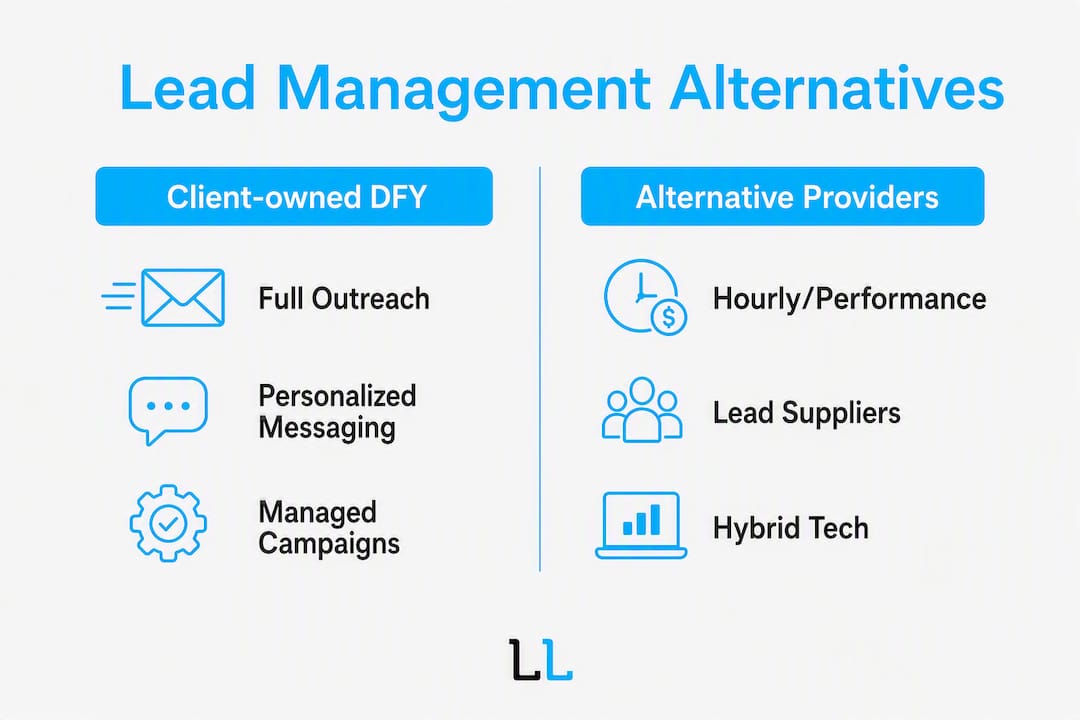
Understanding what you’re buying beyond the label saves you from expensive mismatches.
Client-owned DFY agencies (The Lead Lab model)
These agencies own the full outreach workflow: ICP targeting, personalized message copywriting, LinkedIn outreach cadences, response management, calendar booking, lead enrichment (mobile and email), and campaign analytics. Some, like The Lead Lab, also offer verified LinkedIn account rental so outreach runs from a warmed, credible profile rather than a cold company page. The ideal client is a professional services firm or consultancy with a defined offer and a principal or sales director who can take calls once meetings land.
Flexible hourly/performance partners
These partners handle specific execution tasks, such as building prospect lists, writing message sequences, or managing ad campaigns, billed hourly or against performance milestones. They suit firms that already have a sales process and need specialist support rather than a fully outsourced function. The automation of reports and dashboards frees expert hours for high-value work, but strategy and follow-up remain your responsibility.

High-volume lead suppliers
Volume-first platforms deliver large batches of contact data or instant form leads. They work well for insurance agencies, mortgage brokers, or any team running a high-call-volume model with disciplined dialers. For consultative professional services sales, the conversion math rarely works: text-verified leads prioritize intent and higher conversion, while instant form leads prioritize speed and volume.
Hybrid agency-technology players
These combine a SaaS platform with a managed service layer. You get software for CRM piping, live LinkedIn overlays, or bulk data enrichment, plus some human support. The trade-off is integration complexity: matching tool type to your existing workflow matters more than feature count.
In-house or hybrid hires
Hiring an SDR or BDR gives you full control and institutional knowledge over time. The cost is real: salary, benefits, tools, and 3–6 months before consistent pipeline appears. A DFY pilot first often makes more sense for firms under 50 employees.
Pro Tip: Distinguish marketing performance agencies (ad spend optimization) from done-for-you appointment-setting services. Only the latter typically includes active calendar booking and response management, which is what most professional services firms actually need.
- Map your sales capacity before choosing a category.
- Confirm whether the provider books meetings or just delivers leads.
- Verify the lead qualification method matches your sales motion.
How do you choose between The Lead Lab and alternative categories?
Six questions cut through most vendor pitches quickly.
- Does their ICP targeting match your buyer? Ask for a sample prospect list from a similar industry before signing.
- Can your team handle the meeting volume? Aligning lead type to internal follow-up capacity is the most common failure point, not lead volume itself.
- How are leads verified? Text-verified or human-verified leads convert at materially higher rates for consultative sales. Instant form leads are volume plays.
- What is the CRM integration latency? Faster routing from lead generation to your CRM directly improves conversion. Ask for the SLA in writing.
- What does the pricing include? Fixed monthly packages give budget predictability; performance-based arrangements are growing but shift risk to both sides.
- What are the reporting commitments and cancellation terms? Vague dashboards and 90-day notice periods are the two most common sources of buyer regret.
Red flags to watch for:
- No verified lead process (form-only or unconfirmed contacts)
- Reporting limited to lead counts with no pipeline or meeting-quality data
- Unwillingness to share sample message threads or calendar screenshots
- Single-channel outreach only, with no email or multi-step follow-up
- Long minimum contract periods with no pilot option
After initial calls, shortlist two or three vendors by asking each for a case study from a professional services client, a sample reporting dashboard, and a reference you can call specifically about follow-up quality.
What features should you expect from a LinkedIn appointment-setting vendor?
Essential features every vendor should include:
- Precise prospect targeting by title, industry, company size, and geography
- Personalized message copywriting with multi-step outreach cadences
- Response management with human follow-up, not just automated replies
- Calendar integration so meetings land directly in your calendar
- Lead enrichment (mobile and email) for multi-channel follow-up
- Quality verification (text-verified or human-verified contacts)
- Campaign analytics with A/B testing on message variants
Value-adds that justify higher pricing:
- Dedicated account manager with regular strategy calls
- Verified LinkedIn account rental for warmed profile outreach
- Multi-channel follow-up combining LinkedIn and automated email sequences
- Written SLA on lead delivery timelines
- Closed-loop reporting tied to pipeline outcomes, not just meetings booked
Good lead nurturing infrastructure is often the difference between a campaign that converts and one that burns budget. Automation and better follow-up can reduce acquisition costs substantially, according to The Lead Lab’s own campaign data.
Pro Tip: Measure vendor quality beyond lead counts. Track time-to-first-response in your CRM and the lead-to-meeting conversion rate. Those two numbers tell you more about vendor quality than any volume metric.
What do pricing models and timelines actually look like?
Common pricing shapes:
- Fixed monthly package with startup fee: Most predictable for budgeting. The startup fee covers ICP build, messaging, and tech setup. Monthly fee covers ongoing outreach and management.
- Hourly/execution support: Flexible but harder to forecast. Works when you need specific tasks done, not a full campaign.
- Performance-based or blended: Growing in popularity as clients demand accountability. Risk shifts to both parties; often includes a base retainer plus a per-meeting fee.
Typical timeline to first qualified meetings:
| Week | Milestone | Buyer responsibility |
|---|---|---|
| 1–2 | Discovery, ICP definition, contact list build | Stakeholder interviews, ICP sign-off |
| 2–3 | Message copywriting and approval | Messaging review and approval within 48 hours |
| 3–4 | Tech integration, LinkedIn account setup, test sends | CRM webhook access, calendar connection |
| 4–5 | First outreach wave | Monitor initial responses, flag any ICP mismatches |
| 6–8 | Iterative optimization, A/B testing | Weekly check-in, pipeline feedback |
| 8+ | Steady-state cadence, predictable meetings | Ongoing feedback loop |
Most professional services firms see their first qualified meetings within a few weeks after onboarding. Campaigns that stall usually do so because messaging approval was delayed or CRM integration was incomplete at launch.
On contract terms: Month-to-month arrangements with a clear startup fee are the most buyer-friendly structure. Watch for contracts that require 60–90 days’ written notice to cancel, which effectively locks you in for an extra quarter after you decide to leave.
What proof should you request before signing with any vendor?
Case studies tied to meetings booked and pipeline outcomes are stronger evidence than raw lead counts. Here is what to ask for specifically:
- Anonymized case study metrics: meetings booked per month, lead-to-meeting conversion rate, pipeline value generated
- Client testimonials with named industries (not just logos)
- Campaign screenshots showing actual message threads and calendar booking confirmations
- Sample reporting dashboard from an active client account
- References from professional services clients you can call directly
Which metrics matter most for professional services:
- Meetings booked that are genuinely qualified (right title, right company size, real buying intent)
- Lead-to-meeting conversion rate, not just total leads delivered
- Pipeline value from booked meetings over a 90-day window
The Lead Lab portfolio shows sample results and client case studies for professional services contexts, which gives you a concrete benchmark before your first call.
Pro Tip: Ask vendors for CRM timestamps from a recent campaign. The gap between lead generation and CRM arrival tells you whether their integration is real-time or batched nightly. Batched delivery kills conversion for time-sensitive outreach.
What does onboarding actually look like, week by week?
- Discovery (Week 1): Vendor interviews key stakeholders, defines ICP, and confirms target titles, industries, and geographies. Your job: be available for a 60-minute call and provide any existing customer data.
- List build and messaging drafts (Weeks 1–2): Vendor builds the prospect list and writes the first message sequence. Your job: review and approve messaging within 48 hours. Delays here push everything back.
- Tech integration and test sends (Week 3): CRM webhooks are connected, LinkedIn account is warmed (if account rental is included), and test messages are sent for quality review. Your job: grant CRM access and connect your calendar.
- First outreach wave (Week 4–5): Live outreach begins. Your job: respond to any inbound replies the vendor flags and attend the first calibration call.
- Iterative optimization (Weeks 6–8): A/B testing on subject lines and message variants. Your job: share pipeline feedback so the vendor can refine targeting.
- Steady-state cadence (Week 8+): Predictable outreach volume with regular reporting. Your job: weekly pipeline review and ongoing ICP feedback.
Common onboarding pitfalls:
- Delayed messaging approval (the single biggest cause of slow starts)
- No CRM webhooks configured before launch, forcing manual lead entry
- Long list-cleaning cycles because the ICP was not defined precisely enough upfront
- Calendar not connected before first meetings are booked, causing double-booking
A vendor worth hiring will send you an onboarding checklist on day one and flag any missing inputs before the first outreach wave goes out.
Key Takeaways
For professional services firms evaluating done-for-you LinkedIn appointment-setting options, the single most important question to resolve in any vendor call is how leads are verified and what the SLA is on follow-up delivery to your CRM.
| Point | Details |
|---|---|
| Recommended pick | The Lead Lab delivers fully managed LinkedIn outreach with verified leads and calendar-ready meetings for professional services firms. |
| Best alternative category | Hourly/performance partners suit firms with partial in-house capacity that need execution support, not a fully outsourced function. |
| Lead verification matters | Text-verified or human-verified leads convert at higher rates than instant form leads for consultative sales teams. |
| Onboarding speed | Most DFY LinkedIn agencies reach first qualified meetings in weeks 5–7; in-house SDR hires take 3–6 months to ramp. |
| The Lead Lab advantage | Fixed monthly packages with a clear startup fee and no 90-day cancellation trap make The Lead Lab a lower-risk entry point than most alternatives. |
When does outsourcing beat hiring in-house?
The conventional wisdom says you should hire an SDR once you hit a certain revenue threshold. In practice, that threshold is almost always set too low, and the math rarely accounts for ramp time.
For most professional services firms under 50 employees, the real tipping point is simpler: if you need qualified meetings in the next 60 days and you don’t have a tested message sequence, a warmed LinkedIn presence, and a dedicated person to run outreach, hiring will not solve that problem in time. A DFY agency will.
Where in-house wins is when you have a repeatable sales motion, a large enough deal size to justify a $80,000–$100,000 annual SDR cost, and the management bandwidth to coach and retain that person. Most boutique consulting firms and professional services practices don’t have all three. The case for outreach agencies comes down to speed, specialist messaging expertise, and predictable pipeline without the fixed overhead.
Run a DFY pilot first if any of these apply: your last hire took more than 90 days to produce pipeline, your current outreach is inconsistent, or you’ve never A/B tested your LinkedIn messaging at scale.
The Lead Lab: qualified meetings without building a team
Professional services firms that want calendar-ready meetings without a six-month hiring cycle have a direct option. The Lead Lab runs fully managed LinkedIn outreach campaigns: precise ICP targeting, personalized message copywriting, multi-step outreach cadences, response management, and calendar integration, all delivered as a fixed monthly package.
The demo call covers your ramp timeline, a sample campaign structure for your industry, and pilot options so you can see results before committing to a full campaign. If you’re comparing leadmanagementlab.com alternatives and want a done-for-you solution built specifically for professional services, book a consultation with The Lead Lab to see what a campaign looks like for your firm.
Useful sources and further reading
Internal resources from The Lead Lab:
- What is B2B appointment setting? — Core definitions and expectations for appointment-setting services; start here if you’re new to outsourced outreach.
- Appointment setting tips for B2B sales — Practical benchmarks and tactics for evaluating vendor performance.
- Scalable lead generation strategies — Models and tools for scaling outreach programs; useful for pricing and timeline planning.
- Lead response management process guide — Detailed SLA guidance for response management; use this to benchmark vendor commitments.
- Personalized prospecting process — Messaging and personalization guidance for LinkedIn outreach campaigns.
- The Lead Lab portfolio — Client case studies and sample results for professional services contexts.
Research citations used in this article:
| Source | What it substantiates |
|---|---|
| LeadLab Media — What Makes Us Different | Flexible hourly models, automation of reporting, and expertise-led execution as alternatives to rigid retainers |
| Lead Lab CRM | Text-verified vs. instant form leads; CRM integration latency as a conversion metric |
| Lead Lab — Lead Management System | Follow-up infrastructure as the primary failure point; case study metrics to request; alignment of lead type to sales capacity |
| LeadLab Media — Performance Marketing | Growing demand for performance-based and blended pricing models |
| AddToCRM — LeadCRM Alternatives | Technology integration choices and how workflow type affects vendor selection |
This article is general information for evaluation purposes, not legal or financial advice. Confirm pricing, contract terms, and service scope directly with any vendor before signing.