
TL;DR:
- Campaign analytics measures marketing campaign performance by connecting activity data to business outcomes like revenue and ROI. It requires defining clear metrics upfront, choosing appropriate attribution models, and integrating data from multiple channels for accurate insights. Using AI tools and proper data hygiene allows faster, more strategic optimization and effective budget allocation.
Campaign analytics is the structured practice of measuring and interpreting data from marketing campaigns to connect spend directly to business outcomes like revenue, pipeline, and ROI. It goes beyond confirming a campaign ran. It tells you whether it worked, why it worked, and what to do next. Platforms like Adobe Marketing Campaign Analytics, HubSpot, and Improvado have made this discipline more accessible, but the fundamentals remain the same: define your metrics, track the right signals, and translate data into decisions. This guide breaks down every layer of campaign analytics for business professionals who need real answers, not theory.
What is campaign analytics and why does it matter?
Campaign analytics is defined as the collection, measurement, and interpretation of data generated by marketing campaigns to evaluate performance and guide future decisions. The industry also refers to this practice as marketing performance measurement, though campaign analytics is the more operationally specific term. Where broader marketing analytics covers brand health and long-term trends, campaign analytics focuses on discrete campaign activities and their direct outcomes.
The distinction matters because campaign analytics measures outcomes like impressions, clicks, conversions, and ROI rather than simply confirming activity occurred. A campaign that generated 10,000 impressions tells you reach. A campaign that generated 10,000 impressions, a 3.2% click-through rate, and a $42 cost per acquisition tells you performance. That difference is the entire point of the discipline.
Multi-channel measurement across social, paid media, email, and offline campaigns gives organizations a unified view of how spend translates to audience behavior and outcomes. Without that unified view, budget decisions are based on incomplete signals. With it, you can reallocate spend in real time, cut underperforming creatives, and double down on what drives pipeline.
What are the primary campaign performance metrics?
Metric selection is not a technical exercise. It is a strategic one. The metrics you track must reflect the campaign’s actual objective, whether that is awareness, demand generation, or closed revenue. Tracking the wrong metrics produces confident-sounding reports that lead to bad decisions.
The most commonly used campaign performance metrics are:
| Metric | Description | Best used for |
|---|---|---|
| CTR (Click-Through Rate) | Clicks divided by impressions | Measuring ad creative and message relevance |
| Conversion Rate | Conversions divided by clicks | Evaluating landing page and offer effectiveness |
| CPA (Cost Per Acquisition) | Total spend divided by conversions | Assessing efficiency of demand generation spend |
| ROAS (Return on Ad Spend) | Revenue divided by campaign cost | Evaluating revenue efficiency of paid campaigns |
| CAC (Customer Acquisition Cost) | Total sales and marketing spend divided by new customers | Strategic budget planning and unit economics |
| Impressions | Total ad views | Awareness and reach campaigns |
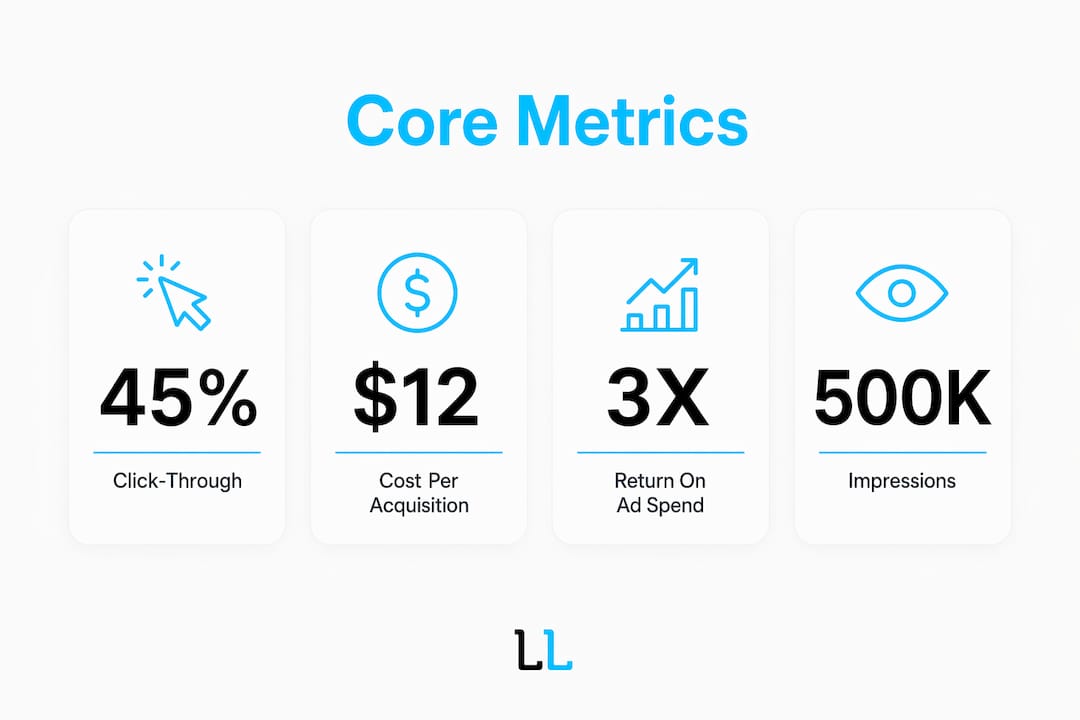
Common metrics like CTR, CPA, and ROAS each serve a different analytical purpose depending on where a campaign sits in the funnel. An awareness campaign should be judged on reach and engagement, not CPA. A revenue campaign should be judged on ROAS and CAC, not impressions. Mixing these up is one of the most common and costly mistakes in campaign reporting.
Pro Tip: Never present platform-reported ROAS to finance without normalization. Cross-channel ROAS normalization and attribution alignment are required before any metric qualifies as finance-ready. Each ad platform calculates ROAS differently, and without reconciliation, you are comparing apples to oranges.
How does attribution modeling impact campaign analytics?
Attribution is the mechanism that assigns conversion credit across the customer journey. It is also the most misunderstood component of campaign analytics. Choose the wrong model and your analytical conclusions will point budget toward the wrong channels.
The main attribution models in use today include:
- First-touch attribution: Gives 100% of conversion credit to the first touchpoint. Useful for understanding awareness drivers, but ignores everything that happened after initial contact.
- Last-touch attribution: Gives 100% of credit to the final touchpoint before conversion. Overvalues bottom-of-funnel channels like branded search and undervalues the channels that created demand.
- Linear attribution: Distributes credit equally across all touchpoints. More balanced, but treats a brand awareness impression the same as a demo request click.
- Data-driven attribution: Uses machine learning to assign credit based on actual conversion path data. This is the current enterprise standard for teams with sufficient conversion volume.
- Marketing mix modeling (MMM): A statistical approach that measures the contribution of each channel at a macro level, including offline channels. MMM provides a broader view of channel interactions that data-driven attribution cannot capture at the individual touchpoint level.
Attribution model selection materially changes campaign analytics results and directly influences budget allocation. A team using last-touch attribution will consistently over-invest in retargeting and branded search while starving the top-of-funnel channels that generate the demand those bottom-funnel tactics convert.
Multi-layered approaches use channel-level attribution for tactical decisions and MMM for strategic budget planning. This combination gives you both the granularity to optimize individual campaigns and the macro perspective to allocate annual budgets intelligently.
Pro Tip: Before drawing any conclusions from campaign analytics, confirm which attribution model the platform is using. Google Ads, Meta Ads, and LinkedIn Campaign Manager each default to different models. Comparing results across platforms without accounting for this produces misleading cross-channel comparisons.
What technologies and tools support effective campaign analytics?
The analytics stack a team uses determines how quickly they can act on data and how far they can push their analysis. Most mature analytics programs operate on two layers: an operational layer for day-to-day campaign monitoring and a strategic layer for budget planning and incrementality measurement.

At the operational layer, platforms like HubSpot, Oracle Eloqua, and Improvado aggregate campaign data from multiple channels into a single reporting interface. These tools connect to ad platforms via APIs, ingest CRM event data, and apply UTM parameter tracking to attribute web sessions back to specific campaigns. Data integration using tracking pixels, UTM parameters, and APIs feeds into centralized data warehouses like Snowflake or BigQuery, where analysts can run cross-channel queries without platform-level data silos.
At the strategic layer, tools like Adobe Marketing Campaign Analytics apply causal inference and AI-powered modeling to separate true marketing impact from external noise. Adobe’s approach delivers incremental signals in hours or days rather than months, enabling scenario planning and in-flight campaign optimization at a speed that traditional MMM cannot match. This matters because traditional MMM studies often take six to twelve weeks to produce results, by which time the campaign has ended.
For B2B marketers specifically, CRM integration is the critical data layer. Connecting CRM conversion data to campaign spend data closes the loop between marketing activity and actual pipeline or revenue. Without it, you are measuring clicks and form fills, not business outcomes. Pairing CRM data with B2B marketing automation creates a feedback loop where campaign performance data continuously informs targeting and messaging decisions.
Why use campaign analytics: benefits and common challenges
Effective campaign analytics explains why campaigns worked, enabling optimization and ROI improvement rather than guesswork. That explanatory power is what separates teams that grow marketing efficiency year over year from teams that repeat the same mistakes with larger budgets.
The core benefits are direct:
- Informed budget allocation. Analytics reveals which channels, audiences, and creatives generate the best return, so budget flows toward what works rather than what looks good in a presentation.
- Improved targeting. Performance data identifies which audience segments convert at the lowest cost, allowing you to refine targeting parameters and reduce wasted spend.
- Creative optimization. CTR and conversion rate data at the ad level shows which messages resonate, enabling faster creative iteration.
- Demonstrable marketing impact. Finance-ready metrics built on normalized, attribution-aligned data give marketing teams credibility in budget conversations.
The common pitfalls are equally direct. Defining KPIs before campaign launch is the single most important practice in campaign analytics, yet many teams select metrics after the fact to fit the results they got. This produces analytics that confirms activity rather than measures outcomes. Other frequent failures include over-reliance on a single metric like ROAS, ignoring incrementality entirely, and treating disconnected platform reports as a unified view of performance.
Campaign analytics turns raw data into marketing intelligence only when the data is clean, the metrics are pre-defined, and the attribution model is appropriate for the campaign objective. All three conditions must be met simultaneously. Missing any one of them produces analysis that feels rigorous but leads to the wrong conclusions.
Pro Tip: When setting up prospect segmentation for a new campaign, define your conversion event and success metric at the same time. Segmentation and measurement decisions made together produce far cleaner analytics than those made separately.
Key takeaways
Campaign analytics produces reliable, finance-ready insights only when success metrics are defined before launch, attribution models match campaign objectives, and data is normalized across channels.
| Point | Details |
|---|---|
| Define metrics before launch | Pre-defined KPIs prevent post-hoc rationalization and produce valid, comparable results. |
| Match metrics to campaign goals | Awareness campaigns need reach metrics; revenue campaigns need ROAS and CAC. |
| Choose attribution carefully | Model selection materially changes conclusions and budget allocation decisions. |
| Integrate data across channels | UTM parameters, CRM events, and APIs feeding a central warehouse are the data foundation. |
| Use AI tools for speed | Platforms like Adobe Marketing Campaign Analytics compress insight timelines from months to days. |
The metric that actually tells you something
Most campaign analytics conversations I have with B2B marketers start in the same place: they have dashboards full of data and no clear answer to the question their CFO is asking. The data is not the problem. The framing is.
The teams that get the most out of campaign analytics are not the ones with the most sophisticated tools. They are the ones that decided, before the campaign launched, exactly what success looks like in dollar terms. Not “we want more leads.” Not “we want to improve CTR.” A specific number tied to a specific business outcome. Everything else follows from that.
The attribution debate is real, but it is also a distraction if you have not solved the basics. I have seen teams spend months debating data-driven versus linear attribution while their UTM parameters were inconsistently applied across half their campaigns. Fix the data hygiene first. Then argue about the model.
The most underused practice in campaign analytics is incrementality testing. Most teams measure correlation between spend and outcomes and call it performance. Incrementality testing measures causation. It tells you what would have happened without the campaign. That is the number that actually justifies budget. If you are not running holdout tests or using causal inference tools, you are measuring activity, not impact.
The future of this discipline is faster feedback loops. Adobe’s causal inference approach and similar AI-powered tools are compressing the time between campaign launch and actionable insight. That speed changes what is possible in terms of in-flight optimization. The teams investing in that capability now will have a structural advantage within two to three years.
— Toby
How The Lead Lab helps you measure what matters
Understanding campaign analytics is one thing. Building the infrastructure to act on it consistently is another challenge entirely.
The Lead Lab specializes in done-for-you LinkedIn outreach campaigns for professional services firms, with campaign analytics built into every engagement. From prospect targeting and message performance tracking to response rate analysis and pipeline attribution, every campaign The Lead Lab runs is designed to produce data you can take to a board meeting. Explore The Lead Lab’s client work to see how campaign analytics translates into qualified meetings and measurable pipeline. When you are ready to connect spend to outcomes, The Lead Lab is the place to start.
FAQ
What does campaign analytics measure?
Campaign analytics measures the performance of marketing campaigns using metrics like impressions, clicks, conversions, CPA, and ROAS, connecting campaign activity to measurable business outcomes like revenue and ROI.
How is campaign analytics different from marketing analytics?
Campaign analytics focuses on the performance of specific, time-bound campaigns, while marketing analytics covers broader trends including brand health, customer lifetime value, and long-term channel performance. Campaign analytics is the operational subset of the broader discipline.
What is the best attribution model for campaign analytics?
Data-driven attribution is the current enterprise standard for teams with sufficient conversion volume, while marketing mix modeling provides a macro view of channel interactions. The right model depends on campaign objectives, data volume, and whether you need tactical or strategic insights.
How do you track campaign analytics effectively?
Effective tracking requires consistent UTM parameters on all campaign links, API connections between ad platforms and a central data warehouse, CRM event data tied to campaign touchpoints, and pre-defined KPIs set before the campaign launches.
Why do platform-reported metrics sometimes mislead marketers?
Each ad platform calculates metrics like ROAS and CPA using its own attribution logic, which means cross-channel normalization is required before comparing results across Google Ads, Meta, and LinkedIn. Without normalization, you are not comparing equivalent numbers.
Hello everyone, I’m new here. I joined after checking out a number of threads and noticing how informative the discussions are. The site seems structured well, which makes it more comfortable for someone new to locate relevant information. I enjoy the friendly tone here and I’m looking forward to sticking around. I have been studying about this lately.
https://chessmaxchesslessons.blogspot.com/2026/02/why-experienced-chess-coaches-and.html
First time here and excited to get started. I appreciate the amount of information already shared and hope to join in once I’m more familiar with things. f9f214d