
TL;DR:
- Marketing automation programs generate an average of $5.44 return per dollar spent over three years, but many firms underutilize its potential. It connects marketing, sales, and management, providing real-time engagement insights that improve lead quality, shorten sales cycles, and boost ROI. Success depends on deep CRM integration, effective lead scoring, and AI-driven optimization, turning automation into a crucial operating layer rather than just a campaign tool.
Marketing automation programs return $5.44 per dollar spent on average over three years. Yet many professional services firms still treat the role of marketing automation as a secondary concern, something bolted onto existing workflows rather than built into them. That misunderstanding is expensive. For marketing leaders in consulting, legal, financial, and advisory firms, automation is where the real gap between mediocre and high-performing B2B pipelines lives. This article breaks down what automation actually does, how it supercharges LinkedIn lead generation, and which strategies separate firms that get results from those that just get software licenses.
Table of Contents
- Understanding marketing automation and its value for professional services
- How marketing automation boosts B2B lead generation and LinkedIn outreach
- Key components and strategies for successful marketing automation deployment
- Measuring impact: ROI, conversion lifts, and cost efficiency with marketing automation
- Best practices for integrating LinkedIn lead generation with marketing automation
- Why marketing automation success depends on treating it as an operating layer, not just a tool
- Enhance your professional services marketing with The Lead Lab
- Frequently asked questions
Key Takeaways
| Point | Details |
|---|---|
| High ROI evidence | Marketing automation delivers an average of $5.44 revenue for every $1 spent in professional services. |
| Integration is key | Deep CRM and data integration significantly improve conversion rates and ROI outcomes. |
| LinkedIn lead gen boost | Combining LinkedIn behavioral data with automation increases lead quality and sales velocity. |
| AI improves efficiency | AI-powered automation provides real-time personalization that drives cost reductions and higher ROI. |
| Treat automation as an operating layer | To maximize value, firms must embed marketing automation as a strategic, continuously optimized system. |
Understanding marketing automation and its value for professional services
Marketing automation is software that executes, tracks, and optimizes marketing and sales touchpoints without requiring manual action at every step. In B2B professional services, that means moving beyond scheduled email blasts into something far more powerful. Marketing automation connects marketing, sales, and management under one system, aligning every campaign and outreach effort with revenue in real time.
That real-time visibility matters enormously in professional services. A consulting firm’s sales cycle can run six to eighteen months. Without automation tracking engagement at every stage, your team is guessing about intent. With it, you know exactly which prospects opened the white paper, attended the webinar, and revisited the pricing page, all before a single call is made.
The importance of marketing automation for professional services firms becomes clearest when you look at how it changes lead quality rather than just lead volume. Here is what it delivers specifically:
- Integrated marketing and sales data in one place, reducing the gap between what marketing generates and what sales actually works with
- Behavioral lead scoring that ranks prospects by real engagement signals, not just demographic fit
- Automated nurture sequences that keep your firm visible during the long consideration periods typical in professional services buying
- ROMI tracking (return on marketing investment) that ties specific campaigns to closed revenue, a metric most manual programs cannot reliably produce
- Faster sales cycles because sales teams receive fully warmed leads with context, not cold names from a list
The reason professional services firms gain distinct advantages through automation is trust. Buyers in these categories do not purchase quickly. They research, compare, and look for evidence of expertise. Automation lets you systematically deliver that evidence at the right moment, to the right person, without burning human bandwidth on low-intent contacts.
How marketing automation boosts B2B lead generation and LinkedIn outreach
The benefits of marketing automation become most visible in lead generation. Firms using automation for lead nurturing see a 451% increase in qualified leads, with 50% more sales-ready prospects at 33% lower cost per lead. Those are not marginal improvements. They are the difference between a full pipeline and a struggling one.
LinkedIn is where professional services buyers spend time during the research phase, which makes it the right channel to automate intelligently. In B2B professional services, behavioral tracking from LinkedIn ads and content engagement feeds directly into scoring workflows, so you prioritize high-potential prospects before your sales team ever reaches out.
Here is what that looks like in practice:
- A prospect engages with a LinkedIn post on regulatory changes in their industry
- They click through to your firm’s related case study
- Their lead score increases automatically based on that sequence of high-intent signals
- A personalized LinkedIn message sequence begins within 24 hours, referencing their area of interest
- Sales receives an alert when the prospect hits a defined score threshold, with full engagement history attached
That kind of multi-touch lead sequencing is what separates the top-performing professional services firms from the ones still relying on sporadic outreach.
The key to making this work is smart segmentation strategies built before you launch a single sequence. Without segmentation, automation just accelerates noise.

Pro Tip: Prioritize LinkedIn prospects who engage with firm-specific case studies, thought leadership, or industry reports over those who interact with general brand content. Engagement with specific work signals buying-stage intent. General engagement signals awareness at best.
Key components and strategies for successful marketing automation deployment
Understanding the benefits of marketing automation is the easy part. Deploying it well is where most firms stumble. The gap between leaders and laggards in marketing automation outcomes comes down to three factors: CRM integration depth, lead scoring maturity, and how fast firms adopt AI-driven automation.
Here is a practical implementation checklist for professional services marketing leaders:
- Audit your CRM data first. If your contact data is incomplete, duplicated, or outdated, automation will amplify that problem, not fix it. Clean data is not optional.
- Define your lead scoring model before building any workflows. Assign point values to specific actions: LinkedIn profile visits, content downloads, email clicks, and webinar attendance.
- Map your buyer’s journey by service line. A firm selling M&A advisory has a different buyer journey than one selling HR consulting. Each needs its own workflow.
- Integrate your CRM tightly with your automation platform. Firms with deep CRM integration for lead generation see significantly higher MQL-to-SQL conversion rates because sales acts on complete context, not partial data.
- Introduce AI-driven workflows for dynamic content personalization, send-time optimization, and predictive lead scoring. Marketers using AI correctly report a 20% ROI increase and 19% cost reductions, but only when built on unified data foundations.
- Test and optimize continuously. Automation is not a set-and-forget system. Build review cycles into your calendar.
Understanding the role of AI in marketing is increasingly critical here. Agentic AI, meaning AI that takes autonomous action within defined parameters, is already changing how top firms optimize their nurture sequences in real time.
Here is a direct comparison of deployment pitfalls versus best practices:
| Common pitfall | Best practice |
|---|---|
| Launching without clean CRM data | Audit and deduplicate contacts before setup |
| Generic scoring for all service lines | Build service-specific scoring models |
| Treating automation as a one-time setup | Schedule quarterly workflow reviews |
| Ignoring AI capabilities | Integrate AI for timing and content personalization |
| Siloed marketing and sales data | Unify all engagement data in one system |
Pro Tip: Before purchasing or upgrading your automation platform, run a 30-day data hygiene audit. Most firms discover that 20 to 40 percent of their CRM records have gaps that will break automation logic. Fix the foundation first, then build on it with prospect segmentation strategies.
Measuring impact: ROI, conversion lifts, and cost efficiency with marketing automation
The marketing automation impact on sales is well documented, and the numbers are worth understanding in detail before you make investment decisions.
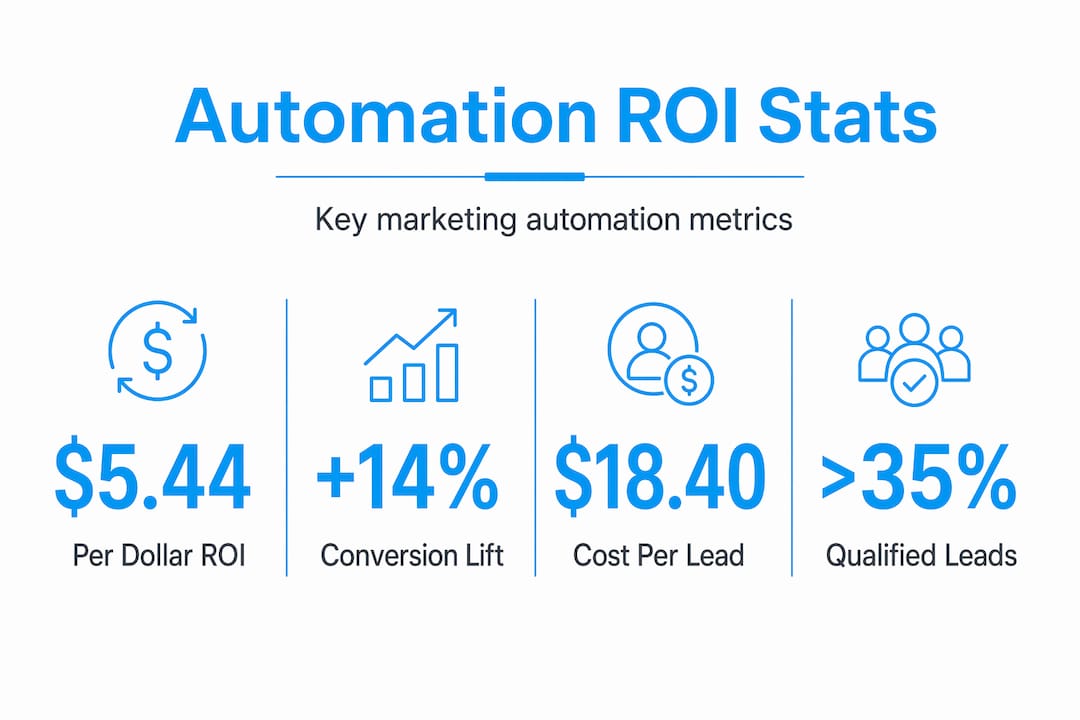
| Metric | Automated programs | Manual programs |
|---|---|---|
| Average cost per qualified lead | $18.40 | $26.10 |
| Average return per dollar spent | $5.44 | Below $2.00 |
| Top quartile ROI | $8.71 per dollar | N/A |
| Sales touch time | 43% faster | Baseline |
Firms that invest in lead nurturing strategies see particularly strong commercial outcomes. Leads nurtured through automation move through sales 23% faster and generate purchases 47% larger than non-nurtured leads. In professional services, where deal sizes can range from five figures to seven, that difference in average purchase value is transformative.
Automated programs also achieve $18.40 per qualified lead versus $26.10 for manual programs, with 43% faster sales touch time. Lower cost, faster conversion, and larger deals. That combination is why marketing automation has moved from a nice-to-have to a competitive necessity.
“The firms winning new business consistently in professional services are not outspending their competitors. They are out-nurturing them, using automation to stay relevant through long sales cycles while everyone else sends monthly newsletters and hopes for the best.”
ROMI tracking changes how you allocate marketing budget. When you can see which LinkedIn campaigns, content assets, and outreach sequences tie to actual revenue, you stop guessing and start investing in what works. That shift alone compounds returns year over year.
Best practices for integrating LinkedIn lead generation with marketing automation
The practical payoff of combining LinkedIn with automation is substantial. Automation shines in multi-touch LinkedIn attribution, shortening sales cycles by handing sales warm leads who come with a full engagement history attached.
Here is how to build this integration correctly:
Link LinkedIn behavioral data to lead scores:
- Connect LinkedIn Campaign Manager data to your automation platform
- Create score triggers for specific actions: post engagement, video views, document downloads, and ad clicks
- Weight firm-specific content higher than general brand interactions
Design multi-touch sequences that match the buyer stage:
- Awareness stage: share relevant industry insights and data, no sales language
- Consideration stage: case studies, results-focused content, peer comparisons
- Decision stage: direct outreach with specific proposal or meeting offer
Steps to run coordinated LinkedIn campaigns within your automation platform:
- Define audience segments by industry, role, and firm size before building any sequences
- Map each segment to specific content tracks that reflect their known business challenges
- Set score thresholds that trigger sales alerts, so reps contact prospects at peak intent
- Use your automation platform to build a lead response management process that ensures no warm lead waits more than 24 hours for follow-up
- Review attribution data monthly to identify which message sequences and content types produce the fastest pipeline movement
The firms generating the most qualified meetings through LinkedIn are not the ones with the biggest audiences. They are the ones with the most precise systems behind their outreach.
Why marketing automation success depends on treating it as an operating layer, not just a tool
Most firms buy marketing automation software thinking it is a campaign tool. A place to build email flows and schedule posts. That framing is what keeps their results mediocre.
Marketing automation in 2026 is the operating layer that sits between your CRM, email, AI-driven channels, and LinkedIn activity. Integration depth and segmentation quality are what separate firms that get 8x returns from those still wondering why they see limited results.
The analogy that resonates most with marketing leaders we work with is this: treating automation as a campaign tool is like buying a commercial kitchen and only using it to boil water. The infrastructure can do far more. The limitation is how you have chosen to use it.
The real value of automation in B2B marketing comes from continuous learning loops. Your scoring model gets smarter as it processes more engagement data. Your nurture sequences improve as you test content and timing. Your sales team gets progressively better context about who to call and why. None of that happens if you configure the system once and walk away.
The firms extracting the most value from automation are also the fastest to adopt AI-driven capabilities within their existing platforms. Not by replacing their teams, but by letting AI handle optimization decisions that humans simply cannot make at the speed and scale required.
Our honest advice: before you invest in a new platform or expand your automation stack, audit your current CRM integration and data quality. Most firms do not have a software problem. They have a data readiness problem. Solve that first, and the ROI follows quickly.
Enhance your professional services marketing with The Lead Lab
Understanding the role of marketing automation is one thing. Executing it in a way that fills your pipeline with qualified decision-makers is another challenge entirely.
At The Lead Lab, we specialize in done-for-you LinkedIn lead generation and marketing automation for professional services firms. From building precise prospect targeting and personalized outreach sequences to managing responses and tracking campaign performance, we handle the execution so your team focuses on closing. Explore our client portfolio to see how firms like yours have grown their pipelines, and join our marketing automation webinars to go deeper on strategy. If your firm is ready to turn automation from a concept into a competitive advantage, let’s talk.
Frequently asked questions
What is the main role of marketing automation in professional services?
Marketing automation connects marketing, sales, and management under one system, delivering more qualified leads, improving conversion rates, and providing real-time revenue visibility for professional services firms.
How does marketing automation improve LinkedIn lead generation?
It enables behavioral tracking and lead scoring on LinkedIn interactions, allowing firms to prioritize high-potential prospects and run personalized, automated multi-touch sequences that boost lead quality and shorten sales cycles. Integrating behavioral tracking from LinkedIn into scoring workflows ensures prospects engaging with firm-specific content receive timely, relevant follow-up.
What factors most impact marketing automation success?
CRM integration, lead scoring maturity, and agentic AI adoption are the decisive factors separating high-performing automation programs from underperforming ones, directly affecting conversion rates and cost efficiency.
What ROI can professional services firms expect from marketing automation?
Programs return $5.44 per dollar on average, with top quartile programs exceeding $8.71 per dollar, driven by deeper CRM integration and AI-powered workflows.
How does AI enhance marketing automation?
Marketers deploying AI correctly report 20% ROI increases and 19% cost reductions, achieved through real-time personalization, optimized send timing, and adaptive decisioning across customer journeys when built on unified data.