
TL;DR:
- Personalized content goes far beyond inserting a name; it uses data to tailor messages that genuinely resonate with individual prospects.
- Effective personalization improves response and conversion rates significantly, making outreach more impactful and driving greater revenue.
If you think personalized content means swapping in a first name at the top of a LinkedIn message, you are leaving serious pipeline on the table. What is personalized content, really? It is the practice of using behavioral data, firmographics, and individual signals to craft messages and experiences that feel like they were built for one person, not distributed to ten thousand. For marketing leaders in professional services, this distinction is not semantic. It is the difference between a campaign that books meetings and one that gets archived without a reply.
Table of Contents
- What is personalized content? Defining the concept beyond basics
- The impact of personalized content on B2B lead generation
- How personalization works on LinkedIn for professional services lead generation
- Common pitfalls and how to avoid them in personalized content strategies
- Measuring success and applying personalized content tactics strategically
- Why most personalization efforts fail in B2B LinkedIn marketing, and how to fix it
- How The Lead Lab helps professional services master personalized LinkedIn marketing
- Frequently asked questions
Key Takeaways
| Point | Details |
|---|---|
| Personalization definition | Personalized content tailors marketing to individual preferences, boosting trust and engagement. |
| Proven impact | Personalization drives up to 67% higher conversion rates and significant revenue growth in B2B. |
| LinkedIn tactics | Effective LinkedIn personalization uses AI, segmentation, and public engagement for better lead gen. |
| Avoid pitfalls | Generic messages hurt performance; hybrid AI-human approaches ensure authenticity. |
| Measure and optimize | Track KPIs and integrate CRM data to refine and prove personalization success. |
What is personalized content? Defining the concept beyond basics
The definition of personalized content goes well beyond mail-merge logic. As Salesforce explains, content personalization is tailoring marketing messages, website experiences, and customer interactions based on individual preferences, behaviors, and demographics, turning generic content into customized experiences. That definition has real weight in B2B contexts, where buyers are sophisticated and trust is slow to build.
Think about the difference between a LinkedIn message that references a prospect’s recent company announcement versus one that opens with “I noticed we are both in the financial services space.” One signals that you did your homework. The other signals that you ran a search filter and pressed send. Buyers feel the difference immediately, and they respond accordingly.
Personalized content in professional services should adapt to at least four layers of audience data:
- Role and seniority: A managing partner at a consulting firm has different pain points than a marketing director at the same firm.
- Company signals: Recent funding rounds, leadership changes, new service lines, and headcount shifts are all triggers for relevant outreach.
- Behavioral data: Which posts a prospect engages with, which content they share, and which events they attend reveal what they actually care about.
- Stage in the buying journey: A prospect who has viewed your profile twice this week needs a different message than someone who has never encountered your brand.
Generic content treats every prospect as interchangeable. Strategic messaging grounded in real data recreates the feeling of being known, which is exactly what builds the trust that professional services relationships depend on.
The impact of personalized content on B2B lead generation
The importance of personalized content is not a matter of opinion anymore. The numbers are decisive. Personalized marketing delivers a 20% uplift in customer retention rates for B2B firms, and conversion rates boost by 67% when personalization is implemented correctly. Those are not marginal gains. A 67% lift in conversions can restructure a firm’s entire growth trajectory.

Revenue follows the same pattern. Companies that lead in personalization generate 40% more revenue, and 52% of global companies were investing in personalization technology by 2023, up from 40% the year before. The shift is accelerating, which means firms that treat personalization as optional are falling further behind each quarter.
On LinkedIn specifically, the impact is equally measurable. AI personalization increases response rates by 35% by tailoring messages to recent activity, job title, and company size. For a professional services firm running outreach at scale, that kind of improvement in response rates compounds fast.
| Metric | Without personalization | With personalization | Uplift |
|---|---|---|---|
| Customer retention rate | Baseline | +20% | 20% |
| Conversion rate | Baseline | +67% | 67% |
| Revenue growth | Baseline | +40% | 40% |
| LinkedIn response rate | Baseline | +35% | 35% |
The case for personalized prospecting is no longer about competitive differentiation. It is about staying viable. If your outreach is generic, LinkedIn’s algorithm is already working against you, and your prospects are already ignoring you. A personalized messaging guide can help you close that gap faster than most firms expect.
How personalization works on LinkedIn for professional services lead generation
LinkedIn personalization is not just about what you say in a direct message. It starts well before the inbox.
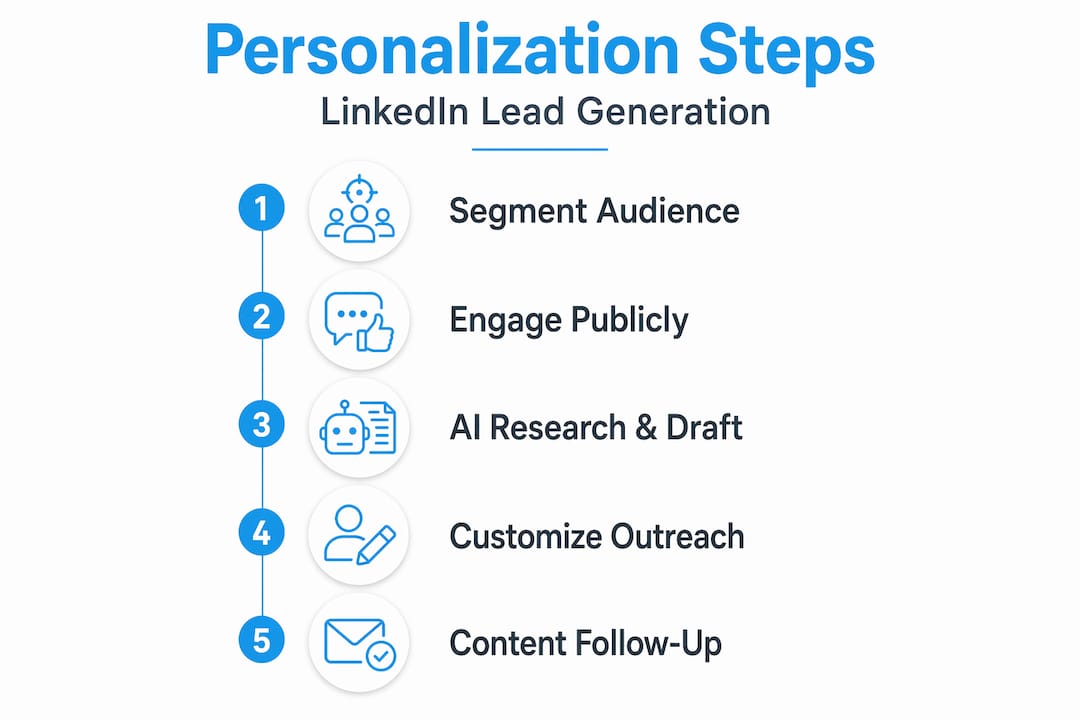
Step 1: Segment your audience by firmographic and behavioral signals.
Group prospects by industry vertical, company size, seniority level, and recent activity. A boutique law firm targeting CFOs at mid-market manufacturing companies needs a completely different message thread than one targeting HR directors at professional employer organizations.
Step 2: Build visibility through public engagement before outreach.
Comment on your prospect’s posts with genuine, specific observations. This creates what insiders call a halo effect where public engagement boosts DM acceptance rates. You are no longer a cold stranger. You are a familiar name with a visible point of view.
Step 3: Use AI to research and draft, then have a human review.
AI personalization tools can pull signals from a prospect’s recent activity, job title, and company size to generate a relevant message draft in seconds. But human review is non-negotiable before sending. The goal is a message that reads like a person wrote it, because ultimately it should.
Step 4: Tailor your customized LinkedIn outreach to each segment’s specific pain points.
Reference a recent industry trend that applies to their niche. Mention a challenge that firms at their stage typically face. Avoid anything that could have been copy-pasted.
Step 5: Follow up with content, not just reminders.
A follow-up that shares a relevant case study or insight is personalization in action. A follow-up that just says “circling back” is not.
Pro Tip: Review your LinkedIn outreach tips and audit your current message sequences. If any message could be sent to 500 different prospects without changing a word, it is not personalized.
Common pitfalls and how to avoid them in personalized content strategies
The biggest mistake in personalized content is believing that automation solves the problem. It solves part of the problem. The other part requires judgment.
LinkedIn’s 2026 algorithm actively penalizes generic mass messages and favors two-way dialogue. This means that if your outreach reads like a broadcast, LinkedIn’s systems will quietly suppress it. Your open rates fall. Your acceptance rates fall. And you never get told why.
Here are the most common pitfalls marketing leaders run into:
- Over-automating without review: Sending AI-generated messages without human approval introduces tone errors and factual gaps that destroy credibility.
- Ignoring engagement signals: A prospect who commented on your post, visited your profile, or shared content in your industry is a warm lead. Treating them identically to a cold contact is a missed opportunity.
- Neglecting follow-up sequences: Personalization does not end at the first message. Each follow-up should layer in new context or value.
- Skipping measurement: Without tracking response rates by segment, you cannot know which personalization angles are working.
- Failing to segment prospects properly: Broad segments produce generic messages. The narrower your segment, the more specific and relevant your content can be.
Pro Tip: Set a monthly review cadence where you audit your best-performing messages. Look for the specific phrases, references, or structures that generated replies and build your next round of templates around those patterns. Automation in B2B marketing works best when it runs on frameworks that humans validated first.
Measuring success and applying personalized content tactics strategically
Personalization without measurement is guesswork dressed up as strategy. Here is how to track what actually matters.
Step 1: Define your core KPIs before the campaign launches.
For LinkedIn personalization campaigns, the relevant metrics are connection acceptance rate, response rate, meeting booking rate, and downstream conversion to MQL or SQL in your CRM.
Step 2: Use UTM parameters on all linked content.
When you share a case study or a landing page in a LinkedIn message, UTM tags tie that click to the specific segment and message variant. This is how you know which personalized angle drove action.
Step 3: Integrate CRM data to close the loop.
Tailoring landing pages post-click using job function, industry, and company size data pulled from UTM parameters directly connects your LinkedIn outreach to CRM metrics like MQLs and pipeline value. Without this connection, you are measuring activity instead of revenue impact.
Step 4: Benchmark against segment performance, not just overall averages.
A campaign targeting operations directors at 50-person firms may perform completely differently from one targeting the same role at 500-person firms. Aggregated data masks these gaps.
Step 5: Feed insights into lead nurturing strategies to extend personalization beyond first contact.
The data you gather in the outreach phase should shape what content a prospect receives once they enter your nurturing workflow.
| KPI | Pre-personalization baseline | Post-personalization | Typical uplift |
|---|---|---|---|
| Connection acceptance rate | 18% | 27% | +50% |
| Message response rate | 8% | 11% | +35% |
| Meeting booking rate | 2% | 3.3% | +65% |
| Landing page conversion rate | 3% | 5% | +67% |
Strong personalized prospecting processes connect every touchpoint from first connection request to sales conversation. That continuity is what turns personalization from a tactic into a system.
Why most personalization efforts fail in B2B LinkedIn marketing, and how to fix it
Here is the uncomfortable truth: most firms that think they are doing personalization are doing segmentation at best. There is a meaningful gap between “we send different messages to different industries” and “we tailor each message to this specific person’s current context.”
The most common failure mode is treating LinkedIn like an email broadcast channel. Marketers invest in automation tools, build out sequences, and congratulate themselves on “scalable personalization.” Then they check their response rates three months later and wonder why nothing moved.
What they missed is the public layer. LinkedIn’s algorithm rewards two-way dialogue and penalizes one-sided broadcast behavior. Firms that focus exclusively on DMs while ignoring the comment section, the feed, and the content engagement layer are essentially running their campaigns with one hand tied behind their back.
Authentic dialogue is not a nice-to-have in B2B LinkedIn marketing. It is the signal the algorithm uses to decide whether you are worth amplifying or suppressing.
The fix is not complicated, but it requires a mindset shift. Start by auditing how much of your personalization budget goes toward public engagement versus private outreach. If the ratio is 90/10 in favor of DMs, you have found your bottleneck.
Critical fixes that work in practice:
- Engage publicly before you message privately. Comments on a prospect’s content warm the relationship before any DM arrives.
- Use AI for research, humans for writing approval. This is the only way to maintain authenticity at scale without triggering spam filters.
- Measure algorithm impact, not just delivery rates. If your campaigns are being suppressed, you will not see it in open rates. You will see it in response rates that plateau or decline.
- Continuously optimize based on dialogue, not just clicks. The replies you receive contain more strategic insight than any A/B test.
A refined personalized prospecting process accounts for all of this. It is not just about what you send. It is about the entire ecosystem of signals you create before, during, and after each outreach touchpoint.
How The Lead Lab helps professional services master personalized LinkedIn marketing
Knowing what personalized content is, and actually implementing it at scale across a professional services firm, are two very different challenges. Most marketing teams have the intent but not the infrastructure.
The Lead Lab specializes in exactly this gap. We build and run done-for-you LinkedIn lead generation campaigns for professional services firms that need qualified meetings, not just impressions. Our campaigns combine AI-powered research with human-reviewed messaging to produce outreach that actually converts. You can explore real results in our client portfolio, and our webinars keep you current on the personalization strategies that are working right now. If you are ready to move from generic outreach to campaigns that drive pipeline, reach out to us for a consultation.
Frequently asked questions
What exactly qualifies as personalized content in B2B marketing?
Personalized content means tailoring messages and experiences to individual preferences and behaviors using data like job roles, industry, and prior interactions, not just inserting a name. According to Salesforce, it turns generic content into customized experiences that resonate with each individual.
How does personalized content improve lead generation on LinkedIn?
It improves relevance by using AI to tailor messages based on firmographics and recent activity. AI-driven personalization boosts LinkedIn response rates by approximately 35%, which compounds significantly at campaign scale.
Can personalization be scaled without losing authenticity on LinkedIn?
Yes, and the key is a hybrid model. A hybrid AI-human approach where AI handles research and drafting while humans approve the final message keeps outreach genuine and avoids spam filter penalties.
What are common mistakes to avoid in personalized content strategies?
The biggest mistakes are sending generic mass messages, skipping audience segmentation, and failing to create two-way dialogue. LinkedIn’s algorithm actively penalizes broadcast-style outreach in favor of conversations.
How should professional services firms measure the success of their personalization efforts?
Track engagement rates, response rates, meeting bookings, and CRM metrics like MQLs. Landing page personalization tied to UTM data by job function, industry, and company size closes the feedback loop from ad click to pipeline.