
TL;DR:
- Sending more than 3 or 4 emails in sequence increases spam risk and reduces message effectiveness.
- A well-structured, multi-channel LinkedIn outreach sequence builds relevance through timing, variation, and manual engagement.
Most B2B marketing leaders assume that sending more messages automatically produces more meetings. It doesn’t. Sending more than 3 or 4 emails in a sequence can triple your spam risk, pushing your carefully crafted messages straight into the junk folder before a single decision-maker ever reads them. For professional services firms running LinkedIn campaigns, the difference between a sequence that books qualified meetings and one that gets ignored often comes down to structure, channel mix, and timing rather than sheer volume.
Table of Contents
- What is an outreach sequence?
- Core components of impactful LinkedIn outreach sequences
- Avoiding pitfalls: Common mistakes and risks in outreach sequences
- Quarterly optimization: Testing, AI, and human oversight
- Why most outreach sequences miss the mark (and how to fix it)
- Connect your outreach strategy with results
- Frequently asked questions
Key Takeaways
| Point | Details |
|---|---|
| Sequence length matters | 8-12 touchpoints drive results in B2B campaigns, but going beyond 3-4 emails risks being marked as spam. |
| Channel mix optimization | Combining manual LinkedIn touches with strategic emails increases engagement and lowers risk. |
| Continuous testing wins | Quarterly A/B testing and AI-driven analysis keep your outreach sequence effective and responsive. |
| Human oversight essential | AI streamlines the process, but real conversations and oversight protect your brand and maximize conversions. |
| Unenroll promptly | Remove prospects from the sequence as soon as they reply or book—this reduces annoyance and builds trust. |
What is an outreach sequence?
An outreach sequence is a structured, multi-step series of messages sent across one or more channels with the goal of initiating a meaningful conversation with a target prospect. It is not a single cold message blasted to a list. It is a deliberate, timed cadence where each touchpoint builds on the last, moving the prospect from awareness to engagement to action.
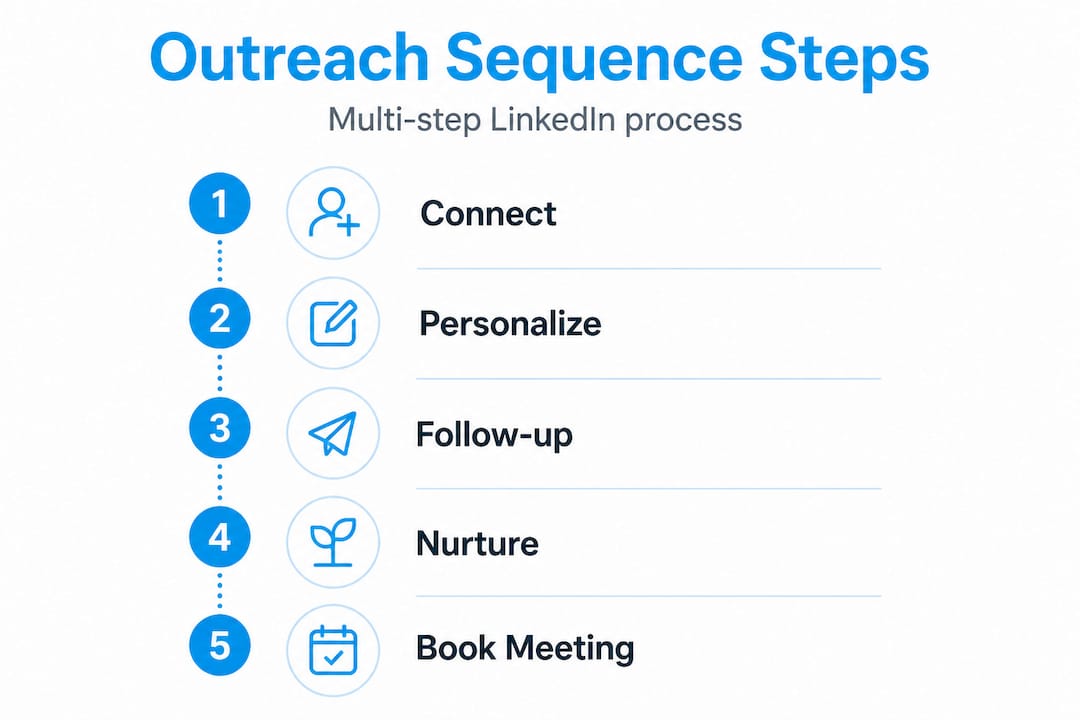
The distinction matters enormously in B2B contexts. A single-touch outreach treats every prospect the same regardless of where they are in their awareness of your firm. A multi-touch sequence, by contrast, layers context and value progressively. Your first LinkedIn connection request sets the stage. A follow-up message that references a shared industry challenge adds relevance. A subsequent email or LinkedIn InMail that offers a concrete insight closes the loop and opens a dialog.
Understanding the LinkedIn outreach basics before designing a sequence helps you appreciate why LinkedIn is uniquely suited for professional services outreach. Decision-makers in consulting, legal, financial advisory, and similar fields are active on LinkedIn in a professional mindset, making it the highest-intent channel for B2B communication.
Key elements that define a well-built outreach sequence include:
- Timing: The gap between touches matters. Too fast feels aggressive; too slow loses momentum.
- Message variation: Each message must offer a different angle, value point, or call to action.
- Channel mix: Combining LinkedIn, email, and occasionally phone creates multiple points of contact without feeling repetitive.
- Unenrollment logic: Prospects who reply or book a meeting must be removed from the sequence immediately.
“Edge cases: Avoid more than 3-4 emails in a sequence, as this increases spam classification by 3x; use manual LinkedIn touches to evade platform bans; and always unenroll prospects upon reply or booking.” — HubSpot, Sales Sequences 2026
That last point about unenrollment is not a minor housekeeping detail. It is a fundamental design principle. Continuing to message someone who has already responded damages trust and can get your LinkedIn account flagged. Building smart unenrollment triggers into your sequence from day one is what separates professional campaigns from clumsy automation.
Core components of impactful LinkedIn outreach sequences
Understanding the definition sets a foundation. Now let’s build on that by dissecting the anatomy of successful LinkedIn outreach sequences.
The first structural question every campaign manager faces is: how many touches should the sequence include? For most complex B2B sales, 8 to 12 touches represent the effective range, but that number is not static. The real test is the reply rate on your final step. If more than 3% of prospects are still responding at step 10 or 11, your sequence has not yet exhausted its value and you should consider extending it.
Crafting effective LinkedIn messaging at each stage requires you to think about what the prospect needs to hear at that exact moment in the sequence, not what you want to say. Early touches should focus entirely on the prospect’s world. Middle touches introduce your firm’s value indirectly through evidence and insight. Later touches add gentle urgency and a clear next step.
Here is an example of how a seven-step LinkedIn-led sequence might be structured for a professional services campaign:
| Step | Channel | Message type | Timing |
|---|---|---|---|
| 1 | Connection request with short note | Day 1 | |
| 2 | Value-based follow-up message | Day 3 | |
| 3 | Industry insight with soft CTA | Day 6 | |
| 4 | Engagement on prospect’s post | Day 9 | |
| 5 | Case study or proof point | Day 13 | |
| 6 | LinkedIn InMail | Direct meeting request | Day 17 |
| 7 | Final breakup message | Day 21 |
Notice that email appears only three times. That keeps you safely below the spam risk threshold while still covering the inbox channel. Manual LinkedIn touches, like engaging with a prospect’s content, add social warmth that automation simply cannot replicate.
When building the sequence, follow this numbered framework:
- Map your ideal client persona first. Every message must speak to a specific role, industry, and pain point.
- Write all messages before launching. Testing sequence logic with complete drafts prevents mid-campaign improvisation.
- Set time delays deliberately. Most sequences fail not from bad writing but from poor timing, either too aggressive or too spread out.
- Build in unenrollment conditions. Any reply, meeting booking, or unsubscribe should remove the prospect immediately.
- Assign ownership for manual touches. Engaging with a prospect’s LinkedIn post must be a human action, not a bot task.
Exploring outreach campaign ideas across different industries reveals that customized LinkedIn campaigns consistently outperform generic, templated sequences because they align message tone and timing with the buyer’s specific context.
When you properly optimize your lead workflow, you create a system where each sequence feeds qualified, warmed-up prospects into your pipeline rather than raw, cold contacts who have never heard of your firm.

Pro Tip: Unenroll prospects the moment they reply or book a call. Continuing the sequence after a positive response is one of the fastest ways to undo a warm lead and lose the meeting before it ever happens.
Avoiding pitfalls: Common mistakes and risks in outreach sequences
Knowing what makes an effective sequence allows you to proactively avoid the most damaging pitfalls.
The single biggest mistake professional services firms make is treating outreach sequences as a fully automated process. Automation handles repetition brilliantly. It cannot handle nuance. When every prospect receives identical, machine-sent messages at identical intervals, engagement rates fall and LinkedIn’s algorithm begins flagging accounts for unusual behavior.
Common mistakes that kill sequence performance include:
- Over-automating LinkedIn touches. LinkedIn actively monitors for bot behavior. Automated connection requests sent in bulk are a fast track to account restrictions.
- Exceeding the 3-4 email threshold. Sending more than 3-4 emails in a sequence increases spam classification by 3 times, which decimates deliverability rates.
- Ignoring manual LinkedIn touches. Skipping human-driven actions like profile visits, post likes, and thoughtful comments removes the social proof layer that makes LinkedIn uniquely powerful.
- Failing to personalize beyond the first name. Referencing a prospect’s specific company challenge, recent post, or industry trend increases reply rates dramatically compared to generic openers.
- Leaving replied prospects in the sequence. This is both unprofessional and damaging to your firm’s reputation with that specific contact.
Key stat: Reply rate on your final sequence step is your most important optimization signal. If more than 3% of prospects respond at the last touchpoint, extend the sequence rather than cutting it off.
For a fuller breakdown of what to watch out for, reviewing LinkedIn outreach pitfalls gives you a practical checklist before you launch any campaign.
The channel combination question deserves special attention. Many teams default to running LinkedIn sequences entirely within the platform, which limits their reach and puts all their risk in one place. A mixed sequence that uses email for longer, evidence-based messages and LinkedIn for shorter, relationship-driven touches creates two distinct paths to the same conversation. When you apply LinkedIn lead generation tips across both channels simultaneously, the combined signal is stronger than either channel alone.
Quarterly optimization: Testing, AI, and human oversight
Sidestepping mistakes is just the start. Continual optimization gives your outreach sequence sustained impact over months, not just a single campaign cycle.
Best-in-class B2B teams test and optimize quarterly through A/B messaging experiments and channel mix adjustments, using AI to detect patterns while keeping humans in the loop for context-sensitive decisions. This is not a “set it and forget it” discipline. Markets shift, prospect behavior changes with economic cycles, and what worked in Q1 may underperform by Q3 if the messaging hasn’t evolved.
Here is how quarterly performance data typically looks for teams running structured optimization cycles:
| Quarter | Avg. reply rate | Meeting booking rate | Primary change made |
|---|---|---|---|
| Q1 | 4.2% | 1.1% | Baseline campaign launch |
| Q2 | 6.8% | 1.9% | Revised subject lines, added InMail step |
| Q3 | 8.4% | 2.6% | Reduced email frequency, increased LinkedIn touches |
| Q4 | 9.7% | 3.1% | Persona-specific message variants introduced |
The trajectory is consistent: teams that treat their sequence as a living system rather than a fixed template steadily improve on every metric that matters.
AI plays a growing role in this optimization loop. Pattern detection across thousands of message interactions gives AI tools an advantage that no human analyst can match at scale. AI can identify that messages sent on Tuesday mornings to CFOs in the financial services sector get 40% more replies than the same messages sent on Thursday afternoons, and it can surface that insight automatically. When you automate LinkedIn outreach with intelligent tooling, you free your team from manual data crunching so they can focus on creative and strategic decisions.
But AI has hard limits. It cannot tell when a prospect’s tone signals genuine interest versus polite deflection. It cannot judge when a campaign is creating brand damage in a niche professional community where everyone talks to everyone. That is where human oversight becomes essential. Integrating CRM outreach strategies with your sequence data gives your team the full picture of each prospect’s journey, making it far easier for a human reviewer to catch anomalies that an AI model might categorize as noise.
The future of outreach optimization sits squarely in multi-channel engagement frameworks where AI handles pattern recognition and scheduling while human team members handle personalization, relationship nuance, and campaign strategy.
Pro Tip: Run your quarterly A/B tests on one variable at a time. Changing subject lines, message length, and channel order simultaneously makes it impossible to know which adjustment actually drove the improvement.
Why most outreach sequences miss the mark (and how to fix it)
Here is the uncomfortable truth most LinkedIn outreach guides won’t tell you: the majority of B2B outreach sequences fail not because the technology is wrong but because the thinking behind them is lazy.
Teams copy templates from blog posts, plug in a prospect’s first name and company, set up an automation tool, and expect pipeline results. What they get instead is a flood of polite “not interested” replies at best and silent deletion at worst. The mechanics might be technically correct but the strategy is hollow.
What actually drives results is something much harder to systematize: genuine relevance. A message that shows you understand a specific firm’s growth challenge, references a regulatory shift affecting their sector, or acknowledges a recent company milestone lands completely differently than a generic “I’d love to connect” opener. This level of specificity cannot be faked at scale without serious intent and infrastructure behind it.
The teams we see generating consistent pipeline from LinkedIn sequences share three practices that the average team skips. First, they build message variants for different personas within the same target company because the pain points of a managing partner differ entirely from those of a business development director. Second, they track reply rates at every individual step in the sequence, not just as an overall campaign metric, which lets them pinpoint exactly where prospects are dropping off. Third, they treat manual LinkedIn engagement as a non-negotiable part of the sequence rather than an optional add-on.
Exploring bespoke LinkedIn strategies reveals how this level of customization translates directly into higher meeting conversion rates, particularly in professional services where trust and credibility are prerequisites for any sales conversation.
The fix is not to add more automation layers. It is to do less, but do it with far greater precision. Fewer, more relevant messages to a tightly defined audience consistently outperform high-volume sequences built on a generic template.
Connect your outreach strategy with results
If the frameworks and principles in this article resonate with your team’s priorities, putting them into practice at scale is the next challenge. Building and managing optimized LinkedIn outreach sequences requires expertise in prospect targeting, message copywriting, channel design, and ongoing performance analysis.
The Lead Lab’s outreach solutions are built specifically for professional services firms that need qualified meetings, not just connection requests. From persona-specific message sequences to full response management, every campaign is designed around your ideal client profile rather than a generic template. You can explore live examples in the B2B outreach portfolio to see the kind of results structured sequencing delivers in practice. For a deeper look at strategy and emerging best practices, the LinkedIn outreach webinars cover the latest thinking on channel mix, message personalization, and campaign optimization for professional services teams ready to grow their pipeline.
Frequently asked questions
How many touches should a LinkedIn outreach sequence have?
Most effective LinkedIn outreach sequences use 8 to 12 touches for complex B2B sales, but you should always assess reply rates at the final step to decide whether extending the sequence is warranted.
What’s the risk of sending too many outreach emails?
Sending more than 3-4 emails in a sequence increases the risk of spam classification by up to 3 times, which severely damages your email deliverability and overall campaign performance.
Can AI fully replace human oversight in outreach sequence management?
No. AI aids pattern detection and optimization at scale, but human oversight is essential for nuanced interactions, relationship judgment, and managing edge cases that algorithms routinely misread.
How do you avoid being banned on LinkedIn during outreach?
Manual LinkedIn engagement and carefully controlled message frequency are the most reliable ways to avoid platform bans, while any automation tools used should be deployed conservatively and monitored consistently.
Recommended
- Craft High-Impact Outreach Messages for LinkedIn B2B Leads – The Lead Lab
- Copywriting strategies that win on LinkedIn outreach – The Lead Lab
- How to Automate Outreach Campaigns for LinkedIn Success – The Lead Lab
- How to Scale Outreach on LinkedIn: Strategies for More Leads – The Lead Lab
- Personalized email outreach guide: Boost B2B results with AI