
TL;DR:
- Aligning content with buyer stages on LinkedIn transforms it from a brand visibility tool into a powerful prospecting lever that builds familiarity, demonstrates expertise, and enables non-intrusive engagement. Creating stage-specific content formats, such as educational posts at awareness, case studies at trust, and testimonials at decision, increases response rates and prospects’ readiness to engage. Strategic distribution from personal profiles, groups, and targeted channels amplifies impact, with consistent, intent-driven content accumulating in qualified pipeline conversations.
Content is often treated as a brand-building tool, something you post to stay visible and look credible. But that framing leaves pipeline results on the table. When content is mapped intentionally to where your prospects are in their decision process, it becomes one of the most powerful prospecting levers you have on LinkedIn. This article breaks down exactly how to align your content strategy to buyer stages, which formats move the needle at each point, and how professional services firms can turn posts, guides, and case studies into qualified conversations and booked meetings.
Table of Contents
- Why content is mission-critical for LinkedIn prospecting
- Mapping content to the buyer journey: From awareness to decision
- Types of content that drive prospect response and engagement
- Best practices for distributing and amplifying content on LinkedIn
- Our take: Content strategy shifts that supercharge prospecting in professional services
- Accelerate your LinkedIn prospecting with expert content support
- Frequently asked questions
Key Takeaways
| Point | Details |
|---|---|
| Content maps the journey | Tailor content for each stage—awareness, trust, decision—to move prospects forward. |
| Context beats quantity | Strategically aligned content outperforms generic volume for LinkedIn prospecting results. |
| High-impact formats win | Webinars, case studies, and ROI-driven assets offer the highest engagement in professional services. |
| Distribution is critical | Timely and segmented sharing on LinkedIn exponentially raises response rates and qualified leads. |
Why content is mission-critical for LinkedIn prospecting
Most marketing and sales leaders at professional services firms treat LinkedIn content as a top-of-funnel activity. You publish thought leadership, you build your brand, and then separately, you run outreach campaigns. The two tracks rarely talk to each other. That’s a missed opportunity.
Content on LinkedIn does something outreach alone cannot: it builds familiarity before the first direct message ever lands. When a prospect has already seen your posts, read your insights, or engaged with your content, they recognize you. That recognition is worth more than any clever opener in a cold message. It shifts the dynamic from stranger to familiar voice, and that shift makes responses far more likely.
There are three distinct things content achieves in a prospecting context:
- Builds familiarity: Repeated exposure to your name and insights makes you a known quantity before outreach begins.
- Demonstrates expertise: Specific, niche-relevant content signals that you understand your prospect’s world, not just your own service offering.
- Enables non-intrusive engagement: A like, a comment, or a share from a prospect is an engagement signal you can act on without being pushy.
Good prospect segmentation strategies make this even more powerful because you can tailor content to resonate with different audience segments simultaneously.
As one framing in content’s role in modern demand generation puts it:
“For demand generation and prospecting, content should be mapped to the buyer journey — awareness, trust, decision — so it addresses specific buyer needs at each stage, not just brand messaging.”
That’s the key shift. Content stops being about broadcasting your brand and starts being about serving your prospect’s specific needs at each point in their journey. When you integrate this thinking into your LinkedIn lead generation strategies, you stop spraying content and start building a systematic pipeline engine.
Mapping content to the buyer journey: From awareness to decision
Understanding why content matters is step one. Step two is knowing exactly what to create and when. The buyer journey has three distinct stages, and each one calls for a different content approach.
Awareness stage: Your prospect doesn’t yet know they have a problem you can solve, or they know the problem but haven’t considered you as a solution. Here, educational content wins. Think about posts that name the specific challenges your ideal client faces, articles that reframe a common industry problem, or short video insights that make prospects say “yes, that’s exactly what we’re dealing with.”
Trust stage: The prospect knows their problem and is actively exploring options. They want evidence that you understand their situation deeply and have delivered results for people like them. This is where lead nurturing content takes over. Case studies, webinars, and comparison guides do the heavy lifting here.

Decision stage: The prospect is evaluating whether to work with you specifically. Now they need proof of outcome. Demos, testimonials, ROI analyses, and clear next-step offers are what push them from “interested” to “ready to talk.”
Here’s a practical breakdown of which content formats perform best at each stage:
| Buyer stage | Goal | Best content formats |
|---|---|---|
| Awareness | Capture attention, name the problem | Short posts, articles, polls, videos |
| Trust | Build credibility, show depth | Case studies, webinars, comparison guides, deep-dive articles |
| Decision | Trigger action, reduce perceived risk | Testimonials, ROI breakdowns, demos, client success stories |
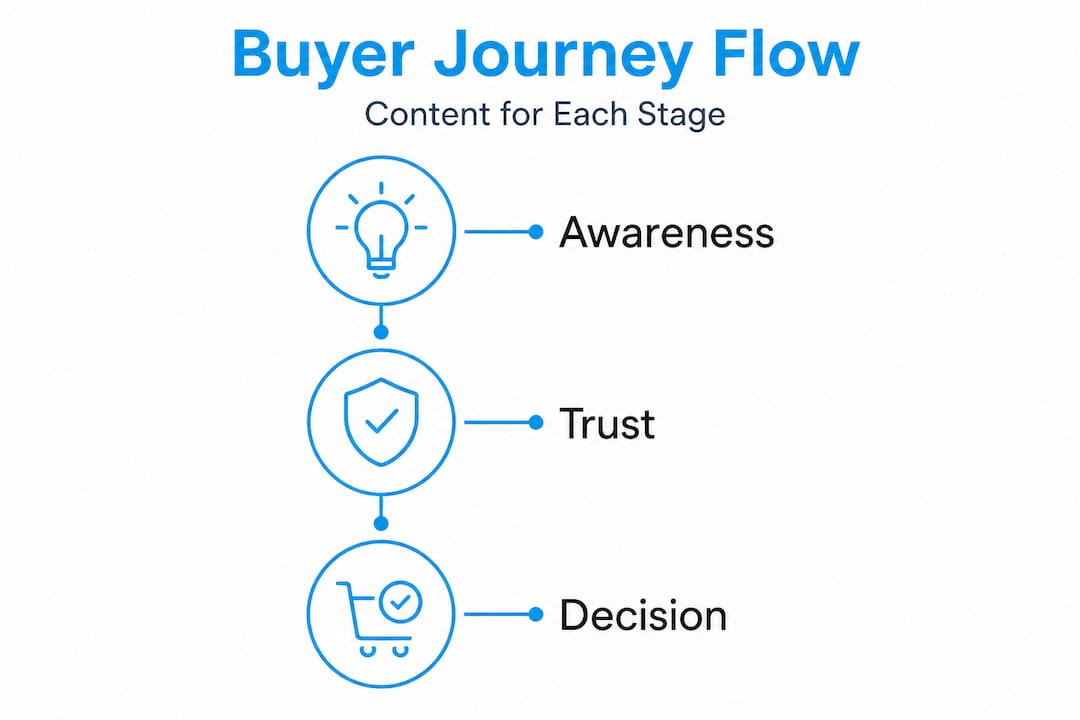
A journey-based approach relies on educational content for awareness, webinars and case studies for trust, and demos and ROI proof for decision, all of which support better lead readiness and conversion.
The reason random or generic content fails is that it has no stage context. A post about “5 trends in consulting” might get likes, but it doesn’t move a trust-stage prospect closer to a conversation. You need to know where your prospect is and serve them accordingly.
Pro Tip: Take one core idea, say, a client challenge you solved last quarter, and repurpose it across all three stages. A short awareness post names the problem. A mid-length article explains your approach. A detailed case study shows the outcome. Three assets, one coherent message, and a prospect can follow the thread across their entire journey. This is what makes innovative LinkedIn outreach ideas genuinely effective rather than just creative.
Types of content that drive prospect response and engagement
Knowing the stages is one thing. Knowing which specific content types actually get responses is another. Not all formats are created equal when it comes to driving direct engagement with prospects.
Short-form vs. long-form content: Short-form posts (under 300 words) work best for awareness and staying top of mind. They’re scrollable, easy to engage with, and generate fast feedback signals like comments and shares. Long-form content, articles, guides, and case studies, are better suited to trust and decision stages where a prospect needs to spend more time with your thinking before they’re ready to talk. The key is not picking one over the other but using each in its right context.
Linking content type to buyer stage: A prospect who just entered your orbit doesn’t want a 2,000-word case study. They want a sharp, insightful post that makes them think. A prospect who has been watching your content for three weeks is ready for a detailed guide or a client story that mirrors their situation.
Here are the top-performing content types for professional services prospecting:
- Checklists: Easy to consume and share, great for awareness and early trust building.
- Case studies: The highest-trust content type; show real client problems and real outcomes.
- Webinars: Create real-time engagement and allow prospects to self-qualify by attending.
- Comparison guides: Help trust-stage prospects evaluate options and position you clearly.
- Testimonials: Short, specific, and powerful for late-stage decision making.
- ROI breakdowns: Numbers-focused content that speaks directly to decision-stage buyers.
The research on content’s role in demand generation is clear: webinars and case studies build trust while testimonials and ROI proof drive decisions, each supporting better lead readiness and conversion.
When you’re crafting your outreach sequences, matching your prospecting email examples with the right supporting content asset dramatically improves response rates. A message that references a piece of content your prospect may have already seen feels relevant, not cold.
Pro Tip: Interactive content like LinkedIn polls and short quizzes are underutilized in professional services. A well-crafted poll that asks about a challenge your ideal client faces generates two things simultaneously: engagement data you can act on and a subtle qualification signal. Prospects who interact with your poll are showing you their priorities. Use that in your LinkedIn messaging tips when you follow up.
Best practices for distributing and amplifying content on LinkedIn
Creating good content is only half the equation. How you distribute it determines whether it actually reaches and influences your target prospects. Too many firms create solid content but distribute it lazily, posting once to their company page and hoping the algorithm does the rest.
Distribution needs to be as deliberate as creation. Here’s a step-by-step approach to aligning your distribution with your prospect segments:
- Identify your primary prospect segments before you publish. Know whether you’re talking to CFOs at mid-market firms, HR leaders in financial services, or managing partners at boutique law firms.
- Publish from personal profiles first. LinkedIn’s algorithm favors personal profiles over company pages for organic reach. Your team members should be sharing content directly from their accounts.
- Post into relevant LinkedIn groups where your target prospects are already spending time. A focused comment in a relevant group reaches a more qualified audience than a broadcast post.
- Engage first, then share. Comment on your prospects’ posts before sharing your own content. This increases your visibility in their feed before your content appears.
- Repurpose for direct outreach. Share content assets directly in messages to warm prospects as a reason to reconnect or as a value-add follow-up.
Here’s how organic distribution compares to paid promotion on LinkedIn:
| Distribution method | Reach | Cost | Best use case |
|---|---|---|---|
| Personal profile posts | Medium, high engagement | Free | Awareness and trust stages |
| Company page posts | Lower organic reach | Free | Brand consistency and credibility |
| LinkedIn groups | Targeted, community-specific | Free | Trust-stage engagement |
| Sponsored content | High, controlled targeting | Paid | Scaling awareness to new segments |
| Message ads | Direct, high intent | Paid | Decision-stage acceleration |
Research shows that content mapped to the buyer journey supports better lead readiness and conversion, but only when it actually reaches the right people at the right moment.
Timing matters too. Consistent distribution creates multiple touchpoints across a prospect’s feed over time, increasing familiarity without requiring you to send another message. When you layer this with your LinkedIn segmentation strategies, you can ensure different content streams are reaching different prospect types simultaneously. The firms that get this right are the ones consistently optimizing outreach campaigns with data on what’s resonating and what’s not.
Our take: Content strategy shifts that supercharge prospecting in professional services
Here’s the uncomfortable truth most content guides won’t tell you: posting more often will not get you more pipeline. It will get you more impressions. Those are not the same thing.
We see professional services firms fall into the volume trap constantly. They commit to a five-posts-per-week schedule, hire a content writer, fill their calendar, and then wonder why the qualified conversations aren’t materializing. The problem isn’t the quantity. It’s the absence of intent.
Every piece of content you publish should be tied to a specific prospect challenge at a specific stage of their journey. That’s the standard. If you can’t answer “what decision does this help my prospect make?” about a piece of content, it shouldn’t be published in its current form.
One insight-packed case study that mirrors the exact situation your ideal client is in right now will outperform thirty generic thought leadership posts. A precise ROI analysis showing outcomes for a firm similar to your prospect’s will do more to move a conversation forward than a year’s worth of industry trend commentary.
For professional services specifically, niche wins. Generic consulting content is everywhere on LinkedIn. What your prospects are actually hungry for is someone who clearly understands their specific industry, their specific role, and their specific pain. When your content demonstrates that, you don’t need to be clever in your outreach. The content has already done the qualifying work.
Scalable lead generation strategies work because they build systems around repeatable, intentional content frameworks rather than chasing viral moments. The firms that win on LinkedIn are not the loudest. They’re the most relevant.
Accelerate your LinkedIn prospecting with expert content support
If this article has clarified how content can work harder inside your prospecting system, the logical next step is building that system with the right support.
At The Lead Lab, we build done-for-you LinkedIn prospecting campaigns that integrate targeted content with personalized outreach for professional services firms. Our approach connects the right message to the right prospect at the right stage of their journey, turning your content investment into a consistent pipeline of qualified meetings. Explore our expert webinars for tactical guidance or review our proven client results to see what journey-mapped content prospecting looks like in practice.
Frequently asked questions
How does content support LinkedIn lead generation beyond branding?
Content qualifies, educates, and builds trust with prospects so they are more likely to respond and convert. When mapped to the buyer journey, it moves prospects from awareness through to decision-readiness before direct outreach even begins.
What content formats work best for professional services prospecting?
Case studies, comparison guides, webinars, and ROI-focused testimonials drive the most engagement and prospect readiness. As the research on content and conversion shows, webinars and case studies build trust while demos and testimonials close the decision gap.
How do you segment LinkedIn content to different prospect types?
Tailor your topics, formats, and distribution channels to address the specific challenges of each prospect segment, because content that speaks directly to a CFO will look very different from content designed for an HR director.
Can content replace direct outreach in prospecting?
Content dramatically boosts outreach effectiveness but works best in tandem with thoughtful, timely personal follow-up. Think of content as the warm-up and direct outreach as the conversation starter that converts familiarity into a booked meeting.
Recommended
- Targeted prospecting on LinkedIn: boost leads with precision – The Lead Lab
- LinkedIn Prospecting Checklist: Win More Qualified B2B Leads – The Lead Lab
- Master LinkedIn content creation for qualified leads in 2026 – The Lead Lab
- Lead generation strategies that drive results on LinkedIn – The Lead Lab
- AI prospecting guide: automate B2B leads in 2026