
TL;DR:
- Most B2B outreach fails when targeting the wrong decision makers within buying groups.
- Engaging multiple roles like economic buyers, champions, and technical evaluators increases deal success.
- Continuous stakeholder mapping and role-specific messaging are essential for high-impact B2B campaigns.
Most B2B outreach campaigns fail not because the message is wrong, but because it reaches the wrong person. Marketing leaders and business development executives in professional services firms often invest months refining their value proposition, only to send it straight to someone who cannot sign a check or champion a deal internally. B2B purchases involve buying committees of 8 to 13 stakeholders on average, which means the single contact you found on LinkedIn is rarely the one who seals the deal. Getting this right is not optional; it is the difference between a full pipeline and a calendar of wasted discovery calls.
Table of Contents
- Why decision makers drive deal outcomes
- The anatomy of modern buying groups
- The pitfalls of ignoring or mistargeting decision makers
- Strategies for effectively engaging decision makers
- Why the conventional approach to decision maker targeting falls short
- Enhance your outreach strategy with The Lead Lab
- Frequently asked questions
Key Takeaways
| Point | Details |
|---|---|
| B2B buying is group-driven | Major purchases involve committees of 8-13 decision makers, not individuals. |
| Roles matter for outreach | Tailoring your approach to economic buyers, technical evaluators, and champions increases impact. |
| Mistargeting wastes resources | Reaching the wrong people leads to delayed or lost deals and wasted budgets. |
| Multichannel and segmentation win | Combining personalized outreach with broad coverage delivers better consensus. |
| Keep decision mapping agile | Regularly update your understanding of who influences buying to stay ahead. |
Why decision makers drive deal outcomes
Now that you see the size and complexity of buying groups, let’s clarify the unique roles decision makers play in shaping deal outcomes. The term “decision maker” gets thrown around loosely, but in a B2B context it reaches far beyond the CEO or procurement manager. A decision maker is anyone with real authority over the outcome of a purchase, whether that authority is financial, technical, or operational. Ignoring this broader definition is where most outreach campaigns quietly fall apart.
“B2B purchases involve buying committees of 8 to 13 stakeholders on average, each playing a distinct role in the buying process.” — Forrester: The State of Business Buying
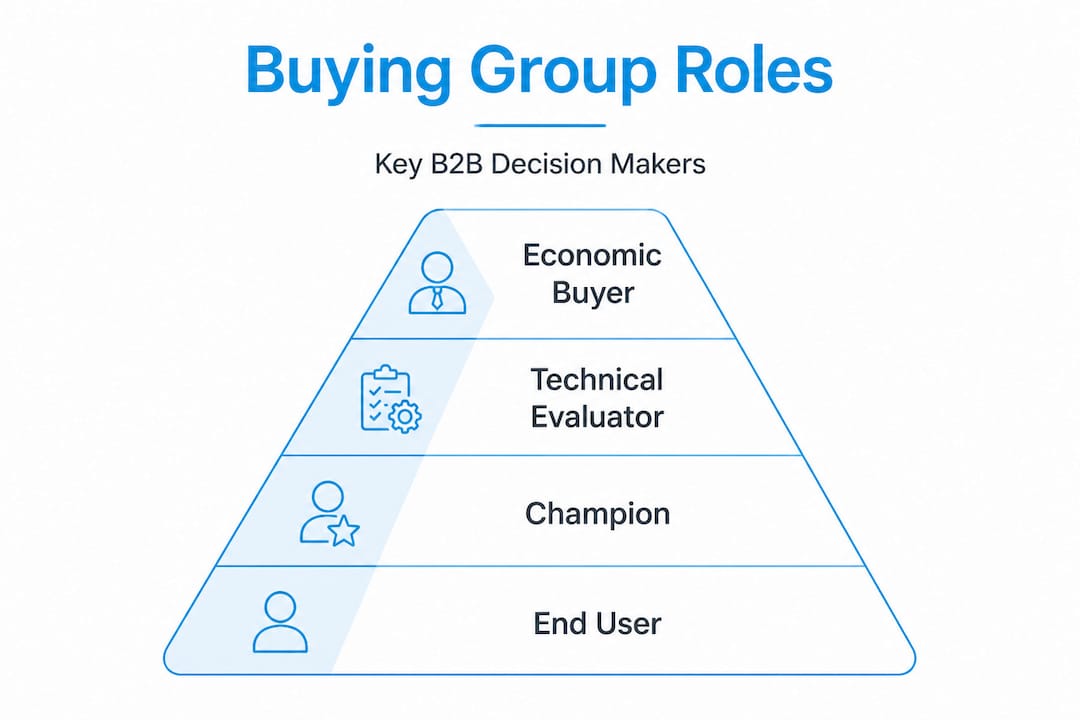
When you engage only one type of decision maker, you create blind spots. The economic buyer controls the budget and expects a return-on-investment conversation. The technical evaluator wants integration specs and security documentation. The internal champion needs talking points to sell the idea upstairs. Miss any one of these, and your deal stalls at exactly the moment it should be accelerating.
The ripple effect of mistargeting is severe. You burn budget on outreach that generates responses from people with no real authority. You lose weeks in follow-up sequences that never convert because the actual decision maker was never in the room. Deals go dark without explanation because your champion lacked the internal ammunition to move things forward.
True decision makers can unlock things that regular contacts simply cannot:
- Budget sign-off: Only the economic buyer can formally approve spend, no matter how enthusiastic the end-user is.
- Strategic fit validation: Senior stakeholders confirm whether your solution aligns with the firm’s broader direction and priorities.
- Process acceleration: Champions with organizational credibility can fast-track internal reviews, shortening your sales cycle significantly.
- Risk removal: Technical evaluators who approve your solution remove the “not invented here” objection before it derails your proposal.
When you focus on targeting ideal clients and mapping decision makers before your first outreach touch, you start every conversation with strategic intent rather than hopeful guesswork.
Pro Tip: Build a stakeholder map at the start of every new account, not midway through the sales cycle. Use your CRM or sales engagement platform to log each contact’s role, influence level, and likely concerns. Revisit the map after every conversation and update it based on what you learn.
The anatomy of modern buying groups
Understanding these different decision maker types helps shape how and where to direct your outreach. Modern B2B buying groups are not flat hierarchies. They are layered, cross-functional committees where each person evaluates your solution through a completely different lens. Knowing this changes everything about how you structure your messaging.
Buying committees include economic buyers, technical evaluators, champions, and others, each of whom responds to different messaging formats, channels, and conversation styles. Here is a breakdown of the key roles and how to approach each one:

| Role | Primary goal | Best outreach channel | What they need from you |
|---|---|---|---|
| Economic buyer | Maximize ROI, protect budget | LinkedIn, executive briefings | Financial impact, proven results |
| Champion | Build internal credibility | Direct messages, calls | Easy-to-share materials, talking points |
| Technical evaluator | Reduce integration risk | Email, demos, documentation | Specs, security details, case studies |
| End user | Simplify their daily workflow | Webinars, peer communities | Ease of use, time savings |
| Blocker | Protect current processes | Patience, education | Risk mitigation, reassurance |
Each of these roles requires a distinct prospect segmentation strategy. Sending the same generic message to an economic buyer and a technical evaluator is like pitching a financial return story to someone who just wants to know if your API connects with their existing stack. Neither conversation goes anywhere productive.
Here is how to map buying group roles in new accounts before you ever send a message:
- Research the org chart. Use LinkedIn, the company website, and your CRM to identify who holds budget authority, who manages the technical stack, and who influences internal decisions.
- Identify your best entry point. Look for a likely champion, someone who has engaged with content on your topic, attended relevant events, or previously interacted with your firm.
- Tag each contact by role. Label them in your CRM by their buying group role, not just their job title.
- Map relationships between stakeholders. Understand who reports to whom and who holds informal influence in the group.
- Design role-specific messaging. Write separate message tracks for each role, addressing their specific concerns and goals.
Multithreading, which means engaging multiple roles simultaneously, dramatically increases your odds of reaching consensus. If your champion leaves the company or loses internal support, a deal that relied on a single contact will collapse. Exploring innovative outreach campaign ideas that address multiple stakeholders at once gives your pipeline real resilience.
The pitfalls of ignoring or mistargeting decision makers
Having seen the buying group structure, it is critical to avoid costly mistakes in targeting. The consequences of getting this wrong go far beyond a few lost deals. They compound over time, creating systematic waste in your marketing and business development budget.
Targeting the wrong stakeholders blocks deals and wastes resources that could have been redirected toward qualified opportunities. Here is how that plays out in practice:
| Pitfall | Short-term effect | Long-term effect |
|---|---|---|
| Targeting only the initial contact | Quick responses with no forward momentum | Pipeline bloated with dead-end opportunities |
| Skipping the economic buyer | Enthusiastic conversations, no budget approval | Deals that collapse at proposal stage |
| Ignoring the blocker | Smooth early stages | Late-stage surprises that kill deals without warning |
| Missing the technical evaluator | Strong business case, failed implementation review | Lost deals after significant time investment |
| Over-relying on one champion | Fast early traction | Single point of failure if the champion leaves |
Research from buying groups for the win shows that multithreading across buying group members compresses sales cycles and delivers measurable results, especially in large organizations where consensus is required before any purchase can move forward.
The warning signs that your outreach is missing key decision makers are often visible well before a deal formally dies. Watch for these red flags:
- Deals stalling without explanation: Your contact seems engaged but cannot secure an internal meeting or next step.
- Stakeholders being looped in late: You hear “we’ll need to get legal/finance/IT involved” weeks into a conversation that should have progressed.
- Vague responses to pricing or timeline questions: Your contact deflects rather than engaging with specifics, suggesting they lack authority.
- Repeated “we’re still evaluating” responses: The buying group has concerns you have not addressed because you have not spoken to everyone involved.
- Sudden ghosting after initial interest: Your champion lost internal support and does not know how to tell you.
Integrating B2B marketing automation into your outreach helps flag these warning signs at scale. Automated engagement tracking can surface which contacts are opening emails, clicking links, or going silent, giving you data to adjust your stakeholder approach in real time. Combining this with outreach campaign optimization practices ensures you are not just sending more messages, but sending smarter ones to the people who actually move deals forward.
Strategies for effectively engaging decision makers
Equipped with these best practices, professional services teams can begin to see much stronger ROI from their outreach efforts. The gap between firms that close complex B2B deals consistently and those that struggle is rarely about product quality. It is almost always about how systematically they engage the right people across the buying group.
Multithreading compresses sales cycles and wins consensus, but the mechanics of making it work require deliberate planning at every stage of your outreach.
Here is a hands-on framework for identifying, segmenting, and creating tailored messaging for each decision maker type:
- Define the ideal buying group profile for your solution. List every role that typically influences a purchase in your target market. Be specific about industry, company size, and organizational complexity.
- Build tiered prospect lists. Prioritize accounts that match your ideal client profile, then identify multiple contacts within each account across the key buying group roles.
- Write role-specific message tracks. Create separate LinkedIn connection requests, follow-up messages, and call scripts for economic buyers, champions, and technical evaluators.
- Sequence outreach to create internal momentum. Start with the champion to warm the ground, then engage the economic buyer with a referral or peer introduction when possible.
- Track engagement by role, not just by account. Log every interaction against the stakeholder map and adjust your approach based on who is responding and who is going quiet.
- Use content to do the multithreading for you. Share thought leadership pieces, case studies, and industry data that your champion can forward internally, effectively getting your message in front of stakeholders you have not yet reached directly.
The channels and approaches that consistently outperform in professional services include:
- LinkedIn: The highest-signal channel for reaching senior decision makers who are actively engaged in professional content and industry conversations.
- Peer referrals: A warm introduction from a mutual connection compresses trust-building by months.
- Executive events and roundtables: In-person or virtual events where decision makers gather are among the highest-conversion touchpoints available.
- Personalized video messages: Short, specific video outreach cuts through inbox noise and communicates personality in a way text cannot.
Pro Tip: Use a mix of personalized outreach for your top 20 target accounts and scalable sequences for the broader list. Multi-channel outreach ensures you are present on multiple platforms without overwhelming your team. Pair this with low-friction LinkedIn messaging to make it easy for decision makers to engage without feeling sold to on first contact. And when you are segmenting prospects by buying group role, your messaging will always feel relevant rather than generic.
Why the conventional approach to decision maker targeting falls short
Let’s reflect on what most firms miss and how you can stand apart in your approach to decision maker targeting. The standard playbook tells you to build a buyer persona, lock it in, and use it across every campaign. That approach made more sense when buying groups were smaller and organizational structures were more stable. Today, it creates a false sense of precision.
Static buyer personas quickly become outdated in large, shifting buying groups. A CFO who was the economic buyer six months ago may have delegated that authority to a newly hired VP of Operations. An internal champion who loved your solution may have moved to a different team or company entirely. Firms that rely on the same personas quarter after quarter are essentially targeting a snapshot of reality that no longer exists.
The teams that consistently win complex B2B deals treat stakeholder mapping as a living discipline. They revisit their maps after every deal, won or lost, and ask specific questions: Who had influence that we did not anticipate? Which role slowed the deal down unexpectedly? Where did our messaging miss the mark because we misread someone’s priorities? These post-mortems are where the real competitive intelligence lives.
Real-world outreach wins when you continuously revalidate who holds influence at each stage of the buying process. The person who matters most at the awareness stage is often different from the person who holds the final veto at the decision stage. Building flexibility into your outreach strategy, so that your team can pivot and engage a new stakeholder when the situation changes, is what separates adaptive sales organizations from rigid ones.
Custom LinkedIn outreach strategies that treat each buying group as unique rather than templated are far more effective in professional services environments where relationships and reputation carry enormous weight. The firms that stand apart are the ones willing to do the harder work of real-time stakeholder mapping instead of defaulting to last year’s persona deck.
Enhance your outreach strategy with The Lead Lab
If the frameworks above resonate, the next question is how to operationalize them without adding headcount or rebuilding your entire outreach process from scratch.
The Lead Lab specializes in smart, targeted B2B outreach built specifically for professional services firms navigating complex buying environments. From prospect targeting and stakeholder segmentation to personalized message copywriting and response management, every campaign is designed to reach the right people with the right message at the right stage. You can explore outreach success stories from firms that have used this approach to secure qualified meetings with genuine decision makers, or register for one of the upcoming webinars to see these strategies applied in real-world scenarios relevant to your market.
Frequently asked questions
What is a B2B buying committee?
A B2B buying committee is a group of 8 to 13 stakeholders, including economic buyers and technical evaluators, who jointly evaluate and approve purchasing decisions rather than leaving the choice to a single individual.
How do I identify the true decision makers within a target company?
Start by mapping roles such as budget holders, end-users, and key influencers during your initial discovery phase, then update your stakeholder map after every conversation as you learn more about who holds real authority and influence.
Why does focusing on buying groups improve sales outcomes?
Engaging multiple decision makers secures stronger internal commitment and compresses sales cycles, especially in large organizations where one person alone rarely has the authority or the political capital to push a purchase through.
What’s the risk if I only target one contact in a company?
You risk deal delays or outright failure since B2B buying committees of 8 to 13 stakeholders require consensus, meaning your single contact may want to move forward but lack the authority or internal support to do so.
Does targeting decision makers work for smaller firms too?
Yes, even in smaller organizations, identifying key decision makers early shortens buying cycles, reduces the number of surprise objections late in the process, and raises close rates by ensuring your message reaches everyone whose opinion shapes the final answer.
Recommended
- Proven Ways to Target Ideal Clients for B2B Success – The Lead Lab
- Targeted messaging: why it drives LinkedIn B2B success – The Lead Lab
- Personalized Prospecting Process: Boost B2B Leads – The Lead Lab
- Drive B2B lead gen success with strategic messaging – The Lead Lab
- AI Lead Generation: Improve Sales with Autonomous AI Agents by AIM Agency