
TL;DR:
- Professional services marketing builds trust over time by demonstrating credibility and expertise in long-term efforts. Firms that focus on creating a trust infrastructure and targeted LinkedIn outreach typically outperform short-term campaign strategies. Pricing that reflects specialization and value signaling influences buyer confidence and premium positioning.
Professional services marketing is defined as the strategic practice of selling intangible expertise, trust, and judgment to attract and convert clients in sectors like consulting, law, accounting, and finance. Unlike product marketing, it cannot rely on demos, free trials, or shelf placement. Buyers cannot evaluate the service before they buy it. That single fact changes everything about how firms must market themselves. Specialized firms charge 15–30% higher fees than generalist competitors, and sales cycles typically run 6–18 months. Those two numbers explain why what is professional services marketing matters so much to get right from the start.
What is professional services marketing and why does it differ?
Professional services marketing is the discipline of building enough trust and credibility that a prospective client chooses your firm over every alternative they cannot fully evaluate in advance. The recognized industry term for this discipline is services marketing, and it operates under fundamentally different rules than product marketing.
Product marketing sells features you can see, touch, or test. Services marketing sells outcomes you can only promise. That gap creates the core challenge: buyers carry high perceived risk, so they rely on signals rather than direct evidence.
The four properties that separate services from products are worth naming precisely:
- Intangibility. A law firm’s advice has no physical form. A consulting engagement cannot be returned.
- Inseparability. The service is produced and consumed at the same time, meaning the provider’s reputation is always on the line.
- Variability. Quality depends on who delivers the service and when, making consistency a marketing asset.
- Perishability. An unfilled consulting hour is revenue lost forever. There is no inventory to sell later.
These four properties mean that trust-building marketing acts as an infrastructure that compounds over 6–18 months, not a campaign you run once and measure in weeks. Firms that treat marketing as a short-term lead-generation tactic consistently underperform against firms that treat it as a long-term credibility system.
Pro Tip: Never run mass cold email campaigns as your primary channel for professional services. Buyers in this space interpret volume outreach as a signal that you lack selectivity, which directly undermines the premium positioning you need.
What are the most effective strategies for marketing professional services?
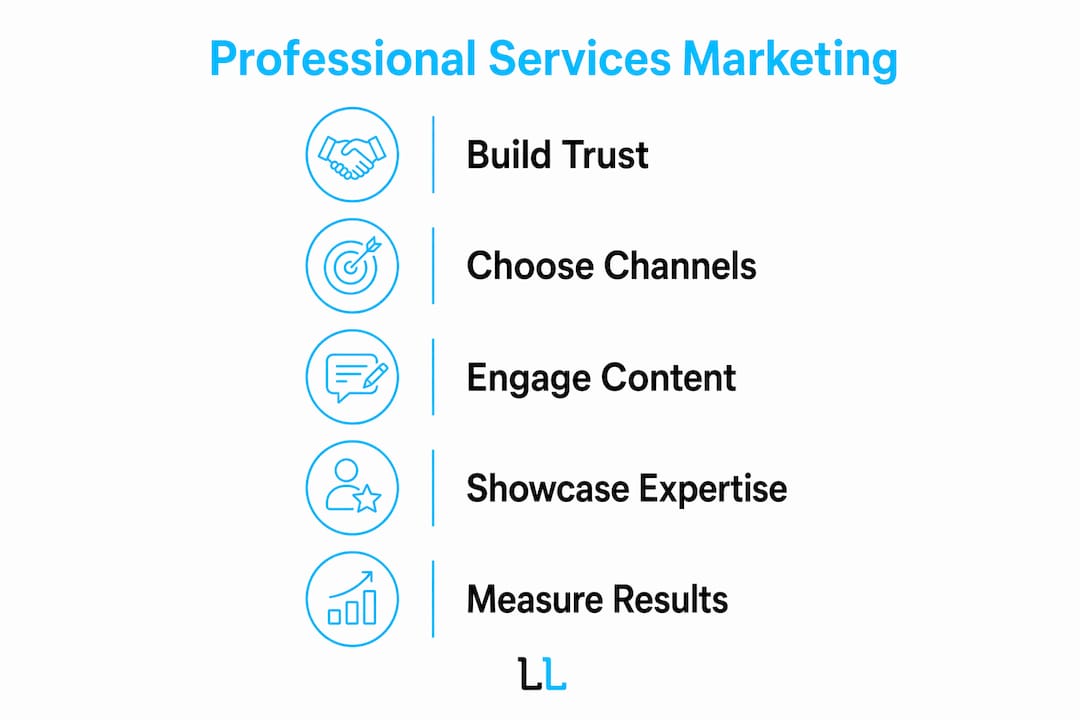
The firms that win consistently build what practitioners call a trust-building architecture. It has four stages, and skipping any one of them stalls the pipeline.
-
Credibility signals. These are the baseline proof points: credentials, certifications, named client logos, and press mentions. They answer the question “Are you legitimate?” before a buyer will engage further.
-
Expertise demonstration. This is where content marketing does its real work. 95% of decision-makers are more receptive to firms publishing quality thought leadership, according to Edelman and LinkedIn’s 2025 research. Publishing detailed case studies, original frameworks, and founder-led analysis signals that you understand the buyer’s world at a level competitors do not.
-
Low-risk interactions. Webinars, free audits, short discovery calls, and diagnostic tools let buyers sample your thinking before committing. These interactions reduce perceived risk without discounting your fees.
-
Social proof. Testimonials, case studies, and referrals close the gap between interest and decision. 73% of professional buyers research firms before making initial contact, which means your social proof must be visible before you ever speak to a prospect.
Choosing the right channels
LinkedIn is the dominant B2B platform for professional services, with over 233 million sector users. Firms that publish consistently on LinkedIn, combined with 2–4 conference speaking engagements and targeted podcast appearances per senior leader annually, build compounding visibility that paid advertising cannot replicate at the same cost.

Founder-led content outperforms brand-page content on every major B2B platform. When the managing partner or practice lead publishes their own analysis, buyers connect with a person, not a logo. That connection is what drives referrals and inbound inquiries.
Pro Tip: Assign one senior subject matter expert to own a single LinkedIn content pillar for 90 days before expanding. Depth on one topic builds more authority than scattered posts across five.
Examples of professional services marketing that actually convert
The best examples of professional services marketing share one trait: they lead with the buyer’s problem, not the firm’s credentials. Engagement sequences that name specific buyer situations and challenges significantly increase conversion compared to generic capability statements.
Website and local SEO
Your website is the first place a referred prospect goes to confirm their decision. A credibility-focused website needs clear positioning (who you serve and what outcome you deliver), named case studies with measurable results, and a frictionless contact path. Buried phone numbers and multi-step forms kill conversions.
Local SEO matters more than most professional services firms realize. A complete Google Business Profile, strong Map Pack rankings, and positive recent reviews are decisive factors in client choice for law firms, accounting practices, and consultancies with regional client bases. Measuring the return on that SEO investment is straightforward with the right tracking in place, and a small business SEO ROI guide can help firms establish a baseline before scaling spend.
Content that meets Google’s E-E-A-T standard
Google’s E-E-A-T framework (Experience, Expertise, Authoritativeness, and Trust) is the quality standard that determines whether your content ranks. For professional services, this means publishing content written by named practitioners with verifiable credentials, citing primary research, and updating articles regularly. Generic blog posts written by anonymous contractors fail this standard and waste budget.
LinkedIn outreach and segmentation
Targeted LinkedIn outreach, when built around precise audience segmentation, produces qualified meetings at a fraction of the cost of paid advertising. The key is matching message to buyer stage. A cold prospect needs a problem-framing message. A warm prospect who has engaged with your content needs a low-friction next step. The Lead Lab’s approach to LinkedIn lead generation segmentation separates these audiences and tailors messaging accordingly, which is why response rates improve significantly compared to unsegmented blasts.
For firms building their outreach from scratch, a structured LinkedIn prospecting checklist prevents the most common mistakes: wrong audience targeting, generic opening lines, and no clear call to action.
How does pricing signal quality in professional services marketing?
Pricing in professional services is not just a financial decision. It is a positioning statement. A firm that prices below market signals uncertainty about its own value. A firm that prices at a premium and communicates that premium clearly signals confidence and selectivity.
Specialized firms charge 15–30% higher fees than generalist competitors. That premium is not accidental. It reflects the buyer’s perception that a specialist carries less risk than a generalist. A tax attorney who works exclusively with private equity firms commands more than one who handles all tax matters, because the buyer believes the specialist has seen their exact problem before.
Marketing’s role in pricing is to make the value visible before the fee conversation starts. Case studies that quantify outcomes, testimonials that reference specific results, and content that demonstrates deep sector knowledge all shift the buyer’s reference point upward. When a prospect arrives at a pricing conversation already convinced of your expertise, the fee feels proportionate rather than expensive.
Pro Tip: Never list your fees as a range without context. A range signals negotiability and invites buyers to anchor on the lower number. Instead, frame pricing around the outcome it funds.
SEO for service industries follows the same logic: visibility without clear positioning just attracts the wrong buyers at the wrong price point.
B2B content marketing in professional services requires sustained effort, with major impact typically appearing after 12–18 months. Firms that commit to that timeline and align their pricing with their positioning consistently outperform those chasing short-term volume.
Key Takeaways
Professional services marketing succeeds when firms treat trust-building as a long-term infrastructure, not a campaign, and align their positioning, pricing, and content to reduce buyer risk at every stage.
| Point | Details |
|---|---|
| Trust is the product | Buyers cannot evaluate services before purchase, so every marketing touchpoint must reduce perceived risk. |
| Specialization commands premiums | Specialized firms charge 15–30% higher fees because buyers perceive lower risk in hiring a focused expert. |
| Sales cycles require patience | Professional services sales cycles run 6–18 months, so marketing must sustain credibility across a long timeline. |
| Content must demonstrate expertise | Publishing thought leadership by named practitioners meets Google’s E-E-A-T standard and builds buyer confidence. |
| LinkedIn drives qualified B2B visibility | With over 233 million professional sector users, LinkedIn is the highest-return channel for targeted outreach and authority building. |
The trust infrastructure most firms skip
Most professional services firms treat marketing as a series of campaigns. Run an ad, send a sequence, attend a conference. When results disappoint, they switch channels. The problem is not the channel. The problem is the absence of an underlying trust infrastructure.
Trust infrastructure is the accumulated body of proof that exists before a buyer ever contacts you. It includes your content archive, your client testimonials, your speaking record, your LinkedIn presence, and the consistency of your positioning over time. None of these assets produce results in 30 days. All of them compound over 18 months into a pipeline that feels almost automatic.
I have watched firms with half the budget of their competitors consistently win better clients because they committed to depth over breadth. They picked one platform, one content format, and one audience segment. They published consistently for a year. They did not chase every new channel. That discipline is rare, and it is exactly why it works.
The rise of AI-powered search is making this even more consequential. When buyers ask ChatGPT or Perplexity which consulting firm to consider, the answer draws from indexed content, reviews, and authority signals. Firms with a thin digital footprint will not appear. Firms with a deep, consistent content record will. The investment you make in thought leadership today is the visibility you earn in AI-assisted discovery tomorrow.
My honest advice: stop asking “what channel should we use?” and start asking “what proof do we need to build?” The channel is secondary. The proof is everything.
— Toby
How The Lead Lab helps professional services firms grow
Professional services marketing requires more than a content calendar and a LinkedIn profile. It requires a system that identifies the right buyers, reaches them with the right message, and converts interest into qualified meetings.
The Lead Lab builds done-for-you LinkedIn outreach campaigns specifically for professional services firms. Every campaign includes precise prospect targeting, personalized message copywriting, response management, and campaign analytics. The results are visible in the client portfolio, where case studies show how firms in consulting, finance, and legal services have generated qualified meetings at scale. If you want a pipeline that reflects your firm’s expertise and pricing, The Lead Lab is built for exactly that conversation.
FAQ
What is professional services marketing in simple terms?
Professional services marketing is the practice of attracting and converting clients for intangible, expertise-based services like consulting, law, and accounting by building trust and demonstrating credibility rather than promoting product features.
How long does professional services marketing take to produce results?
Early wins can appear within months, but meaningful lead generation and business development typically compound over 12–18 months of consistent effort.
Why does specialization matter in professional services marketing?
Specialized firms charge 15–30% higher fees than generalists because buyers perceive a specialist as carrying less risk. Specialization also sharpens positioning and makes marketing messages more precise.
What are the best channels for marketing professional services?
LinkedIn is the dominant B2B channel for professional services, supported by thought leadership content, local SEO, Google Business Profile management, and targeted conference or podcast appearances by senior practitioners.
How does pricing relate to professional services marketing?
Pricing acts as a trust and quality signal. Firms that communicate the value behind their fees through case studies and outcome-focused content shift buyer perception upward before the pricing conversation begins.