TL;DR:
- Conversion optimization focuses on increasing the percentage of website visitors who complete desired actions without boosting traffic or ad spend. It involves analyzing visitor behavior, forming hypotheses, and testing changes to elements like headlines, CTAs, lead forms, and trust signals to improve conversions. Successful CRO relies on measuring funnel-stage metrics, ensuring statistical significance, and prioritizing copy and value propositions over technical fixes or traffic growth.
Conversion optimization is defined as the systematic, data-driven process of increasing the percentage of website visitors who complete a desired action, such as submitting a lead form, booking a demo, or making a purchase, without increasing traffic or ad spend. The industry standard term is conversion rate optimization, or CRO. The formula is straightforward: divide conversions by total visitors, then multiply by 100. Average website conversion rates sit at 2.35%, while the top 10% of sites exceed 11%. That gap represents an enormous amount of revenue left on the table by businesses that focus only on driving more traffic instead of converting the visitors they already have.
What is conversion optimization and what does it actually involve?
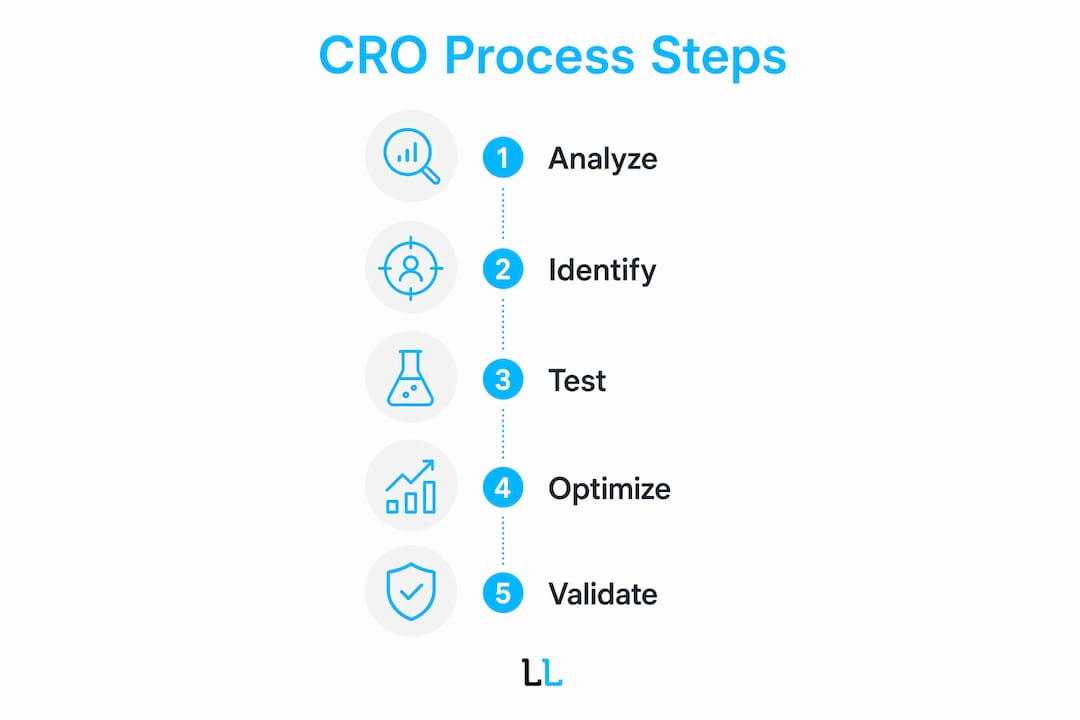
CRO is a structured cycle, not a one-time fix. It starts with analyzing how visitors behave on your site, identifying where they drop off, forming a hypothesis about why, and then testing a change to confirm or reject that hypothesis. SEO drives traffic while CRO maximizes the value of that traffic. The two disciplines are complementary, but they solve different problems.

The core components of a CRO process
The elements most commonly tested in a CRO program include:
- Headlines and value propositions: The first thing a visitor reads determines whether they stay or leave.
- Calls to action (CTAs): Button copy, placement, and color all affect click-through rates.
- Lead forms: The number of fields, labels, and error messages all create or reduce friction.
- Page layout and visual hierarchy: Where the eye travels on a page shapes what action a visitor takes.
- Trust signals: Testimonials, case studies, security badges, and client logos reduce purchase anxiety.
Analysis techniques include user behavior tracking through session recordings, heatmaps that show where visitors click and scroll, and funnel analytics that reveal exactly where drop-off occurs. The iterative test cycle runs through hypothesis formation, A/B or multivariate testing, and result analysis before the next test begins. Testing four times a month keeps momentum without rushing to conclusions.
Pro Tip: Prioritize tests on your highest-traffic pages first. A 10% lift on a page with 50,000 monthly visitors produces far more revenue than a 30% lift on a page with 500 visitors.
How do you measure CRO success?
Measuring CRO effectiveness requires tracking the right metrics at the right level of the funnel. Blending all conversions into a single site-wide rate is one of the most common mistakes marketers make. Measuring conversion rates by funnel stage gives more precise insight and reveals exactly where the biggest opportunities sit.
Key CRO metrics and their purposes
| Metric | Purpose |
|---|---|
| Conversion rate (by funnel stage) | Identifies where visitors drop off in the buying process |
| Micro conversions | Tracks smaller actions (email signups, video plays) that predict purchase intent |
| Revenue per visitor | Measures the dollar value generated per unique session |
| Bounce rate | Signals whether landing page messaging matches visitor expectations |
| Statistical significance | Confirms that test results reflect real behavior, not random variation |
Statistical significance is non-negotiable in CRO. Tests require at least 300 conversions per variation for reliable results at typical conversion rates. Ending a test early because results look promising is a common source of false positives that waste resources and mislead future decisions.
Common tools used for CRO measurement and testing include Google Analytics 4 for funnel tracking, Hotjar or Microsoft Clarity for heatmaps and session recordings, and Google Optimize alternatives for A/B testing. Each tool serves a distinct role in the measurement stack.
Pro Tip: Never call a test a winner until it reaches both your minimum sample size and a 95% confidence level. Premature conclusions are the single biggest source of wasted CRO budget.
What are the most effective conversion optimization strategies?
Copy-driven CRO strategies yield the highest conversion lifts, ranging from 50% to over 200%. Design and UX improvements rank second, typically producing 10–50% gains. Technical fixes such as load speed improvements rank third, generating 2–10% lifts. This hierarchy matters because most teams default to technical tweaks when the biggest gains come from rewriting copy.
Why headline clarity produces outsized results
People decide in 50 milliseconds whether to stay on a page. That judgment happens before they read a single word of body copy. A clear headline that matches the visitor’s intent and the ad or link they clicked retains attention. A vague or generic headline loses it immediately. This is why headline testing consistently produces larger lifts than button color changes.
The value proposition is the second most critical element. It answers the question every visitor asks: “Why should I choose you over every other option?” A strong value proposition is specific, credible, and tied to an outcome the visitor actually wants. Weak value propositions use phrases like “world-class service” or “end-to-end solutions” that say nothing concrete.
Friction reduction and trust building
Friction is anything that makes it harder for a visitor to complete the desired action. Reducing form fields from 11 to 4 can increase conversions by up to 120%. That single change requires no design overhaul and no new traffic. It is purely a friction reduction decision.
Trust signals work by reducing the psychological risk a visitor perceives before converting. The most effective trust signals are specific: a named client testimonial with a job title and company, a case study with measurable results, or a security certification logo on a checkout page. Generic five-star ratings without context carry far less weight.
Key friction reduction tactics include:
- Removing unnecessary form fields and replacing required fields with optional ones where possible.
- Cutting page load time, since slower pages lose visitors before the content even renders.
- Aligning the CTA copy with the specific outcome the visitor wants, not a generic “Submit” or “Click here.”
- Placing the primary CTA above the fold so visitors see it without scrolling.
Effective B2B messaging strategies apply the same friction reduction principles to outreach campaigns, not just landing pages.
Pro Tip: Test your value proposition before testing your design. A page with a mediocre design and a compelling value proposition will outperform a beautifully designed page with a weak one every time.
What are the most common CRO mistakes?
Most CRO programs fail not because the concept is flawed but because execution skips the fundamentals. The errors below account for the majority of wasted testing cycles.
- Tracking blended conversion rates. Combining all site visitors into one conversion rate hides where the real problems are. A checkout page with a 1% conversion rate and a blog post with a 0.1% email signup rate should never be averaged together. Funnel-stage tracking is the correct approach.
- Prioritizing technical tweaks over copy. Fixing a broken redirect or improving mobile responsiveness matters, but these changes rarely move the needle on conversion rates the way a rewritten headline does. Teams that spend months on technical work while ignoring copy leave most of their potential gains untouched.
- Running tests without enough traffic. A test that ends after 50 conversions per variation tells you almost nothing. The result is statistically meaningless and can actively mislead your next decision.
- Ignoring user intent. A visitor who arrives from a “how to generate B2B leads” search query has different expectations than one who clicks a retargeting ad. Sending both to the same generic landing page guarantees poor performance for at least one segment.
- Testing too many variables at once. Multivariate testing requires significantly more traffic than A/B testing to reach significance. Running it on low-traffic pages produces noise, not insight.
Improving lead quality through outreach follows the same logic: targeting the right audience before optimizing the message produces better results than optimizing the message for the wrong audience.
Key Takeaways
Conversion rate optimization delivers the highest return when teams prioritize copy and value proposition testing before design or technical changes, measure results by funnel stage, and run tests to statistical significance before acting on results.
| Point | Details |
|---|---|
| CRO definition | CRO increases the percentage of visitors who complete a desired action without adding traffic spend. |
| Copy outperforms design | Copy-driven changes produce 50–200%+ lifts; technical fixes typically yield only 2–10%. |
| Statistical significance matters | Tests need at least 300 conversions per variation to produce reliable, actionable results. |
| Funnel-stage measurement | Tracking conversion rates by funnel stage reveals specific drop-off points more accurately than site-wide averages. |
| Friction reduction wins | Cutting form fields from 11 to 4 can increase conversions by up to 120% with no design changes required. |
CRO works best when you stop chasing traffic
I have watched marketing teams spend six months and significant budget driving more traffic to pages that were never going to convert. The instinct to buy more ads or publish more content is understandable. Traffic feels like progress. But AI-driven search is already reducing organic click-through rates, which means the traffic you have today is more valuable than the traffic you might acquire tomorrow.
The teams that win at CRO treat it as a discipline, not a project. They run tests continuously, prioritize ruthlessly, and resist the urge to declare victory after one successful experiment. The biggest lesson I have learned is that test prioritization is where most programs either succeed or stall. Teams that test headlines and value propositions first consistently outperform teams that spend the same time on button colors and font sizes.
CRO also does not exist in isolation. The quality of traffic matters enormously. When you segment your prospects before they reach your landing page, you send higher-intent visitors who are far more likely to convert regardless of which headline variant wins. The best CRO programs work upstream, not just on the page itself.
The mindset shift that produces the most durable results is moving from “how do we get more visitors” to “how do we make every visitor count.” That shift changes which questions you ask, which tests you run, and which metrics you report to leadership.
— Toby
How The Lead Lab approaches conversion and lead generation
The Lead Lab specializes in LinkedIn outreach and lead generation for professional services firms, with a direct focus on sending qualified, high-intent prospects to your pipeline. Conversion optimization starts before a visitor ever reaches your website. When outreach targets the right decision-makers with the right message, the leads that arrive are already primed to convert. The Lead Lab’s done-for-you campaigns combine targeted prospecting, personalized copywriting, and response management to produce meetings with qualified buyers. For a closer look at results, the client portfolio shows measurable outcomes across professional services and consulting firms.
FAQ
What is the average website conversion rate?
The average conversion rate across websites is 2.35%, with the top 10% of sites converting at above 11%. Landing pages average around 4.02%.
How is conversion rate calculated?
Conversion rate equals conversions divided by total visitors, multiplied by 100. A site with 10,000 monthly visitors and 235 conversions has a 2.35% conversion rate.
What is the difference between CRO and SEO?
SEO increases the volume of traffic arriving at your site. CRO increases the percentage of that traffic that converts. Both are necessary, but without stable qualified traffic, CRO tests lack the sample size needed to produce reliable results.
How long should a CRO test run?
A test should run until each variation reaches at least 300 conversions and achieves 95% statistical confidence. Ending tests early based on early results is a leading cause of false positives and wasted budget.
Which CRO changes produce the biggest results?
Copy-driven changes produce the largest lifts, typically 50–200% or more. Headline rewrites and value proposition improvements consistently outperform design changes and technical fixes.