
TL;DR:
- Appointment setting involves qualifying prospects and booking confirmed meetings to move leads into active sales pipelines. It relies on multi-channel outreach, thorough qualification, and structured handoffs to improve meeting retention and sales success. Effective appointment setting treats it as a core sales discipline, focusing on quality metrics and timely follow-up.
Appointment setting is defined as the structured process of qualifying prospects and scheduling confirmed sales meetings that move leads from initial contact into active pipeline. It is the recognized industry term for what many professionals loosely call “booking meetings,” but the two are not the same. A booked meeting is an outcome. Appointment setting is the discipline that produces qualified, confirmed, and context-rich meetings at scale. The BANT qualification framework (Budget, Authority, Need, Timeline) sits at the core of most professional appointment setting processes, and B2B sales appointments mark the shift from prospecting to active selling. The Lead Lab builds entire outreach programs around this discipline for professional services firms.
What is appointment setting in sales and how does it fit into the sales funnel?
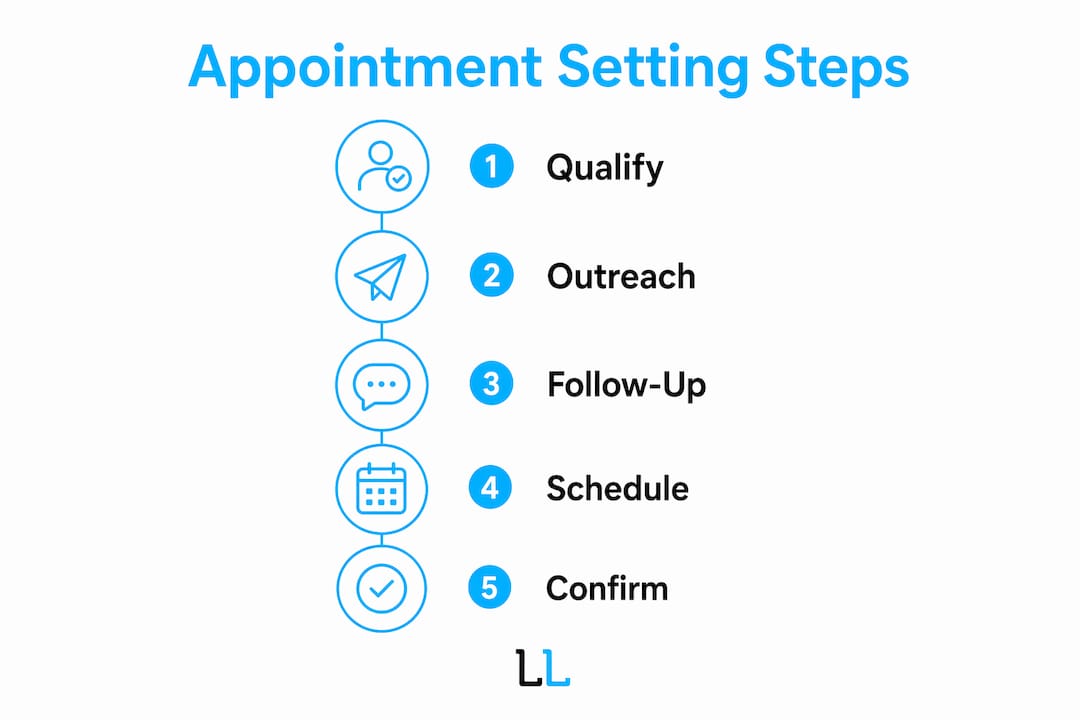
Appointment setting occupies the critical space between lead generation and the sales conversation. It is not the top of the funnel, where awareness is built, and it is not the close, where deals are won. It is the inflection point where a prospect becomes a real opportunity.
A sales appointment setter specializes in researching leads, qualifying them against defined criteria, and booking meetings before any demo or proposal takes place. This role is distinct from closing. Sales Development Representatives (SDRs) and Business Development Representatives (BDRs) handle appointment setting, while Account Executives (AEs) handle the actual sales conversations. Mixing these roles creates inefficiency and wastes expensive AE time.
Qualification is what separates appointment setting from casual scheduling. Before any meeting gets booked, a prospect should meet minimum criteria. The BANT framework provides a reliable structure:
- Budget: Does the prospect have financial capacity for your solution?
- Authority: Are you speaking with a decision-maker or influencer?
- Need: Does the prospect have a problem your solution solves?
- Timeline: Is there urgency, or is this a distant, low-priority consideration?
Buyer timing also matters. 71% of buyers prefer engaging sellers early in the buying process. That finding means the best appointment setters reach prospects before competitors do, not after a prospect has already formed preferences. Appointments booked more than 10 days in advance also face greater cancellation risk, so timing your outreach to compress the gap between contact and meeting is a real performance variable.
How does modern appointment setting work?
Modern appointment setting runs on multi-channel outreach, not single-channel cold calls. Email, phone, and LinkedIn each play a distinct role in a coordinated cadence. No single channel carries the full weight. Coordinated multi-channel outreach triples prospect conversion compared to single-channel approaches.

The standard cadence runs 14–21 days with 8–12 touchpoints spread across channels. That structure gives prospects enough exposure without burning the relationship. Each touchpoint serves a purpose: the first email opens the conversation, a LinkedIn connection request adds social proof, a follow-up call adds urgency, and a final email closes the loop with a clear ask.
Personalization is not optional. Referencing a prospect’s role or achievements can improve response rates by up to 30%. Generic sequences that treat every prospect identically produce predictably poor results. The most effective messages reference something specific: a recent company announcement, a role change, or a shared connection.
Trigger-based outreach produces the strongest results. Trigger-based sequences generate 2–3 times higher reply rates than generic outreach. A trigger is a specific business event: a funding round, a new hire in a target role, a product launch, or a job posting that signals a pain point. Building outreach around these signals turns cold contact into a timely, relevant conversation.
Pro Tip: Set up LinkedIn and Google Alerts for your top target accounts. When a trigger event fires, reach out within 24 hours. Speed to relevance matters more than message polish.
The appointment scheduling process should also account for confirmation sequences. Sending reminders at 48 hours and 2 hours before a meeting reduces no-show rates from 30–40% down to under 15%. That single operational step nearly doubles the number of meetings that actually happen.
What differentiates effective appointment setting from basic meeting booking?
The difference between a booked meeting and a productive meeting comes down to qualification depth, meeting type clarity, and handoff quality. Most organizations underperform on all three.
Meeting type matters more than most teams realize. A discovery call and a product demo require completely different preparation. A discovery call is exploratory: the goal is to confirm fit and uncover pain. A demo assumes fit is already established and focuses on showing capability. Sending an unprepared AE into a discovery call framed as a demo wastes everyone’s time and signals poor process to the prospect.
True appointment setting success focuses on meetings held, not just meetings booked. That distinction is significant. A team that books 50 meetings but holds 30 is outperforming a team that books 80 but holds 25. Tracking “meetings held” as the primary metric forces accountability across the entire process, from list quality to confirmation sequences.
Poor SDR-to-AE handoff is one of the most common and costly failures in appointment setting. When an AE walks into a call without context, they re-qualify the prospect from scratch. The prospect notices. It signals disorganization and erodes trust before the sales conversation even begins. Structured handoff notes that capture qualification data, conversation history, and prospect pain points eliminate this problem entirely.
Pro Tip: Build a standard handoff template that every SDR completes before transferring a meeting. Include the prospect’s BANT status, the trigger that prompted outreach, and any objections already raised. AEs who receive this context close at higher rates.
Data quality sits underneath all of this. About 30% of B2B contacts change roles annually. Outreach built on stale data produces high bounce rates, which trigger spam penalties and damage sender reputation. Real-time data verification keeps bounce rates below 5% and preserves the deliverability that makes outreach possible in the first place. Appointment setting is, at its core, a data-targeting challenge, not a messaging volume challenge.
How can organizations measure appointment setting effectiveness?
Measurement separates teams that improve from teams that repeat the same mistakes. The right metrics create feedback loops that drive continuous improvement across every stage of the process.
The core KPIs for appointment setting are:
- Response rate: The percentage of prospects who reply to outreach. A low response rate points to list quality or messaging problems.
- Appointment conversion rate: The percentage of responses that result in a booked meeting. A strong process yields 20–40 qualified meetings per month with a 2–5% conversion rate from outreach to meeting.
- No-show rate: The percentage of booked meetings that do not happen. Anything above 15% signals a confirmation sequence problem.
- Meetings held rate: The ratio of meetings held to meetings booked. This is the most honest measure of appointment setting quality.
- Pipeline contribution: The revenue value of opportunities created from held meetings. This connects appointment setting directly to business outcomes.
Tracking lead-to-opportunity conversion requires clean data at every stage. When contact records are inaccurate, attribution breaks down and you cannot tell which outreach channels or messages actually work. Real-time verification of contact data is not a nice-to-have. It is the foundation that makes every other metric trustworthy.
Timely follow-up also affects measurement accuracy. When a prospect responds and the follow-up takes 48 hours, the conversion window closes. Fast response to inbound signals, combined with structured appointment setting tips applied consistently, produces the compounding improvements that show up in pipeline data over time.
Key takeaways
Appointment setting is a structured sales discipline that drives pipeline growth by qualifying prospects and securing confirmed, context-rich meetings before any sales conversation begins.
| Point | Details |
|---|---|
| Definition and role | Appointment setting qualifies prospects and books confirmed meetings, bridging lead generation and active selling. |
| Multi-channel outreach | Coordinated email, phone, and LinkedIn cadences of 8–12 touchpoints over 14–21 days triple conversion rates. |
| Quality over quantity | Meetings held, not meetings booked, is the metric that reflects true appointment setting performance. |
| Data hygiene is critical | 30% of B2B contacts change roles annually; real-time verification keeps bounce rates below 5%. |
| Handoff and confirmation | Structured SDR-to-AE handoff notes and confirmation sequences at 48 and 2 hours before meetings cut no-shows below 15%. |
Why appointment setting deserves more respect than it gets
Most sales leaders treat appointment setting as an entry-level task. They hand it to the newest SDR, give them a list and a script, and measure success by call volume. That approach produces mediocre results and high SDR turnover.
Appointment setting done well is one of the most technically demanding parts of the sales process. It requires data analysis to build the right list, copywriting skill to craft messages that get replies, timing judgment to reach prospects at the right moment, and process discipline to execute confirmation sequences and handoffs without dropping the ball. That is not an entry-level job description.
The teams I have seen consistently fill pipeline are the ones that treat appointment setting as a core competency, not a stepping stone. They invest in list quality before they write a single message. They build trigger-based sequences around real business events. They track meetings held, not meetings booked, and they hold SDRs accountable for handoff quality, not just booking volume.
The other mistake I see constantly is conflating discovery calls with demos. Sending a prospect to a demo before qualifying their fit is not appointment setting. It is wishful thinking. The meeting type has to match the prospect’s stage, and the AE has to walk in with full context. When those two conditions are met, close rates improve noticeably.
If you are building or rebuilding an appointment setting function, start with your data. A clean, well-targeted list with a mediocre message outperforms a brilliant message sent to the wrong people every time.
— Toby
How The Lead Lab approaches appointment setting for professional services firms
The Lead Lab runs done-for-you outreach campaigns built around the exact principles covered in this article: precise prospect targeting, trigger-based personalization, multi-channel coordination, and confirmation sequences that protect meeting rates.
For professional services firms that need a consistent flow of qualified meetings without building an internal SDR team, The Lead Lab handles the full process. That includes list building, message copywriting, response management, and campaign analytics. You can see how the process works and review past client outcomes on The Lead Lab’s portfolio. To learn more about the full service offering or to request a consultation, visit The Lead Lab directly.
FAQ
What is appointment setting in simple terms?
Appointment setting is the process of qualifying prospects and scheduling confirmed sales meetings. It sits between lead generation and the sales conversation in the B2B pipeline.
How is appointment setting different from lead generation?
Lead generation identifies potential prospects. Appointment setting qualifies those prospects and converts them into confirmed, scheduled meetings with sales teams.
What is a good appointment conversion rate?
A well-run appointment setting process yields 20–40 qualified meetings per month with a 2–5% conversion rate from outreach to booked meeting.
How do you reduce no-shows in appointment setting?
Confirmation sequences with reminders sent 48 hours and 2 hours before a meeting reduce no-show rates from 30–40% down to under 15%.
What is the BANT framework in appointment setting?
BANT stands for Budget, Authority, Need, and Timeline. It is the standard qualification framework used to determine whether a prospect is worth booking a meeting with before engaging a sales closer.