
TL;DR:
- The best LinkedIn alternatives include The Lead Lab, PeopleDB, LinkedIn Sales Navigator, and LabX Media Group, each serving different prospecting needs. Fully managed services deliver personalized outreach and campaign management, while self-serve tools provide raw data for in-house execution, with cost structures and data quality influencing effectiveness. Selecting the right platform depends on your team’s capacity, budget, data needs, and goal for warm outreach versus raw contacts.
If you’re searching for thelinkedpeople.com alternatives, the four platforms worth your attention are The Lead Lab, PeopleDB, LinkedIn Sales Navigator, and LabX Media Group. Each takes a different approach to LinkedIn B2B lead generation, and the right choice depends almost entirely on whether you want someone else running your campaigns or prefer direct access to a prospecting tool.
Here’s the short version:
- The Lead Lab — done-for-you LinkedIn outreach with personalized messaging, campaign analytics, and dedicated management for professional services firms
- PeopleDB — credit-based API access with real-time cross-platform data enrichment, no monthly seat subscription required
- LinkedIn Sales Navigator — LinkedIn’s own self-serve prospecting tool, powerful within the platform but constrained by its own search filters
- LabX Media Group — managed B2B media and lead generation services with multi-channel campaign capabilities
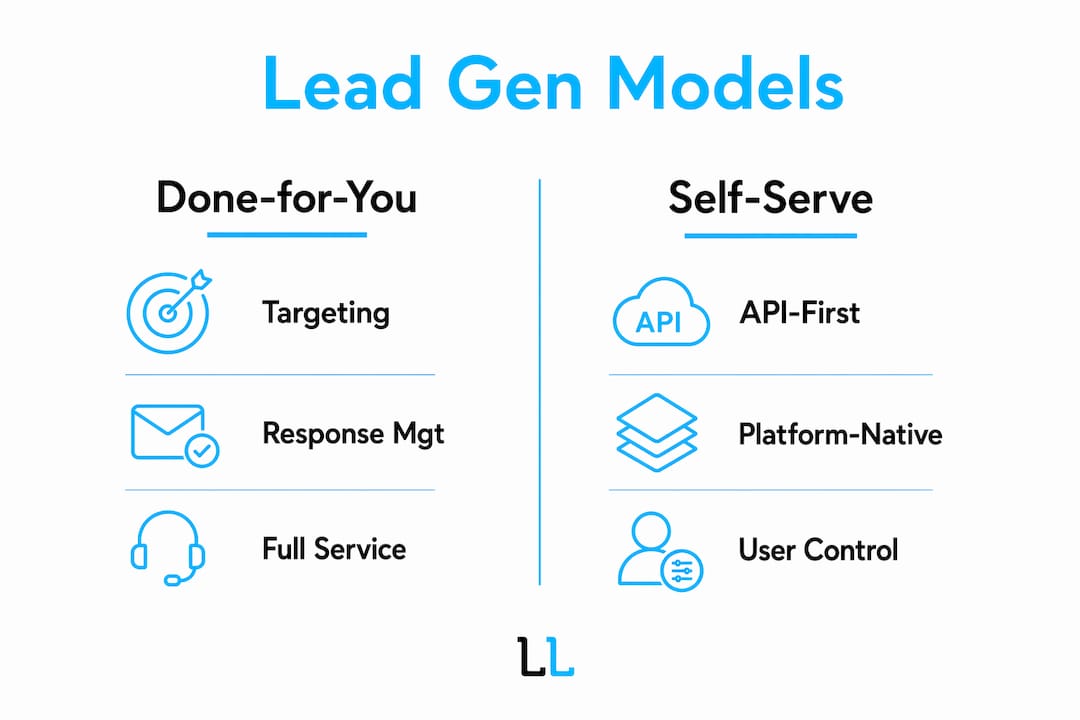
The core split is simple: done-for-you services handle everything from targeting to response management, while self-serve tools hand you the data and leave execution to your team. For marketing leaders who need qualified meetings booked without adding headcount, done-for-you wins on efficiency. For teams with in-house SDRs who need raw data at scale, self-serve or API-first tools make more sense.
Pro Tip: Before evaluating any platform, audit your current pipeline. If your team is spending a significant portion of selling time on prospecting, a done-for-you service will almost always deliver a faster return than a new data subscription.
Table of Contents
- How do these TheLinkedPeople.com alternatives actually compare?
- How to choose the right LinkedIn lead generation service for your business
- Why LinkedIn lead generation is shifting fast in 2026
- The Lead Lab delivers done-for-you LinkedIn outreach that actually converts
- Key Takeaways
How do these TheLinkedPeople.com alternatives actually compare?
The differences between these platforms become clearest when you line them up across the dimensions that actually affect campaign outcomes.

| Dimension | Done-for-You (full-service) | Self-Serve / API-First | Platform-Native |
|---|---|---|---|
| Service model | Fully managed outreach | You run it; tool provides data | Self-serve inside LinkedIn |
| Pricing model | Monthly retainer or tiered packages | Credit-based or pay-per-lookup | Subscription (seat-based) |
| Data scope | LinkedIn + multi-source enrichment | Multi-source (web, GitHub, etc.) | LinkedIn internal only |
| AI capabilities | AI targeting + human-written messaging | AI-powered search and enrichment | Basic filter-based search |
| Customization | High — bespoke sequences per segment | Moderate — query-level control | Low — limited to platform filters |
| Support quality | Dedicated account management | Documentation + ticket support | LinkedIn standard support |
Business professionals consistently distinguish these categories by service model first, pricing second. A credit-based tool like PeopleDB gives you flexibility without locking you into a seat subscription, which matters when your outreach volume fluctuates quarter to quarter. LinkedIn Sales Navigator, by contrast, charges per seat regardless of usage, and its filters are bounded by what LinkedIn itself surfaces.
Key factors that separate strong performers from weak ones:
- Data freshness: static databases go stale fast; real-time enrichment from multiple sources keeps deliverability high
- Personalization depth: generic sequences get ignored; platforms that support segment-level message customization consistently outperform
- Response management: capturing and routing replies is where most self-serve tools fall short
- Campaign analytics: you need to know what’s working at the message level, not just open rates
User satisfaction tends to track closely with expectation-setting. Teams that buy a data tool expecting it to generate meetings end up disappointed. Teams that buy a managed service expecting raw data access face the same mismatch. Knowing which category you need before you sign anything saves real money.
How to choose the right LinkedIn lead generation service for your business
Start with your internal capacity, not the feature list. The best platform for a 200-person sales org with dedicated SDRs looks nothing like the best option for a 10-person consulting firm where the founder is also the closer.
Criteria worth working through before you commit:
- Service model fit: do you have the bandwidth to run sequences, handle replies, and iterate messaging? If not, self-serve tools will sit unused after the first month
- Budget structure: monthly retainers offer predictability; credit-based pricing suits variable outreach volumes; seat subscriptions only make sense when usage is consistent
- Data breadth needed: LinkedIn-only data works for straightforward ICP targeting; complex personas or niche verticals often require multi-source enrichment to find enough verified contacts
- AI and automation requirements: natural language search and intent-based targeting are now available outside LinkedIn’s walls, which matters when your ICP is hard to define with standard filters
- Customization level: enterprise sales cycles with multiple stakeholders need sequence branching and persona-specific messaging; simpler outreach can run on templates
- Support expectations: a managed service should include a human who knows your campaign; a self-serve tool should at minimum offer responsive ticket support and solid documentation
The most common pitfall is over-relying on a large static database. Volume feels reassuring until bounce rates climb and your sending domain takes a hit. Multi-source verified data, refreshed in real time, consistently outperforms a bigger but staler list. A targeted prospecting approach built on verified contacts will outperform a spray-and-pray blast every time.
Pro Tip: Ask any vendor how recently their data was validated and from how many independent sources. If the answer is vague, treat that as a red flag. Real-time cross-platform enrichment is now table stakes for serious B2B outreach.
One more thing: your team’s existing LinkedIn connections are an underused asset. Aggregating those connections into a searchable prospect pool gives you warm outreach at a fraction of the cost of cold lists. Most platforms don’t support this natively. The ones that do tend to deliver meaningfully better conversion rates.
Why LinkedIn lead generation is shifting fast in 2026
LinkedIn remains the dominant channel for B2B prospecting in the US, but the tools built on top of it are evolving quickly. The platform’s own search infrastructure was never designed for the kind of intent-based, behavioral targeting that modern sales teams need.
A few shifts worth understanding:
- AI-powered cross-platform search now lets tools like FindThem query over 1 billion LinkedIn profiles using natural language, without requiring a LinkedIn Premium subscription. That’s a meaningful change from filter-based search.
- Intent-based targeting goes beyond job title and company size. Advanced tools can surface leads based on funding history, hiring signals, and behavioral patterns that LinkedIn’s own filters can’t access.
- Multi-source enrichment addresses the core weakness of platform-dependent tools: data that lives only inside LinkedIn gets stale, and LinkedIn’s verification standards aren’t built for deliverability. Cross-referencing against independent sources keeps contact data accurate.
- Network aggregation is the most underleveraged trend. Pooling a sales team’s combined connections into one searchable database creates a proprietary warm-contact pool. Warm outreach consistently converts at higher rates than cold prospecting, and the cost per acquisition drops accordingly.
LinkedIn Sales Navigator remains useful for teams already embedded in the LinkedIn ecosystem, but its filter limitations become a real constraint once your ICP gets specific. The B2B lead generation tools gaining ground are the ones that treat LinkedIn as one data source among many, not the whole picture.
A professional LinkedIn profile also matters more than most teams acknowledge. Outreach from a profile with a strong headshot and clear positioning converts at a higher rate than the same message sent from a sparse profile.
The Lead Lab delivers done-for-you LinkedIn outreach that actually converts
Most of the platforms covered in this article hand you a tool and step back. The Lead Lab operates differently: every campaign is built, managed, and optimized by a team that specializes exclusively in LinkedIn outreach for professional services firms.
The service covers the full cycle: ICP targeting, message copywriting, A/B testing, response management, and campaign analytics. Clients don’t need to write sequences, monitor inboxes, or interpret data. The Lead Lab handles it, and the output is qualified meetings on your calendar. For a marketing leader who needs pipeline without adding SDR headcount, that’s the practical difference between a tool and a result.
Client case studies on the platform show consistent outcomes across consulting, financial services, and B2B technology firms. The combination of AI-driven targeting and human-crafted messaging is what separates The Lead Lab from purely automated alternatives. Automation scales volume; human judgment is what keeps messaging from sounding like every other LinkedIn connection request.
If you’re ready to replace a fragmented prospecting stack with a single, accountable partner, book a consultation with The Lead Lab and see what a bespoke campaign looks like for your firm.
Key Takeaways
The most effective thelinkedpeople.com alternative depends on your service model preference, budget structure, and whether your team has the capacity to run outreach independently.
| Point | Details |
|---|---|
| Service model is the first decision | Choose done-for-you if your team lacks SDR capacity; choose self-serve if you have in-house execution. |
| Pricing structures vary significantly | Credit-based tools suit variable volume; seat subscriptions only make sense with consistent, high-frequency usage. |
| Data scope affects deliverability | Multi-source, real-time enrichment outperforms static LinkedIn-only databases for contact accuracy. |
| Network aggregation is underleveraged | Pooling your team’s existing connections creates a warm-contact pool that lowers acquisition costs. |
| The Lead Lab | Offers fully managed LinkedIn outreach with personalized targeting, response management, and campaign analytics for professional services firms. |