
TL;DR:
- Low response rates in B2B outreach harm pipeline growth and waste resources, with elite senders achieving 10-15%.
- Improving deliverability infrastructure, targeting a qualified list, and personalizing messages with behavioral insights are key to increasing reply rates.
You craft a message. You hit send. Then nothing. Low response rates are one of the most expensive problems in B2B outreach, and they compound fast. A poor reply rate kills pipeline, wastes budget, and signals deeper issues with targeting, deliverability, or messaging. The average B2B cold email reply rate sits at just 3.43%, yet elite senders consistently hit 10 to 15%. That gap isn’t luck. This guide walks you through exactly how to improve response rates across every stage of your outreach, from infrastructure to follow-up sequencing, with data to back every recommendation.
Table of Contents
- Key takeaways
- How to improve response rates: start with your foundation
- Crafting messages that actually get replies
- Sequence design: how follow-up timing shapes your total reply rate
- Using signals and multi-channel approaches to boost response rates
- Monitoring and optimizing your outreach campaigns
- My honest take on why most outreach programs underperform
- Ready to turn your outreach into a reply-generating system?
- FAQ
Key takeaways
| Point | Details |
|---|---|
| Fix your foundation first | Deliverability infrastructure, list quality, and ICP definition matter more than copy or timing. |
| Personalize beyond names | Behavioral and context-aware messaging drives reply rates up to 15% or higher. |
| Follow up with purpose | Campaigns with 4 to 7 emails achieve reply rates three times higher than single-send campaigns. |
| Use intent signals | Signal-triggered outreach generates reply rates of 4 to 8%, compared to 1 to 2% for cold lists. |
| Measure and iterate | Track reply rates, bounce rates, and inbox placement at the segment level to spot and fix issues fast. |
How to improve response rates: start with your foundation
Most marketers jump straight to copywriting when response rates drop. That’s usually the wrong place to start. Before a single word of your message matters, your outreach needs to be landing in inboxes at all.
Deliverability infrastructure
Poor deliverability infrastructure makes high response rates impossible regardless of how sharp your copy is. At minimum, your sending domain needs SPF, DKIM, and DMARC records properly configured. You also need a warmed domain. Sending high volumes from a cold domain triggers spam filters almost immediately.
Keep your sending volume consistent. Erratic spikes in email volume raise red flags with mailbox providers. If you’re launching a new campaign, ramp up gradually over two to three weeks before hitting full send capacity.
List quality and ICP targeting
No deliverability setup can compensate for a bad list. Bounce rates above 2% trigger reputation damage that compounds quickly and can take weeks to recover from. Verify every contact before it enters your sequence.
Defining your ideal customer profile tightly is what separates relevant outreach from noise. Segment by industry, company size, role seniority, and geographic market. Verified, targeted lists of 500 people consistently outperform spray-and-pray lists of 50,000 because relevance drives replies.
Here’s a quick look at how common list verification approaches compare:
| Verification method | Best for | Bounce rate reduction |
|---|---|---|
| Real-time API verification | High-volume daily sends | Up to 95% |
| Bulk list scrubbing | Pre-campaign cleanup | 70 to 85% |
| Manual LinkedIn cross-check | Senior-level targeting | High accuracy, low scale |
| Catch-all domain filtering | Reducing risk on edge cases | Moderate |
Pro Tip: Never import a list older than 90 days without re-verifying it. Contact data decays fast, especially in fast-moving B2B sectors.
Crafting messages that actually get replies
Once your foundation is solid, messaging is where you win or lose the reply. Most cold messages fail for the same reasons: they’re too long, too self-focused, and too generic.

Go beyond first-name personalization
Micro-segmentation and hyper-personalization push reply rates to 15% and above. First-name personalization is table stakes. What actually moves the needle is referencing a prospect’s recent activity, a business challenge specific to their role, or a shift happening in their industry. Context-aware tailoring can improve customer engagement by 15 to 20% compared to generic outreach.
For example, instead of “Hi [First Name], I help companies like yours grow revenue,” try “Hi Sarah, I noticed [Company] just expanded into the Southeast market. Firms at that inflection point often run into X problem. We help solve it in about six weeks.” One message shows you paid attention. The other proves you didn’t.
Check out Theleadlab’s guide on personalized B2B prospecting for a detailed framework on building this kind of targeted messaging at scale.
Subject lines, length, and calls to action
Keep your initial email under 80 words. Seriously. Decision-makers scan, they don’t read. A message that takes four seconds to process beats one that takes forty every time.
Your subject line has one job: earn the open. Avoid vague teasers or overly clever wordplay. Specific, benefit-led subject lines consistently outperform clever ones. “Quick question about your Q3 hiring” beats “Thought you’d want to see this.”
Your call to action should ask for one thing. One. Not a call, a demo, a whitepaper download, and a reply. Pick your lowest-commitment ask and make it the only path forward. “Does Thursday at 2pm work for a 15-minute call?” is clearer and less cognitively demanding than “Let me know if you’d like to explore options.”
Pro Tip: Use Spintax variation in your email copy. Rotating synonyms and sentence structures helps avoid spam filter pattern-matching, which protects your sender reputation across large-volume campaigns.
Sequence design: how follow-up timing shapes your total reply rate
Sending one email and waiting is leaving replies on the table. 42% of all replies come from follow-up emails, not the original send. That statistic alone should change how you design your sequences.
Campaigns with four to seven emails generate reply rates roughly three times higher than campaigns with just one to three. Here’s how to structure that without burning your list or getting flagged as spam.
Wait at least three days before your first follow-up. After that, space additional emails four to five days apart. Each message should add something new, a piece of relevant content, a different angle on the problem, a case example. A follow-up that just says “Circling back” wastes everyone’s time and signals you have nothing else to offer.
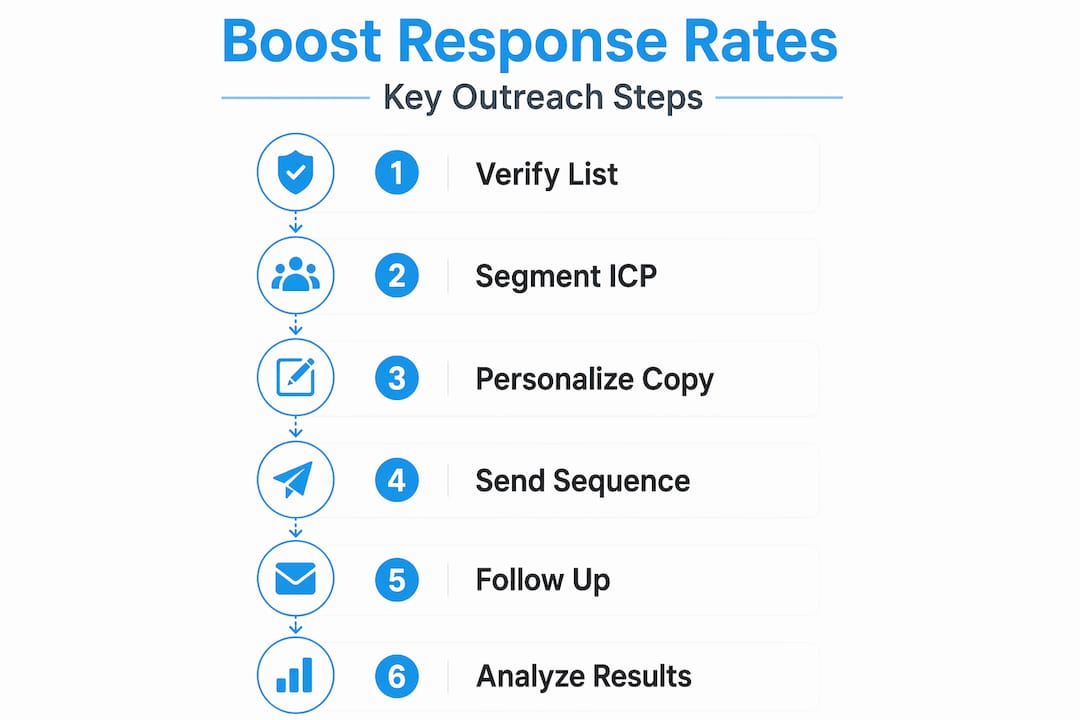
Here’s how each follow-up step contributes to overall campaign performance:
| Email number | Role in sequence | Estimated reply contribution |
|---|---|---|
| Email 1 | Initial cold outreach | 30 to 40% of total replies |
| Email 2 | Re-framed value proposition | 20 to 25% of total replies |
| Email 3 | Social proof or case study | 12 to 15% of total replies |
| Email 4 | Different angle or objection handling | 8 to 12% of total replies |
| Emails 5 to 7 | Persistence, breakup message | 10 to 15% of total replies |
For warm contacts or post-demo follow-ups, compress the sequence. Someone who attended a webinar or visited your pricing page doesn’t need the same nurture arc as a completely cold prospect.
Pro Tip: Frame your follow-ups as replies to your original email in your email client. Threading keeps your outreach contextual and reduces the chance of recipients feeling like they’re receiving a mass campaign.
The role of automation in maintaining consistent spacing and adding value at each step is what makes these sequences repeatable and scalable across hundreds of prospects simultaneously.
Using signals and multi-channel approaches to boost response rates
The biggest unlock for most outreach programs isn’t better copy. It’s better timing. Signal-triggered outreach generates reply rates of 4 to 8% compared to 1 to 2% for cold lists with no intent data. That’s a four-fold difference from timing alone.
Intent signals worth acting on include:
- Job changes: A new VP of Sales is often re-evaluating existing tools and vendors within their first 90 days.
- Funding rounds: Companies that just raised capital are actively building teams and buying software.
- Website visits: A prospect who visited your pricing page twice in one week is showing clear intent.
- Content engagement: Someone who downloaded your whitepaper or attended your webinar is warmer than any cold contact.
When you combine signal-based timing with multi-channel outreach coordination, the results compound. Reaching a prospect on LinkedIn after they engaged with your email creates familiarity and makes each subsequent touch feel less intrusive.
The industry shift toward AI-enabled, multi-channel engagement reflects exactly this logic. Instead of isolated emails firing into a void, agentic AI tools can maintain conversation continuity across channels, remembering prior interactions and adjusting messaging accordingly. For engagement strategies built around AI-driven audience insights, this kind of orchestration is quickly becoming standard practice.
Monitoring and optimizing your outreach campaigns
Knowing how to improve response rates isn’t just about setup. It’s about sustained monitoring and iteration. Most campaigns degrade over time without active management.
Track these metrics at the segment level, not just overall:
- Reply rate: Benchmark against the 3.43% average; aim for 5.5% or higher in the top quartile.
- Bounce rate: Keep this below 2% at all times. Above that threshold, reputation damage accelerates.
- Spam complaint rate: Anything above 0.1% warrants immediate review of your list and messaging.
- Inbox placement rate: Open rate data alone misleads. Use seed testing to confirm actual inbox delivery.
A/B test one variable at a time: subject line, opening sentence, or call to action. Testing multiple variables simultaneously makes it impossible to attribute what drove the change. Run each test for at least 200 sends before drawing conclusions.
Re-verify your list every 90 days. Data decays fast. A contact who was valid six months ago may have changed roles or left the company entirely.
Pro Tip: If your bounce rate spikes above 3%, cut your daily send volume by 50% immediately and pause new contact imports until you identify the source. Continuing to send during a bounce spike accelerates domain reputation damage and can take months to reverse.
My honest take on why most outreach programs underperform
I’ve watched dozens of outreach programs run identical campaigns and get wildly different results. The gap almost never comes down to copy. It comes down to discipline.
In my experience, the two most common failure modes are prioritizing volume over relevance and giving up too early. Most teams send one or two emails, see a 2% reply rate, and conclude the channel doesn’t work. What they’ve actually learned is that their list was too broad or their sequence was too short.
The foundational work, cleaning lists, configuring deliverability properly, building tight ICP segments, isn’t exciting. But it compounds. A team that invests two weeks in proper setup will outperform a team that sends three times the volume on a dirty list every single time.
What I’ve found actually works is treating every follow-up as a chance to deliver something genuinely useful. Not a reminder. Not a “just checking in.” A different angle, a relevant example, a piece of content that addresses a real concern. That posture turns outreach into something people occasionally appreciate rather than something they universally ignore.
The data-driven teams who iterate monthly, testing subject lines, adjusting sequence timing, refreshing their ICP based on what’s actually converting, are the ones who move from average reply rates to elite ones. There’s no shortcut. But there’s absolutely a system.
— Toby
Ready to turn your outreach into a reply-generating system?
If you’ve read this far, you understand what it takes to move the needle on response rates. The strategies are clear. The challenge is executing them consistently at scale without a full team dedicated to campaign management and analytics.
Theleadlab is built for exactly this. From verified prospect targeting and personalized message copywriting to automated multi-touch sequences and response management, Theleadlab runs done-for-you outreach campaigns that apply every best practice covered in this guide. The team handles the full execution cycle so you can focus on the meetings, not the mechanics. Explore what’s possible at Theleadlab, or browse the client portfolio to see what results look like in practice.
FAQ
What is a good response rate for cold email outreach?
The average B2B cold email reply rate is 3.43%. Top-quartile senders achieve 5.5% or higher, and elite campaigns using micro-segmentation and signal-based timing regularly hit 10 to 15%.
How many follow-up emails should I send to increase replies?
Campaigns with four to seven emails generate reply rates roughly three times higher than campaigns with just one to three emails. Space follow-ups three to five days apart and add new value with each message.
How does personalization affect response rates?
Going beyond first-name personalization to include behavioral context and role-specific relevance can push reply rates to 15% or higher and improve overall engagement by 15 to 20% compared to generic outreach.
What are intent signals and how do they improve outreach?
Intent signals are behavioral triggers such as job changes, funding rounds, or website visits that indicate a prospect is more likely to be receptive. Signal-triggered outreach achieves reply rates of 4 to 8% versus 1 to 2% for cold lists with no intent data.
How do I keep my bounce rate below 2%?
Verify your contact list before every campaign and re-verify it every 90 days. Use real-time API verification for high-volume sends, remove catch-all domains where possible, and cut send volume immediately if your bounce rate exceeds 2% to prevent accelerating domain reputation damage.