
Sales prospecting is the discipline of finding, qualifying, and starting conversations with people and companies that match your ideal customer profile. Start today with three steps: define your ICP, pick 10 priority accounts, and run a two-touch outreach sequence across at least two channels.
Your immediate starter plan:
- Write down your ICP in one paragraph (industry, company size, job title, pain point).
- Build a ranked list of 10 accounts that match it, using LinkedIn, Crunchbase, or your CRM.
- Send a short, personalized first touch on LinkedIn or email, then follow up by phone or a second message three days later.
Top channels to start with:
- Email: High volume, easy to track, works well for cold outreach when personalized.
- LinkedIn: Best for professional services and B2B; connection requests plus direct messages outperform cold email for senior decision-makers.
- Phone: Still the fastest path to a real conversation when you have a warm signal or a referral.
Key Takeaways
Consistent, signal-driven prospecting is the single most reliable way to maintain pipeline coverage and reduce quota risk across any B2B sales team.
| Point | Details |
|---|---|
| Start with a ranked 10-account list | Define your ICP first, then source and score accounts by buying signals before sending a single message. |
| Run a 7-touch, multi-channel sequence | Combine LinkedIn, email, and phone across 17 days; most replies come after the third or fourth touch. |
| Track activity and outcome KPIs weekly | Monitor touches, reply rates, and meetings booked by channel to diagnose what is working and adjust fast. |
| Only 34% of reps are quota-confident | Per HubSpot’s 2026 research, consistent prospecting is the primary lever for closing that gap. |
| The Lead Lab handles the full outreach cycle | For firms that need a done-for-you option, The Lead Lab delivers qualified calendar meetings via LinkedIn outreach. |
Table of Contents
- Why consistent sales prospecting is the difference between hitting quota and missing it
- Sales prospecting vs. lead generation: who does what and when
- Who should prospect inside a modern sales organization
- Inbound vs. outbound prospecting: how to choose and combine them
- A repeatable prospecting process: from ICP to nurture
- Ready-to-use outreach templates and a 7-touch sequence
- Channels and tactics: how to use email, LinkedIn, phone, referrals, and events
- Tools and tech stack for modern prospecting in the UK
- KPIs to track and how to measure prospecting success
- Common prospecting mistakes and how to fix them fast
- When to outsource prospecting: what a done-for-you LinkedIn campaign looks like
- Data privacy and compliance in prospecting outreach
- What top-performing reps actually do differently
- The Lead Lab delivers qualified meetings so your team can focus on closing
- Sources
Why consistent sales prospecting is the difference between hitting quota and missing it
HubSpot’s 2026 research found that only 34% of sales professionals are confident they will hit their quota. That number is striking, and the root cause is almost always the same: inconsistent prospecting. When the pipeline runs dry, there is no quick fix. Deals that close in Q3 were usually seeded in Q1.
Disciplined prospecting creates a buffer. When you prospect every week, you always have new conversations entering the top of your funnel, which means a lost deal or a stalled opportunity does not crater your quarter. Teams that treat prospecting as a daily motion, not a panic response, tend to forecast more accurately because they can see what is coming 60 to 90 days out.
The business case is straightforward:
- Pipeline coverage: Most sales methodologies recommend 3x pipeline coverage to hit quota reliably. Consistent prospecting is the only way to maintain it.
- Shorter dry spells: Reps who prospect daily rarely face the feast-or-famine cycle that kills momentum.
- Better conversion data: A steady flow of new prospects gives you enough volume to test messaging, channels, and timing, and to draw real conclusions.
- Forecasting confidence: Managers can plan headcount and resource allocation when pipeline is predictable.
Selling Power warns that many reps have developed a “prospecting deficit” after years of relying on inbound leads. Rebuilding that skill and the discipline behind it is one of the highest-leverage investments a sales team can make.
Sales prospecting vs. lead generation: who does what and when
These two terms get conflated constantly, and the confusion costs teams real money. Here is the practical distinction: lead generation is a marketing function that creates awareness and captures contact information at scale. Sales prospecting is a sales function that takes those raw leads, or self-sourced contacts, and qualifies them into opportunities worth pursuing.
A lead is anyone who has shown some interest or fits a broad profile. A prospect is a lead that a salesperson has evaluated and decided is worth a direct conversation. The gap between the two is where most pipeline leakage happens.
Salesforce recommends a “proactive by design” approach: define a precise ICP, research firmographics, and target decision-makers who have budget, authority, and a current need. That is prospecting. Marketing can hand you a list; only a salesperson can turn it into a qualified pipeline.
Who owns what:
- Marketing owns: Content, SEO, paid ads, events, webinars, and the inbound lead capture that feeds the CRM.
- Sales owns: Outbound outreach, qualification calls, account research, and the decision about whether a contact is worth pursuing.
- Shared: Lead scoring models, ICP definitions, and the handoff criteria that determine when a lead becomes a sales-qualified lead (SQL).
Handoff and measurement differences:
- Marketing measures cost per lead (CPL), traffic, and marketing-qualified leads (MQLs).
- Sales measures reply rates, meetings booked, and opportunities created from prospecting activity.
- The handoff point is the SQL: a contact that meets the agreed ICP criteria and has shown enough intent to warrant a sales conversation.
For a deeper look at how B2B prospecting fits into a broader pipeline strategy, The Lead Lab’s guide covers the fundamentals and common pitfalls.
Who should prospect inside a modern sales organization
The honest answer is: it depends on your stage and structure. But here is how the responsibilities typically break down.
SDRs and BDRs are the prospecting engine in most mid-size and enterprise sales organizations. Their job is pure top-of-funnel: source accounts, research contacts, run outreach sequences, and book discovery calls for account executives. Success is measured in meetings booked and SQLs created, not closed revenue.

Account executives (AEs) often resist prospecting because it feels like a step down from closing. That instinct is understandable but expensive. AEs who prospect their own accounts, especially for expansion or referral opportunities, tend to carry higher average deal values because they understand the buyer’s context before the first call.
Founders and business owners in early-stage companies or professional services firms usually have to do all of it themselves. The advantage is authenticity: a message from the founder lands differently than one from an SDR. The disadvantage is time. Founders who prospect well tend to batch it: two focused hours on Tuesday and Thursday rather than scattered 10-minute attempts throughout the week.
Role responsibilities at a glance:
- SDR/BDR: Account sourcing, contact research, outreach sequences, meeting booking, CRM hygiene.
- AE: Strategic account selection, executive-level outreach, expansion prospecting, referral cultivation.
- Founder/Owner: ICP definition, high-value outreach, relationship-led prospecting, referral network activation.
When to decentralize: if your deal sizes are large and relationships are the primary buying signal, AE-led prospecting often outperforms a pure SDR model.
Sales enablement resources can help each role prospect more efficiently by providing the right templates, tools, and training at the right stage.
Inbound vs. outbound prospecting: how to choose and combine them
Neither approach wins on its own. The question is always which mix fits your resources, your market, and how fast you need results.
| Dimension | Inbound | Outbound |
|---|---|---|
| Time to first results | Weeks to months | Days to weeks |
| Cost structure | High upfront (content, SEO), lower ongoing | Lower upfront, scales with headcount or tools |
| Lead quality | Often higher intent at point of contact | Varies; depends on ICP precision and signals |
| Control over volume | Low (algorithm and search dependent) | High (you decide how many accounts to target) |
| Best for | Established brands with content authority | New markets, new products, or tight timelines |
Recommended mix by situation:
- SMB or early-stage: Lead with outbound. You need conversations fast, and inbound takes time to build. Use LinkedIn and email as primary channels.
- Midmarket: Run both in parallel. Outbound targets named accounts while inbound captures demand your brand is already generating.
- Professional services: Outbound via LinkedIn tends to outperform cold email because the channel signals credibility and allows for relationship-building before the ask.
When resources are limited, prioritize outbound first. You can always add inbound content later. The reverse is harder: waiting for inbound to kick in while your pipeline is empty is a slow and painful strategy.
For a practical breakdown of multi-channel outreach that combines email, LinkedIn, and phone into a single cadence, The Lead Lab’s guide covers the sequencing logic in detail.
A repeatable prospecting process: from ICP to nurture
Clay frames modern prospecting as the discipline of turning a defined market into a short, ranked list, then using real-time signals to re-sort that list so reps always start with the highest-intent accounts. That framing is useful because it separates the work into two distinct phases: building the list and working the list.
Step-by-step playbook:
- Define your ICP. Capture industry, company size (headcount and revenue), geography, tech stack, job titles of buyers and influencers, and the specific pain your product solves. Update it every quarter.
- Source your list. Use LinkedIn Sales Navigator, Crunchbase, or a data provider like Cognism to pull accounts that match your ICP. Aim for 50–100 accounts per rep per month.
- Verify contacts. Run contacts through a tool like Hunter to confirm email addresses are valid. Bad data wastes time and damages sender reputation.
- Score and prioritize by signals. Sort accounts by buying signals: recent funding, new leadership hire, job postings in your buyer’s department, tech stack changes, or a competitor contract expiry. Start with the accounts showing two or more signals.
- Run your outreach cadence. Execute a structured sequence (see the next section for a 7-touch example) across email, LinkedIn, and phone. Never rely on a single channel.
- Qualify on the first call. Use BANT (Budget, Authority, Need, Timeline) or MEDDIC as a framework. The goal is to confirm fit, not to pitch. If they do not qualify, disqualify cleanly and move on.
- Hand off or nurture. Qualified prospects go to an AE or into an active deal. Prospects who are not ready but are a good fit go into a nurture sequence with a 30 or 60-day re-engagement trigger.
ICP data points to capture:
- Industry and sub-vertical
- Headcount range and revenue band
- Geography (UK-specific: region, city, or national)
- Tech stack (CRM, marketing automation, ERP)
- Buyer job title and seniority
- Common pain points and trigger events
- Typical deal size and sales cycle length
Buying signals worth tracking:
- Series A, B, or C funding announcement
- New VP of Sales, CMO, or CTO hire
- Job postings for roles your product supports
- Recent press coverage of a strategic initiative
- Competitor contract renewal window
Proven ways to target ideal clients covers ICP-building in more depth, including how to segment by firmographic and behavioral signals.
Ready-to-use outreach templates and a 7-touch sequence
A sequence is only as good as its structure. The goal is to create multiple low-pressure touchpoints across channels before asking for anything. Here is a 7-touch sequence that works for most B2B professional services outreach.
Sample 7-touch sequence:
- Day 1 — LinkedIn connection request (no note, or a one-line personalized note referencing a shared connection or recent post).
- Day 3 — LinkedIn message (short, 3–4 sentences, reference a specific signal or their content).
- Day 5 — Cold email (subject line under 7 words, body under 100 words, one clear ask).
- Day 8 — Phone call (leave a 20-second voicemail if no answer; reference the LinkedIn message).
- Day 11 — LinkedIn follow-up message (add value: share a relevant article, case study, or insight).
- Day 14 — Email follow-up (the “last try” frame: short, direct, easy to reply to).
- Day 17 — Final call or email (close the loop; offer to reconnect in 90 days if timing is off).
Template 1: Cold email
Subject: [Company name] + [your company name]
Hi [First name],
Noticed [specific signal, e.g., “you recently hired a new Head of Sales”]. We work with [similar company type] to [specific outcome, e.g., “book 8–12 qualified meetings per month via LinkedIn”].
Worth a 15-minute call this week?
[Your name]
Template 2: LinkedIn connection note
Hi [First name], I work with [industry] firms on [specific outcome]. Thought it was worth connecting.
Template 3: LinkedIn follow-up message (Day 5)
Hi [First name], sent an email last week about [topic]. Sharing this [article/case study] in case it’s useful. Happy to chat if the timing is right.
Template 4: Voicemail script (Day 8)
Template 5: Final email (Day 14)
Hi [First name],
Last note from me on this. If [pain point] isn’t a priority right now, no problem at all. If it becomes one, I’m happy to reconnect.
[Your name]
Pro Tip: Personalize the first two lines of every message and template the rest. Specifically, reference something that happened in the last 30 days: a funding round, a LinkedIn post they wrote, or a company announcement. That single detail does more for reply rates than any subject line trick.
Prospecting email examples from The Lead Lab’s blog include additional templates adapted for professional services outreach.
Channels and tactics: how to use email, LinkedIn, phone, referrals, and events
HubSpot’s research confirms that outreach effectiveness now hinges on personalization driven by recent, visible signals. The channel you choose matters less than the relevance of what you say in it. That said, each channel has its own mechanics.
- Keep subject lines under 7 words and avoid spam triggers (“free,” “guaranteed,” “limited time”).
- Send between 7:30 AM and 9:00 AM or 4:00 PM and 5:30 PM on Tuesday, Wednesday, or Thursday for the best open rates.
- Body copy under 100 words. One ask per email.
- Follow up at least twice before moving to a different channel.
- Connect first, message second. A connection request with no note has a higher acceptance rate than one with a long pitch.
- Use voice notes on LinkedIn for follow-ups. Almost nobody does it, which means almost nobody ignores them.
- Engage with a prospect’s posts before sending a message. A comment they can see creates context.
- For LinkedIn outreach, LinkedIn Sales Navigator’s saved search and alert features let you track job changes and company news in real time.
Phone
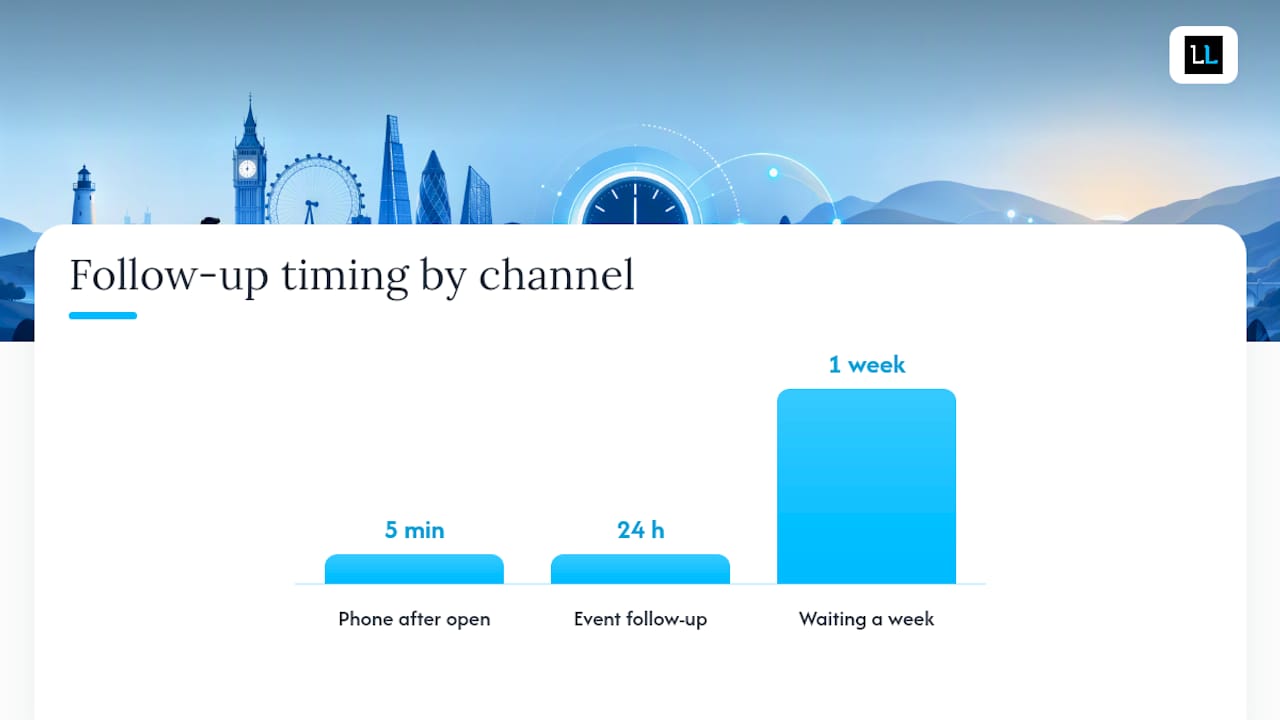
- Call within 5 minutes of a prospect opening your email. Timing matters more than the script.
- If you reach voicemail, leave a message that references your email and asks one specific question.
- Phone prospecting works best as a follow-up to a digital touch, not as a cold first contact.
Referrals
- Ask for referrals at the close of every successful meeting, not just at the end of a deal.
- A warm introduction from a mutual connection converts at a significantly higher rate than any cold channel.
- Build a referral cadence into your quarterly account review process.
Events and conferences
- Pre-book meetings before the event using LinkedIn or email. Walking the floor cold is inefficient.
- Follow up within 24 hours of meeting someone. Waiting a week means starting over.
- Use event attendance as a signal: if a prospect is attending the same conference, they are likely thinking about the same problems you solve.
Account multithreading across channels is essential in modern B2B prospecting because single-thread outreach often fails to influence purchase committees. Engage the financial buyer, the end-user, and the technical implementer with role-specific messages, not the same email sent to three people.
Tools and tech stack for modern prospecting in the UK
You do not need a 12-tool stack. You need the right four or five, working together. Here is how to think about each category.
CRM (Customer Relationship Management)
- HubSpot CRM: Free tier works for early-stage teams; paid tiers add sequences, reporting, and deal management. Strong for SMBs and professional services.
- Salesforce: The enterprise standard. More powerful, more complex, and more expensive. Worth it when you have a dedicated admin and a large team.
Contact data and enrichment
- Cognism: UK-focused B2B data provider with GDPR-compliant mobile numbers and direct dials. Strong for UK and European prospecting.
- Hunter: Email finder and verifier. Use it to confirm addresses before sending to protect sender reputation.
- LinkedIn Sales Navigator: The most reliable source of current job titles, company data, and buying signals for B2B prospecting. Pairs well with any CRM.
- Crunchbase: Funding data, leadership changes, and company news. Useful for signal-based prioritization.
Sales engagement and sequencing
- Salesloft: Manages multi-channel sequences (email, phone, LinkedIn tasks) with built-in analytics. Used by mid-market and enterprise teams.
- Gong: Conversation intelligence platform that records, transcribes, and analyzes sales calls. Helps reps understand what messaging works and where deals stall.
Intent and signal data
- Use LinkedIn alerts, Google Alerts, and Crunchbase notifications to track funding, hires, and leadership changes at target accounts. These signals tell you when to reach out, not just who to reach out to.
When to add AI-assisted research
Salesforce reports that teams using AI agents are seeing measurable time savings on research and higher throughput for personalization tasks. If your team is spending more than 20 minutes per account on manual research, an AI research layer (built into tools like Clay or Salesloft) can cut that significantly and free reps to focus on conversations.
KPIs to track and how to measure prospecting success
Prospecting metrics fall into two buckets: activity metrics (what your reps are doing) and outcome metrics (what that activity produces). You need both. Activity without outcomes means the process is broken. Outcomes without activity data means you cannot diagnose why.
Core KPIs:
- Touches per week per rep: Total outreach attempts across email, LinkedIn, and phone. A useful baseline is 50–80 touches per week for a full-time SDR.
- Reply rate: The percentage of outreach attempts that generate a response. A cold email reply rate above 5% is strong; LinkedIn tends to run higher.
- Meetings booked: The primary conversion metric for SDRs. Track by channel to see where your sequence is working.
- Show rate: The percentage of booked meetings that actually happen. A show rate below 70% suggests a qualification or scheduling problem.
- Opportunities created: Meetings that convert into active pipeline. This is the metric that connects prospecting to revenue.
- Pipeline created (£): The total value of opportunities generated from prospecting activity. This is the number your CFO cares about.
Reporting cadence:
- Daily: Activity metrics (touches, dials, emails sent). Reps self-report or CRM captures automatically.
- Weekly: Reply rates, meetings booked, show rates. Review in a 30-minute team standup.
- Monthly: Opportunities created, pipeline value, and conversion rates by channel and rep.
Benchmark context: With only 34% of sales professionals confident about hitting quota, per HubSpot’s 2026 data, the teams that outperform tend to be the ones tracking pipeline coverage weekly and adjusting their prospecting volume before a shortfall becomes a crisis.
Common prospecting mistakes and how to fix them fast
Most prospecting failures come down to the same handful of errors. Here is what to look for and what to do about it.
Spray-and-pray outreach. Sending the same generic message to 500 contacts and hoping for replies. Fix: cut your list to 50 high-fit accounts and write a first line specific to each one. Volume without relevance is noise.
No signal-based prioritization. Reaching out to accounts with no visible buying trigger. Fix: before adding an account to your sequence, confirm at least one signal (funding, hire, tech change). Clay’s approach to signal-driven list scoring is worth adopting: rank accounts by signal strength, not alphabetically.
Single-thread outreach. Emailing one person at a company and giving up when they do not reply. Fix: identify three contacts per account (economic buyer, end-user, technical evaluator) and run parallel sequences with role-specific messaging.
Weak follow-up. Sending one email and never following up. Fix: commit to at least five touches before marking an account as inactive. Most replies come after the third or fourth contact.
No ICP discipline. Chasing any company that shows a pulse. Fix: score every new account against your ICP before adding it to a sequence. If it does not fit on at least three criteria, drop it.
Quick-audit checklist for your current process:
- Is every account on your list a genuine ICP match?
- Does each outreach message reference a specific, recent signal?
- Are you reaching at least two contacts per account?
- Have you sent at least five touches before marking an account inactive?
- Are you tracking reply rates and meetings booked by channel?
Micro-habits that remove friction:
- Batch your research on Monday morning. Spend 60 minutes building and scoring your weekly account list before you send a single message.
- Keep two custom lines per template ready to personalize. One references the company; one references the contact. Everything else stays templated.
- Set a daily prospecting block of 90 minutes. Treat it like a client meeting: non-negotiable and in the calendar.
When to outsource prospecting: what a done-for-you LinkedIn campaign looks like
There is a point where doing prospecting in-house stops making sense. If your senior people are spending significant time on list-building and outreach instead of closing, or if you have tried prospecting and cannot get consistent results, outsourcing is worth considering.
A done-for-you (DFY) LinkedIn outreach campaign, run by a specialist agency, typically works like this:
Process overview:
- Targeting: The agency builds a prospect list from LinkedIn Sales Navigator based on your ICP, filtering by industry, company size, geography, seniority, and job title.
- Copywriting: Outreach messages are written to match your voice and value proposition, with personalization built into the sequence structure.
- Outreach execution: Messages go out from a verified LinkedIn account (either yours or a rented account) on a controlled daily schedule to stay within LinkedIn’s limits.
- Response management: Replies are monitored and handled, with warm leads passed to your calendar as booked meetings.
- Reporting: You receive regular updates on connection rates, reply rates, and meetings booked, with campaign analytics to track what is working.
Typical timelines: Most campaigns take two to four weeks to set up (targeting, copy approval, account configuration). Early results, meaning first replies and meetings, typically appear within the first two to three weeks of going live.
Questions to ask any agency before signing:
- Can you show me anonymized case studies from clients in my industry or a similar one?
- What is your average reply rate and meetings-booked rate across active campaigns?
- How do you handle LinkedIn account safety and connection limits?
- What does the handoff process look like when a prospect responds?
- What are your pricing tiers and what is included at each level?
Good case-study evidence shows specific outcomes: meetings booked per month, industries served, and campaign duration. Be cautious of agencies that only show vanity metrics like connection rates without tying them to meetings or pipeline.
For generating leads on LinkedIn, the channel rewards consistency and personalization over volume. A well-run DFY campaign delivers both.
Data privacy and compliance in prospecting outreach
Prospecting in the UK means operating under UK GDPR, which came into effect after Brexit and mirrors the EU’s GDPR framework with some domestic adaptations. The core principle is straightforward: you need a lawful basis to contact someone, and that basis must be documented.
For B2B cold outreach, the most commonly used lawful basis is legitimate interests. This means you have a genuine business reason to contact someone, the outreach is relevant to their professional role, and the contact’s privacy interests do not override yours. This is not a blanket permission. You still need to give recipients a clear way to opt out, honor those requests immediately, and avoid contacting individuals on suppression lists.
Key compliance points for UK prospecting:
- PECR (Privacy and Electronic Communications Regulations): Governs electronic marketing in the UK. Cold email to business addresses is generally permitted under legitimate interests, but you must include an unsubscribe mechanism in every message.
- Data sourcing: Only use data providers that are GDPR-compliant and can demonstrate how their data was collected. Cognism, for example, publishes its compliance framework and allows users to check individual records against suppression lists.
- Data retention: Do not hold prospect data indefinitely. Set a retention policy (typically 12–24 months for inactive prospects) and purge records that fall outside it.
- LinkedIn outreach: LinkedIn’s own terms of service govern automated outreach. Using automation tools that violate those terms can result in account restrictions. Work with providers that operate within LinkedIn’s published limits.
- Phone prospecting: Check numbers against the Telephone Preference Service (TPS) and Corporate TPS (CTPS) registers before calling. Calling a registered number without consent is a breach of PECR.
When in doubt, consult a qualified data protection officer or legal adviser. The Information Commissioner’s Office (ICO) publishes practical guidance on legitimate interests assessments that is worth reading before you launch any outreach campaign.
What top-performing reps actually do differently
The gap between a rep who hits quota consistently and one who misses it every other quarter is rarely about talent. It is almost always about habits.
The best prospectors treat their pipeline like a garden. They tend it every day, not just when it looks bare. They block time for prospecting the same way they block time for demos. They do not wait for a perfect list or a perfect message. They send the good-enough message today and improve it next week based on what they learn.
What I see consistently in top performers is a refusal to let prospecting become reactive. The moment you only prospect when your pipeline is thin, you have already lost two months.
The practical habit that makes the biggest difference is a weekly prospecting review. Every Friday, spend 20 minutes asking three questions: How many new accounts did I add this week? How many touches did I send? How many replies did I get? If any of those numbers is zero, something is wrong, and you have the weekend to figure out what.
Pro Tip: Run a one-week experiment: prospect for 90 minutes every morning before you check email or Slack. Most reps find their weekly meeting count goes up within the first two weeks, simply because the activity is no longer crowded out by reactive tasks.
The other habit worth stealing from top performers is signal-based prioritization. They do not work their list top to bottom. They check for signals every Monday morning and re-sort their accounts based on what happened last week. A company that just announced a funding round jumps to the top. An account that has gone quiet for 30 days drops to the bottom.
The Lead Lab delivers qualified meetings so your team can focus on closing
If you have read this far and the honest conclusion is that your team does not have the time, the tools, or the bandwidth to run a consistent prospecting motion, that is a common situation for professional services firms. The Lead Lab is a done-for-you LinkedIn outreach and appointment-setting service built specifically for that scenario.
The Lead Lab handles the full outreach cycle: ICP-based prospect targeting, personalized message copywriting, outreach execution from verified LinkedIn accounts, response management, and calendar meetings delivered directly to your team. You stay focused on conversations and closing. Campaigns run on tiered monthly packages with a one-time setup fee, and most clients see their first qualified meetings within the first two to three weeks of going live.
View client results and campaign examples to see what outcomes look like across different professional services sectors. To discuss your ICP and get a sense of what a campaign would look like for your firm, book a call with The Lead Lab and get a straight answer on whether it is the right fit.
Sources
- B2B sales prospecting: 11 best strategies to win buyers in 2026
- B2B Sales Prospecting: Top 5 Strategies for 2026 | Salesforce
- The Complete Guide to B2B Prospecting (2026) | Clay
- Prospecting & Sales Leads / Prospecting Strategies for Growing New Business / Selling Power