
Sales enablement is the ongoing, strategic process that equips sellers with the content, coaching, tools, and data they need to engage buyers, shorten sales cycles, and win more business. For professional services firms specifically, it means fewer unproductive conversations, faster time to qualified meetings, and consistent messaging across every advisor on your team. According to G2, key success metrics include time-to-quota reduction, content adoption rates, win-rate improvements, and sales velocity. Those aren’t abstract numbers. They’re the difference between a firm that grows predictably and one that relies on a handful of rainmakers to carry the whole book.
Table of Contents
- Why sales enablement matters for professional services firms
- How does sales enablement differ from sales training?
- What does a complete sales enablement program include?
- Which KPIs should you track, and what are realistic targets?
- How do you implement sales enablement in six steps?
- What mistakes do firms make when building enablement?
- How does sales enablement support LinkedIn outreach and lead generation?
- Key Takeaways
- The gap between enablement theory and what actually moves the needle
- The Lead Lab runs done-for-you LinkedIn campaigns with enablement built in
- Useful sources and further reading
Why sales enablement matters for professional services firms
Professional services firms face a specific problem that product companies don’t: your sellers are often also your deliverers. A consultant pitching a new engagement is the same person who will run it. That dual role creates seller drag, the administrative and cognitive friction that pulls people away from revenue-generating activity.
Gartner advises top enablement leaders to prioritize the seller experience, arguing that reducing administrative friction improves retention and long-term productivity more reliably than adding more training. For a professional services firm, that translates directly to billable hours recovered and pipeline velocity improved.
The concrete benefits for firms at this stage:
- Consistent messaging across all advisors, regardless of seniority or specialty
- Faster onboarding for new hires, who ramp against a documented playbook rather than tribal knowledge
- Higher content adoption, because materials are findable and relevant rather than buried in shared drives
- Fewer unproductive admin tasks, freeing senior advisors to focus on relationships and qualified conversations
Microsoft’s research on sales enablement shows that centralizing the content lifecycle increases content adoption and delivers consistent buyer experiences across reps. In a firm where every advisor has slightly different pitch materials, that consistency alone can meaningfully lift conversion rates.
How does sales enablement differ from sales training?
Training is event-based and skill-focused. You run a workshop, people learn something, and then they go back to their desks. Enablement is continuous and embedded in daily workflows.
Salesforce draws this distinction clearly: enablement integrates content, coaching, and reinforcement into sellers’ daily tasks rather than concentrating everything into a single training event. A training session teaches a consultant how to handle objections. Enablement gives that same consultant the right case study, the right message template, and a feedback loop so the next version is better.
Sales operations is a separate concept that trips up a lot of firms. Operations owns systems, automation, and process infrastructure. Enablement owns the seller-facing side: messaging, content, and coaching. Confusing the two produces tech-heavy initiatives that miss the human element entirely.

Pro Tip: When scoping an enablement project, ask one question first: “Does this reduce friction for the seller or add to it?” If the answer is the latter, it belongs in operations, not enablement.
What does a complete sales enablement program include?
A complete program bundles five components. Miss one and the others underperform.
- Content library and playbooks: Centralized, role-specific assets that sellers can find and use without hunting. Think proposal templates, objection-handling guides, and case studies organized by buyer persona.
- Role-based coaching: Ongoing, structured feedback tied to real deals, not generic skill drills. According to TD.org, enablement spans training, coaching, content, process improvement, and talent development.
- Enablement technology: A content management platform that tracks what gets used and what doesn’t. TechTarget notes that enablement platforms typically include content management, coaching tools, and engagement analytics.
- Analytics and feedback loops: HubSpot’s research shows high-performing firms use seller feedback to update collateral continuously, creating an optimization cycle rather than a one-time content build.
- Onboarding and ramp programs: Structured 30/60/90-day plans that get new advisors to first meeting faster.
Ownership matters as much as the components themselves. Content typically sits with marketing. Coaching sits with sales leadership. Analytics and process sit with operations. Enablement coordinates all three.
Pro Tip: Assign a single named owner to the content feedback loop. Without one, outdated materials stay in circulation for months and sellers stop trusting the library.
Which KPIs should you track, and what are realistic targets?
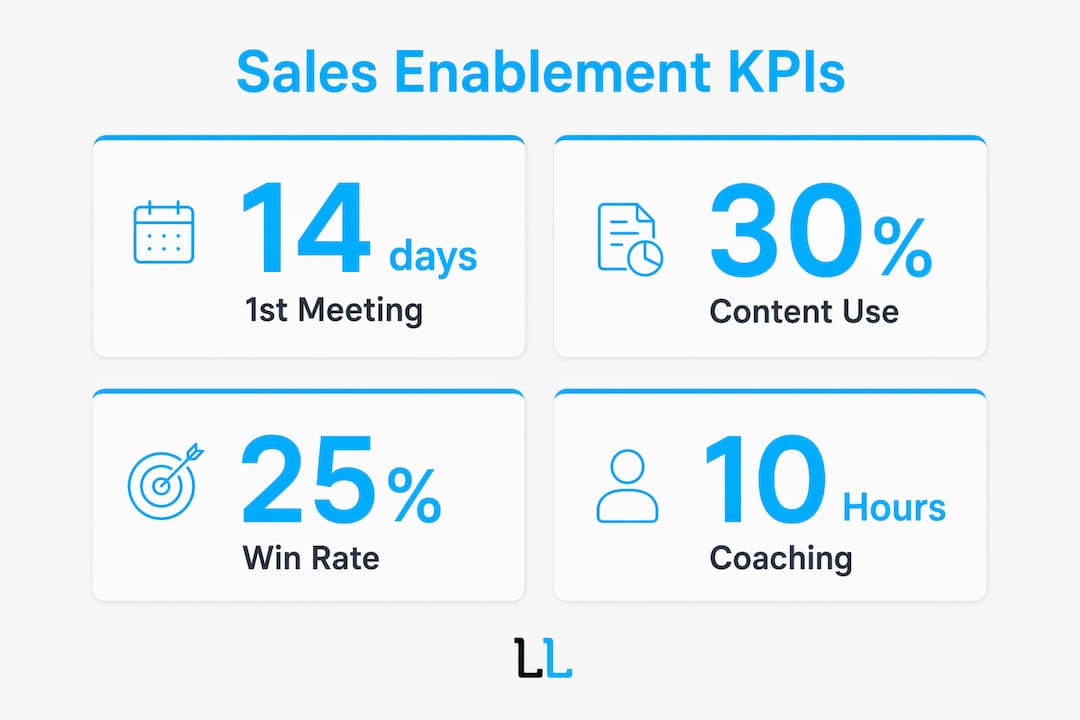
Measure both adoption and outcomes. Adoption metrics tell you whether enablement is being used. Outcome metrics tell you whether it’s working.
The four KPIs that matter most for professional services firms:
- Time to first meeting: How long from initial outreach to a qualified conversation
- Time to quota: How quickly new advisors reach full productivity
- Content adoption rate: Percentage of sellers actively using approved materials
- Win rate: Qualified opportunities converted to closed engagements
| KPI | Definition | Example baseline target |
|---|---|---|
| Time to first meeting | Days from outreach to first qualified meeting | Typically within a few weeks |
| Time to quota | Months for a new advisor to hit full productivity | A few months |
| Content adoption rate | Percentage of sellers using centralized content assets | A majority of sellers (more than half actively use approved materials) |
| Win rate | Percentage of qualified opportunities closed | A portion of qualified opportunities |
| Sales velocity | Revenue generated per day across active pipeline | Firm-specific; track trend |
These ranges are starting points for mid-sized professional services firms. Your baseline will shift based on deal complexity, average contract value, and whether you’re running outreach in-house or through a done-for-you partner. For more on prospect segmentation and how it affects these numbers, the targeting approach matters as much as the content.
How do you implement sales enablement in six steps?
Start small. A pilot with a defined cohort and measurable KPIs proves value before you commit budget to a full build. Sales Enablement Collective recommends pilots that combine content, coaching, and simple tech integrations as the fastest path to demonstrable results.
- Assess current state: Map what content exists, where it lives, and which KPIs you can measure today.
- Align stakeholders: Get sales, marketing, and operations in the same room with a shared definition of success.
- Choose quick wins: Identify one or two high-friction points (e.g., inconsistent outreach messaging) and fix those first.
- Build content and workflows: Create a small, curated content library and at least one documented outreach sequence.
- Pilot with a seller cohort: Run the program with 3–5 advisors for 60–90 days. Measure against your baseline.
- Measure and iterate: Use seller feedback and KPI data to refine before scaling.
| Phase | Timeline | Internal build cost | Outsourced DFY range |
|---|---|---|---|
| Pilot | — | Staff time + tools (~$5K) | $3K/month |
| Expansion | 3–6 months | — | $5K/month |
| Scale | — | Ongoing headcount + platform | Negotiated retainer |
When evaluating vendors, ask specifically about SLAs for content delivery, response handling, and reporting cadence. A vendor who can’t define those upfront is a risk.
What mistakes do firms make when building enablement?
The most common traps:
- Over-investing in point tools before defining the seller workflow. Technology doesn’t fix a broken process.
- Ignoring seller feedback. If advisors can’t find content or find it irrelevant, adoption collapses. Gartner’s guidance on seller experience makes this explicit.
- Measuring the wrong KPIs. Tracking content downloads instead of content-influenced win rates tells you nothing useful.
- Poor content discoverability. A library no one can navigate is worse than no library at all.
Red flags in vendor conversations: vague promises about “pipeline impact” with no defined measurement methodology, no named point of contact for your account, and no structured onboarding timeline.
Pro Tip: Before signing any enablement vendor contract, ask to see a sample reporting dashboard. If they can’t show you one, they’re not measuring outcomes.
How does sales enablement support LinkedIn outreach and lead generation?
Enablement provides the messaging, persona insights, content assets, and reporting that make done-for-you LinkedIn outreach repeatable and measurable. Without it, outreach campaigns rely on whoever wrote the last message sequence, with no feedback loop and no consistency.
The connection is direct:
- Content templates built from enablement playbooks feed directly into outreach sequences
- Role-based messaging ensures a CFO receives a different sequence than a VP of Operations
- Shared content libraries allow rapid campaign personalization without starting from scratch each time
- Analytics from outreach feed back into the content library, improving future sequences
A typical DFY LinkedIn workflow maps to enablement components at every stage: prospect targeting (persona insights), personalized message templates (content library), automated outreach (process workflow), response handling (coaching and scripts), and appointment setting (outcome KPI). For firms exploring B2B appointment setting, the enablement layer is what separates a one-off campaign from a repeatable pipeline system.
A well-structured LinkedIn engagement strategy pairs with enablement content to make each outreach sequence more relevant and easier to personalize at scale.
Key Takeaways
Sales enablement works when it combines content, coaching, analytics, and process alignment into a continuous system, not a one-time project.
| Point | Details |
|---|---|
| Core definition | Sales enablement equips sellers with content, coaching, tools, and data to shorten cycles and improve win rates. |
| Top KPIs to track | Win rate, time to first meeting, and content adoption rate are the three metrics that reveal whether enablement is working. |
| Build vs. buy | A 0–3 month pilot costs $5K–$15K internally or $3K/month outsourced; start small before scaling. |
| Biggest pitfall | Treating enablement as a content dump or one-off training kills adoption within 90 days. |
| The Lead Lab | The Lead Lab delivers done-for-you LinkedIn outreach with built-in enablement components: persona targeting, message templates, response handling, and campaign analytics. |
The gap between enablement theory and what actually moves the needle
Most enablement guides focus on frameworks. What they understate is how much the feedback loop matters in practice, especially for LinkedIn outreach.
When a message sequence stops converting, the instinct is to write a new one. The better move is to ask why the current one failed. Was the persona wrong? Was the value proposition too generic? Did the call to action ask for too much too soon? Those answers live with the sellers running the conversations, not with whoever built the content.
The firms that get the most from enablement, whether they build internally or use a done-for-you partner, are the ones that treat seller feedback as a data source, not a complaint channel. A single insight from a rep who ran 50 conversations last month is worth more than a content audit. The personalized prospecting work that actually converts comes from that loop, not from a content calendar.
If you’re evaluating whether to build an internal enablement function or outsource it, the honest answer is: most professional services firms don’t have the volume to justify a full internal build in year one. A pilot with a DFY partner gives you the data to make that decision with evidence.
The Lead Lab runs done-for-you LinkedIn campaigns with enablement built in
If you’d rather skip the internal build and get a measurable pilot running in weeks. The Lead Lab delivers targeted LinkedIn outreach campaigns with every enablement component included: prospect targeting, personalized message copywriting, automated outreach, response management, and calendar-ready appointment setting.
A typical pilot runs 60–90 days, targets a defined prospect list, and delivers qualified meetings with measurable KPIs from week one. There’s no need to hire an enablement manager or build a content library before you start. The Lead Lab handles the messaging, the sequencing, and the reporting so you can evaluate results before committing to a longer engagement. See what a campaign looks like or review client outcomes to get a sense of what’s realistic for your firm’s pipeline goals.
Useful sources and further reading
- G2: Sales Enablement Guide — Covers the full definition, key metrics, and software options. Start here for a broad overview and KPI benchmarks.
- Gartner: What Is Sales Enablement? — Authoritative strategy guidance from the analyst firm most cited by enterprise sales leaders. Strong on seller experience and revenue enablement trends.
- Microsoft: Sales Enablement — Practical coverage of content lifecycle management and technology integration.
- Salesforce: What Is Sales Enablement? — Clear breakdown of the training vs. enablement distinction with workflow examples.
- HubSpot: Sales Enablement Practices — Best resource for feedback loop governance and content optimization cycles.
- TechTarget: What Is Sales Enablement? — Useful for technology evaluation: platform features, CRM integration, and analytics.
- TD.org: What Is Sales Enablement? — Talent development perspective on cross-functional scope and role ownership.
- The Lead Lab — Done-for-you LinkedIn outreach with enablement components built into every campaign, specifically for professional services firms.