
Segmentation is the operating system that turns generic LinkedIn outreach into conversations that actually convert. When professional services firms stop sending the same message to everyone and start matching message, timing, and offer to a specific buyer’s context, response rates climb, discovery calls become more productive, and pipeline quality improves. The American Marketing Association frames segmentation as an organizational transformation, not a messaging tactic. Investopedia notes it should directly inform pricing and service tiers. The Lead Lab applies this logic daily across LinkedIn campaigns for consulting, legal, financial, and advisory firms.
Three outcomes follow when segmentation is done right:
- Higher response rates feed faster pipeline. Relevant messages get replies; generic ones get ignored.
- Better-fit clients drive higher lifetime value. Segmentation surfaces buyers whose needs match your highest-margin services.
- Wasted spend drops. Focused outreach means fewer hours chasing prospects who were never going to buy.
Table of Contents
- Why does segmentation change results for professional services?
- Which segmentation variables actually move the needle on LinkedIn?
- How do you turn variables into segments you can actually use?
- How should you tailor LinkedIn messages for each segment?
- What should you measure, and when should you judge a test?
- Why segmentation requires organizational change, not just a marketing fix
- What are the most common segmentation mistakes, and how do you fix them?
- How The Lead Lab used segmentation to lift qualified meetings
- Key Takeaways
- The part most firms get wrong
- The Lead Lab can build and run your segmented outreach
- Useful sources and further reading
Why does segmentation change results for professional services?
Professional services firms sell time and expertise, which means a mismatched meeting costs more than a missed click. Segmentation cuts the number of discovery calls that go nowhere by ensuring the message reaching a prospect reflects their actual situation, not a generic pitch.
Behavioral segmentation shifts marketing from batch-and-blast to personalized engagement that raises conversion rates, customer lifetime value, and retention. For a firm selling retainers, that CLV difference compounds quickly. A client who stays three years instead of one is worth far more than the fee difference suggests, because referrals and upsells follow. Salesforce research shows segmentation also concentrates ad and sales spend on high-fit audiences, reducing wasted impressions on buyers who will never convert.
The AMA’s research is direct: while a majority of marketers agree segmentation is pivotal, most use it only for execution rather than strategic decisions. That gap is where professional services firms leave money on the table.
Pro Tip: Prioritize segments that map to your current revenue goals. If high-margin retainer clients are the target, build your first segment around them, not around the largest available audience.
Which segmentation variables actually move the needle on LinkedIn?
The three must-have variable types for LinkedIn outreach are engagement and intent signals, firmographics, and role or seniority. Everything else is secondary until those three are working.
Must-have attributes:
- Intent signals: recent content downloads, profile visits, post engagement, or job-change activity indicate active buying readiness.
- Firmographics: company size, industry, and revenue band determine whether a prospect can actually buy what you sell.
- Role and seniority: decision-maker vs. influencer vs. gatekeeper changes the entire message angle and call-to-action.
Nice-to-have attributes (add after the basics are running):
- Technographic data (CRM or marketing stack in use)
- Growth signals (recent funding, headcount expansion, new office)
- Engagement history with your own content
Behavioral and intent-based segments consistently outperform static firmographic slices for outreach activation because they reflect where a buyer is right now, not where they were when the data was collected. A CFO at a 200-person firm who just downloaded a guide on outsourced finance is a fundamentally different prospect than a CFO at the same firm who has never engaged with your content.
Pro Tip: Avoid vanity attributes like LinkedIn follower count or general “industry interest” tags. If a variable doesn’t change your message or your priority score, it’s not a segment variable — it’s noise.

How do you turn variables into segments you can actually use?
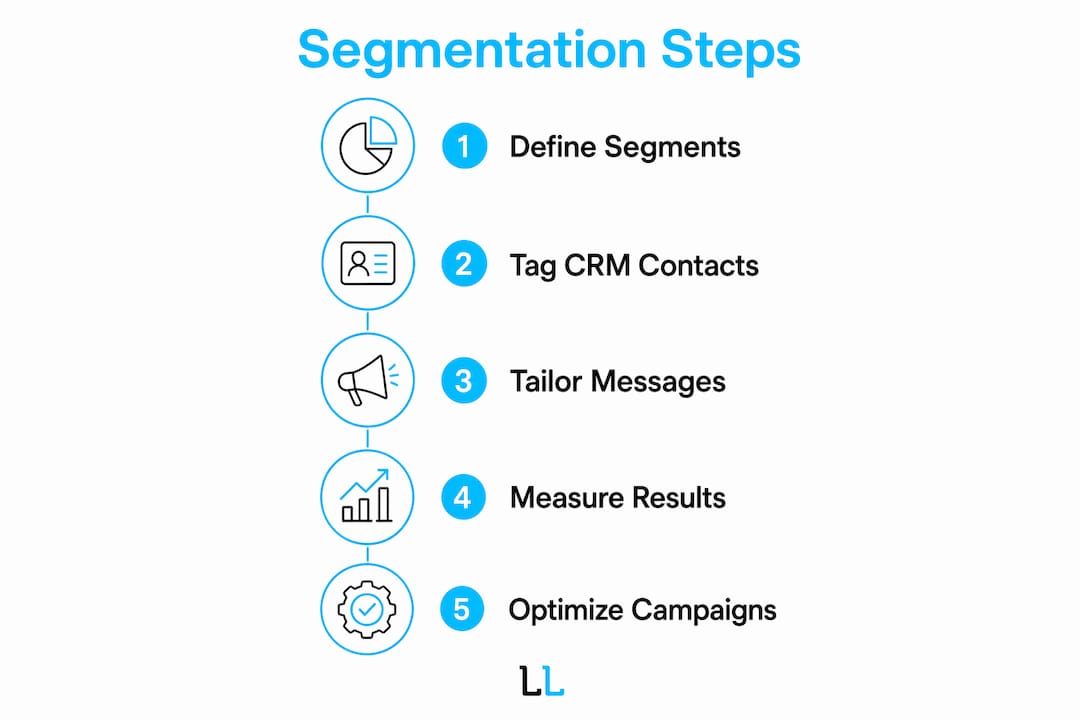
The core process runs in five steps: define the commercial goal, inventory available signals, build scoring rules, validate with a small pilot, then iterate.
- Set a commercial objective. “Book retainer-track meetings with heads of finance at 50–500-person professional services firms” is a segment brief. “Target CFOs” is not.
- Inventory your signals. Pull what you have from LinkedIn Sales Navigator, your CRM, and any marketing automation tool. Flag gaps early.
- Build simple scoring rules. Assign weight to intent signals (highest), role match (high), and firmographic fit (medium). A spreadsheet works for the first pass.
- Validate with a pilot. Run 50–100 outreach sequences to the new segment before scaling. Check reply rate and meeting rate against your baseline.
- Iterate based on response. If a segment underperforms, check whether the signal was real or assumed, then adjust the scoring rule.
Minimum viable segment checklist before activating outreach:
- At least 100 records that meet the criteria
- A clear activation rule (what triggers the sequence)
- One measurable KPI tied to the segment goal
- A named owner responsible for results
For the first 30 days, focus on tagging existing CRM contacts with segment labels, connecting LinkedIn Sales Navigator filters to those labels, and setting automation rules that route new contacts into the right sequence. The LinkedIn lead generation segmentation guide from The Lead Lab covers the CRM-to-sequence connection in detail.
How should you tailor LinkedIn messages for each segment?
Personalization must change at least one of three things per segment: the message angle, the call-to-action, or the cadence. Changing all three is ideal; changing none is just mail merge.
Three common professional-services segment archetypes and their sequence frameworks:
-
High-value retainer prospect (strong intent signal, senior role, right firmographic fit)
- Touch 1: Connection request with a one-line context hook (why you’re connecting, no pitch)
- Touch 2: Value message referencing a specific challenge their firm type faces
- Touch 3: Credibility message (case result or named client outcome, no hype)
- Touch 4: Soft ask for a 20-minute call
-
Procurement-led mid-market buyer (committee decision, longer cycle, price-sensitive)
- Touch 1: Connection with a peer-level framing (“working with similar firms on X”)
- Touch 2: Educational content relevant to their buying stage
- Touch 3: Social proof from a comparable firm
- Touch 4: Ask framed around a no-commitment conversation, not a sales call
- Touch 5: Follow-up with a specific question to re-engage
-
Referral-warm lead (already knows your name, lower friction)
- Touch 1: Connection that names the mutual contact
- Touch 2: Short message referencing the referral context and a specific offer
- Touch 3: Direct ask for a call, shorter cadence than cold outreach
Dos and don’ts for LinkedIn personalization:
- Do reference a specific, observable signal (a post they wrote, a role change, a shared connection).
- Do vary the CTA by segment — a retainer prospect gets a different ask than a referral-warm lead.
- Don’t use personal data that would feel invasive (family details, location patterns).
- Don’t over-personalize without a real signal. Generic “I noticed you work in finance” is not personalization.
The personalized prospecting guide from The Lead Lab maps these nodes to full sequence templates.
What should you measure, and when should you judge a test?
Prioritize action-based metrics in this order: reply rate, meeting rate, qualified opportunity rate, and pipeline value. Vanity metrics like connection acceptance rate tell you almost nothing about commercial impact.
| KPI | Definition | Benchmark range |
|---|---|---|
| Reply rate | Replies ÷ messages sent | — |
| Meeting rate | Meetings booked ÷ replies | 20% depending on segment quality |
| Qualified opportunity rate | Qualified opps ÷ meetings held | 30–50% for well-matched segments |
| Cost per qualified meeting | Total campaign cost ÷ qualified meetings | Compare to historic cost per acquisition |
Run a pilot for several weeks before drawing conclusions. Shorter windows produce less reliable data because LinkedIn sequences have natural reply lags. For statistical confidence, aim for a sufficiently large number of outreach contacts per segment variant before comparing results.
Pro Tip: Calculate cost per qualified meeting and compare it to the hourly value of a senior sales rep’s time. If a segmented campaign books the same meetings at lower cost, the ROI case is already made.
Segmented campaigns can produce significant revenue uplifts when segments are tied to action-based routing and follow-up, though results depend heavily on segment quality and message fit. The campaign performance measurement guide from The Lead Lab covers how to set up tracking for these KPIs from day one.
Why segmentation requires organizational change, not just a marketing fix
Segmentation embedded across sales, marketing, and delivery teams produces measurably better results than segmentation owned by one person in one department. The AMA’s research is clear: firms that treat segmentation as an organization-wide initiative unlock the real ROI; those that treat it as an insights project do not.
| Role | Responsibility |
|---|---|
| Marketing lead | Segment design, naming conventions, activation rules |
| Sales/BD lead | Sequence execution, reply handling, feedback on fit |
| Data/CRM owner | Data hygiene, tagging, refresh cadence |
| Leadership sponsor | Quarterly review, prioritization, resource allocation |
Governance checklist for sustained segmentation:
- Refresh segments at least quarterly (monthly for intent-signal-based segments).
- Maintain a single naming convention across CRM, LinkedIn, and automation tools.
- Document the activation rule and KPI for every live segment.
- Hold a quarterly review tied to pipeline KPIs, not just activity metrics.
ACCA’s strategic resources reinforce that segmentation must align with corporate strategy. Grouping audiences is useless unless those groups are prioritized and serviced differently based on commercial objectives.
What are the most common segmentation mistakes, and how do you fix them?
The five mistakes that destroy segmentation ROI:
- Over-segmentation. Too many small segments with no clear activation rule. Fix: merge segments by actionability, not by similarity.
- Stale data. Segments built on data that’s 12+ months old. Fix: automate a quarterly data refresh and flag contacts with no recent activity.
- Siloed ownership. Marketing builds segments that sales never uses. Fix: involve sales in segment design from day one.
- Bias in segment design. Segments reflect internal assumptions, not buyer behavior. Fix: use a cross-functional design session with a single source of truth.
- Vanity variables. Segments built on attributes that don’t change the message or priority. Fix: ask “does this variable change what we say or who we call first?” If not, drop it.
Segment validation checklist before activating outreach:
- Does this segment change the message angle, CTA, or cadence?
- Does it have a named owner and a measurable KPI?
- Is the data less than 90 days old for intent signals?
- Does it meet the minimum record count (100+)?
On privacy: always follow LinkedIn’s platform terms and applicable data regulations when collecting and using prospect data for outreach.
How The Lead Lab used segmentation to lift qualified meetings
A professional services client came to The Lead Lab running undifferentiated LinkedIn outreach across a single broad list. Response rates were flat, and most meetings that did book were with contacts outside the firm’s target buyer profile.
What changed:
- Replaced the broad list with three defined segments: retainer-track senior buyers, mid-market procurement-led contacts, and referral-warm leads.
- Built separate 4–5 touch sequences for each segment with distinct message angles and CTAs.
- Added intent signal scoring (recent content engagement, job changes) to prioritize the retainer-track segment.
Results within 60 days:
- Meeting rate with qualified prospects increased materially.
- Discovery calls that converted to proposals rose as a share of total meetings held.
- The referral-warm segment booked meetings in fewer touches than either cold segment.
The approach scaled in subsequent quarters by adding technographic signals to the retainer-track segment, further tightening fit.
Key Takeaways
Segmentation converts generic LinkedIn outreach into targeted, higher-converting engagement by matching message, timing, and offer to each buyer’s specific context and readiness.
| Point | Details |
|---|---|
| Intent signals beat firmographics | Behavioral and intent-based segments outperform static firmographic slices for outreach activation. |
| Minimum viable segment first | Every segment needs 100+ records, a clear activation rule, one measurable KPI, and a named owner before launch. |
| Measure action-based KPIs | Track reply rate, meeting rate, and qualified opportunity rate — not connection acceptance. |
| Segmentation is organizational | Cross-functional ownership across marketing, sales, and data teams is what sustains results over time. |
| The Lead Lab approach | The Lead Lab builds and runs segmented LinkedIn sequences for professional services firms, with defined segments, separate cadences, and intent-signal scoring from day one. |
The part most firms get wrong
Most professional services firms I work with at The Lead Lab have tried some form of segmentation. The problem is almost never the concept — it’s the execution gap between “we have a segment” and “we have a sequence, an owner, and a KPI tied to it.”
Segmentation without activation is just a spreadsheet. The firms that see real pipeline movement are the ones that connect segment design directly to message copy, CRM routing, and a named person who owns the result. That’s the methodology The Lead Lab brings to every engagement. If your team is ready to operationalize segments rather than just define them, reach out to discuss your current outreach setup.
The Lead Lab can build and run your segmented outreach
Qualified meetings from LinkedIn outreach don’t come from sending more messages. They come from sending the right message to a precisely defined segment, at the right moment in the buyer’s journey. That’s the concrete difference The Lead Lab delivers versus a generic outreach agency.
The Lead Lab handles the full segmentation-to-sequence workflow for professional services firms: segment design and scoring, LinkedIn message copywriting by segment, CRM tagging and automation setup, and ongoing performance measurement. Typical engagements produce a live segmented campaign within 30 days. View client results and campaign examples to see how segmented outreach performs across consulting, legal, financial advisory, and other professional services contexts. Ready to scope an engagement? Start with a discovery call to map your segments and sequence strategy.
Useful sources and further reading
- American Marketing Association: Reinventing Segmentation — the organizational transformation argument and the 72% marketer survey finding.
- Investopedia: Market Segmentation — how segmentation informs pricing and service tier decisions.
- ACCA: Segmentation and Strategic Business Leader — alignment of segmentation with corporate strategy.
- Databricks: What Is Customer Segmentation? — retention and CLV outcomes from segmentation.
- Salesforce: What Is Market Segmentation? — ad spend efficiency and acquisition cost reduction.
- Clepher: Why Segmentation Is Important — behavioral segmentation and revenue uplift evidence.
- OpenStax: Market Segmentation and Consumer Markets — foundational segmentation concepts.
- ResearchGate: Why Does Segmentation Matter? — bias and siloed data pitfalls.
- The Lead Lab: Why Segment Prospects — practitioner guide to segmentation for professional services lead generation.
- The Lead Lab: LinkedIn Lead Generation Segmentation Strategies — CRM-to-sequence workflow for segmented outreach.
- The Lead Lab: Campaign Performance Measurement — KPI setup and tracking for segmented LinkedIn campaigns.
- lflow: Multi-Link Strategy for Marketers — tracking and attribution strategies that complement segmented outreach across channels.