
TL;DR:
- Campaign performance measurement involves tracking marketing metrics that directly relate to business outcomes, not just activity.
- It is essential to choose the right metrics, such as ROAS and incrementality testing, to understand causation rather than correlation.
- Implementing a measurement hierarchy, focusing on key KPIs, and separating attribution from causality improve marketing success and decision-making.
Campaign performance measurement is the practice of systematically tracking marketing metrics tied directly to business outcomes, not just activity. For marketing professionals and business owners, understanding why measure campaign performance separates teams that grow revenue from those that simply run ads. The core tools of this discipline include ROAS (return on ad spend), cost per lead, conversion rates, attribution modeling, and incrementality testing. Moving beyond vanity metrics like impressions or reach is not optional. It is the difference between spending confidently and spending blindly.
Why measure campaign performance: the metrics and methodologies that matter
The foundation of any measurement practice is choosing the right metrics. Efficiency metrics like ROAS and cost per lead (CPL) tell you how much output you are getting per dollar spent. Attribution models tell you which touchpoints received credit for a conversion. Incrementality testing tells you whether your spend actually caused the conversion or whether the customer would have converted anyway.
These three categories serve different purposes:
- Efficiency metrics (ROAS, CPL, conversion rate): measure the ratio of output to input across channels
- Attribution models (last-click, linear, data-driven): distribute credit across the customer journey
- Incrementality testing: isolates the causal lift your campaign generated by comparing an exposed group to a holdout control group
52% of US marketers now employ incrementality experiments, reflecting how mainstream this methodology has become as privacy restrictions erode user-level tracking. That number signals a fundamental shift: marketers are no longer satisfied with correlation. They want proof of causation.
Last-click attribution, still the default in many Google Ads and Meta accounts, assigns 100% of credit to the final touchpoint before conversion. This systematically overstates the value of bottom-funnel channels like branded search and undercounts the contribution of awareness campaigns on LinkedIn or YouTube. A more accurate picture requires layering attribution data with incrementality results and, for larger budgets, marketing mix modeling (MMM).
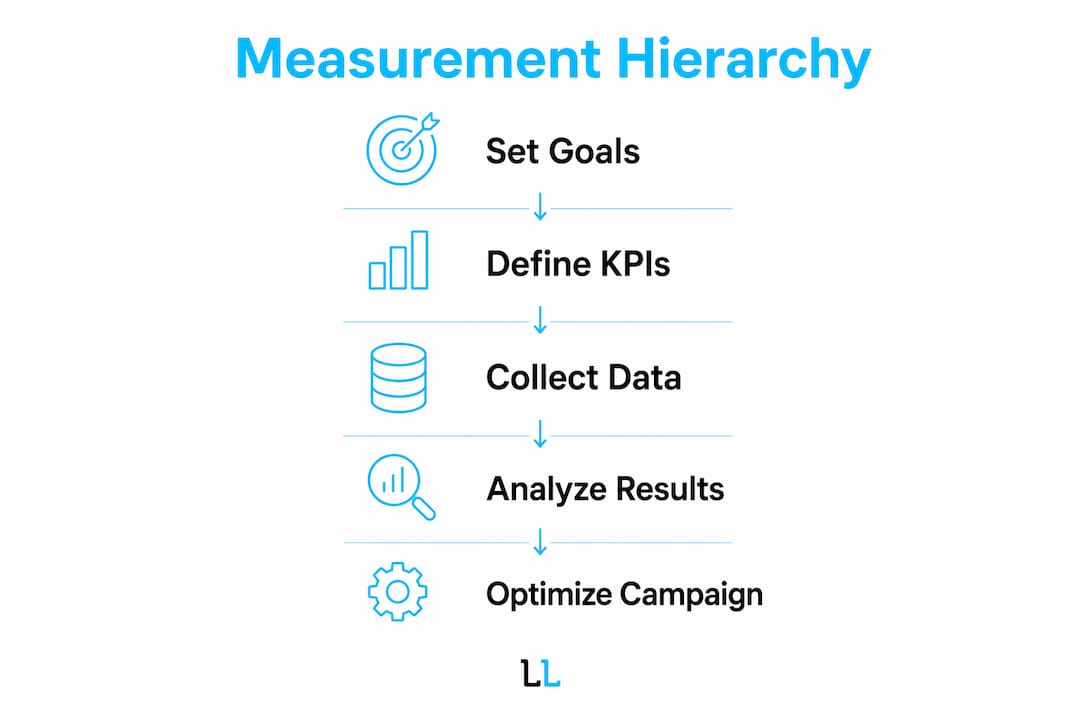
Pro Tip: Set up a measurement hierarchy before your campaign launches. Define which metric is your primary success indicator, which are secondary diagnostics, and which are operational checks. Mixing all three in a single dashboard creates noise, not clarity.
| Measurement type | What it answers | Primary limitation |
|---|---|---|
| Efficiency metrics | How much did each conversion cost? | Does not prove causality |
| Attribution modeling | Which touchpoints received credit? | Correlation, not causation |
| Incrementality testing | Did the campaign cause the result? | Requires holdout groups and scale |
| Marketing mix modeling | How does spend across channels drive revenue? | Requires historical data and statistical expertise |
How to analyze campaign results to improve marketing success
Campaign analytics enables teams to optimize spend and prove ROI by connecting data directly to business outcomes across the full funnel. The key word is “connecting.” Raw numbers in a dashboard are not analysis. Analysis means forming a hypothesis about why performance looks the way it does and then testing it.
A practical framework for campaign performance analysis follows this sequence:
- Establish your baseline. Before diagnosing problems, confirm what normal looks like. Document expected CPL, conversion rate by stage, and lead-to-opportunity ratios from previous campaigns.
- Map the full funnel. Track from impressions through to marketing-qualified leads (MQLs), sales-qualified leads (SQLs), and closed revenue. A drop at any stage points to a specific problem, not a general one.
- Check operational factors. Leads contacted within one hour convert significantly more often than those followed up later. If your CPL looks fine but pipeline is thin, the problem may be in sales execution, not campaign performance.
- Identify the symptom, then form a hypothesis. Disciplined hypothesis testing before making changes prevents the most common misdiagnosis in campaign analysis: blaming creative fatigue when the real issue is a broken tracking pixel or a data feed error.
- Monitor in real time with alerts. Live dashboards and automated alerts catch spend pacing issues, data anomalies, and performance drops before they compound into wasted budget.
- Document findings and feed them forward. Every campaign analysis should produce a written hypothesis log. This is what turns measurement into a continuous optimization flywheel, where each campaign informs the next.
The most underused diagnostic in B2B campaign analysis is the lead handoff audit. Building full-funnel measurements with lead handoff diagnostics and sales follow-up metrics separates marketing funnel problems from sales execution issues. Without this separation, marketing teams absorb blame for revenue shortfalls that originate downstream.
Pro Tip: When performance drops, check pixel integrity and data feed accuracy before touching creative or budget. Tracking errors are the most common cause of apparent performance decline, and they are invisible unless you look for them.

Why differentiating attribution from incrementality improves campaign measurement
Attribution and incrementality are not competing methodologies. They answer different questions, and confusing them leads to poor budget decisions. Attribution distributes credit. Incrementality measures causal lift by comparing what happened in an exposed group versus a holdout control group that saw no ads.
The practical consequence of this distinction is significant. Platform-reported ROAS is almost always inflated because it fails to account for the counterfactual. A customer who was already going to buy your product will be counted as a conversion by your attribution model even though your ad had zero causal impact. Incrementality testing removes this distortion.
Common mistakes teams make when relying solely on attribution:
- Over-investing in retargeting. Retargeting campaigns score well on last-click attribution because they reach people already in the purchase funnel. Incrementality testing frequently reveals that a large portion of those conversions would have happened without the retargeting ad.
- Undervaluing awareness channels. LinkedIn Thought Leader Ads or YouTube pre-roll rarely get last-click credit. Attribution models make them look inefficient. Incrementality testing often reveals they are driving significant net-new demand.
- Misreading channel contribution. When two channels both claim credit for the same conversion, attribution models split or assign it arbitrarily. Only incrementality testing can determine which channel actually moved the needle.
Most marketing teams spend little time on incrementality despite its importance for understanding true business value. The reason is practical: incrementality tests require holdout groups, which means excluding some audiences from ads and accepting a short-term opportunity cost. Teams prioritize testing where attribution discrepancies are largest or where budget decisions are highest stakes. For LinkedIn outreach campaigns, where CPL can be significant, this trade-off is almost always worth making. You can explore how prospect segmentation affects incrementality results by ensuring your holdout groups are properly matched.
What are best practices and common pitfalls in measuring campaign performance?
Building a measurement framework before launch is the single most important best practice in campaign measurement. Teams that define success criteria after a campaign ends are post-rationalizing, not measuring. The framework must specify business objectives, primary KPIs, attribution method, and numeric targets before a dollar is spent.
Best practices for a measurement framework that actually works:
- Limit primary KPIs to three or fewer. A focused dashboard with 8 to 10 key metrics avoids noise and supports faster decisions. Every metric beyond your core set should be a diagnostic, not a headline number.
- Use consistent attribution methods across campaigns. Switching attribution models mid-flight makes comparison impossible. Acknowledge the model’s limitations in your reporting rather than switching to one that makes results look better.
- Avoid vanity metrics as primary success indicators. Impressions, reach, and follower growth are useful context but they do not prove business impact. If your primary KPI is not tied to revenue, pipeline, or qualified leads, your measurement framework is incomplete.
- Surface strategic problems early. Measurement frameworks can reveal strategic, infrastructure, and alignment problems within organizations before campaigns even run. If you cannot define what success looks like before launch, that is a strategic problem worth solving before spending budget.
- Separate channel performance from creative performance. A campaign can underperform because the channel is wrong, the audience is wrong, the creative is wrong, or the offer is wrong. Measurement that does not isolate these variables cannot produce useful optimization guidance.
For LinkedIn outreach specifically, tracking the full journey from connection request to booked meeting to closed deal is what separates campaign analytics from simple activity reporting.
Key takeaways
Measuring campaign performance requires connecting metrics to business outcomes, not just tracking activity, and the most accurate measurement combines attribution, incrementality testing, and full-funnel diagnostics.
| Point | Details |
|---|---|
| Define success before launch | Build your measurement framework with KPIs and targets before spending a dollar. |
| Use incrementality to validate attribution | Attribution assigns credit; incrementality proves whether your spend caused the result. |
| Track the full funnel including sales handoff | Separating marketing funnel problems from sales execution issues requires lead handoff diagnostics. |
| Limit your primary KPIs | A focused dashboard of 8 to 10 metrics drives better decisions than a crowded one. |
| Treat analysis as diagnosis | Form a hypothesis before changing creative, budget, or targeting to avoid misdiagnosis. |
The measurement mistake I see most often
After working with professional services firms on LinkedIn outreach campaigns, the pattern I see most often is this: teams measure what is easy to report, not what is hard to prove. They pull platform dashboards, celebrate a low CPL, and declare the campaign a success. Six months later, the pipeline is thin and nobody can explain why.
The uncomfortable truth is that platform-reported metrics are designed to make platforms look good. Meta, Google, and LinkedIn all use attribution windows and default models that maximize the number of conversions they can claim credit for. I am not saying they are lying. I am saying their incentives and yours are not aligned.
The shift I have seen produce the most durable results is treating measurement as a diagnostic discipline rather than a reporting function. That means forming a hypothesis before every optimization decision, running incrementality tests on your highest-spend channels at least once per quarter, and building a lead handoff audit into every campaign review. It also means being willing to tell a client or a leadership team that the data suggests a strategic problem, not a creative one.
Incrementality testing is becoming non-negotiable as privacy changes continue to erode cookie-based tracking. Teams that build this capability now will have a significant advantage over those scrambling to adopt it later. The opportunity cost of holdout groups is real but small compared to the cost of optimizing toward metrics that do not reflect actual business impact.
The most valuable thing measurement does is not prove that your campaigns worked. It is that it forces you to define what “working” means before you start.
— Toby
See how The Lead Lab turns campaign data into qualified meetings
The Lead Lab builds LinkedIn outreach campaigns where every metric connects back to one outcome: qualified meetings in your calendar. The team tracks the full journey from first connection to booked call, using campaign analytics to identify exactly where prospects drop off and what messaging converts. Rather than handing you a dashboard of activity metrics, The Lead Lab delivers a clear picture of what is driving pipeline and what needs to change. If you are ready to move from reporting numbers to growing revenue, explore done-for-you outreach or review client campaign results to see what measurable performance looks like in practice.
FAQ
Why measure campaign performance at all?
Measuring campaign performance connects marketing spend directly to business outcomes, making it possible to optimize budget allocation and prove ROI. Without measurement, teams cannot distinguish between campaigns that drive revenue and those that only generate activity.
What is the difference between attribution and incrementality?
Attribution distributes credit across touchpoints in the customer journey, while incrementality testing measures whether your campaign actually caused a conversion by comparing exposed audiences to a holdout control group. Attribution shows correlation; incrementality proves causation.
What metrics should I prioritize for campaign performance analysis?
Limit your primary KPIs to three or fewer metrics tied directly to revenue or qualified pipeline, such as CPL, conversion rate, and ROAS. Supporting metrics like impressions and click-through rate serve as diagnostics, not headline success indicators.
How do I know if poor campaign results are a marketing or sales problem?
Track the full funnel including lead handoff timing and sales follow-up rates. Leads contacted within one hour convert significantly more often, so a thin pipeline despite strong CPL often points to a sales execution issue rather than a campaign problem.
When should I run an incrementality test?
Run incrementality tests on your highest-spend channels at least once per quarter, or whenever attribution data and business results appear misaligned. The opportunity cost of holdout groups is worth accepting when the budget decision is significant.
TripScan — это современный онлайн-сервис для создания уникальных и персонализированных туристических маршрутов. Забудьте о часах, потраченных на изучение форумов и путеводителей. С трипскан планирование путешествия превращается в увлекательный и простой процесс. Сервис помогает подобрать достопримечательности, отели, рестораны и развлечения, идеально подходящие именно вам.
трип скан
* Персонализация: Создавайте маршруты, основываясь на ваших интересах, бюджете и времени.
tripscan сайт
* Экономия времени: Вся необходимая информация собрана в одном месте.
трипскан вход
* Удобство: Планируйте поездки с любого устройства, где есть интернет.
tripscan зеркало
* Вдохновение: Находите новые, неизведанные места и идеи для путешествий.
tripscan
Чтобы воспользоваться всеми преимуществами платформы, необходимо выполнить простой трипскан вход в личный кабинет.
1. Перейдите на трипскан сайт через ваш браузер.
2. Нажмите кнопку «Войти» или «Регистрация».
3. Введите свои данные или используйте быструю авторизацию через социальные сети.
https://trip75c.co
трипскан