
TL;DR:
- Scaling a campaign effectively depends on building robust infrastructure, automation, and leadership discipline rather than simply increasing budgets.
- Leadership must establish clear governance, optimize campaign structures, and ensure data readiness to achieve scalable, cost-efficient growth.
Most marketing leaders assume scaling a campaign means increasing the budget. Double the spend, double the leads. It sounds logical, but it rarely works that way. Truly scalable campaigns are built on infrastructure, not just dollars. They require automation, clean data, smart campaign architecture, and leadership discipline. Understanding why choose scalable campaigns matters starts with recognizing that scaling is an operational challenge as much as a financial one. This article breaks down what makes campaigns genuinely scalable, how to implement them, and the leadership decisions that determine whether they grow efficiently or fall apart under pressure.
Table of Contents
- Key takeaways
- Why choose scalable campaigns for business growth
- Technical factors that enable campaign scalability
- Leadership challenges when scaling campaigns
- How to implement scalable campaigns step by step
- My honest take on why most companies get this wrong
- Ready to build campaigns that actually scale?
- FAQ
Key takeaways
| Point | Details |
|---|---|
| Scalability is structural | True scalability comes from automation and data infrastructure, not just budget increases. |
| Signal thresholds matter | Campaigns must meet minimum event volumes to optimize effectively at scale. |
| Leadership drives scale | Protecting creative quality and strategic focus requires deliberate organizational decisions. |
| Budget guardrails beat manual tweaking | Setting budgets as fixed guardrails lets AI systems optimize without constant interference. |
| Readiness determines success | Assessing data, attribution, and metrics before scaling prevents costly mistakes. |
Why choose scalable campaigns for business growth
A scalable campaign is one that can grow output without proportional growth in manual effort, cost per lead, or operational complexity. That definition matters because it separates genuine scalability from simple volume increases.
The core characteristics of a scalable campaign are flexibility, automation, and adaptability. Flexibility means the campaign structure can absorb more budget, broader audiences, or new channels without requiring a rebuild. Automation handles bid adjustments, audience updates, and performance monitoring without constant human intervention. Adaptability means the campaign responds to new data, changing market conditions, or audience behavior without losing performance.
The benefits of scalable advertising go well beyond convenience. When campaigns scale efficiently, you get predictable cost per lead even as volume increases. You reduce the hours your team spends on manual adjustments. You also get cleaner attribution data because consistent campaign structures make it easier to track what is actually driving results. For professional services firms focused on lead generation at scale, this predictability is the difference between a growth strategy and an expensive experiment.
“Scalable campaigns don’t just grow output. They grow output while keeping unit economics stable. That’s the goal.”
The importance of scalable campaigns also ties directly to multi-channel coordination. When your campaign infrastructure is scalable, adding a new channel, say LinkedIn outreach alongside paid search, does not require rebuilding your audience data or starting attribution from scratch. You layer in the new channel with consistent tracking and audience logic already in place. That is how multi-channel outreach compounds results instead of just adding noise.
Technical factors that enable campaign scalability
Getting the technical foundations right is where most campaigns succeed or fail at scale. Three areas matter most: budget management, optimization signal thresholds, and audience data infrastructure.

Budget management and pacing
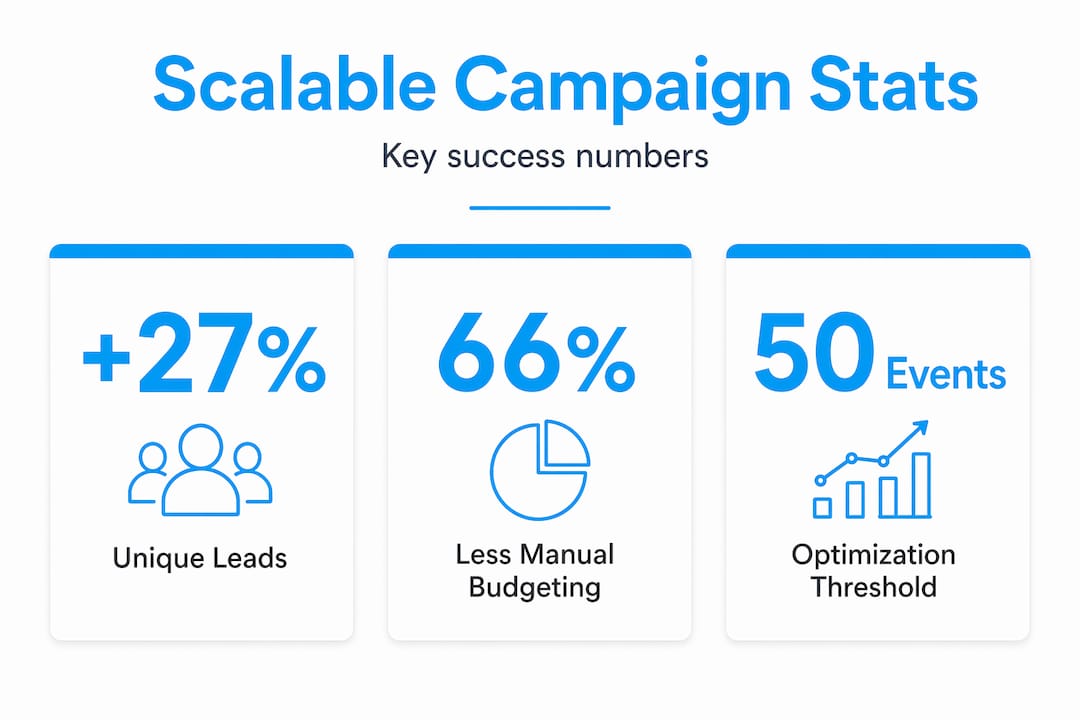
Campaign total budgets reduced manual budget adjustments by 66% compared to daily budgets, which directly supports faster scaling with less operational overhead. Instead of logging in every day to check pacing and shift dollars around, you set a total budget with guardrails and let the system allocate spend where demand is highest. Demand-led pacing takes this further by dynamically adjusting daily spend to match fluctuations in consumer interest, which means peak days get more budget automatically while slow days spend less.
The practical implication: treat budgets as guardrails with specific targets and limits, not as levers to adjust manually every few days. When you constantly override the system, you reset the optimization cycle and lose the efficiency gains that automation was supposed to deliver.
Optimization signal thresholds
This is a technical detail that many teams overlook until it becomes a performance crisis. Meta’s ad sets require roughly 50 optimization events within a 7-day window to exit the learning phase. If your campaign structure splits budget too thin across too many ad sets, none of them accumulate enough signal to optimize properly, and you get unstable costs and inconsistent results at scale.
Ad set consolidation improves the learning phase exit rate because broader ad sets with adequate budgets accumulate signal faster. Fewer, broader audiences beat many narrow segments when your goal is efficient scaling.
Audience data and preference infrastructure
Scalable preference centers unify customer consent and channel preferences across marketing systems, reducing launch delays and activation errors. A single enforced source of truth for customer data means your audience lists stay clean and synchronized whether you are running email, paid social, or outbound outreach simultaneously.
| Infrastructure element | Scaling impact | Manual overhead without it |
|---|---|---|
| Campaign total budgets | Reduces budget adjustments by 66% | Daily check-ins and manual reallocation |
| Ad set consolidation | Faster learning phase exit | Fragmented signal, unstable costs |
| Preference centers | Clean, synchronized audiences | Duplicate records, consent errors |
| AI bidding tools | 27% more converting users | Manual bid management per campaign |
Pro Tip: Before scaling spend, audit your campaign structure for signal fragmentation. If any single ad set is generating fewer than 50 conversions per week, consolidate before increasing budget.
AI-driven bidding also plays a major role. Smart Bidding Exploration helps search campaigns reach a 27% increase in unique converting users by expanding reach beyond obvious query patterns without requiring manual targeting changes. That is the kind of leverage that makes LinkedIn automation and paid search scale together efficiently.
Leadership challenges when scaling campaigns
Technology alone does not make campaigns scalable. The organizational decisions around how campaigns are managed, prioritized, and evaluated determine whether scale produces results or just produces activity.
The most consistent failure pattern in scaling is prioritizing volume over effectiveness. It is significantly easier to scale output than to scale impact. Volume is easier to scale than effectiveness, and leadership’s challenge is protecting creative quality and strategic focus as marketing complexity grows. When teams feel pressure to show growth, they often produce more ads, more campaigns, more ad sets, without asking whether any of it is working better.
Leadership must establish clear decision ownership and governance before scaling begins. Who approves creative changes? Who decides when to consolidate ad sets or pause underperforming campaigns? Without those answers documented and enforced, scaling creates confusion, not growth.
- Creative fatigue accelerates at scale. More impressions per person means ad creative wears out faster, requiring a systematic refresh process, not ad hoc replacements.
- Attribution clarity breaks down under volume. More campaigns running simultaneously makes it harder to know what is actually driving conversions without disciplined tracking frameworks.
- Budget authority diffuses. Scaling often means more stakeholders with opinions about spend allocation, which slows decisions and creates conflicting optimization signals.
- Strategic focus narrows. Teams running high volumes of campaigns often default to optimizing what they can measure easily, abandoning longer-term brand and pipeline metrics.
“The organizations that scale marketing well aren’t the ones with the biggest budgets. They’re the ones with the clearest decision-making structures.”
Pro Tip: Assign a single decision owner for campaign consolidation and creative approvals before scaling. Committees slow scaling down and dilute creative quality.
Why scalable campaigns matter from a leadership perspective is not just about efficiency. It is about organizational capability. Teams that build scalable systems develop muscle memory for data-driven decisions, which compounds over time into a genuine competitive advantage.
How to implement scalable campaigns step by step
Knowing why scalable campaigns matter is useful. Knowing how to implement scalable campaigns is what actually moves the business forward. Here is a practical sequence that works for professional services firms and B2B marketing teams.
-
Assess readiness before scaling. Check whether your current campaigns have stable cost per lead metrics over at least 4 consecutive weeks. Confirm your attribution system correctly assigns credit across channels. Verify that your audience data is clean and consent compliant. Increasing budget too fast causes cost per acquisition to spike, so readiness is not optional.
-
Consolidate campaign structure. Merge ad sets that are below signal thresholds. Broaden audience targeting rather than adding new narrow segments. Reduce the total number of active campaigns to those with proven performance. Each campaign you eliminate from noise improves the signal quality of those that remain.
-
Set budget guardrails and activate automation. Switch from daily budgets to campaign total budgets. Set target CPA or ROAS values as inputs to AI bidding tools, then resist the urge to adjust them more than once every two weeks. Frequent manual overrides restart the learning cycle and undercut performance.
-
Build a creative refresh schedule. Identify the frequency at which your audience segments begin showing engagement drop-off, typically after 3 to 5 exposures. Build a content calendar that rotates creative before fatigue sets in, with a defined approval process that does not require committee sign-off for every asset.
-
Define scaling metrics beyond volume. Track cost per qualified lead, not just cost per click. Monitor pipeline contribution, not just marketing qualified leads. Establish a governance cadence, weekly or biweekly, to review whether scaling decisions are improving unit economics or just increasing spend.
| Scaling stage | Key action | Success indicator |
|---|---|---|
| Pre-scale audit | Confirm stable CPA and clean data | 4 weeks of consistent CPL |
| Structure consolidation | Merge underperforming ad sets | Signal threshold met per ad set |
| Budget automation | Set total budgets with AI bidding | Reduced manual adjustment time |
| Creative management | Schedule proactive refreshes | Sustained engagement rates |
| Governance | Define metrics and decision owners | Scaling decisions tracked and owned |
My honest take on why most companies get this wrong
I have worked with enough marketing teams to know that the biggest obstacle to scalable campaigns is not technology. It is the assumption that scaling is just a matter of adding resources.
What I have seen again and again is that teams rush to scale before their data infrastructure can support it. They run 15 ad sets when three would work better, fragment their budget across too many targeting variations, and then blame the platform when costs spike. The problem was not the platform. The problem was structure.
The other thing I have learned is that treating budgets as dials to turn frequently is one of the most common ways to sabotage scaling. Every time you manually override an AI bidding system, you push it back to the beginning of its optimization cycle. The best results I have observed come from teams that set their budget guardrails deliberately, then leave them alone long enough for the system to actually learn.
Leadership behavior matters more than most leaders want to admit. Creative quality collapses at scale not because teams run out of ideas, but because approval processes slow down and the path of least resistance becomes recycling old assets. The teams that scale creative effectively are the ones where a single person has clear authority to approve or reject work quickly.
My honest advice: before you ask why scalable campaigns matter or whether to pursue them, ask whether your organization is operationally ready to support them. The technology is available. The question is whether your team has the discipline to use it properly.
— Toby
Ready to build campaigns that actually scale?
If you have read this far, you already know that scalable campaigns require more than a bigger budget. They require the right structure, the right automation, and the right team behind them.
At Theleadlab, we build done-for-you LinkedIn outreach campaigns designed specifically for professional services firms that need qualified leads at scale, not just more impressions. Our campaigns are built on targeted prospecting, tested messaging, and automated follow-up systems that grow without adding proportional overhead to your team.
Visit Theleadlab to see how we approach scalable lead generation. You can also explore our campaign portfolio for real examples of what scalable outreach looks like in practice, or join one of our upcoming webinars focused on lead generation strategy. If you are ready to talk specifics, request a consultation and we will map out what a scalable campaign looks like for your firm.
FAQ
Why choose scalable campaigns over standard campaigns?
Scalable campaigns maintain stable cost per lead as volume increases, whereas standard campaigns typically see rising acquisition costs under pressure. The difference is in automation, campaign structure, and data infrastructure, not just spend level.
What is the biggest barrier to scaling campaigns effectively?
The most common barrier is scaling before the campaign structure and data infrastructure are ready. Fragmented ad sets, inconsistent attribution, and manual budget management all prevent efficient scaling regardless of budget size.
How many optimization events does a campaign need to scale properly on Meta?
Meta requires roughly 50 optimization events per ad set within a 7-day window to exit the learning phase. Campaigns below this threshold experience unstable costs and cannot scale reliably.
How do you implement scalable campaigns without spiking acquisition costs?
Scale incrementally using a stepwise budget increase process, confirm stable performance metrics before each increase, and use AI bidding tools set to target CPA or ROAS rather than manually adjusting bids. Systematic data-driven scaling consistently outperforms rapid budget increases.
What role does leadership play in scalable campaign success?
Leadership determines governance, decision ownership, and creative approval processes, all of which directly affect whether scaling produces results or just produces activity. Without clear accountability structures, creative quality and strategic focus deteriorate as campaign volume grows.