
TL;DR:
- Effective B2B sales outreach requires building a clear ideal customer profile and utilizing multi-channel strategies for maximum engagement. Rapid responses within five minutes and automated follow-ups significantly increase meeting success rates, while combining digital outreach with strategic events accelerates trust-building. Monitoring key metrics such as reply, booking, and show rates helps identify process gaps and optimize sales performance.
Getting meetings on the calendar is one of the hardest parts of B2B sales, and most teams are losing ground without knowing why. If your reply rates are flat, your show rates are inconsistent, and your pipeline looks thinner than it should, the strategies in this guide will help you understand how to boost B2B meetings with a repeatable, data-backed system. We cover everything from building your outreach foundation to mastering response times, running multi-touch cadences, and using events as a trust accelerator.
Table of Contents
- Key takeaways
- How to boost B2B meetings with the right outreach foundation
- Building a multi-touch cadence that books meetings
- Lead response management: turning replies into meetings
- Using events to accelerate trust and secure meetings
- Measuring what works and fixing what does not
- My take on what actually moves the needle
- Ready to put these strategies to work?
- FAQ
Key takeaways
| Point | Details |
|---|---|
| Build on ICP clarity | Targeting the right contacts with personalized messaging is the single biggest driver of meeting volume. |
| Go multi-channel | Combining email, LinkedIn, and phone boosts engagement by up to 250% compared to single-channel outreach. |
| Respond within 5 minutes | Speed to lead matters more than most teams realize. Waiting longer than 5 minutes cuts your qualification odds dramatically. |
| Automate your follow-up | Automated reminders and action tracking push meeting show rates to 70-80% and cut drop-off by up to 12%. |
| Measure and iterate | Tracking reply rate, show rate, and conversion to opportunity tells you exactly where your process breaks down. |
How to boost B2B meetings with the right outreach foundation
Before you send a single message, you need a clear picture of who you are targeting. Most teams skip this step or treat it as a one-time exercise. That is a mistake. Your ideal customer profile (ICP) is not just firmographic data. It is a living document that includes the specific pain points your best clients had before they found you, the triggers that made them ready to buy, and the language they used to describe their problem.
Once you have a sharp ICP, your messaging gets dramatically easier to write. A prospect receiving a message that speaks directly to a challenge they dealt with last quarter is far more likely to reply than someone reading a generic pitch about your services. Personalization at the pain-point level is what separates meeting-generating outreach from noise.
Choosing the right channels for your ICP
Not every channel works equally well for every audience. The table below compares the three most common outreach channels for B2B professionals, so you can build a mix that fits your market.
| Channel | Strengths | Best use case |
|---|---|---|
| Scalable, easy to personalize at volume, trackable | Cold outreach, follow-up sequences, nurturing | |
| Social proof, warm connection requests, profile context | Senior decision-makers, relationship-building | |
| Phone | Highest conversion rate for booked meetings | Late-sequence follow-up, warm prospects |
Phone calls still dominate for booked meetings. Phone outreach accounts for 85% of all booked sales meetings, while email accounts for just 8%. That does not mean email is useless. It means email and LinkedIn warm the prospect so the phone call converts.
The smartest strategies for B2B meetings use all three in sequence. Start with a LinkedIn connection, follow with a value-focused email, then call. Your prospect already recognizes your name when the phone rings. That familiarity is worth more than any script. For a deeper breakdown of how these channels work together, the Theleadlab guide on multi-channel outreach is worth reading before you build your sequence.
Pro Tip: Reference something specific from a prospect’s LinkedIn activity or company news in your first touch. One sentence of genuine relevance outperforms five sentences of generic value propositions.
Building a multi-touch cadence that books meetings
Most salespeople give up too early. 80% of sales require at least five touches, yet the average rep stops at two. A structured cadence changes that by removing the guesswork and replacing it with a system.
Here is a proven five-step sequence you can adapt:
- Day 1: LinkedIn connection request with a brief, relevant note. No pitch. Just a reason to connect.
- Day 3: Personalized email referencing a shared challenge or relevant company development. Include one clear ask.
- Day 6: Follow-up email adding a piece of value. A relevant article, a stat, a short insight that makes their job easier.
- Day 10: Phone call. You are now a familiar name, not a cold stranger.
- Day 14: Breakup email. Keep it short. Acknowledge they are busy and leave the door open. This one often generates the most replies.
The optimal spacing of 2-3 days between touches increases reply rates by 11% compared to clustering messages together. Spread your cadence across 10-30 days with 8-12 total contact points for the highest conversion rates.
Automation makes this scalable. AI tools can personalize messages at volume, schedule touches based on prospect behavior, and flag warm replies for immediate human follow-up. The goal is not to remove humans from the process. It is to remove the manual tasks that slow humans down.

Pro Tip: Run A/B tests on your subject lines, call-to-action phrasing, and send times every two weeks. Even a 10% improvement in open rate compounds significantly across a full quarter of outreach. Theleadlab has seen subject line testing shift reply rates by 15-20% on its own.
Lead response management: turning replies into meetings
Booking a meeting and losing it to slow follow-up is one of the most preventable revenue leaks in B2B sales. Responding within 5 minutes makes you 21 times more likely to qualify a lead than responding an hour later. Yet most teams take hours, or even days, to respond to inbound signals.
The fix is partly operational and partly mindset. You need a process that routes warm replies to a human immediately, not a process that treats them like any other email in a shared inbox.
Here is what a tight lead response process looks like in practice:
- Instant notification: Set up alerts so you know the moment a prospect replies or books time.
- Templated but personalized replies: Have a response ready that acknowledges their specific message and confirms next steps within seconds of receiving a notification.
- Qualification in the first exchange: Use the first reply to confirm fit. Ask one or two questions that tell you whether this is a prospect worth a full conversation.
- Automated confirmations: Once a meeting is booked, send an immediate confirmation, a 24-hour reminder, and a 1-hour nudge. This three-touch reminder sequence cuts no-show rates from 22-28% down to 12-18%.
You can also use automation to handle meeting follow-ups after the call itself. Automated action tracking leads to 91% completion of agreed next steps, compared to 61% with manual tracking. That gap directly impacts how many deals progress after the first meeting.
A slow follow-up that drops close probability by just 5% can translate into six-figure quarterly losses for teams running 20 meetings per week. Speed is not just professionalism. It is revenue. The Theleadlab resource on lead response best practices walks through exactly how to set up this kind of system.
Pro Tip: If your team cannot monitor inbound replies in real time, use an AI tool that flags high-intent language in replies and sends a priority alert. “Would Thursday work?” should never sit unread for 48 hours.
Using events to accelerate trust and secure meetings
Digital outreach builds awareness. Events build trust. And in B2B sales, trust is what converts a conversation into a commitment.
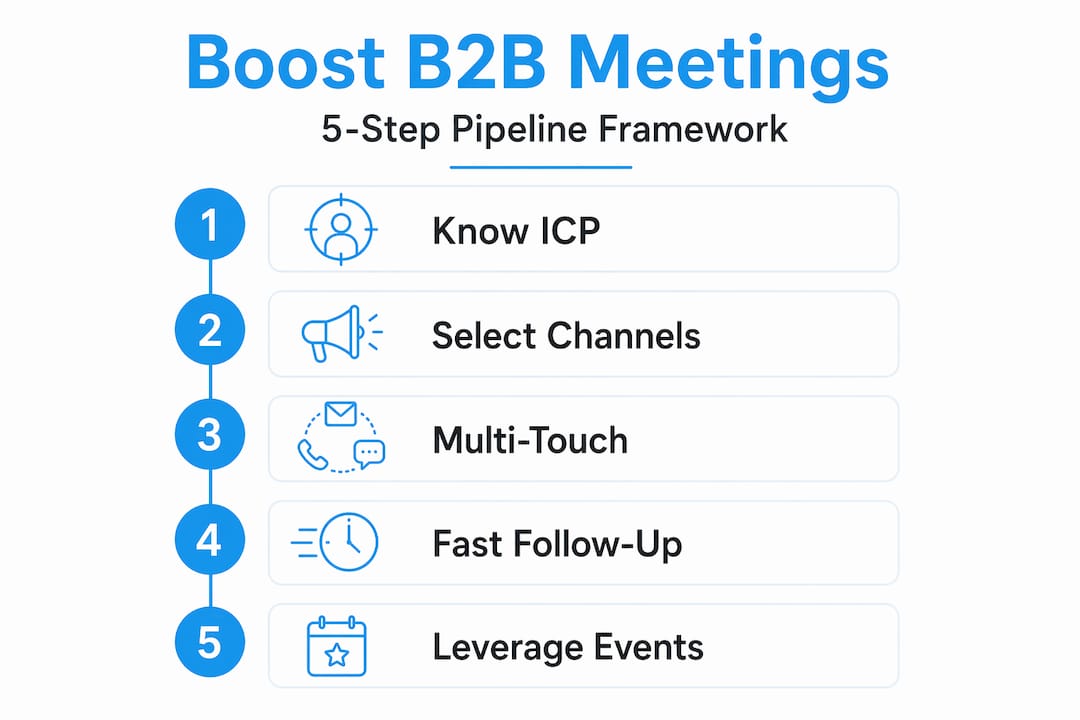
One in-person meeting often equals three virtual meetings in terms of trust-building value. That is not an argument to abandon digital. It is an argument to use events strategically as an accelerator for deals that are already in motion.
| Event type | Trust potential | Meeting opportunity |
|---|---|---|
| Industry conference | High | Pre-scheduled one-on-ones |
| Hosted roundtable | Very high | Intimate, high-intent conversations |
| Virtual webinar | Medium | Post-event follow-up meetings |
| Trade show | Medium | High volume, lower intent |
The biggest mistake most companies make at events is collecting business cards and calling it a win. The meeting opportunity at an event is what happens before the event ends.
Here is how to convert event presence into booked meetings:
- Reach out to registered attendees two weeks before the event and request a 15-minute conversation on-site.
- Prepare a short, specific conversation opener tied to the event theme, not your pitch.
- After any meaningful conversation, send a same-day follow-up with a specific next step. Not “let’s stay in touch.” A date and a time.
Combining event presence with a targeted digital outreach sequence before and after the event creates a compounding effect on meeting rates. Prospects who have met you in person are significantly more likely to accept a follow-up meeting request than cold contacts.
Measuring what works and fixing what does not
You cannot improve what you do not track. The teams that consistently increase B2B meeting effectiveness are the ones that review their metrics weekly, not quarterly.
The four numbers every B2B sales leader should monitor:
- Reply rate: Are your messages resonating? Anything below 3% on cold outreach signals a messaging or targeting problem.
- Meeting booking rate: Of the replies you get, how many convert to scheduled meetings? The industry benchmark sits at 30-50% for interested replies converting to meetings.
- Show rate: Are booked meetings actually happening? Target 70-80% through automated reminder sequences.
- Conversion to opportunity: After the meeting, how many move forward? This tells you whether your qualification process is working.
When you map these numbers across your cadence, bottlenecks become obvious. Low reply rate points to messaging. Low show rate points to confirmation and reminder gaps. Low conversion to opportunity points to ICP targeting or discovery quality. Each metric is a diagnostic, not just a scoreboard.
A/B testing should run continuously, not as a one-time project. Test one variable at a time: subject line, opening sentence, CTA phrasing, send day, or channel sequence. Rotate through them over eight to twelve week cycles so your data is statistically meaningful.
My take on what actually moves the needle
I have watched a lot of B2B teams invest in outreach tools and still wonder why their meeting volume does not grow. The issue is almost never the technology. It is the gap between mechanistic execution and genuine personalization.
Multi-channel outreach is necessary. But running LinkedIn, email, and phone on autopilot without actually reading the prospect’s profile or understanding their business sends a signal that you did not care enough to try. Prospects feel that. They do not respond, and you end up with low reply rates and a frustrated team blaming the wrong variables.
What I have found works is treating automation as the skeleton and human judgment as the muscle. Let automation handle scheduling, reminders, CRM updates, and follow-up templates. Let your team handle the parts where a human voice actually changes the outcome: the opening message, the phone call, the post-meeting note that references something specific from the conversation.
The teams I respect most are the ones experimenting with in-person events alongside their digital sequences. Not as a substitute, but as a trust accelerator for deals that were already warm. That combination, digital outreach to warm the prospect plus an event moment to anchor the relationship, shortens sales cycles in ways that pure digital never quite replicates.
The data points to process. But the wins come from people who understand that a process only works when someone cares enough to execute it with attention.
— Toby
Ready to put these strategies to work?
If you have read this far, you have a clear framework for increasing meeting volume and quality across your outreach. Theleadlab specializes in exactly this kind of done-for-you outreach, combining LinkedIn prospecting, personalized messaging, response management, and campaign analytics for professional services firms.
Whether you want to see what a high-performing outreach sequence looks like in practice or explore how automation can free your team to focus on conversations that matter, Theleadlab has the tools and the track record. Browse the client campaign results to see what structured outreach delivers. Or visit Theleadlab to book a consultation and find out what a bespoke campaign could do for your pipeline.
FAQ
How many touchpoints does it take to book a B2B meeting?
Most B2B sales require at least five to eight touches before a prospect responds. A structured cadence of 8-12 contact points spaced across 10-30 days delivers the highest conversion rates.
What is the best channel for booking B2B meetings?
Phone calls convert at the highest rate, accounting for 85% of booked sales meetings. Email and LinkedIn are most effective when used earlier in the sequence to warm the prospect before a call.
How quickly should I follow up with a B2B lead?
Respond within 5 minutes whenever possible. Responding in under 5 minutes makes you 21 times more likely to qualify the lead compared to waiting an hour or more.
How do I reduce no-shows for booked B2B meetings?
Use a three-step automated reminder sequence: an immediate confirmation, a 24-hour reminder, and a 1-hour nudge before the meeting. This approach reduces no-show rates from up to 28% down to around 12-18%.
What metrics should I track to improve B2B meeting rates?
Focus on four core numbers: reply rate, meeting booking rate, show rate, and conversion to opportunity. Each metric points to a specific stage in your process where performance can be improved.