
TL;DR:
- Using predictive analytics transforms LinkedIn outreach by enabling targeted messaging based on engagement signals and data-driven prospect lists. It shifts the focus from volume to relevance, improving reply and conversion rates through continuous testing and optimization. Success relies on balancing data insights with creative messaging and disciplined experimentation.
Most marketing leaders at professional services firms have tried scaling their LinkedIn outreach, only to watch reply rates plateau and meeting bookings stay flat. The instinct is to send more messages, add more connections, and push harder on volume. But that instinct is wrong. Predictive analytics for LinkedIn enables prospect targeting and messaging optimization by using data signals to identify high-value leads, predict engagement likelihood, and personalize at scale, which means the shift from guesswork to analytics is what separates campaigns that generate real revenue from those that burn time and damage your brand.
Table of Contents
- Why analytics matters in LinkedIn outreach
- Key metrics that power data-driven outreach
- Applying analytics for targeting and message optimization
- Operationalizing analytics: Testing, learning, and continuous improvement
- A fresh take: Why analytics alone isn’t enough for outreach mastery
- Next steps: Unlocking analytics-powered outreach with The Lead Lab
- Frequently asked questions
Key Takeaways
| Point | Details |
|---|---|
| Analytics boosts lead quality | Data-driven outreach means smarter targeting and better conversations with high-value prospects. |
| Track metrics that matter | Connection acceptance, reply rates, and meetings set the foundation for continuous outreach improvement. |
| Benchmarks should guide, not dictate | Use industry data as a reference but always adapt benchmarks to your firm’s actual funnel. |
| Combine data with creativity | Analytics sets direction but successful outreach also requires message testing and human insight. |
| Test, learn, and optimize | Iterative experiment cycles turn analytics insights into real pipeline growth on LinkedIn. |
Why analytics matters in LinkedIn outreach
Traditional outreach often works like a megaphone. Send a generic connection request to a large list, follow up with a templated pitch, and hope for the best. This model produces low-quality leads because it ignores the most important question: who actually wants to hear from you, and why?
Understanding LinkedIn outreach basics makes clear that the platform rewards relevance above all else. LinkedIn’s own algorithm deprioritizes spammy messages, and busy decision-makers delete anything that feels mass-produced. Analytics flips this dynamic by turning each outreach decision into a data-informed choice rather than an educated guess.
Here is what analytics-powered outreach actually changes:
- Prospect identification: Instead of targeting everyone with a certain job title, you use engagement signals, profile data, and firmographic filters to find people who match your ideal client profile and show signs of active buying intent.
- Message sequencing: Analytics reveals where prospects drop off in your funnel so you can adjust the timing and content of each message in your sequence.
- Offer relevance: Data from past campaigns shows which value propositions resonate with specific segments, so you can lead with the right hook for each audience.
- List quality over list size: A targeted list of 300 high-intent prospects consistently outperforms a generic list of 3,000 cold contacts.
“The goal isn’t to reach more people. It’s to reach the right people with the right message at exactly the right moment.” This shift in mindset is the foundation of every effective analytics-driven outreach program.
The 2026 benchmark report reinforces this point with hard data, showing that firms applying smarter targeting and personalization are pulling ahead of those still chasing volume metrics. Analytics is not a nice-to-have feature. It is the engine.
Key metrics that power data-driven outreach
Understanding the role of analytics sets the stage. Now let’s look at the hard numbers and benchmarks behind effective outreach.
The first thing most firms discover when they start tracking properly is that their funnel has a leak they didn’t know existed. A practical methodology for diagnosing that leak is to track conversion steps such as connection acceptance rate, message reply rate, and meeting booking rate to identify whether the problem lives in your targeting, your messaging, or your offer.
Here is a breakdown of the four metrics that matter most:
- Connection acceptance rate: The percentage of sent connection requests that get accepted. A low rate signals a targeting or profile credibility problem, not a messaging problem. Fix the list or the sender profile before touching your copy.
- Reply rate: The percentage of accepted connections who respond to your first or subsequent messages. This is primarily a messaging quality indicator. If acceptance is strong but replies are weak, your opener isn’t landing.
- Positive reply rate: Not all replies are good replies. Tracking the share of responses that show genuine interest helps you distinguish between campaigns that generate noise and those that generate pipeline.
- Meeting booking rate: The ultimate conversion metric. This measures how many positive conversations convert to scheduled calls or demos.
| Metric | Benchmark (H1 2026) | Warning threshold |
|---|---|---|
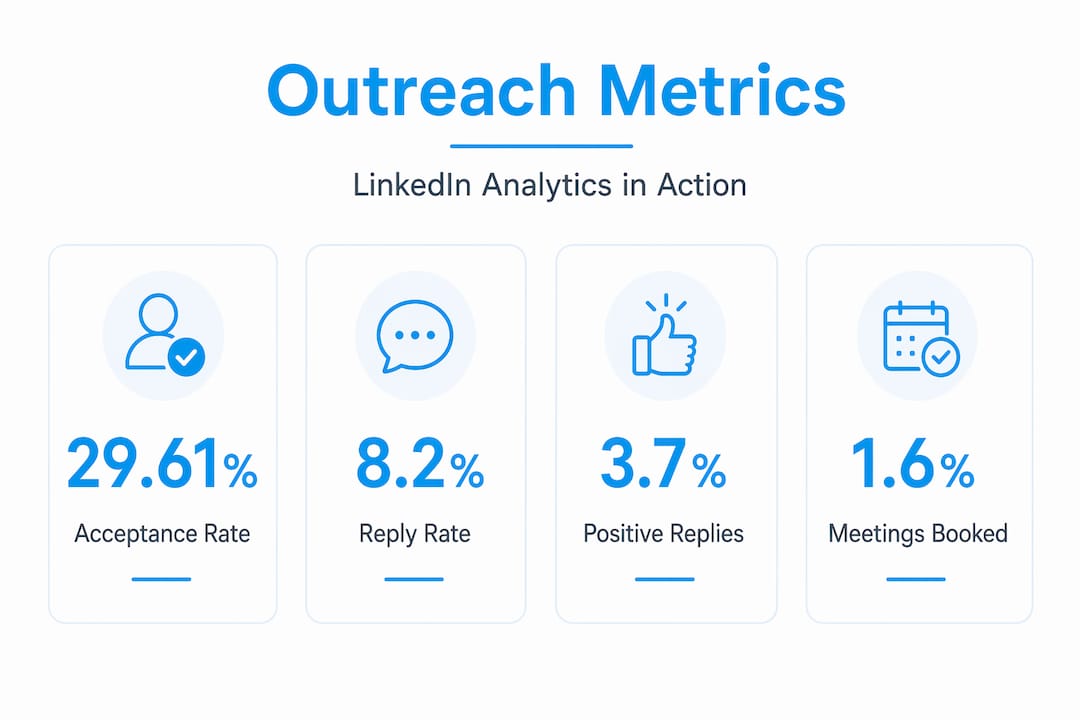
| Connection acceptance rate | ~29.61% | Below 20% |
| Message reply rate | ~16.86% | Below 10% |
| LinkedIn response rate vs cold email | 10.3% vs 5.1% | N/A |
| Meeting booking rate | Varies by industry | Below 2% of replies |
According to Expandi’s H1 2026 data, Connector campaigns see an average acceptance rate of 29.61%, while messenger campaigns deliver a reply rate of around 16.86%. Importantly, LinkedIn response rates average 10.3% compared to cold email’s 5.1%, which makes LinkedIn the higher-performing channel when executed correctly.
Pro Tip: If your acceptance rate is above 25% but your reply rate is under 8%, the problem is your message, not your list. Run a focused A/B test on subject lines and openers before making any other changes.
Understanding where your numbers fall relative to benchmarks gives you a clear diagnostic framework. Review more campaign ideas designed specifically for professional services, and audit your process against the common outreach mistakes that quietly sabotage even well-funded campaigns.
Applying analytics for targeting and message optimization
With key metrics and benchmarks in hand, the next step is transforming those insights into targeted actions that increase conversion rates.
This is where the work gets strategic. Analytics doesn’t just tell you what happened. It tells you who responded and why, which allows you to build smarter prospect lists and sharper messages for the next cycle. Predictive analytics helps you identify high-value leads and personalize messaging at scale based on data signals rather than assumptions.
Targeting with analytics
Predictive scoring takes firmographic data (company size, industry, revenue, growth signals) and overlays it with behavioral signals (post engagement, profile updates, content interaction) to rank prospects by likelihood to respond. Rather than building a list based on job title alone, you are filtering for people who are actively engaged in your topic area, recently promoted, or working at companies showing signs of expansion.

Segmentation plays a critical role here. Breaking your audience into distinct groups, for example by role seniority, industry vertical, or company stage, lets you tailor both the list and the message. A managing director at a boutique law firm needs a very different hook than a VP of business development at a mid-market consulting firm.
| Targeting approach | Inputs used | Expected impact |
|---|---|---|
| Generic job title filtering | Title only | Baseline acceptance, low reply rate |
| Firmographic segmentation | Industry, size, revenue | Higher relevance, better acceptance |
| Behavioral scoring | Engagement history, profile activity | Strong reply and positive reply rates |
| Predictive prospect lists | All signals combined | Highest meeting booking rates |
Message optimization with analytics
Once you have the right audience, analytics guides message refinement through structured testing. A/B testing different openers, call-to-action styles, and value propositions reveals what resonates in each segment. Dynamic personalization, where you reference the prospect’s recent activity, shared connection, or company milestone, lifts reply rates significantly compared to generic templates.
The key principles for high-impact message crafting on LinkedIn are brevity, relevance, and a clear reason for reaching out. Analytics tells you which of those three you are currently failing at, which is far more useful than guessing.
Pro Tip: Use your positive reply data as a creative brief. If a particular opener or value statement generates a disproportionate share of positive replies, dissect exactly what made it work and replicate that structure across new segments. Use segmentation strategies to ensure each segment gets a tailored version rather than one-size-fits-all copy.
Personalized outreach strategies consistently outperform generic approaches in both connection acceptance and downstream conversion, confirming that the effort invested in audience-specific messaging pays measurable returns.
Operationalizing analytics: Testing, learning, and continuous improvement
Once analytics are applied, the real leverage comes from optimizing each element through organized experimentation. Here’s how to make that process rigorous and repeatable.
Many firms review their analytics once a quarter, draw a few conclusions, and then change nothing. That approach leaves enormous performance gains on the table. The firms that win at LinkedIn outreach build structured test and learn loops that create compounding improvements over time.
Here is a practical framework for operationalizing outreach analytics:
- Establish a baseline. Before testing anything, document your current acceptance rate, reply rate, and meeting booking rate for each active campaign. You cannot measure improvement without a starting point.
- Isolate one variable per test. Change only one element at a time, whether that is the targeting criteria, connection message, opener in the follow-up sequence, or the call-to-action. Testing multiple variables simultaneously makes it impossible to know what drove the change.
- Set a minimum sample size. Decisions made on fewer than 50 to 100 responses are often noise, not signal. Agree on a minimum sample before you draw conclusions, especially in lower-volume campaigns.
- Track against your own funnel, not just benchmarks. LinkedIn outreach benchmarks are directional and platform-specific. Your industry, audience seniority, and offer complexity all affect what “good” looks like. Use published benchmarks to set expectations, then calibrate against your own CRM-attributed data.
- Iterate in order. Fix targeting first (acceptance rate), then messaging (reply rate), then conversion elements (meeting booking rate). Trying to optimize downstream metrics when upstream targeting is broken wastes cycles.
“Analytics should be operationalized into test/learn loops, where you measure acceptance and reply rates, then iterate on targeting, opener, and asset order. This discipline reduces wasted cycles, especially when metrics move slowly or are confounded by prospect context.” George Khoshtaria
The pitfalls to watch for are just as important as the steps. Analysis paralysis happens when teams spend more time reviewing dashboards than running campaigns. Overreacting to short-term fluctuations (a bad week of replies, an unusual spike in acceptance) leads to premature changes that disrupt campaigns before they reach statistical significance. Slow metric feedback, especially in longer sales cycles, means you need patience alongside rigor.
Pro Tip: Build a simple testing log in a shared spreadsheet. Record each test date, variable changed, sample size, and result. Over 12 months, this becomes one of your most valuable campaign intelligence assets. Learn more about scaling LinkedIn outreach and optimizing for lead quality to sustain momentum as you grow. Tracking digital marketing results with the same rigor across channels also helps you see how LinkedIn outreach contributes to your broader pipeline.
A fresh take: Why analytics alone isn’t enough for outreach mastery
Here is an uncomfortable truth that most analytics vendors won’t tell you. Data can tell you what is happening in your outreach campaigns, but it cannot tell you why it matters to the specific human being reading your message on a Tuesday afternoon between back-to-back calls.
We work with professional services firms every day and see the same pattern repeatedly. A firm invests in a solid analytics stack, builds detailed dashboards, and still struggles to move the needle on meetings booked. The reason is almost always the same: they optimized the metrics without improving the underlying human experience of receiving the outreach.
Analytics is a compass. It points you in the right direction. But you still have to steer, and steering requires judgment that no algorithm can fully replace. Knowing that your reply rate is 8% is useful. Understanding why your best-performing message resonated, which piece of the story it told, which specific frustration it acknowledged, and why that prospect felt it was worth a reply, that understanding lives in the intersection of data and human empathy.
The firms achieving the highest ROI from LinkedIn outreach share a specific characteristic. They use analytics to narrow the field and then invest serious creative energy into what they say within that field. They treat every A/B test as a storytelling experiment, not just a variable swap. They read their positive replies carefully and extract nuance from the language prospects use, which feeds directly back into sharper targeting and more resonant messaging.
Most professional services firms under-invest in creative testing and process rigor, favoring dashboards over disciplined experiments. The data is only as good as the creative hypothesis it’s testing. Explore creative outreach ideas that blend analytical precision with messaging that actually connects with real decision-makers.
The highest-performing campaigns we have seen always combine three things: clean data, creative courage, and a rigorous process for learning from both successes and failures. No single element is sufficient on its own.
Next steps: Unlocking analytics-powered outreach with The Lead Lab
For firms looking to put these principles into action, expert support accelerates results significantly.
The Lead Lab specializes in blending analytics, outreach creativity, and deep professional services expertise into done-for-you LinkedIn campaigns that generate qualified meetings, not just activity metrics. Every campaign includes rigorous prospect targeting, personalized message sequences, and detailed analytics reporting so you always know exactly where your pipeline stands and why. You can review client success stories to see how firms like yours have improved their lead quality and meeting volumes through analytics-driven outreach. If you want to go deeper on strategy, join our analytics webinars where our team walks through real campaign data and emerging best practices for LinkedIn outreach in professional services.
Frequently asked questions
Which LinkedIn outreach metrics matter most for lead generation?
Core metrics include connection acceptance rate, reply rate, positive reply rate, and meeting booking rate, and tracking these conversion steps gives you a clear diagnostic view of where your funnel needs attention.
How should firms use outreach benchmarks like those from Expandi?
Treat them as directional starting points, not absolute targets. Platform-specific benchmarks help set initial expectations, but your own CRM-attributed funnel data should always be the final authority for decision-making.
What is the main value of predictive analytics in LinkedIn outreach?
Predictive analytics helps you identify high-value prospects before reaching out, so your messages reach people with genuine buying intent rather than broadly defined job titles.
What are common pitfalls when operationalizing outreach analytics?
The most damaging pitfalls are overreacting to short-term data noise and skipping structured testing. Operationalizing analytics into test/learn loops reduces wasted campaign cycles and produces more reliable, compounding improvements over time.