
TL;DR:
- Most professional services firms fail to turn lead magnets into high-quality pipelines due to ineffective strategies centered on broad, generic offers. Highly specific, actionable, and targeted magnets that address clear problems and pre-qualify prospects significantly outperform broad content in generating qualified, conversion-ready leads. Regularly updating, segmenting, and testing lead magnets ensures sustained relevance and optimal performance within a strategic lead generation system.
Many professional services firms invest time and budget creating lead magnets, only to watch them collect digital dust. The problem is rarely effort. It’s strategy. Generic PDFs and broad “ultimate guides” might work for consumer brands, but decision-makers at law firms, consultancies, and financial advisory practices are too busy and too skeptical for that approach. This guide breaks down exactly what a lead magnet is, how it functions inside a B2B lead generation funnel, which formats actually convert, and how to avoid the traps that drain your pipeline of quality prospects.
Table of Contents
- What is a lead magnet?
- How lead magnets work in the lead generation funnel
- High-converting formats for professional services
- Common pitfalls and how to avoid low-performing lead magnets
- Keeping your lead magnets relevant and high-converting
- Why precision and specificity win over volume in B2B lead magnets
- Ready to create or optimize your lead magnet?
- Frequently asked questions
Key Takeaways
| Point | Details |
|---|---|
| Lead magnets defined | A lead magnet is a valuable, free resource used to capture contact details and pre-qualify potential clients. |
| Funnel integration | Lead magnets are most effective when paired with a full lead nurture and conversion funnel. |
| Format matters | Microspecific formats like checklists and templates achieve highest conversion in B2B settings. |
| Avoid common pitfalls | Generic, lengthy, or outdated magnets underperform and may attract the wrong audience. |
| Continuous optimization | Regular updates and testing are essential to maintain lead quality and magnet performance. |
What is a lead magnet?
A lead magnet is not just a freebie you staple to a contact form. For professional services firms, it is a precisely engineered exchange of value. As defined clearly, “a lead magnet is a free, valuable resource offered in exchange for contact information, typically an email address, to convert anonymous visitors into qualified leads.” That definition sounds simple, but the execution is where most firms fall short.
Think of a lead magnet as your firm’s first handshake with a potential client. That handshake tells them what kind of partner you are, whether you understand their world, and whether your expertise is worth their attention. A poorly designed magnet communicates the opposite.
A high-performing lead magnet does one thing really well: it earns trust from exactly the right person at exactly the right moment.
For marketing directors at professional services firms, the goal is not to rack up email addresses from anyone willing to click. It is to attract the specific decision-makers who have the problem your firm solves, and then move them through a structured lead nurturing strategies process that builds genuine interest over time.
Here is what separates a real lead magnet from common impostors:
- It solves one specific, well-defined problem for a named audience
- It delivers value before any sale is made, building immediate credibility
- It pre-qualifies intent by attracting people who care about that specific problem
- It sets up the next step in the relationship rather than just sitting in someone’s downloads folder
- It is NOT a product discount, a generic welcome email, or a company brochure dressed up as a resource
The last point matters more than most firms realize. Discounts and promotional offers are among the lowest-converting lead magnet types in professional services. Decision-makers do not respond to them the way a retail consumer might. They respond to expertise, relevance, and specificity.
How lead magnets work in the lead generation funnel
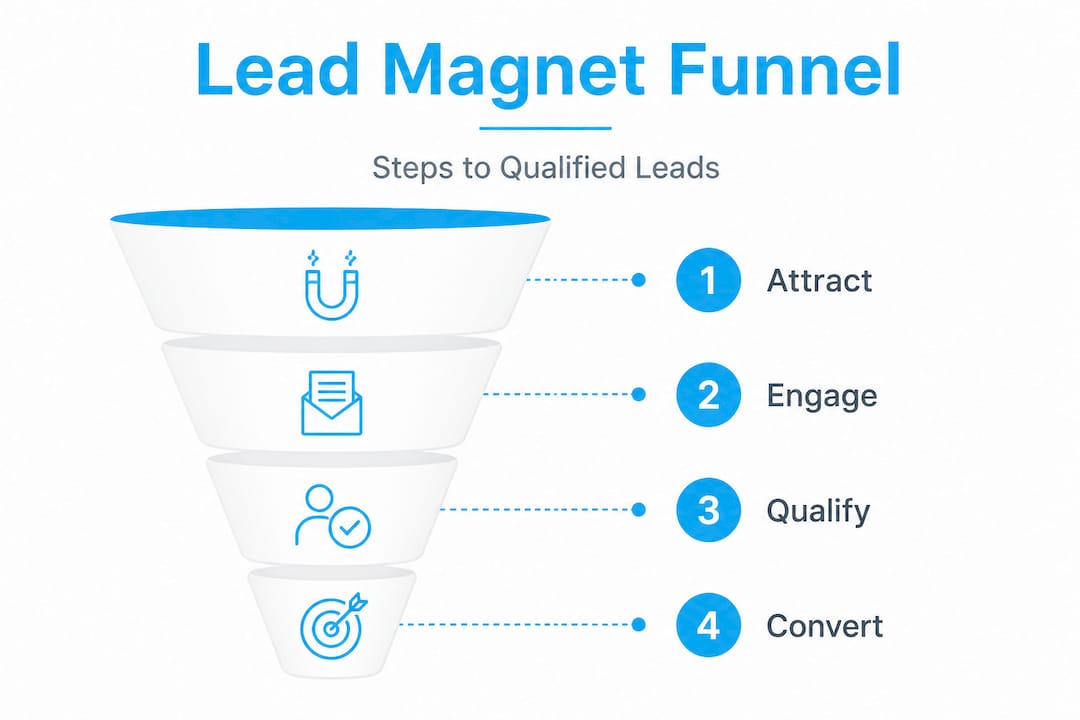
Understanding the mechanics behind a lead magnet helps you stop treating it as a standalone tactic and start seeing it as one critical part of a broader system. As research on lead generation funnels confirms, lead magnets function by attracting visitors with the offer, capturing contact details via gated content, nurturing via email sequences, and converting those contacts into customers.

Each stage of that process has its own success criteria, especially in B2B contexts where buying cycles are longer and more relationship-driven.
| Funnel stage | What happens | Success indicator |
|---|---|---|
| Attract | Decision-maker discovers the lead magnet via LinkedIn, search, or referral | High click-through rate from target persona |
| Capture | Visitor exchanges contact info for the resource | Opt-in conversion rate above 20% for targeted traffic |
| Nurture | Automated email sequence delivers additional value | Email open rate, reply rate, meeting requests |
| Convert | Lead books a consultation or responds to outreach | Qualified meetings per 100 leads |
The nuances at each stage matter significantly more in B2B than in consumer marketing. For example, the nurture sequence after a lead opts in is not just a drip of promotional emails. It should be a deliberate series that reinforces the original value delivered, introduces adjacent expertise, and creates natural moments to invite a conversation. Strategic messaging for B2B audiences requires a fundamentally different tone than B2C nurturing.
Here is a practical breakdown of how to execute each stage effectively:
- Attract: Distribute the lead magnet where your target decision-makers already spend time. LinkedIn organic posts, LinkedIn ads, and targeted outreach messages are the most effective channels for professional services. Tie the offer directly to a pain point your ideal client is actively searching for.
- Capture: Design the opt-in page for clarity and trust. One clear headline, a concise description of what the lead gets, and social proof such as a client testimonial or download count.
- Nurture: Send the first follow-up email within minutes of the opt-in. The sequence should include at least three to five touchpoints over two to three weeks, each delivering additional insight rather than pushing for a sale immediately.
- Convert: Use LinkedIn outreach tips to personalize your conversion messages based on what the lead downloaded and where they are in the funnel.
Pro Tip: Add one qualifying question to your opt-in form, such as company size or current challenge. This pre-qualifies leads at the capture stage and dramatically increases the quality of prospects entering your nurture sequence, improving your campaign return on investment.
High-converting formats for professional services
Not every lead magnet format works equally well for a time-pressed CFO, a managing partner at a law firm, or a heads-of-strategy at a consulting group. The format you choose signals as much as the content inside it. Choosing the wrong format, even with great content, can tank your conversion rate.
Best-practice research on lead magnet design is clear: effective lead magnets solve specific problems for targeted audiences, and the best formats include checklists, templates, ebooks, and webinars. Critically, the highest performers deliver value in under 20 minutes and use scannable, specific design rather than dense long-form writing.
| Format | Time to consume | Best for | Conversion potential |
|---|---|---|---|
| Checklist | 5 to 10 minutes | Operational decision-makers | Very high |
| Template | 10 to 15 minutes | Practitioners and managers | High |
| Short guide or report | 15 to 20 minutes | Strategic decision-makers | High |
| Webinar or video | 30 to 60 minutes | Engaged, later-stage leads | Medium |
| Long-form ebook | 45+ minutes | Brand awareness, not conversion | Low to medium |
For most professional services firms, checklists and templates are the unsung heroes of the lead magnet world. A “10-point vendor due diligence checklist for procurement directors” is infinitely more actionable and targeted than a 40-page whitepaper on procurement best practices. Decision-makers will download the checklist, use it, and remember who gave it to them.
What makes a lead magnet truly irresistible to a senior decision-maker comes down to a few core attributes:
- Ultra-specific headline that names the reader’s role and problem (“For marketing directors at consultancies managing more than 10 accounts”)
- Immediate applicability so the reader can use it today, not someday
- Credibility signals built into the asset itself, such as data, client examples, or a named methodology
- A clear bridge to the next logical step, whether that is a discovery call, a related resource, or an outreach sequence
Scalable lead generation strategies require that your lead magnet formats can be repurposed and tested across multiple campaigns without starting from scratch each time. Templates and checklists are particularly easy to update, segment by industry, and reuse across personalized prospecting campaigns on LinkedIn.
Pro Tip: “Micro-offers” that can be consumed in under 20 minutes consistently achieve the highest opt-in rates with professional audiences. If your lead magnet takes longer than that to read or use, split it into a series and gate each part separately to drive continued engagement.
Common pitfalls and how to avoid low-performing lead magnets
Even firms with strong content teams routinely produce lead magnets that generate disappointing results. Understanding why is critical before you invest another dollar or hour into a campaign.
The biggest single mistake is creating a lead magnet that is too broad. Generic titles like “The Complete Guide to Growing Your Business” attract low-intent visitors who are browsing, not buying. Research on lead magnet performance confirms that generic and broad magnets fail because they attract low-intent audiences, discounts perform poorly with conversion rates as low as 16.2%, and content that takes over 20 minutes to consume reduces engagement sharply.
Watch out for these specific traps:
- The generic PDF trap: A 30-page PDF with a vague title and no specific audience in mind. It gets downloaded, never read, and you get an unresponsive list.
- The discount mistake: Offering a reduced rate consultation or a trial discount as a lead magnet. This attracts price-sensitive prospects, not ideal clients with genuine need.
- The overlong content problem: Webinars longer than 45 minutes, ebooks over 5,000 words, or video series requiring hours of viewing. Professional decision-makers simply will not engage at that depth without a prior relationship.
- The outdated asset: A 2023 regulatory guide still on your website in 2026. Stale content signals that your firm is not paying attention, which is catastrophic for trust.
- The missing call to action: A brilliant resource with no clear next step for the reader. Always include a specific, low-friction invitation to continue the conversation.
Reviewing your existing LinkedIn outreach mistakes alongside your lead magnet performance data often reveals a pattern: the firms getting the lowest quality leads from LinkedIn are usually pairing great outreach with weak or mismatched magnets.
Pro Tip: Run a quick A/B test on just your headline and call-to-action copy before redesigning an entire lead magnet. In many cases, a headline change alone can lift opt-in rates by 15 to 30 percent. Test one variable at a time and run each version for at least two weeks before drawing conclusions.
Keeping your lead magnets relevant and high-converting
Launching a lead magnet is not a “set it and forget it” exercise. The professional services landscape changes, your clients’ priorities shift, regulations update, and competitor content evolves. If your lead magnets are not evolving too, they will gradually lose their pull and your pipeline will quietly shrink.
As performance data consistently shows, the most resilient lead magnet programs continuously update assets and A/B test headlines and calls to action to maintain conversion performance.
Here is a practical optimization cycle to keep your magnets performing:
- Quarterly content audit: Review every active lead magnet for accuracy, relevance, and alignment with your current service positioning. Retire anything that no longer reflects your firm’s expertise or your audience’s needs.
- Segment your offers: Use what you know about your audience to create variations of your best-performing magnets for different industries, roles, or company sizes. Segmenting prospects before running lead magnet campaigns consistently improves both opt-in rates and lead quality.
- A/B test relentlessly: Test headline variations, opt-in form copy, button text, and even the format of the lead magnet itself. Small changes compound into significant performance gains over a quarter.
- Track the full funnel: Do not just measure downloads. Track what happens after the opt-in, how many leads open the nurture sequence, how many reply, and how many eventually book a call. Use these numbers to optimize outreach campaigns and improve the entire pipeline, not just the top of it.
- Align with lead response management: The moment a lead downloads your asset is the moment the clock starts. Fast, relevant follow-up within the first hour dramatically increases the chance of converting that lead into a meeting.
Pro Tip: Rotate your primary lead magnets at least every quarter. Even a highly relevant asset experiences “magnet fatigue” as it circulates through your network. A fresh angle on the same topic, presented in a new format, can re-engage existing contacts while attracting new ones.
Why precision and specificity win over volume in B2B lead magnets
Here is the uncomfortable truth that most lead generation advice avoids: chasing download volume is the wrong goal for professional services firms. It feels good to see 500 new names on your list. It feels significantly less good when your sales team burns through three months of follow-up on prospects who were never remotely qualified.
The conventional wisdom in content marketing pushes toward broad appeal, bigger audiences, and more top-of-funnel volume. For professional services, that logic is backwards. A firm that generates 30 highly targeted leads per month from a tightly scoped magnet built for mid-market CFOs will consistently outperform one generating 300 leads from a generic finance guide that appeals to anyone with an interest in money.
We have seen this play out repeatedly. When agencies and consultancies move from broad content to sector-specific, role-targeted resources, often the total download number drops while the pipeline value increases significantly. A narrowly focused “due diligence checklist for private equity associates evaluating HR tech platforms” will get far fewer downloads than a generic talent management guide. But every single person who downloads the narrow version is exactly who you want in your funnel.
This is why the most effective B2B marketers we work with at The Lead Lab spend more time narrowing their magnet’s audience than expanding their distribution. Specificity creates self-selection. When a decision-maker reads your headline and thinks “this was written for me,” you have already won the trust battle before they even download the asset.
The shift from volume thinking to precision thinking also changes how you measure success. Instead of total opt-ins, you track qualified opt-ins, meeting conversion rate, and revenue influenced per lead magnet. Those metrics align with business outcomes rather than vanity numbers, and they make it much easier to justify ongoing investment in strategic content.
Ready to create or optimize your lead magnet?
Building a lead magnet that consistently attracts qualified clients requires more than good writing. It requires deep audience insight, tested messaging, and a structured nurture system behind it.
At The Lead Lab, we specialize in designing and executing done-for-you lead generation campaigns for professional services firms, including the full lead magnet strategy, copywriting, and LinkedIn distribution that converts the right prospects into booked meetings. Browse our client portfolio to see how firms like yours have transformed their pipelines, and register for our upcoming lead generation webinars where our team walks through real campaign builds from start to finish. If you are ready to stop guessing and start generating, let’s talk.
Frequently asked questions
What makes a lead magnet effective for B2B professionals?
It must address a specific pain point, deliver actionable value in under 20 minutes, and feel tailored to the decision-maker’s role or sector. As best practices confirm, the most effective formats combine clear value promises, scannable design, and high specificity.
How often should lead magnets be updated to stay relevant?
Review and refresh at least every quarter, or when your audience’s needs or market trends shift, to keep engagement high. Consistent updates and A/B testing of headlines and calls to action are essential to maintaining conversion performance.
What types of lead magnets convert best on LinkedIn?
Checklists, templates, and short insights tailored to niche audiences tend to outperform long-form ebooks and generic whitepapers. Targeted formats that solve specific problems for a defined audience consistently outperform broad content on LinkedIn.
Why do some lead magnets generate low-quality leads?
Generic or overly broad lead magnets attract low-intent prospects, while highly targeted resources attract qualified decision-makers. Research shows that generic and broad magnets consistently fail to convert because they lack the specificity needed to filter for genuine buyer intent.
Recommended
- The Lead Lab
- Lead generation strategies that drive results on LinkedIn – The Lead Lab
- LinkedIn Prospecting Checklist: Win More Qualified B2B Leads – The Lead Lab
- Why building a prospect list boosts lead generation – The Lead Lab
- Blog | spherescout.io – B2B Lead Generation Insights
- Master step by step lead qualification for B2B sales