
TL;DR:
- Most marketing leaders focus on activity metrics that do not reflect outreach effectiveness in complex professional services sales. Accurate tracking requires mapping every touchpoint, integrating CRM, and extending attribution windows to capture long sales cycles effectively. Building a real-time, unified analytics system enables firms to make informed decisions, optimize campaigns, and accelerate revenue growth.
Most marketing leaders at professional services firms believe outreach tracking means counting sent emails, logged calls, and booked demos. That number tells you how busy your team is, not how effective it is. The firms pulling ahead in competitive B2B markets have figured out something different: when you measure the right signals at every stage of the buying journey, you stop guessing and start making decisions that consistently fill your pipeline with qualified prospects. This article gives you the frameworks, evidence, and practical steps to do exactly that.
Table of Contents
- Why outreach performance tracking matters for professional services
- The building blocks: What to track in outreach performance
- Mechanics of effective tracking: Systems, dashboards, and integrations
- Tackling long sales cycles: Adapting tracking for professional services
- Why most outreach tracking fails—and what actually works in B2B
- Transform your outreach results with expert tracking solutions
- Frequently asked questions
Key Takeaways
| Point | Details |
|---|---|
| Track beyond the basics | Successful B2B firms track every client touchpoint, not just outreach volume. |
| Measure what matters | Focus on multi-stage conversions and engagement metrics for true insight into outreach impact. |
| Centralize your data | Dashboards integrating CRM and channel data enable faster, smarter decisions. |
| Adapt for long cycles | Custom events and extended attribution windows are crucial for long professional services sales cycles. |
Why outreach performance tracking matters for professional services
Let’s break down why basic tracking merely scratches the surface for B2B professional services firms.
Professional services buying journeys are fundamentally different from product sales. A company buying accounting, legal, consulting, or financial advisory services rarely converts after a single touchpoint. Decision-makers read case studies, attend webinars, ask for referrals, and revisit your firm’s LinkedIn page multiple times over weeks or months before committing. The sales cycle is long, nonlinear, and deeply relational.
Default analytics tools were never built for this complexity. Google Analytics 4, for example, tracks sessions and clicks well, but without custom events per journey stage and extended attribution windows, you will completely miss the touchpoints that actually drove a prospect to sign. A 90-day attribution window is often the minimum recommended for professional services, yet most firms leave their tracking at the default 30-day setting.
The result? Your best-performing outreach channels get zero credit for deals they influenced. You defund what works and invest more in what looks busy but converts poorly. Learning to optimize outreach campaigns starts with understanding what you are actually measuring.
“If you only track activity volume, you measure your team’s effort, not your firm’s progress. Real traction lives in conversion data most firms never even look at.”
Consider the B2B sales metrics that actually predict revenue growth for professional services: pipeline velocity, touchpoint-to-conversion rates, and engagement depth per prospect. These are invisible if your tracking stops at open rates and call counts. Building a rigorous measurement practice is not a reporting exercise. It is a competitive advantage.
Key problems with surface-level tracking:
- Activity counts (emails sent, calls made) mask whether those activities are reaching the right people
- Standard attribution misses late-stage touchpoints that close deals
- No CRM integration means marketing and sales data never connect, so you can not trace a signed client back to their first interaction
- Misleading “success” signals can cause firms to scale tactics that look impressive but generate no revenue
The building blocks: What to track in outreach performance
Once you recognize the gaps in basic tracking, it’s crucial to understand exactly what to monitor and measure at each stage.
Not all metrics are created equal. In B2B professional services, you need a clear separation between leading indicators, the early signals that predict future performance, and lagging indicators, the outcomes that confirm a strategy worked. Leading indicators include connection acceptance rates, reply rates, and content engagement. Lagging indicators are signed agreements, revenue generated, and client lifetime value.
Professional services firms should track multi-stage conversion across the entire funnel, from a prospect’s first interaction to a signed engagement letter. This requires thinking about your buyer’s journey in distinct phases.
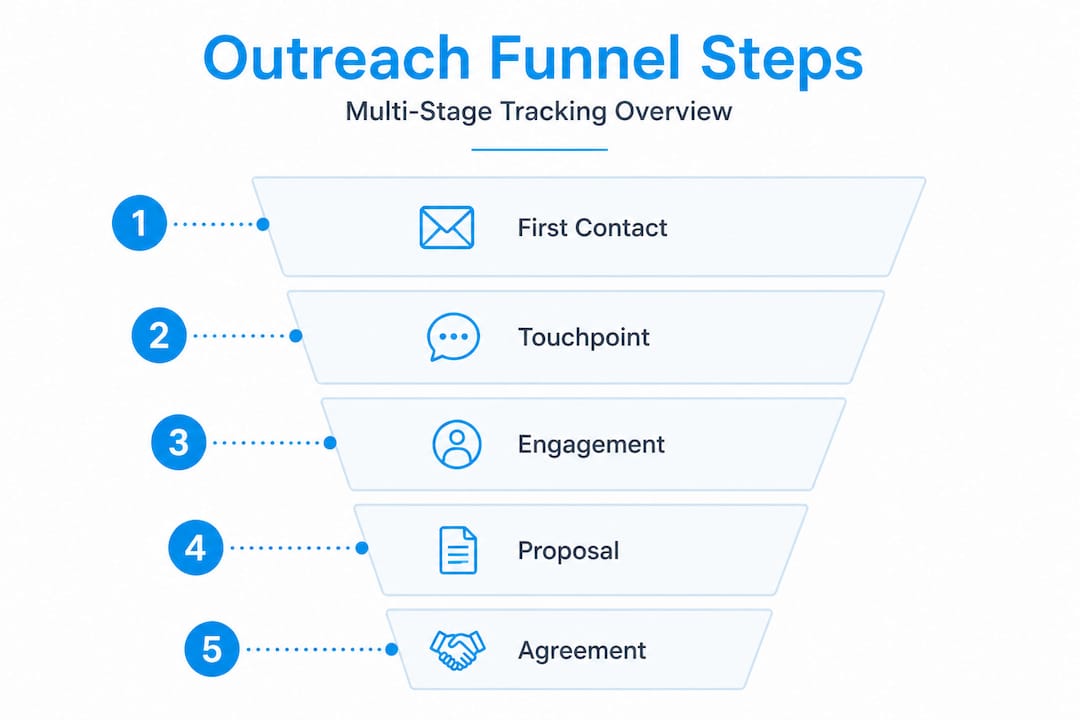
| Stage | Key activity | Primary metric |
|---|---|---|
| Awareness | LinkedIn connection request, cold email | Acceptance rate, open rate |
| Interest | Profile view, content reply, link click | Click-through rate, reply rate |
| Evaluation | Meeting booked, proposal requested | Meeting conversion rate |
| Decision | Proposal sent, follow-up touchpoints | Proposal-to-close rate |
| Signed agreement | Contract executed | Time-to-close, deal value |
Here is how to structure a tracking approach that covers the full journey:
- Map every touchpoint your firm uses across LinkedIn, email, phone, and events to the five stages above.
- Assign at least one trackable metric to each touchpoint so no interaction goes unmeasured.
- Connect your outreach tools to your CRM so every contact’s journey is recorded in one place. Good CRM integration for outreach is the backbone of this approach.
- Set custom conversion events in your analytics platform to capture micro-conversions like content downloads and webinar sign-ups that happen well before a deal closes.
- Review leading and lagging indicators separately in your reporting cadence so you can spot early warning signs before they show up as missed revenue targets.
Pro Tip: Extend your attribution window to at least 90 days for professional services outreach. Prospects researching a complex service often return to your content or LinkedIn profile weeks after their first touchpoint, and short windows make these high-value interactions invisible to your tracking system.
This framework also applies when you run multi-channel outreach across LinkedIn, email, and live events simultaneously. Tracking each channel in isolation gives you fragments. Connecting them gives you the full picture of how prospects move toward a signed agreement.
Mechanics of effective tracking: Systems, dashboards, and integrations
With KPIs mapped out, the next challenge is making measurement seamless and actionable.
Knowing what to track is step one. Knowing how to track it without creating hours of manual reporting every week is step two. Most professional services marketing teams underestimate this infrastructure challenge, and it shows up as stale dashboards nobody trusts and reports that take days to compile.
Practical tracking mechanics for outreach require dashboards that pull data from multiple channels and your CRM into a single, unified view. When your LinkedIn outreach data, email platform statistics, and CRM deal stages all live in separate tabs, your marketing leader spends hours reconciling numbers instead of making decisions.

| Approach | Data freshness | Time to insight | Strategic value |
|---|---|---|---|
| Manual exports and spreadsheets | Stale (days or weeks) | Hours of prep | Low, prone to errors |
| Siloed platform dashboards | Real-time per tool | Moderate | Limited, no cross-channel view |
| Integrated real-time dashboard | Real-time, unified | Minutes | High, drives daily decisions |
The integrated dashboard model wins every time in a professional services context because deals move slowly and you need to catch disengagement signals early. If a high-value prospect stops engaging with your LinkedIn follow-up sequence, you want to know that on day three, not on day thirty when the opportunity has gone cold.
Pro Tip: Automate your CRM and outreach platform data syncs to run at least every four hours. This eliminates the reporting lag that causes teams to make decisions based on yesterday’s picture. Most platforms support native integrations or Zapier-style connections that require minimal technical setup.
The touchpoint mapping guide from leading B2B sales researchers highlights that firms with centralized tracking systems pivot their strategies 40 percent faster in response to campaign performance data. That speed matters enormously in professional services, where a single large client can represent a year of revenue. Marketing automation for outreach is not just a time-saver. It is what makes real-time tracking operationally feasible for lean marketing teams.
When dashboards are built correctly, your weekly team meeting changes completely. Instead of spending 20 minutes figuring out what the numbers mean, you spend 20 minutes deciding what to do about them.
Tackling long sales cycles: Adapting tracking for professional services
Integrated systems set the foundation, but adaptation is required when deals unfold over months or more.
This is where most analytics frameworks fall apart for professional services. A tracking system designed for a seven-day e-commerce funnel cannot accurately represent a six-month consulting engagement sales cycle. You need specific adaptations to make measurement meaningful.
For long-cycle professional services deals, shorter attribution windows will consistently undervalue effective outreach. A prospect who downloaded your whitepaper in January, attended your webinar in March, and signed in April will look like they appeared from nowhere if your attribution only looks back 30 days. You will credit the wrong touchpoint and defund the assets that actually built the relationship.
Here is what advanced tracking looks like in practice for long-cycle deals:
- Set attribution windows of 90 to 180 days depending on your typical sales cycle length, so every meaningful touchpoint gets recorded
- Create custom micro-conversion events for each stage of your funnel, including whitepaper downloads, webinar registrations, LinkedIn profile visits, and proposal deck opens
- Track time-between-stages for each prospect so you can identify where deals typically stall and address those friction points proactively
- Segment outreach by prospect type and campaign to isolate which combinations of messaging, channel, and offer work best for specific buyer profiles
- Review cohort data monthly to see whether deals started in a given month are progressing faster or slower than historical benchmarks
Good prospect segmentation is the key to unlocking this level of detail. When every prospect is treated as the same, your tracking data blurs into averages that hide the real story. Segmenting by industry, firm size, role, and campaign source reveals patterns that would otherwise stay buried.
“Advanced tracking in long sales cycles is not about gathering more data. It is about knowing exactly where each prospect stands in their journey and responding at precisely the right moment.”
Research on B2B sales touchpoints consistently shows that complex service sales require an average of eight or more meaningful interactions before a prospect commits. If your tracking only captures three or four of those touchpoints, you will fundamentally misunderstand what drives your win rate. That misunderstanding compounds over time, leading to budget decisions that undermine your best-performing outreach assets.
Why most outreach tracking fails—and what actually works in B2B
These strategies set a new standard, but why do so many firms still miss the mark?
Here is the uncomfortable reality we have observed working with professional services firms across industries: most organizations do not have a data problem. They have an interpretation problem. The data exists. It sits in LinkedIn Campaign Manager, in HubSpot, in email platforms, in proposal software. The failure is in treating all of those data streams as separate reports rather than chapters of the same story.
Default tools lull firms into complacency because they produce numbers that look meaningful. A 45 percent email open rate feels like success. A 300 percent increase in LinkedIn connection requests feels like momentum. But if none of those metrics connect to a signed agreement or a qualified sales conversation, they are noise dressed up as signal.
The teams that consistently outperform treat tracking as a living feedback loop, not a reporting exercise. They review campaign performance weekly, not quarterly. They ask the question “what did we learn this week that changes what we do next week?” They test one variable at a time, document the result, and apply that learning to the next campaign iteration.
The hardest lesson most B2B marketing leaders face is that great outreach is only half the battle. Without knowing what actually moved a prospect from cold contact to signed client, you cannot replicate the result. Avoiding the common mistakes documented in LinkedIn outreach mistakes is one part of the equation. Building the measurement infrastructure to know whether your fixes are working is the other.
High-growth B2B teams also do something counterintuitive: they celebrate tracking breakdowns. When a data gap surfaces, it means they have found a blind spot in their system. Fixing it improves future decision-making. Firms that only celebrate campaign wins miss the deeper opportunity to strengthen the measurement systems that sustain those wins over time.
Transform your outreach results with expert tracking solutions
If you are ready to move beyond theory and start seeing measurable results, consider what a specialist partner can bring to your outreach performance.
At The Lead Lab, we build done-for-you LinkedIn outreach campaigns that come with the analytics infrastructure to actually measure what works. You do not just get leads. You get visibility into every touchpoint, stage, and conversion driver that produced them.
Browse our client portfolio to see how professional services firms across consulting, finance, legal, and advisory sectors have used structured outreach tracking to shorten their sales cycles and grow revenue predictably. We also run live webinars where our team walks through campaign analytics, attribution strategies, and the specific metrics that move the needle for B2B service firms. If you want to see the tracking frameworks from this article applied to a real campaign, that is where to start.
Frequently asked questions
What is the most important metric in outreach performance tracking?
For professional services, multi-stage conversion rates from initial interaction to signed agreement are typically the most critical metric, because they connect outreach activity directly to revenue outcomes across a complex buying journey.
How can my firm measure the real ROI of outreach?
Extend attribution windows beyond the default 30-day setting and track custom journey events at each stage of the funnel to capture which outreach efforts contributed to actual client wins during lengthy research and evaluation cycles.
What tools support centralized outreach tracking?
Integrated CRM dashboards that combine multi-channel data give sales and marketing leaders a real-time, unified view of outreach performance across every stage of the funnel.
How do attribution windows impact tracking for long sales cycles?
When attribution windows are too short, key touchpoints go unrecognized, causing firms to undervalue the outreach that truly drove a conversion. Longer attribution windows ensure all relevant interactions across a multi-month sales cycle receive appropriate credit and inform smarter budget decisions going forward.
Recommended
- What is multi-channel outreach? B2B engagement guide – The Lead Lab
- Personalized Prospecting Process: Boost B2B Leads – The Lead Lab
- CRM in outreach: Drive LinkedIn lead generation results – The Lead Lab
- Craft High-Impact Outreach Messages for LinkedIn B2B Leads – The Lead Lab
- How personalization drives results in B2B outreach