TL;DR:
- Bespoke outreach involves highly targeted, personalized messaging based on thorough research.
- It outperforms mass campaigns by increasing response rates and lead quality.
- Effective implementation requires segmentation, personalization, multi-touch follow-up, and ongoing measurement.
Most business owners assume that sending more messages means getting more leads. It’s a logical assumption, but it’s wrong. High-volume, generic outreach floods inboxes, damages your brand reputation, and attracts the wrong prospects. Bespoke outreach flips that model entirely. Instead of casting a wide net, you craft highly targeted, research-driven communication that speaks directly to a specific person’s situation, challenges, and goals. This article breaks down exactly what bespoke outreach means, why it outperforms traditional campaigns, and how you can build a practical LinkedIn strategy that generates better leads with fewer but smarter touches.
Table of Contents
- Defining bespoke outreach in modern LinkedIn lead generation
- Core components of effective bespoke outreach
- How bespoke outreach outperforms traditional campaigns
- Practical steps to implement bespoke outreach on LinkedIn
- Why most firms still get outreach wrong and what actually works
- Level up your LinkedIn outreach with expert help
- Frequently asked questions
Key Takeaways
| Point | Details |
|---|---|
| Bespoke outreach defined | Highly personalized, targeted communication delivers superior LinkedIn results. |
| Segmentation and messaging | Careful audience segmentation and tailored messages are the backbone of success. |
| Superior to mass campaigns | Bespoke outreach consistently outperforms generic, high-volume outreach. |
| Step-by-step implementation | A structured approach makes custom outreach manageable at any company size. |
Defining bespoke outreach in modern LinkedIn lead generation
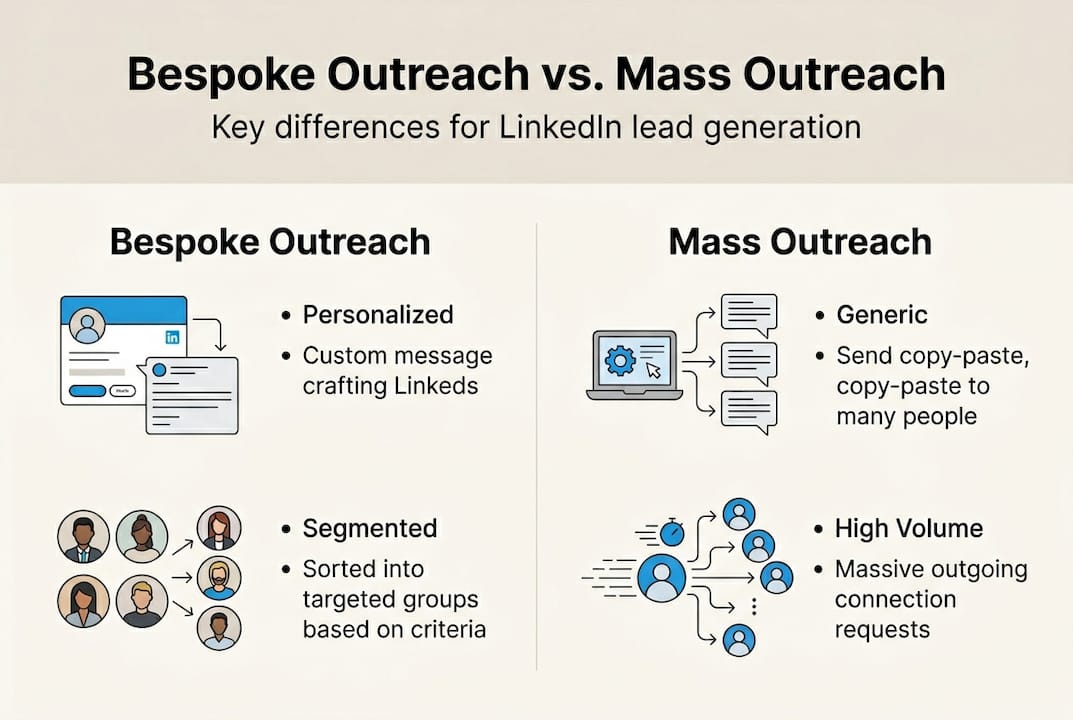
The word “bespoke” comes from the tailoring world, where every suit is cut specifically for one person. Apply that concept to LinkedIn outreach, and you get campaigns built around individual research, precise targeting, and messages crafted for a specific prospect rather than copied from a generic template.
To understand what LinkedIn outreach means at its most effective, you need to move past the idea of “spray and pray” tactics. Bespoke outreach treats every connection request and follow-up message as a deliberate, informed interaction. It uses data about a prospect’s role, company size, recent activity, and pain points to shape every word of every message.
Why does this matter so much on LinkedIn specifically? Because the platform is a professional environment where decision-makers are already suspicious of unsolicited pitches. When a message feels irrelevant or templated, it gets ignored or, worse, reported as spam. A carefully researched, personalized note that references a prospect’s actual business challenge gets read, and often gets a reply.
Personalized outreach messages increase response rates, and that single factor can change the economics of your entire business development effort. More replies mean more conversations. More conversations mean more qualified meetings.
Here’s what bespoke outreach is designed to accomplish:
- Generate more qualified meetings with decision-makers who actually fit your ideal client profile
- Increase response rates by making prospects feel seen and understood
- Improve brand perception by positioning you as thoughtful and credible
- Reduce wasted effort on leads that will never convert
- Build early trust that accelerates the sales cycle
“The goal of bespoke outreach is not to reach everyone. It’s to reach the right people with the right message at the right time.” That distinction is what separates firms that fill their pipeline from those that just fill their sent folder.
Generic mass outreach fails because it treats all prospects as interchangeable. A VP of Operations at a 50-person law firm has completely different concerns than a partner at a 200-person accounting firm. Sending them identical messages is not outreach. It’s noise.
Core components of effective bespoke outreach
With a clear definition in mind, let’s explore what makes an outreach campaign truly bespoke and effective. There are four interlocking components that separate high-performing LinkedIn campaigns from forgettable ones.

1. Segmentation
Before you write a single word, you need to know exactly who you’re targeting. Segmentation is vital for campaign effectiveness, breaking your audience into precise groups based on industry, seniority, company size, geography, or pain point. This allows you to build messaging frameworks that resonate with each slice of your audience rather than trying to speak to everyone at once.
2. Personalization
This goes deeper than inserting a first name. Effective personalized messaging for LinkedIn references a prospect’s recent LinkedIn post, a company milestone, a shared connection, or a challenge specific to their industry. It signals that you did your homework, which immediately differentiates you from the dozens of generic pitches hitting their inbox.
3. Multi-touch follow-up
Most deals don’t happen on the first message. Bespoke outreach includes a thoughtfully sequenced follow-up strategy that adds value at each touchpoint rather than just nagging for a response. Think sharing a relevant article, referencing a piece of industry news, or offering a specific insight.
4. Measurement
You can’t improve what you don’t track. Customized outreach campaigns should be monitored for connection acceptance rates, reply rates, meeting conversion rates, and campaign ROI.
| Element | Bespoke outreach | Generic mass outreach |
|---|---|---|
| Audience targeting | Narrow, research-based segments | Broad, loosely filtered lists |
| Message content | Individually tailored | Templated, one-size-fits-all |
| Follow-up strategy | Value-driven, sequenced | Automated reminders only |
| Tracking | Granular ROI metrics | Open/send volume only |
| Brand perception | Credible and thoughtful | Spammy and impersonal |
Pro Tip: Don’t try to launch a fully bespoke campaign for your entire prospect list at once. Start with your top 20 to 30 highest-priority targets. Refine your approach based on what gets replies, then scale those winning patterns across larger segments.
How bespoke outreach outperforms traditional campaigns
Knowing the core elements, it’s essential to evaluate why a bespoke strategy consistently surpasses traditional approaches. The data and real-world patterns tell a clear story.
Optimized and personalized outreach delivers higher lead quality, which means fewer wasted conversations and a faster path to meetings that actually convert. Generic campaigns might generate a higher raw volume of replies, but the quality is rarely there. You end up chasing prospects who were never a good fit to begin with.
Consider the difference in practice. A professional services firm running a mass campaign might send 500 connection requests per month and book three meetings. A bespoke approach targeting 150 carefully selected prospects might book eight meetings, all with decision-makers who match the firm’s ideal client profile precisely. The volume is lower, but the return on effort is dramatically higher.
| Metric | Mass outreach | Bespoke outreach |
|---|---|---|
| Connection acceptance rate | 15 to 20% | 35 to 50% |
| Reply rate | 2 to 5% | 15 to 25% |
| Meetings booked per 100 contacts | 1 to 2 | 5 to 10 |
| Lead quality score | Low to medium | High |
Mass messaging also carries risks that many firms underestimate. Sending high volumes of identical messages can trigger LinkedIn’s spam filters, restricting your account’s reach. Beyond the platform risk, a poorly targeted message that lands in the wrong inbox actively damages how your brand is perceived by that prospect and anyone they mention it to.
Here are the most common mistakes firms make when shifting from mass to bespoke outreach:
- Treating personalization as just adding a first name token
- Skipping research and assuming industry-level targeting is specific enough
- Writing follow-ups that repeat the original pitch instead of adding new value
- Failing to optimize outreach for lead quality by not tracking which segments actually convert
- Abandoning the approach too early before the compounding effects kick in
Bespoke outreach requires patience. It takes a few weeks to see meaningful data, but once you find the message-segment combinations that generate consistent replies, scaling becomes straightforward.
Practical steps to implement bespoke outreach on LinkedIn
Having compared outcomes, here’s how you can put bespoke outreach into practice for your own LinkedIn campaigns.
“The best outreach message is the one the recipient didn’t expect to be so relevant to them. Relevance is the only shortcut that actually works.”
Follow these steps to build a repeatable bespoke workflow:
- Build your ideal client profile. Define the specific seniority, industry, company size, and problem set of your best-fit prospect. Be specific. “Marketing leaders at consulting firms with 50 to 200 employees struggling to fill their pipeline” is a real profile. “B2B decision-makers” is not.
- Segment your target list. Break your LinkedIn audience into two or three focused segments. Each segment gets its own messaging angle based on what matters most to them.
- Research each prospect before reaching out. Check their recent posts, company news, shared connections, and LinkedIn activity. Even two minutes of research can unlock a genuinely personal opening line.
- Craft a short, specific connection request. Skip the pitch. Reference something real. Your goal at this stage is to get accepted, not to sell.
- Send a warm first message post-connection. Writing high-impact outreach messages means leading with value, asking a relevant question, or referencing a shared context rather than launching into a product description.
- Follow up with added value. Share a relevant article, a short insight, or a specific question tied to their business reality. Space your follow-ups thoughtfully, usually three to five days apart.
- Track and refine. Monitor which segments and message variants generate the best reply and meeting rates, then double down on what works.
High-impact outreach messages make a difference in response rates, particularly when they feel conversational rather than scripted. Pair strong messaging with consistent follow-through, and you build a LinkedIn presence that generates predictable pipeline.
Pro Tip: Use LinkedIn’s native analytics and your CRM to track which prospect segments are converting at each stage of your sequence. Over time, you’ll identify patterns that let you predict which outreach angles will work before you even send the first message. This is how good campaigns become great ones.
Also review LinkedIn outreach tips regularly as the platform’s algorithm and user behavior shift. Staying current keeps your approach fresh and effective.
Why most firms still get outreach wrong and what actually works
Here’s an uncomfortable truth we’ve seen again and again: even sophisticated firms with strong brands and smart people default to automation the moment they try to scale. They buy a list, load it into a tool, and let sequences run on autopilot. The reasoning makes sense on paper but collapses in practice.
Automation without relevance is just faster rejection. What actually builds pipeline isn’t the volume of messages sent. It’s the quality of attention paid to each conversation before it starts. The firms that consistently win appointments are the ones doing the unglamorous work: reading a prospect’s content, understanding their industry pressures, and showing up with something genuinely useful.
We’ve seen innovative outreach ideas work not because they were clever, but because they were rooted in genuine curiosity about the prospect’s situation. Relationship-building is not a soft concept. It’s a measurable competitive advantage. Real appointment setting wins start with treating outreach as the beginning of a relationship, not just a message delivery exercise.
Level up your LinkedIn outreach with expert help
If you’re ready to move beyond generic campaigns and build a LinkedIn outreach engine that consistently delivers qualified meetings, expert partnership accelerates that process significantly.
At TheLeadLab, we build done-for-you bespoke LinkedIn outreach campaigns specifically for professional services firms. Our team handles prospect research, message copywriting, response management, and campaign analytics so your team focuses on closing, not chasing. Explore our proven client results to see what a well-executed bespoke campaign can deliver, or join one of our webinars on outreach to go deeper on strategy. If you’d like us to review your current approach, reach out for a campaign audit and we’ll show you exactly where the gaps are.
Frequently asked questions
What exactly is bespoke outreach?
Bespoke means customized and targeted outreach built for each contact using research and tailored messaging rather than generic templates. It prioritizes relevance over volume at every stage of the campaign.
Does bespoke LinkedIn outreach really generate more high-quality leads?
Yes, because customized campaigns achieve better lead quality by attracting prospects who are genuinely relevant and engaged rather than anyone who happened to match a broad filter.
How do you start implementing bespoke outreach for LinkedIn?
Begin with a precise ideal client profile, then segment your list and craft targeted messages for each group. Segmentation and message personalization are the two foundations everything else is built on.
Is bespoke outreach scalable for small teams?
Absolutely. Small teams can scale effectively by focusing energy on high-priority segments first. Effective segmentation enables scalability by making it possible to create repeatable frameworks rather than starting from scratch for every prospect.