
TL;DR:
- AI enhances prospect targeting but human personalization remains crucial for engagement.
- Deep ICP research and authentic relationships outperform generic AI outreach.
- Strategic content and integrated campaign systems are vital for sustained LinkedIn lead generation.
LinkedIn’s feed is noisier than ever. Automated connection requests, templated InMails, and AI-generated follow-ups flood inboxes every day, making it harder for your firm to get noticed, let alone generate qualified leads. As AI commoditizes generic outreach, the marketers who win are those who combine sharp ICP (ideal customer profile) research with creative, human-led execution. This guide breaks down what’s actually working right now, from understanding AI’s role in outreach to building content ecosystems and innovative campaign frameworks that keep your pipeline full.
Table of Contents
- How AI is reshaping LinkedIn outreach
- Why personalized, human-driven strategies will win
- Content creation for authority and lead magnetization
- Innovative campaign frameworks for 2026
- Our take: The uncomfortable truth most experts miss about LinkedIn marketing
- Get help supercharging your LinkedIn marketing
- Frequently asked questions
Key Takeaways
| Point | Details |
|---|---|
| AI alone isn’t enough | Human-driven, personalized messaging is essential for stand-out LinkedIn campaigns. |
| Content drives authority | Strategic content establishes leadership and attracts qualified leads faster than generic posts. |
| Innovative frameworks boost performance | Advanced segmentation and ecosystem campaigns help sustain lead generation in 2026. |
| Relationships outlast technology | Building meaningful connections remains the best defense against AI commoditization. |
How AI is reshaping LinkedIn outreach
Artificial intelligence has made it possible to send hundreds of personalized-looking messages in the time it once took to write ten. That sounds like a win, but the reality is more complicated. Increased outreach volume has not translated into better engagement. In fact, the opposite is true: prospects are more skeptical, more selective, and quicker to ignore messages that feel automated.
Here’s what AI-driven outreach typically looks like from the recipient’s side:
- A connection request with a vague value proposition
- An immediate follow-up pitching a service before any relationship exists
- Generic language that could apply to any firm in any industry
- No reference to the prospect’s actual business context or recent activity
This pattern has trained decision-makers to tune out. The result is a paradox: the more firms use AI to scale outreach, the lower the average response rate becomes for everyone. Your linkedin outreach tips need to account for this reality.
“The marketers who will thrive are not those with the fastest automation, but those with the sharpest understanding of who they’re targeting and why.”
AI does have legitimate uses in LinkedIn marketing. It can help you identify prospects faster, analyze engagement patterns, draft initial message frameworks, and flag accounts showing buying signals. The key is treating AI as a research and efficiency tool, not as a replacement for human judgment. When you explore innovative outreach campaign ideas, you’ll notice the most effective ones use automation for logistics while keeping the actual messaging human and contextually aware.
Marketing leaders need to audit their current outreach stack. Ask yourself: does each message reflect genuine knowledge of the prospect’s industry, role, and challenges? If the answer is no, AI is working against you.
Why personalized, human-driven strategies will win
With AI-generated outreach becoming commonplace, the power of authentic, human messaging takes center stage. Personalization is no longer just a nice-to-have. It’s the primary trust signal that separates firms that book meetings from those that get ignored.
Human-driven strategies using deep ICP nuance consistently outperform generic AI approaches. But what does deep ICP nuance actually mean in practice? It means going beyond job title and company size. It means understanding the specific pressures a VP of Marketing at a mid-size consulting firm faces right now, the language they use internally, the metrics their CEO holds them to, and the objections they’ve heard from vendors before.
| Generic AI outreach | Human-driven personalized outreach |
|---|---|
| Uses broad job title targeting | Targets by role, industry, and trigger events |
| Template-based messaging | References specific context or recent activity |
| Pitches immediately | Leads with value and relationship building |
| Low response rates | Significantly higher reply and meeting rates |
| Easy to ignore | Feels relevant and timely |
Building a strong ICP requires real research. Pull data from your best existing clients. What industries do they come from? What were their biggest pain points before working with you? What language did they use to describe their problem? A solid personalized messaging guide will help you translate that research into messages that resonate.
Once your ICP is sharp, use it to inform every touchpoint. This includes:
- Connection request notes that reference a shared industry challenge
- Follow-up messages that acknowledge the prospect’s recent content or company news
- Value-first sequences that offer insights before asking for anything
- Customized outreach campaigns built around specific segments, not broad lists
Pro Tip: Before sending any message, ask yourself: “Would this prospect feel like I wrote this specifically for them?” If the answer is no, rewrite it. One well-crafted message beats ten generic ones every time.
Your strategic messaging tips should also factor in timing. Reaching out after a prospect posts on LinkedIn, gets promoted, or announces a company milestone dramatically increases the chance of a positive response.
Content creation for authority and lead magnetization
Beyond direct outreach, leveraging content as an authority builder and lead driver is increasingly vital. Decision-makers on LinkedIn are not just passive scroll-through users. They actively seek out thought leaders who can help them solve real problems. If your firm is not consistently publishing, you are invisible to a large segment of your ideal audience.

Strategic content creation is essential for qualified lead generation on LinkedIn. The firms that generate the most inbound interest are those that publish content with a clear point of view, actionable takeaways, and direct relevance to their target audience’s daily challenges.
Here’s a practical content framework for professional services firms:
- Insight posts: Share a counterintuitive finding from a client engagement or industry report. These drive high engagement because they challenge assumptions.
- Process breakdowns: Walk your audience through how you solve a specific problem. This builds trust and demonstrates expertise without a hard sell.
- Data-backed observations: Use real numbers to support a trend you’re seeing in your market. Decision-makers respect evidence.
- Client outcome stories: Anonymized case studies that show a before-and-after scenario are powerful proof of value.
- Lead magnet posts: Offer a downloadable checklist, framework, or guide in exchange for engagement. This drives both visibility and conversions.
| Content type | Primary benefit | Best format |
|---|---|---|
| Insight posts | Engagement and shares | Short text or carousel |
| Process breakdowns | Authority and trust | Long-form text or video |
| Data observations | Credibility | Text with graphic |
| Client outcome stories | Social proof | Narrative post |
| Lead magnets | Lead capture | Post with link to gated asset |
Pro Tip: Consistency beats frequency. Publishing two high-quality posts per week will outperform daily mediocre content. Block time every week for content creation and treat it like a client commitment.
If you want to go deeper on generating B2B leads through content, focus on building a content calendar that maps each post to a specific stage of the buyer journey. Top-of-funnel content builds awareness. Middle-of-funnel content nurtures consideration. Bottom-of-funnel content drives action.
Innovative campaign frameworks for 2026
Finally, let’s explore the evolving frameworks that are powering the next wave of LinkedIn marketing innovation. The days of running a single outreach sequence and calling it a campaign are over. The most effective LinkedIn marketers now build interconnected systems that combine outreach, content, and data into a continuous lead generation engine.
Innovative campaign ideas are shaping the evolution of LinkedIn marketing in three key directions:
- Account-based segmentation: Rather than targeting broad audiences, segment by account type, industry vertical, company lifecycle stage, and buying intent signals. This allows you to tailor every message and content piece to a specific context.
- Multi-touch ecosystems: Combine connection requests, content engagement, direct messages, and even LinkedIn Events or newsletters into a coordinated sequence. Prospects who see your content before receiving an outreach message are far more receptive.
- Data-driven iteration: Track open rates, reply rates, and meeting conversion rates at every stage. Use this data to continuously refine your targeting, messaging, and offer. Campaigns that are never tested are campaigns that plateau.
Pro Tip: Start your campaign segmentation by splitting your prospect list into at least three distinct buckets based on industry or company size. Run separate message sequences for each. You’ll quickly see which segment responds best and can double down accordingly.
Effective targeted prospecting strategies also incorporate trigger-based outreach. This means reaching out when a prospect shows a buying signal, such as hiring for a role your service supports, raising funding, or expanding into a new market. These triggers make your outreach feel timely rather than intrusive.
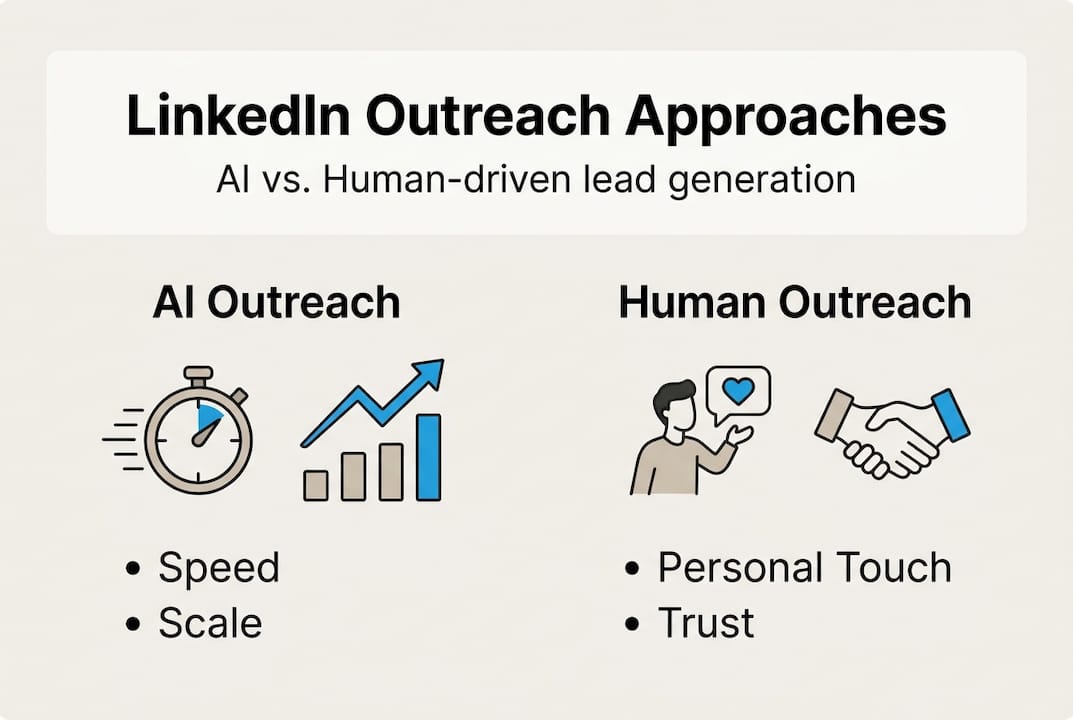
Your linkedin messaging tips should reflect the campaign stage. Early-stage messages focus on curiosity and value. Later-stage messages can be more direct about outcomes and next steps. Matching message tone to relationship stage is one of the simplest ways to improve conversion rates.
Our take: The uncomfortable truth most experts miss about LinkedIn marketing
Most LinkedIn marketing advice focuses on tactics: what to write, when to post, which automation tool to use. But the firms that consistently generate high-quality leads are not winning because of their tools. They’re winning because they’ve invested in something harder to copy: deep brand clarity, rigorous ICP research, and a genuine commitment to building relationships over time.
Technology levels the playing field fast. Whatever edge a new AI tool gives you today, your competitors will have it in three months. What they can’t replicate quickly is your firm’s unique perspective, your team’s ability to have real conversations, and your willingness to experiment and iterate. Real results require human ingenuity and nuanced segmentation, not just faster automation.
We’ve seen firms burn significant budgets chasing instant solutions, only to return to basics when the results don’t materialize. The marketers who build lasting LinkedIn pipelines treat it like a long game. They invest in original insights, develop their team’s communication skills, and measure what matters. That’s the edge that compounds over time.
Get help supercharging your LinkedIn marketing
If you’re ready to implement these strategies, our team can support you every step of the way. At theleadlab.com/, we build custom LinkedIn campaigns that put every principle in this guide into practice, from sharp ICP targeting and human-crafted messaging to content strategy and campaign analytics.
Our LinkedIn marketing solutions are designed specifically for professional services firms that need qualified leads, not just activity metrics. Browse our success stories to see how we’ve helped firms like yours book more meetings and grow their pipelines. And if you want to keep learning, our LinkedIn webinars cover the latest strategies and frameworks in real time. Let’s build something that works.
Frequently asked questions
How can AI improve LinkedIn lead generation?
AI speeds up outreach and helps identify targets at scale, but meaningful responses consistently depend on human-driven personalization that reflects genuine knowledge of the prospect’s context.
What makes a LinkedIn campaign stand out in 2026?
Campaigns succeed by combining deep ICP personalization with high-value content and advanced segmentation frameworks that match messaging to each prospect’s specific situation and buying stage.
Is content creation still critical for LinkedIn marketing?
Content remains a top driver for authority and qualified lead flow, with strategic content creation consistently generating inbound interest from decision-makers who seek out trusted voices before engaging with vendors.
How can decision-makers drive better LinkedIn results?
Sustainable results come from strong relationship-building and rigorous ICP research rather than automation alone, since human ingenuity and nuanced segmentation are what separate top-performing campaigns from average ones.
2 responses