
Most marketing directors assume building an in-house outreach team gives them more control and better results. The numbers tell a different story. Building outbound in-house is 164% more expensive than working with an agency, and the ramp time gap is even more striking. While your competitors are booking qualified meetings through an agency in weeks, an in-house team could still be onboarding its first SDR six months later. This guide breaks down the real cost, speed, and strategic advantages of outreach agencies for professional services firms, so you can make a confident, data-backed decision.
Table of Contents
- The reality of in-house vs agency outreach
- Key advantages of outreach agencies for LinkedIn lead generation
- Common concerns: control, alignment, and agency risks
- Hybrid models: The best of both worlds?
- Choosing the right outreach agency: Decision framework for marketing directors
- How The Lead Lab accelerates LinkedIn lead generation for professional services
- Frequently asked questions
Key Takeaways
| Point | Details |
|---|---|
| Agencies scale outreach fast | Outreach agencies can launch LinkedIn lead generation in weeks instead of the months it takes in-house teams. |
| Costs are significantly lower | Agencies deliver up to 70% savings over building internal SDR teams for professional services firms. |
| Hybrid models suit early-stage | Combining in-house and agency resources helps firms balance speed and brand control, especially when testing new markets. |
| Targeted LinkedIn expertise | Agencies provide specialized LinkedIn outreach, leveraging tools and proven strategies for higher lead quality. |
The reality of in-house vs agency outreach
The comparison between in-house and agency outreach is rarely as straightforward as it looks on a spreadsheet. Most firms focus on the monthly retainer cost of an agency and compare it to a single salary. That framing misses the full picture.
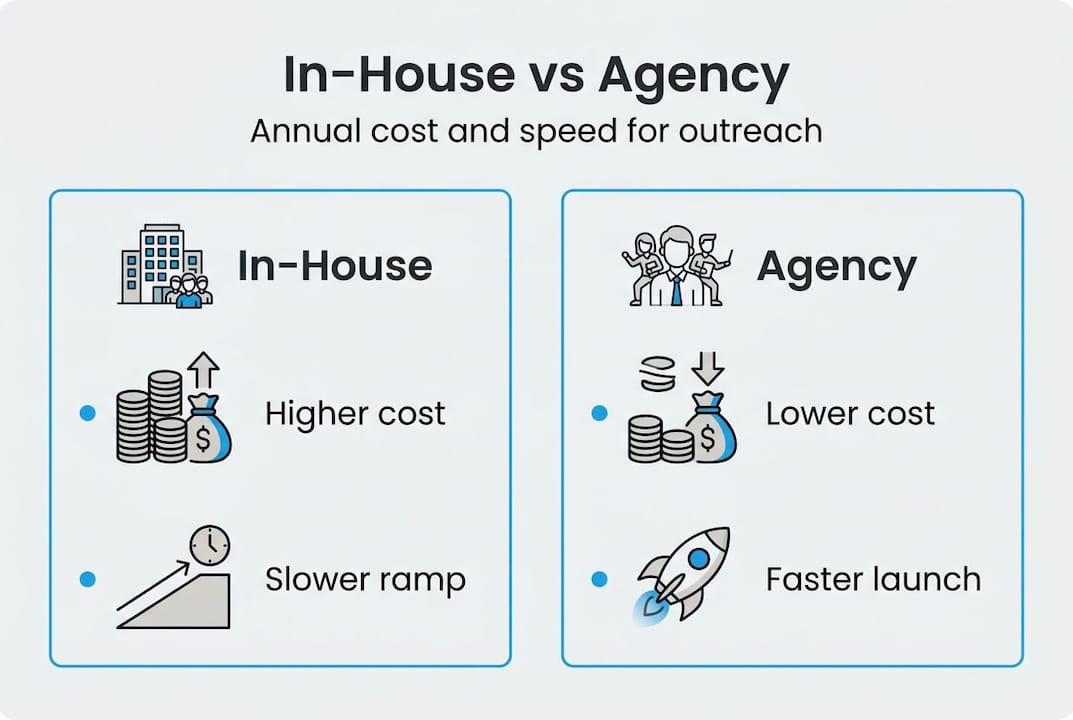
An in-house SDR costs $150,000 to $300,000 per year when you factor in salary, benefits, training, tools, and ramp time. An agency, by contrast, typically runs $3,000 to $8,000 per month and delivers booked meetings from day one. That is a significant difference in both cash outlay and time to value.
Speed is where the gap becomes even more dramatic. In-house ramp time runs 5.7 to 12 months, while an agency can launch a targeted campaign in a matter of weeks. For professional services firms competing in fast-moving markets, that delay is not just inconvenient. It is costly.
Here is a side-by-side comparison to make the contrast concrete:
| Factor | In-house team | Outreach agency |
|---|---|---|
| Annual cost | $150,000 to $300,000 | $36,000 to $96,000 |
| Ramp time | 5.7 to 12 months | 2 to 4 weeks |
| Tools and infrastructure | Additional cost | Included |
| Turnover risk | 30 to 35% annually | Managed by agency |
| Scalability | Slow, hiring-dependent | Fast, campaign-based |
Beyond cost, agencies bring specialized infrastructure that would take months and significant budget to replicate internally. When you are focused on optimizing outreach campaigns for ROI, starting with a team that already has the tools and processes in place is a clear advantage.
Key benefits of choosing an agency over building in-house:
- Immediate access to proven outreach frameworks
- No hiring, onboarding, or training overhead
- Built-in analytics and reporting from campaign launch
- Flexible scaling without headcount decisions
- Expertise in generating B2B leads on LinkedIn from day one
Pro Tip: When evaluating agency speed, ask specifically how long it takes from contract signing to the first outreach message being sent. The best agencies can get campaigns live within two weeks.
Key advantages of outreach agencies for LinkedIn lead generation
LinkedIn is not like email or paid ads. The platform has its own norms, algorithms, and audience expectations. Generic outreach gets ignored or, worse, reported. Agencies that specialize in LinkedIn outreach understand these nuances in ways that a generalist in-house hire rarely does.
The best agencies build outreach strategies around your Ideal Customer Profile, or ICP. That means crafting messages that speak directly to the pain points of your target buyer, not just blasting connection requests at a broad list. This level of precision is what separates a campaign that books 10 meetings a month from one that generates noise.

Agencies provide access to specialized tools and infrastructure without the internal hiring risks that come with building a team from scratch. That includes LinkedIn automation platforms, data enrichment tools, A/B testing frameworks, and response management systems. These are not cheap to license or easy to operate without experience.
Here is what strong agency-led LinkedIn outreach typically includes:
- ICP-driven prospect targeting and list building
- Personalized message sequences tested for response rates
- Ongoing A/B testing of subject lines and call-to-action language
- Response handling and lead qualification
- Weekly or monthly performance reporting
For marketing directors, the value of LinkedIn outreach tips from a specialist team goes beyond tactics. It is about having a system that runs, improves, and scales without requiring your constant attention.
“The firms that win on LinkedIn are not the ones sending the most messages. They are the ones sending the right message to the right person at the right time.”
Agencies also reduce brand risk when managed well. A good agency will align every message with your tone, positioning, and compliance requirements before a single connection request goes out. Targeted LinkedIn prospecting done right protects your reputation while filling your pipeline.
Common concerns: control, alignment, and agency risks
Outsourcing any client-facing function raises legitimate questions. Marketing directors often worry about losing control over how their brand is represented, especially on a platform as personal as LinkedIn. These concerns are valid, but they are also manageable.
In-house teams offer control and brand alignment but come with slow ramp times, high turnover rates of 30 to 35%, and significant administrative overhead. Agencies carry a different risk profile: faster execution but potential for messaging misalignment if the onboarding process is weak.
The solution is not to avoid agencies. It is to choose and manage them well. Here is a practical process for maintaining control without sacrificing speed:
- Define your brand voice in writing. Give the agency a clear brief covering tone, language to avoid, and key value propositions before any messaging is drafted.
- Review and approve all message sequences. No campaign should go live without your sign-off on the copy.
- Set up a weekly check-in cadence. Regular calls keep the agency aligned and give you visibility into what is working.
- Require transparent reporting. You should see open rates, response rates, and meeting conversion data every week, not just a monthly summary.
- Build in a feedback loop. Share what you hear from prospects so the agency can refine messaging in real time.
Strong lead nurturing strategies depend on consistent messaging across every touchpoint. When your agency understands your nurturing framework, their outreach becomes an extension of your broader marketing effort rather than a disconnected activity.
“The best agency relationships feel like an extension of your team, not a vendor transaction.”
Pro Tip: Insist on a shared messaging document that both your team and the agency update in real time. This single source of truth prevents drift and keeps personalized LinkedIn messaging on-brand at every stage.
Hybrid models: The best of both worlds?
Not every firm needs to choose between fully in-house and fully outsourced. Hybrid models are recommended for many firms, especially those at early or mid-stage growth where speed matters but internal capability is still developing.
A hybrid approach typically means an internal team member owns the strategy and relationship management while the agency handles execution, prospecting, and outreach at scale. This gives you the control of in-house oversight with the speed and infrastructure of an agency.
Here is a practical breakdown of when each model makes sense:
| Scenario | Recommended model |
|---|---|
| No SDR team, need pipeline fast | Full agency |
| Testing a new ICP or market | Agency or hybrid |
| Established team, need to scale | Hybrid |
| Long-term brand-led outreach | In-house with agency support |
| Limited budget, early stage | Agency (lower fixed cost) |
Outsource when you lack SDR bandwidth, when you are testing new ICPs or markets, or when you need a predictable pipeline without the overhead of hiring. Keep strategy and relationship management in-house when long-term brand control is the priority.
Hybrid models also work well when you want to test strategic LinkedIn messaging approaches before committing to a full in-house build. The agency becomes your testing ground, and the insights you gain inform your long-term strategy.
Choosing the right outreach agency: Decision framework for marketing directors
Not all outreach agencies are equal. Some specialize in e-commerce, others in SaaS, and only a subset have genuine expertise in professional services LinkedIn outreach. Choosing the wrong agency wastes time and budget. Here is how to evaluate your options systematically.
Outsource when you need predictable pipeline without the risk of a long hiring cycle. But make sure the agency you choose can actually deliver. Use this framework:
- Verify industry experience. Ask for case studies from professional services firms similar to yours. Generic B2B experience is not enough.
- Assess their reporting infrastructure. You need real-time or weekly data on campaign performance, not just end-of-month summaries.
- Evaluate their technology stack. What tools do they use for prospecting, outreach, and analytics? Are these tools compliant with LinkedIn’s terms of service?
- Test their messaging quality. Ask them to draft a sample outreach sequence for your ICP before signing a contract. This reveals their copywriting skill and strategic thinking.
- Check their onboarding process. A structured onboarding that covers brand voice, ICP definition, and approval workflows is a strong signal of a professional operation.
- Ask about response management. Do they handle replies, or do leads land in your inbox unqualified? The best agencies qualify leads before passing them to your team.
Pro Tip: Prioritize agencies with a proven track record of B2B LinkedIn results in your specific sector. A firm that has booked meetings for consulting firms understands the longer sales cycles and relationship-driven nature of professional services buying decisions.
When comparing options, it is also worth reviewing LeadLifter.net alternatives to understand the range of tools and services available in the market before committing to a partner.
How The Lead Lab accelerates LinkedIn lead generation for professional services
Everything covered in this guide points to one practical conclusion: the right agency partner removes the friction, cost, and delay that hold professional services firms back from consistent pipeline growth.
The Lead Lab is built specifically for this challenge. As LinkedIn lead generation specialists, we design done-for-you outreach campaigns that combine precise ICP targeting, personalized messaging, and full response management. Every campaign is tailored to your firm’s voice, your target market, and your growth goals. You can explore real results across industries in our agency portfolio to see how we have helped professional services firms book qualified meetings at scale. If you are ready to move from slow, expensive in-house efforts to a faster, leaner outreach model, we would welcome a conversation about what that looks like for your firm.
Frequently asked questions
How much time can agencies save compared to building in-house outreach teams?
Agencies launch campaigns in weeks, while in-house teams typically take 5.7 to 12 months to ramp up fully. For firms that need pipeline now, that difference is decisive.
What benchmarks exist for outreach agency pricing versus in-house costs?
Outreach agencies typically cost $3,000 to $8,000 per month, while in-house teams run $150,000 to $300,000 per year including training and ramp-up costs.
What are the main risks when outsourcing LinkedIn outreach?
The primary risks are brand misalignment and reduced control over messaging, but these risks are manageable through structured onboarding, message approval workflows, and regular performance reviews.
When is a hybrid outreach model most beneficial?
Hybrid models suit early and mid-stage firms that want the speed and scalability of an agency while keeping strategic oversight and brand management in-house.
One Response